
Why are SaaS architects still settling for custodial gateways that hold their funds hostage and charge high monthly fees regardless of transaction volume? You likely recognize the friction of maintaining complex RPC nodes or watching revenue disappear into rigid pricing models while trying to find the right crypto payment gateway for saas. It's a common pain point for builders who value both security and financial logic. You need a foundation that supports your growth without adding unnecessary technical debt or middleman risk.
This guide demonstrates how to implement a modern infrastructure that prioritizes structural integrity and absolute control. You will learn to integrate a non-custodial, pay-per-call solution that routes funds directly to your own wallets, effectively removing the burden of monthly subscriptions. We will explore how a single, unified API can handle major blockchains like Ethereum and Polygon, providing a high-performance engine that simplifies your stack while ensuring global reach. From normalized data structures to real-time event streaming, we cover the essential components of a 2026-ready payment infrastructure that respects your margins and your keys.
Key Takeaways
- Understand why the 2026 landscape favors modular Web3 infrastructure over traditional, all-in-one custodial platforms for better architectural flexibility.
- Identify the security advantages of non-custodial systems that allow your SaaS to retain full control of private keys and transaction logic.
- Evaluate the cost-efficiency of a pay-per-call crypto payment gateway for saas compared to standard industry models with high monthly fees.
- Implement a reliable developer workflow using multichain RPC providers and real-time webhooks for seamless, low-latency payment confirmations.
- Streamline your technical stack by leveraging a unified API that provides normalized data and high-performance connectivity across all major blockchain networks.
The Evolution of Crypto Payment Gateways for SaaS in 2026
In the current landscape, a crypto payment gateway for saas is no longer just a simple checkout button. It has evolved into a sophisticated, developer-centric bridge that connects decentralized blockchain networks with traditional subscription engines. By 2026, the industry has shifted away from "all-in-one" custodial platforms that demand total control over private keys. Architects now favor modular Web3 infrastructure that integrates seamlessly into existing stacks without introducing third-party custody risks. This transition allows SaaS providers to maintain structural integrity while leveraging the efficiency of blockchain settlement.
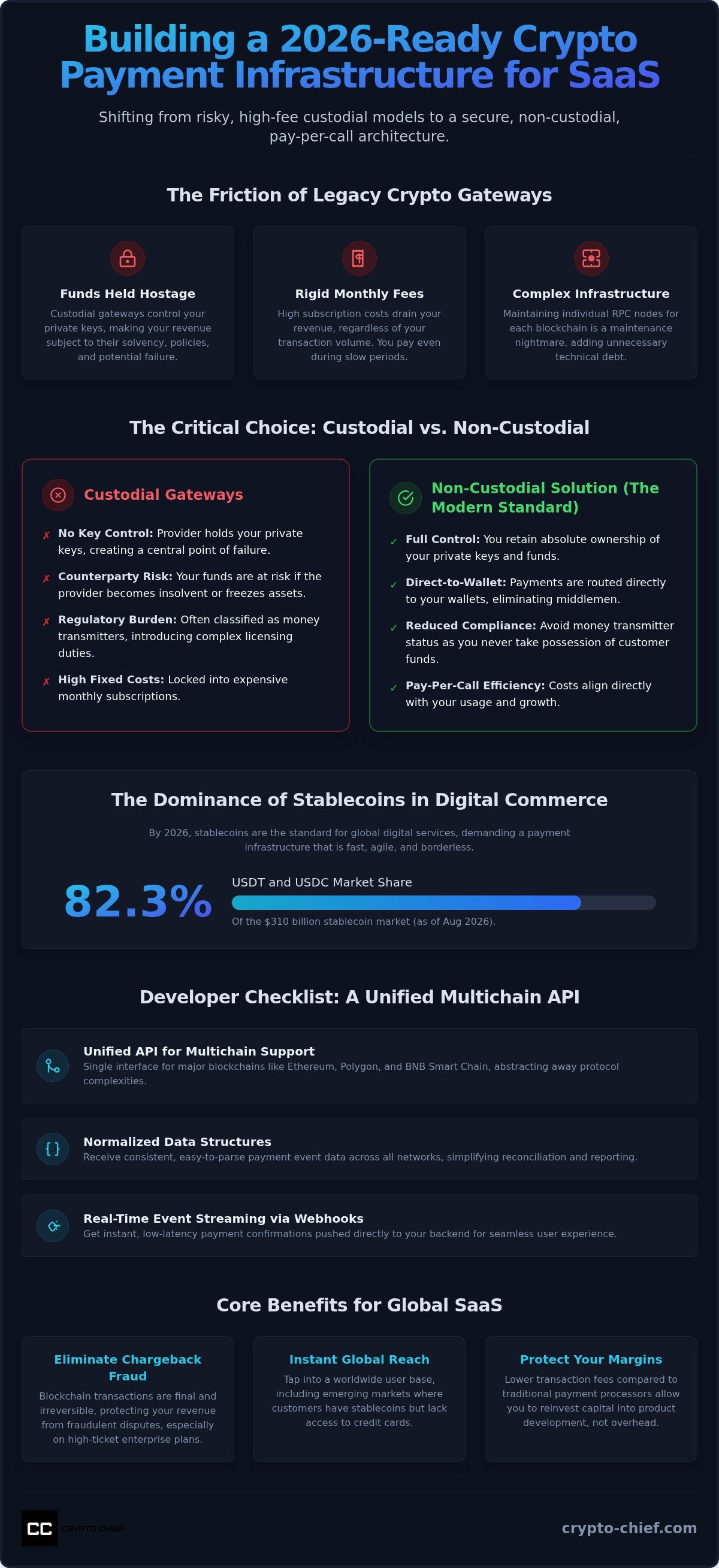
The dominance of stablecoins has redefined how global services are priced and paid for. With USDT and USDC accounting for 82.3% of the $310 billion stablecoin market as of August 2026, these assets have become the standard for digital commerce. Traditional payment gateway solutions often act as bottlenecks in this ecosystem, hampered by legacy processing times and geographic restrictions. Modern SaaS platforms require a more agile approach to handle the high-velocity transaction volume that stablecoins enable.
Why SaaS Businesses are Moving Beyond Credit Cards
Credit cards carry inherent friction that limits global reach. Many potential customers in emerging markets lack access to reliable banking infrastructure, yet they possess stablecoin balances. By adopting a crypto-first approach, SaaS companies can instantly tap into a global user base. This shift also addresses the persistent issue of chargeback fraud, which continues to drain revenue from digital subscriptions. Because blockchain transactions are final, the risk of fraudulent reversals is eliminated. This is particularly vital for high-ticket enterprise tiers where a single chargeback can represent a significant loss. Lowering transaction fees further protects margins, allowing businesses to reinvest capital into product development rather than processing overhead.
The Role of Unified APIs in Modern Payment Stacks
Managing individual nodes for every supported blockchain is a maintenance nightmare that few engineering teams want to tackle. A unified blockchain API solves this by providing a single interface for multichain support. Instead of writing unique logic for Ethereum, Polygon, and BNB Smart Chain, developers interact with a normalized data layer. This approach ensures that payment events are consistent across all networks, simplifying the reconciliation process for merchant reporting. By abstracting the complexity of the underlying protocols, a unified stack allows architects to maintain high uptime and scalability. It transforms the payment layer from a complex technical hurdle into a reliable, background utility that supports the core business logic.
Custodial vs. Non-Custodial Gateways: Protecting SaaS Integrity
The choice between custodial and non-custodial infrastructure is the most critical security decision a modern architect makes when selecting a crypto payment gateway for saas. In a custodial model, the service provider holds the private keys and dictates the flow of funds. This creates a centralized point of failure where your revenue is subject to the provider's solvency and internal policies. Conversely, a non-custodial gateway facilitates the transaction logic while ensuring that the SaaS platform or the end-user retains absolute control over the private keys. By 2026, this decentralized approach has become the gold standard for architects who prioritize structural integrity and long-term stability.
Regulatory clarity has also sharpened the divide between these two models. With the full implementation of the GENIUS Act in the United States and MiCA in the European Union, the burden of regulatory compliance for crypto has intensified. Many custodial providers are now classified as money transmitters, which introduces complex licensing requirements and reporting duties. By utilizing non-custodial tools, SaaS businesses can often avoid these classifications because they never actually take possession of customer funds. The gateway simply acts as a technical relay, allowing you to focus on your product rather than navigating the intricacies of financial intermediary laws.
Risk Mitigation and Fund Security
Non-custodial systems effectively immunize your SaaS revenue from the "exchange-style" collapses that have historically plagued the industry. When funds go directly to your cold storage or operational wallets, there is no middleman who can freeze your account or lose your capital in a liquidity crisis. Integrating a non-custodial crypto payment API serves as a powerful trust builder for your users. They can verify on-chain that their payments are reaching the intended destination without being diverted through a third-party pool. This transparency is essential for enterprise-grade applications where security audits are a standard part of the procurement process.
Developer Control and Customization
Engineers prefer APIs that act as silent partners rather than those that force a specific UI or wallet choice on the end-user. Non-custodial gateways provide raw processing data, giving you the flexibility to build custom checkout flows that match your brand’s aesthetic. This level of control extends to your internal accounting systems. Because you have direct access to the transaction data on your own wallets, reconciliation becomes a straightforward process of querying the blockchain. If you are looking for a way to maintain this level of technical autonomy while scaling, you might consider how a high-performance processing API can streamline your existing payment stack without compromising security.
Aligning Infrastructure Costs: Why Pay-Per-Call Beats Monthly Tiers
Traditional billing models for a crypto payment gateway for saas often create a fundamental misalignment between service value and actual operational cost. Many legacy providers impose a dual-tax system that combines a percentage-based transaction fee with rigid monthly subscription tiers. This approach forces developers to choose between high entry costs or scalable penalties that erode margins as the business grows. Architects who prioritize logic and efficiency are moving toward models that treat blockchain connectivity as a utility rather than a revenue-sharing partnership.
The pay-per-call model reframes infrastructure spending by charging only for the API requests made to the blockchain. This system typically utilizes prepaid API token balances, allowing financial teams to budget with technical precision while ensuring the stack remains active only when needed. Early-stage SaaS startups benefit from low initial overhead, while enterprise-grade platforms avoid the "success tax" associated with high transaction volumes. It's a grounded, performance-focused alternative to the arbitrary pricing structures that have historically dominated the fintech space.
The Problem with Percentage-Based Transaction Fees
Percentage fees are particularly damaging to high-ticket SaaS models. A 1% or 2% fee might seem negligible on a small consumer purchase, but it becomes a significant liability for enterprise contracts worth thousands of dollars. There is no technical justification for a gateway to earn hundreds of dollars for a single transaction that requires the same computational effort as a micro-payment. Flat API call costs offer a more predictable framework for long-term financial planning. Pay-per-call models provide superior cost-efficiency for high-value enterprise transactions by decoupling network activity from the dollar value of the transfer. This allows you to retain more of your revenue as you scale into larger market segments.
Scaling Without Tiered Bottlenecks
Many "unlimited" plans in the industry are marketing facades that hide strict rate limits and performance throttling. When your SaaS experiences a sudden burst in user activity, these tiered bottlenecks can lead to dropped transactions or latency spikes. A web3 rpc gateway handles these bursts naturally by scaling with your request volume rather than your subscription level. This builder-centric ethos ensures you never pay for idle capacity or face artificial caps on your growth. It positions the infrastructure as a silent, powerful partner that supports your expansion without demanding a larger share of your success.
Developer Checklist: Integrating a Multichain Payment API
Implementing a robust crypto payment gateway for saas requires a methodical approach to infrastructure that balances performance with security. Architects must look beyond simple transaction processing and consider the entire lifecycle of a payment event. This involves coordinating multiple blockchain protocols while maintaining the low latency users expect from modern cloud applications. A successful integration follows a logical progression from node selection to automated compliance workflows.
- Step 1: RPC Gateway Selection. Prioritize providers that offer high global uptime and low latency across multiple networks like Ethereum, Polygon, and BNB Smart Chain.
- Step 2: EventStream Configuration. Establish real-time communication between the blockchain and your backend to handle transaction confirmations without manual polling.
- Step 3: AML Intelligence Integration. Automatically screen incoming funds against global risk databases to protect your wallets from illicit capital.
- Step 4: Data Normalization. Use a unified API to ensure that transaction data from different chains is formatted consistently for your internal accounting.
- Step 5: Automated Revenue Splits. Configure your processing API to handle complex payout logic, such as distributing funds between operational wallets and stakeholder accounts.
Real-Time Monitoring with Webhooks
Polling the blockchain for status updates is a performance killer for any scalable SaaS. It creates unnecessary load on your servers and introduces delays in user provisioning. Instead, utilize real-time blockchain webhooks to trigger immediate actions in your application logic. This event-driven architecture ensures that as soon as a payment reaches the required finality, your system grants access to the user. You must also account for chain re-orgs by configuring your webhooks to monitor block confirmations dynamically. This ensures that your crypto payment gateway for saas remains accurate even during periods of high network volatility.
Automated AML and Compliance Workflows
Institutional-grade SaaS clients demand rigorous security standards, making automated compliance a non-negotiable feature. By integrating a crypto aml risk detection api, you can flag high-risk transactions before they ever touch your primary wallets. This system uses advanced funds tracing to identify connections to sanctioned entities or known security breaches. You can automate the "Reject/Accept" logic based on specific risk scores, ensuring your platform stays compliant with global regulations without manual intervention. This proactive stance on security protects your business reputation and simplifies future audits. If you're ready to secure your payment stack, you can register your developer account to begin testing these workflows today.
Scaling Global SaaS with Crypto Chief’s Unified API
Crypto Chief functions as the definitive infrastructure layer for architects who need to consolidate their payment stack. Instead of managing a fragmented collection of third-party tools, developers can rely on a single, high-performance platform to handle the complexities of Web3 commerce. The Crypto Processing API serves as the core engine, allowing you to integrate a secure crypto payment gateway for saas that scales alongside your user base. This unified approach provides native support for major blockchains, including Ethereum, BNB Smart Chain, Polygon, Tron, and Bitcoin, ensuring your platform remains accessible to a global audience.
The structural advantages of this model are clear. You retain absolute control through a non-custodial architecture while benefiting from a pay-per-call pricing structure that aligns perfectly with your actual usage. By normalizing data across all supported chains, the platform provides a cohesive view of your financial operations, removing the friction typically associated with multichain reporting. It's a grounded solution that empowers builders to focus on their core product rather than the underlying plumbing of the blockchain.
Enterprise-Grade Infrastructure for Builders
Reliability is the foundation of any successful SaaS. We maintain a global network of high-performance RPC nodes designed to ensure maximum uptime and minimal latency for your API requests. For teams that require deep technical integration, our developer documentation offers a comprehensive roadmap for every feature, from basic processing to advanced event streaming. If your business model requires a customized experience, you can explore whitelabel options that allow you to maintain your brand’s aesthetic while leveraging our underlying power.
Getting Started: From Sandbox to Production
Transitioning from development to a live environment is a streamlined process. You can begin testing your integration in a sandbox environment using our testnet faucet to acquire tokens without financial risk. Once your logic is verified, moving to production is as simple as updating your API keys. We invite you to visit the registration page to create your project and begin building. For larger organizations with unique requirements, please contact our team to discuss custom enterprise architecture and dedicated support.
Architecting for a Decentralized Future
Selecting a crypto payment gateway for saas is a strategic decision that defines your platform’s scalability and security posture in 2026. You’ve explored how the industry has moved toward modular, non-custodial systems that eliminate middleman risk while providing direct control over revenue. By prioritizing structural integrity and technical precision, you can build a payment stack that doesn't just process transactions but actively supports your global expansion. It's time to move beyond rigid monthly tiers and custodial vulnerabilities that hinder your growth.
The combination of a unified multichain API and a pay-per-call pricing model ensures that your infrastructure remains efficient, regardless of your volume or the complexity of the networks you support. It’s about removing friction and paying only for the value you receive. If you are ready to implement a professional, builder-centric solution, register now to access the non-custodial Crypto Processing API and start building on a foundation designed for performance. Your journey toward a more secure and cost-effective payment ecosystem starts with a single integration. We look forward to seeing what you build.
Frequently Asked Questions
Is a non-custodial crypto payment gateway safer for my SaaS?
Non-custodial systems are inherently more secure because they remove the possibility of exchange-style collapses affecting your revenue. When you use a crypto payment gateway for saas that is non-custodial, you retain the private keys to your wallets. This means funds are settled directly on-chain without passing through a third-party intermediary. It protects your business from counterparty risks, account freezes, and the solvency issues that often plague centralized custodial providers.
How does pay-per-call pricing work for a crypto payment API?
Pay-per-call pricing operates on a utility model where you only incur costs for specific API requests made to the blockchain. Instead of paying a flat monthly fee or a percentage of your transaction volume, you use prepaid tokens to cover your activity. This approach provides a high level of financial predictability for SaaS architects. It ensures that your infrastructure costs scale exactly with your usage, preventing the "success tax" common in traditional fintech models.
Can I accept stablecoins like USDC and USDT with one API?
You can certainly accept major stablecoins like USDC and USDT across multiple networks through a single integration. A Unified API abstracts the technical differences between blockchains like Ethereum, Polygon, and Tron, providing you with a consistent data format. This allows you to manage diverse assets without writing unique code for every network. It simplifies your accounting and reporting processes while offering your global customers their preferred payment options in a stable currency.
What is the difference between an RPC gateway and a payment gateway?
An RPC gateway is the low-level communication interface that allows your application to talk to a blockchain node. In contrast, a payment gateway is a higher-level application layer that manages specific transaction logic, such as verifying payment amounts and confirming network finality. While the RPC layer handles the raw data transmission, the payment API provides the merchant-focused features needed to run a subscription business. Most modern stacks require both for a seamless experience.
How do I handle AML compliance for my crypto-integrated SaaS?
Handling compliance in a crypto payment gateway for saas involves integrating automated risk detection tools. An AML Intelligence API screens incoming transactions in real-time, checking them against global watchlists and identifying links to illicit activity. You can configure your system to automatically reject funds that exceed a specific risk threshold. This proactive approach ensures your SaaS meets institutional security standards and simplifies the auditing process for your legal and financial teams.
Does my SaaS need to run its own blockchain nodes?
Running your own blockchain nodes isn't necessary and often creates significant technical debt. Maintaining a node for every chain you support requires constant monitoring, updates, and high-performance hardware. By leveraging a professional RPC gateway, you outsource the maintenance and uptime responsibilities to an expert partner. This allows your engineering team to focus on building features rather than managing complex infrastructure, while still benefiting from low-latency connectivity and global scalability.
Can I automate payouts to my partners using a crypto API?
You can easily automate revenue splits and partner payouts through the use of processing APIs. These tools allow you to define complex transaction logic, such as sending a percentage of every subscription payment to a secondary wallet. This is particularly useful for SaaS platforms that operate as marketplaces or have affiliate programs. Automation removes the need for manual reconciliation and ensures that your partners receive their funds instantly and transparently on the blockchain.
What blockchains does Crypto Chief support for SaaS payments?
Our infrastructure supports a wide range of major blockchain networks to ensure your SaaS has global reach. This includes high-performance connectivity for Ethereum, BNB Smart Chain, Polygon, Tron, and Bitcoin. We also provide support for specialized networks like TON and Bitcoin Cash. This multichain approach allows you to offer your users the best combination of low transaction fees and network security, regardless of which ecosystem they prefer to use for their digital payments.