
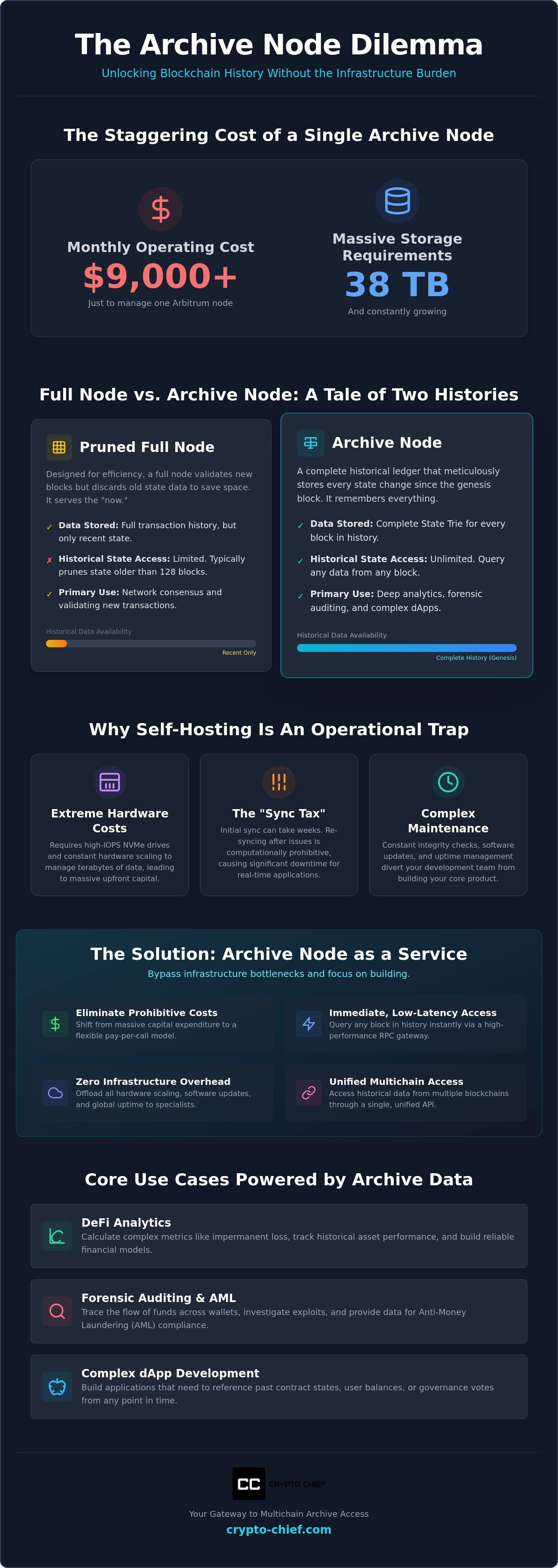
Why would a development team commit over $9,000 every month just to manage the 38-terabyte storage requirements of a single Arbitrum archive node? It's a staggering figure that highlights the growing divide between enterprise giants and agile builders. You've likely felt the frustration of slow sync times and the financial sting of monthly subscriptions that gatekeep the data you need to build. Accessing historical blockchain state shouldn't feel like a luxury reserved for the elite. Adopting an archive node as a service allows you to bypass these infrastructure bottlenecks entirely, shifting your focus back to building logic rather than managing hardware.
You understand that historical data is the backbone of reliable DeFi analytics and forensic auditing. We promise to help you master the complexities of this data landscape while demonstrating how modern service models remove the friction of traditional node management. This guide explores the transition toward cost-effective, unified querying and provides a roadmap for accessing any block in history with enterprise-grade reliability and zero infrastructure overhead.
Key Takeaways
- Understand the fundamental architectural differences between pruned full nodes and archive nodes that maintain a complete State Trie for every block since genesis.
- Evaluate the hidden "sync tax" and the high-IOPS hardware requirements that make self-hosting archive infrastructure an operational burden for most development teams.
- Discover how utilizing an archive node as a service eliminates prohibitive storage costs while providing immediate, low-latency access to historical blockchain data.
- Learn to leverage historical state queries for complex use cases, including DeFi impermanent loss calculations and forensic AML intelligence.
- Identify the benefits of a unified RPC gateway that offers multichain archive access through a single, high-performance interface without expensive monthly minimums.
What is Archive Node as a Service? Beyond the Genesis Block
An archive node as a service represents a specialized managed infrastructure layer that provides developers with a high-performance RPC Gateway to every state change in a network's history. While standard full nodes are essential for validating new blocks and maintaining network consensus, they typically prune historical state data to save space. In the context of Ethereum, for example, a standard node may only retain the state for the last 128 blocks. Querying any data point beyond that window requires an archive node, which meticulously reconstructs the "State Trie" for every single block since the genesis. This service model has evolved significantly. It has moved from the era of renting clunky dedicated servers to sophisticated, unified API access that allows for pay-per-call querying of deep historical records across multiple chains.
The Mechanics of Historical State Storage
To understand why this infrastructure is so resource-intensive, we must look at how blockchain technology handles state. While a block contains a list of transactions, the "state" describes the actual result of those transactions. Archive nodes store every intermediate state snapshot, creating a complete historical map of the virtual machine. Key components of this storage include:
- Account Balances: Every wallet's balance at every specific block height in history.
- Contract Storage: The internal variables and data of smart contracts at any given time.
- State Trie: The Merkle Patricia Trie that organizes this data for cryptographic verification and efficient retrieval.
This cumulative approach leads to massive storage requirements, often exceeding 20TB for mature networks. Maintaining this data requires high-IOPS NVMe drives and constant integrity checks to ensure that historical queries remain accurate and low-latency. Without these snapshots, a node would have to re-execute every transaction from the genesis block just to find a balance at block one million, making real-time queries impossible.
The Shift to Managed Archive Infrastructure
Running your own archive hardware is an operational burden that involves complex maintenance and significant upfront capital. The shift toward a managed archive node as a service model allows developers to offload these responsibilities to a specialized provider. These services manage the "heavy lifting" of hardware scaling, software updates, and global uptime. They ensure that high-performance clusters are always ready to serve archive queries with minimal latency. This democratization of data reduces the barrier to entry for individual creators and analytics firms. It allows them to perform deep forensics or DeFi research without the overhead of a multi-terabyte server farm. By providing a stable foundation, managed providers empower builders to focus on their unique logic rather than the stability of the underlying ledger.
Archive vs. Full Nodes: Tracking Every State Change
The distinction between a full node and an archive node is primarily a matter of memory and accessibility. While both participate in the network and verify new blocks, they differ fundamentally in how they handle historical state data. Full nodes are designed for efficiency. They serve the "now" by maintaining the current state of the ledger, but they suffer from a selective memory regarding the past. When you utilize an archive node as a service, you gain access to a version of the blockchain that has never forgotten a single balance, contract variable, or storage slot since the genesis block. For developers building analytics or compliance tools, this historical depth is not just a feature; it is a technical requirement.
Data Availability and Pruning Explained
Pruning is the process of deleting old state data to save space. While a full node keeps the entire history of blocks and transactions, it discards the snapshots of the machine's state once they fall outside a specific window, which is typically the most recent 128 blocks on Ethereum. To reconstruct the state of a block from six months ago, a full node would theoretically have to re-execute every transaction from that point forward, a process that is computationally prohibitive for real-time applications. Archive nodes avoid this "sync tax" by storing every intermediate state snapshot on high-performance disks. This ensures that API response times for historical data remain consistent, regardless of how far back in time the query reaches.
Archive-Exclusive JSON-RPC Methods
Certain operations are impossible to perform without the specialized data sets found only in archive nodes. If your application needs to verify the state of a smart contract at a specific height or audit a complex transaction, standard full nodes will return an error. Key methods that require archive access include:
- eth_getProof: Essential for generating Merkle proofs to verify account and storage values without trusting a single source.
- eth_call (historical): Allows you to execute a "dry run" of a contract call against the state of any block in history.
- debug_traceTransaction: Provides a step-by-step breakdown of how the EVM executed a specific transaction, which is vital for security auditing and debugging failed calls.
These methods are the lifeblood of protocol auditing and cross-chain state verification. Relying on an archive node as a service ensures these methods are always available through a stable RPC Gateway without the need to manage the massive storage arrays required to host them locally. Choosing the right node type depends entirely on your data window. If you only care about the last ten minutes of activity, a full node suffices. However, for any project involving historical forensics, tax calculations, or long-term portfolio tracking, archive access is non-negotiable.
The Total Cost of Ownership: Why Self-Hosting is a Trap
Self-hosting an archive node often looks like a prudent cost-saving measure on paper. In reality, it's a false economy that consumes more than just your monthly budget. The hardware requirements in 2026 are relentless. To maintain a responsive environment, you need enterprise-grade NVMe storage with exceptionally high IOPS (Input/Output Operations Per Second). There is also the hidden cost of TBW (Total Bytes Written). Archive nodes are write-intensive; they burn through consumer-grade SSDs at an alarming rate, leading to premature hardware failure and potential data corruption. Choosing an archive node as a service allows you to offload these hardware risks to a provider equipped to handle industrial-scale data loads.
The "Sync Tax" is another silent killer of project timelines. Syncing a full archive node from the genesis block can take weeks, even on highly optimized infrastructure. During this period, your deployment is effectively stalled. If a database corruption occurs or a client update fails, you might have to restart that clock from zero. Beyond the initial sync, the operational burden of 24/7 monitoring, electricity, and cooling for a 20TB+ server cluster is a significant drain on resources. High-availability applications can't afford the downtime caused by unexpected client bugs or chain reorgs that require manual intervention.
Infrastructure vs. Innovation: The Developer Dilemma
Managing dev-ops for massive nodes distracts your team from building core product features. Every hour spent troubleshooting a database index is an hour lost on refining your user experience. Scalability presents an even larger hurdle. What happens when your dApp needs to query historical state across five different chains? That represents a 100TB+ storage commitment and a multiplicative increase in maintenance complexity. An archive node as a service provides a unified path to scale, offering immediate access to multiple networks without the need for a massive, fixed-cost server farm.
Optimising Archive Query Expenses
Developers must account for the "Archive Tax" when planning their budgets. Most infrastructure providers charge higher Compute Units for historical queries because they require more resource-heavy disk lookups than standard RPC calls. You can mitigate these costs through strategic implementation. Using RPC request batching is one of the most effective ways to lower data retrieval expenses. By grouping multiple historical requests into a single call, you reduce round-trip latency and overhead. Additionally, implementing webhooks can help you avoid redundant polling of historical state, ensuring that you only pay for the data you actually consume.
Core Use Cases: From DeFi Analytics to AML Forensics
Historical data is the bedrock of modern blockchain forensics and enterprise compliance. While full nodes provide the current state, they lack the historical depth required to map complex financial movements or audit protocol health over time. Leveraging an archive node as a service transforms this raw data into actionable intelligence. For institutions, this isn't just about data retrieval. It's about meeting the rigorous standards of global regulatory frameworks like MiCA. Success in this landscape requires a reliable partner that can deliver every block in history without the friction of self-hosted infrastructure.
Blockchain Forensics and Risk Assessment
Forensic investigators use archive data to peel back layers of obfuscation. By querying historical state, AML Intelligence tools can trace the origin of funds through multiple hops and across mixers that attempt to break the audit trail. This capability is vital for crypto transaction risk assessment, where identifying "tainted" assets depends on knowing exactly what was in a wallet at the moment of a specific interaction. Real-time monitoring tells you where the money is going, but historical monitoring tells you where it truly came from. This synergy ensures that compliance teams can identify risks before they escalate into regulatory failures.
Building Advanced Analytics Platforms
DeFi protocols and portfolio trackers require archive access to calculate performance metrics that are invisible to standard nodes. Calculating "Impermanent Loss" for liquidity providers, for instance, requires comparing current asset ratios against the exact state of the pool at the time of deposit. Data scientists utilize an archive node as a service to aggregate Total Value Locked (TVL) history by querying contract state at specific block intervals. This granular approach allows for the creation of "Time Machine" features in block explorers, giving users a window into the chain's past that feels as immediate as the present. Raw historical state provides the high-fidelity input necessary for training sophisticated machine learning models in predictive analytics.
Auditing and Compliance
Smart contract auditing relies on the ability to replay exploit transactions against historical states. By isolating the exact block height where a vulnerability was triggered, security researchers can identify root causes and test patches without deploying to a live environment. Similarly, tax platforms use this data to generate accurate balance reports for regulatory audits, ensuring that every asset movement is accounted for with cryptographic certainty. This level of precision is only possible when you have unfettered access to the full historical record of the machine. Ready to integrate deep historical insights? Access our high-performance RPC Gateway for seamless, multichain archive data.
Scaling with Crypto Chief: Multichain Archive Access
Scaling historical data access across multiple networks often introduces a fragmented developer experience. If you're building a cross-chain analytics tool, you shouldn't have to manage five different node architectures just to retrieve a historical balance. Crypto Chief addresses this challenge by providing a unified Web3 RPC Gateway that normalizes historical state access. While some providers treat archive data as an Ethereum-only niche, our infrastructure offers full multichain support for Ethereum, BNB Chain, Polygon, and TON. Choosing an archive node as a service shouldn't mean being locked into a single ecosystem.
We've eliminated the enterprise gatekeeping that typically defines this industry. In many cases, an archive node as a service is hidden behind expensive monthly minimums or restrictive "talk to sales" buttons that stall your progress. We've flipped that model. Every developer on our platform gets immediate archive access. Our high-performance global network ensures that your queries for deep history remain stable and low-latency, regardless of which chain you're querying or how far back the data sits in the ledger.
Unified API for Multichain Data
Managing multiple API keys and varying data formats is a significant drain on productivity. Our Unified API abstracts the underlying complexities of different chain architectures into a single, predictable interface. This means you can use one key to access historical state across all supported networks, ensuring your backend remains clean and maintainable. By following the Crypto Chief documentation, you can reduce your integration time from weeks to just a few minutes. You focus on the data logic; we handle the multichain infrastructure.
Pay-Per-Call: The Fair Pricing Revolution
The fair pricing revolution starts with transparency. We've replaced restrictive monthly commitments with a flexible, token-based balance system. This pay-per-call model ensures that you only pay for the archive requests you actually make, rather than paying for idle capacity you don't use. You can monitor your consumption with detailed usage statistics, allowing you to track and optimize your archive request spend as your project scales. It's a supportive approach designed to empower builders at every stage of their journey. If you're ready to master historical state without the overhead, register your account and start querying archive data today.
Future-Proof Your Historical Data Strategy
The era of managing multi-terabyte server clusters just to query a network's past is over. You've seen how self-hosting leads to a "sync tax" that stalls innovation and creates unnecessary operational risks for your team. By transitioning to an archive node as a service, you gain immediate access to the complete State Trie across multiple chains without the burden of hardware maintenance or prohibitive monthly subscriptions. This shift allows you to focus on building logic that delivers real value to your users while we handle the background infrastructure.
You can now leverage a global, high-performance node network to power your DeFi analytics and AML forensics with absolute precision. Our non-custodial, developer-first infrastructure provides a Unified API for 10+ major blockchains, ensuring your project remains agile and scalable as the industry evolves. It's about having a silent, powerful partner that removes the technical barriers to your success. Access Multichain Archive Nodes on a Pay-Per-Call Basis and eliminate the friction of historical data retrieval today. The blockchain's history is a goldmine of intelligence, and you finally have the tools to extract its full value with confidence.
Frequently Asked Questions
What is the difference between an archive node and a full node?
Archive nodes retain the entire history of state changes, while full nodes prune old state data to save space. While a full node keeps the history of blocks and transactions, it only keeps recent state snapshots, typically the last 128 blocks on Ethereum. This makes archive nodes the only choice for querying deep historical data like old account balances or contract variables.
How much storage does an Ethereum archive node require in 2026?
An Ethereum archive node requires between 15TB and 20TB of high-performance storage in 2026. This storage requirement grows daily as every transaction and state change is recorded permanently. Other networks, such as Arbitrum, can exceed 38TB. The massive scale of this data makes the hardware investment and maintenance prohibitive for most independent developers and small teams.
Why are archive node requests more expensive than standard RPC calls?
Archive requests require significantly more disk I/O and computational resources than standard calls. Because the node must look up specific historical state data from massive databases rather than reading the current state from memory, it places a higher load on the infrastructure. Most providers of an archive node as a service use a Compute Unit model to reflect this increased hardware intensity.
Can I query smart contract state at a specific block number with a full node?
No, you can't query historical smart contract state using a standard full node if the block falls outside the pruning window. Full nodes lack the historical state trie needed to reconstruct account balances or contract variables from the distant past. You'll receive an error message unless you utilize an archive node capable of serving that specific point in history.
How long does it take to sync a self-hosted archive node?
Syncing an archive node from scratch can take several weeks depending on your hardware and network bandwidth. Even with high-end enterprise NVMe drives, the process of replaying and indexing every block since the genesis is a massive bottleneck. This "sync tax" is a primary reason why builders prefer managed services to get their projects running immediately.
Does Crypto Chief support archive nodes for chains other than Ethereum?
Yes, Crypto Chief provides multichain archive access across a variety of major networks. Beyond Ethereum, developers can query historical state for BNB Chain, Polygon, and TON through a unified RPC Gateway. This allows for seamless cross-chain analytics and forensic tracing without the need for multiple infrastructure providers or complex API integrations.
What are the best JSON-RPC methods for historical data analysis?
The most critical methods for historical analysis include eth_getProof for generating Merkle proofs and eth_call when executed against a historical block height. Additionally, debug_traceTransaction is essential for replaying specific transactions to understand how state changed during an exploit. These methods allow for deep technical auditing that standard methods simply cannot provide.
Is an archive node necessary for building a crypto tax application?
An archive node is absolutely necessary for crypto tax applications that require precise balance reporting for past fiscal years. To calculate gains or losses accurately, the app must know the exact balance and token valuation at the specific moment of every transaction. Using an archive node as a service ensures this data is retrieved with cryptographic certainty for regulatory audits.