
In the first six months of 2026, Web3 security incidents accounted for $1.39 billion in total losses, marking a period where infrastructure vulnerabilities replaced simple code bugs as the primary threat. You've likely utilized free nodes to accelerate your development cycle. However, as metadata harvesting and frequent rate-limiting become the norm, the trade-offs are becoming impossible to ignore. The central question for any serious builder remains: are public rpc endpoints safe for a production environment that demands absolute integrity?
It's understandable to prioritize speed during the early stages of a project, but relying on public infrastructure often means sacrificing your users' privacy and your dApp's uptime. This guide will help you discover the hidden security, privacy, and performance risks of public RPCs and teach you how to secure your dApp infrastructure against modern threats. We will examine the architectural lessons from the $290 million KelpDAO breach, provide strategies to prevent MEV sandwich attacks, and outline the transition to a scalable, private node environment that grows alongside your user base. By the end of this article, you will have the roadmap needed to achieve complete privacy for your wallet-to-node communication while maintaining a high-performance engine for your users.
Key Takeaways
- Analyze the fundamental privacy risks associated with metadata harvesting to determine if are public rpc endpoints safe for production-grade dApps.
- Compare the reliability of "best effort" public pools against private infrastructure that offers strict SLAs and significantly lower latency.
- Learn how to conduct a thorough connectivity audit and implement failover logic to ensure your infrastructure remains resilient during high network traffic.
- Discover how to protect user transaction sovereignty by decoupling IP addresses from wallet activity through secure node communication.
- Optimize your operational overhead by transitioning to an RPC Gateway with a pay-per-call model that scales seamlessly with your application’s growth.
What is a Public RPC Endpoint and How Does it Function?
Every decentralized application (dApp) requires a bridge to communicate with its underlying blockchain. This bridge is the Remote Procedure Call (RPC), a protocol that allows software to request information or execute commands on a remote server as if it were local. In Web3, RPC endpoints act as the primary gateway, translating complex user interactions into instructions that a node can process. Public endpoints, provided by entities like Infura, Alchemy, or curated lists like Chainlist, offer a low-barrier entry point for developers to connect to networks without hosting their own hardware.
Interactions generally fall into two categories: "Read" and "Write" requests. Read requests query the blockchain for static data, such as a wallet balance or the metadata of an NFT. Write requests involve broadcasting transactions to the network to change the state of the ledger. While public endpoints facilitate both, they operate as shared resources. This means thousands of users compete for the same bandwidth, resulting in a baseline experience characterized by zero service-level agreements (SLAs) and "best effort" delivery. Developers often ask are public rpc endpoints safe for scaling a business. The answer depends on your tolerance for data exposure and unpredictable performance.
The Architecture of Public vs. Private Nodes
Public nodes function as massive traffic aggregators. They funnel requests from disparate global users into shared server clusters, creating significant technical overhead to maintain uptime. Because these services are often provided for free, maintenance and security patches for "Community Endpoints" frequently lag behind enterprise standards. Unlike a dedicated RPC Gateway, which offers isolated environments, public nodes are prone to congestion. If a popular NFT mint or a market crash triggers a surge in traffic, these shared gateways are the first to experience latency or total failure.
Common Use Cases for Public Endpoints
Public infrastructure serves a specific, limited purpose in the development lifecycle. They're ideal for non-critical testing on testnets like Sepolia or for local development where data privacy isn't a concern. Individuals might use them for occasional, non-sensitive balance checks. However, the limitations become glaring when moving from an MVP to a production-grade application. Frequent rate-limiting and the absence of dedicated support make them unsuitable for any dApp that requires high-frequency transactions or a seamless user experience. Transitioning to a professional environment requires a shift from shared convenience to dedicated reliability.
The Hidden Security Risks of Using Public RPCs
The axiom that if you aren't paying for a product, you are the product is particularly relevant in Web3 infrastructure. While the convenience of a free node is undeniable, the hidden cost is often the exposure of sensitive operational data. Developers frequently ask are public rpc endpoints safe, but they often overlook the trade-off between zero cost and total data sovereignty. In a production environment, the risks extend beyond simple downtime to include the compromise of user privacy and financial integrity.
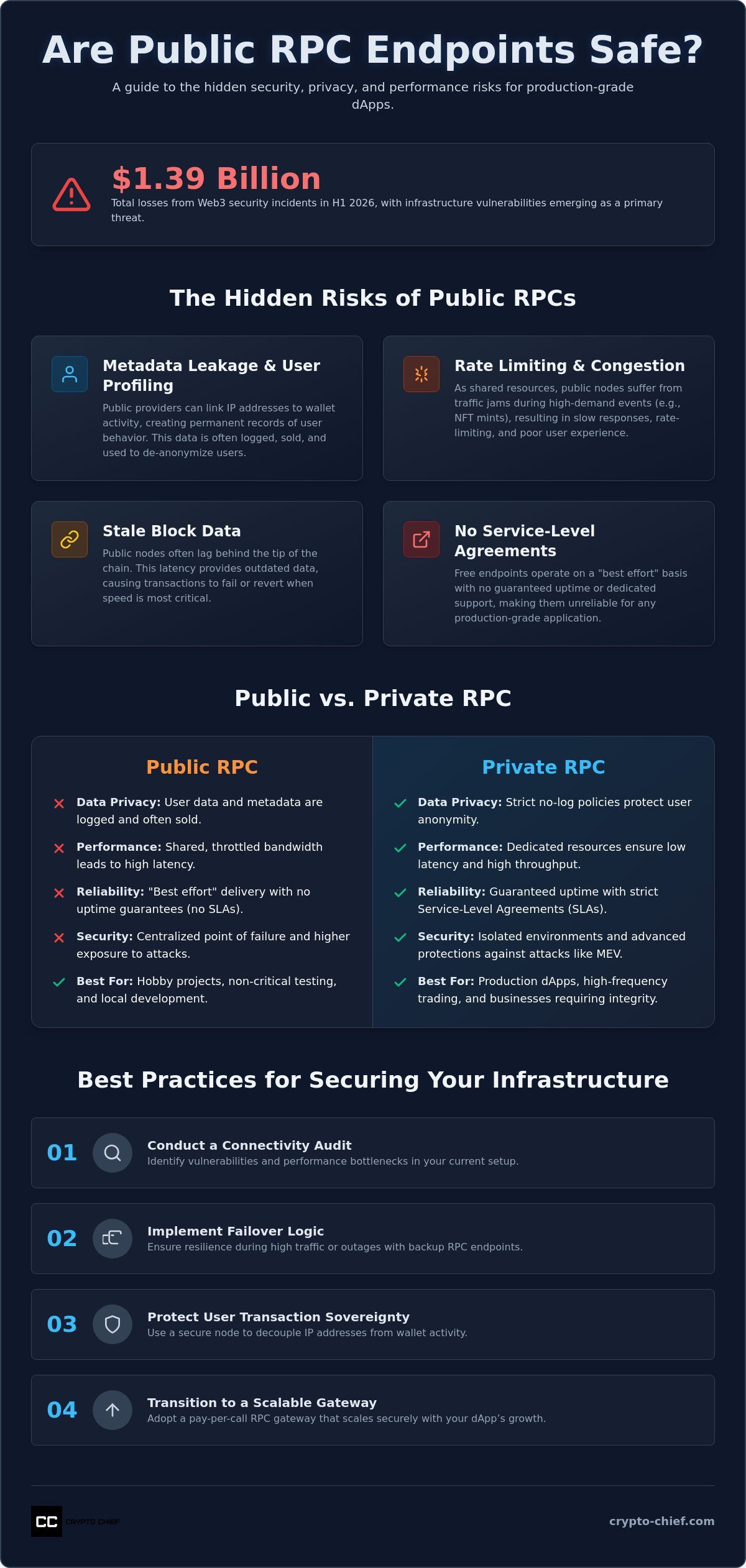
Maintaining high standards of Blockchain Security requires more than just auditing smart contracts; it involves securing the transport layer where your IP address and wallet signature meet. Public providers can link these two data points, creating a permanent record of a user's physical location and their on-chain activity. This mapping is a goldmine for analytics firms and malicious actors alike. Beyond privacy, public nodes often lag behind the tip of the chain. This latency leads to stale block data, causing transactions to fail or revert when speed is most critical.
Metadata Leakage and User Profiling
Every request through a public provider leaks a digital fingerprint. Providers can log User-Agent strings and geographic locations, aggregating this information into shadow profiles that strip away the pseudonymity users expect from decentralized finance. This data isn't just stored; it's often sold to third-party analytics firms or used to build targeted exploit profiles against high-value wallets. For those building for long-term growth, migrating to a private RPC Gateway is the only way to ensure these metadata trails are never created.
MEV Vulnerabilities and Front-Running
Public mempools are hunting grounds for sophisticated bot networks. When you broadcast a transaction through a shared endpoint, you risk exposing your trade parameters to Maximal Extractable Value (MEV) bots. These bots use the transparency of public infrastructure to execute sandwich attacks, where they buy and sell around your transaction to harvest your slippage. In 2026, these attacks have become highly automated, making public nodes a liability for any dApp handling significant swap volumes.
Censorship and Centralized Choke Points
Reliance on shared infrastructure creates centralized choke points. RPC providers can, and do, block specific smart contracts or geographic IP ranges to comply with local regulations. This sudden disconnection can leave your users stranded and your dApp non-functional. True decentralization requires non-custodial infrastructure that resists these top-down interventions, ensuring that your gateway to the blockchain remains open regardless of external pressures.
Public vs. Private RPC: A Comparative Analysis
Choosing between shared infrastructure and dedicated gateways is a pivotal decision for any Web3 architect. While the previous sections detailed the privacy risks of metadata harvesting, the performance delta between these two models is equally stark. Developers often weigh the immediate convenience of free tools against the long-term stability of their dApp, asking themselves: are public rpc endpoints safe for high-stakes financial operations? The reality is that private nodes consistently outperform shared public pools by providing dedicated throughput that remains insulated from the activity of other users.
The "Reliability Gap" is where the distinction becomes most visible. Public endpoints operate on a "best effort" delivery model, meaning they offer no guarantees regarding uptime or response speed. In contrast, a professional RPC Gateway provides strict Service Level Agreements (SLAs), ensuring your application remains responsive even when the network is congested. Beyond reliability, private infrastructure allows for granular customization. You can whitelist specific methods to reduce your attack surface and tune rate limits to match your dApp’s specific traffic patterns, a level of control that public providers simply cannot offer.
Cost efficiency is another area where the models diverge. Many enterprise providers lock developers into expensive monthly tiers that start at $49 or more, regardless of actual usage. This creates a high barrier for scaling startups. A more logical approach is the pay-per-call model, which eliminates fixed overhead and ensures you only pay for the resources your dApp consumes. This flexibility allows your infrastructure costs to scale perfectly in parallel with your user base.
Performance Benchmarks: Latency and Uptime
In the world of liquidations and high-frequency trading, millisecond-level latency is the difference between profit and loss. Public nodes frequently suffer from the "Noisy Neighbor" effect, where a surge in traffic from an unrelated project on the same cluster degrades your performance. Crypto Chief utilizes a global edge network to minimize round-trip time, routing your requests to the nearest healthy node. This architecture ensures that your dApp maintains elite speed, regardless of where your users are located geographically.
Data Integrity and Chain Reorganizations
Ensuring your dApp sees the "truth" of the blockchain in real-time is critical for maintaining user trust. Public endpoints often struggle with chain reorganizations, providing inconsistent data that can lead to failed transactions or incorrect UI displays. Compromised or lagging nodes can even return falsified data, a vulnerability highlighted in this in-depth analysis of Web3 supply chain attacks. You can mitigate these risks by utilizing RPC Request Batching to optimize data integrity and reduce the number of individual calls required to sync your application state.
Best Practices for Securing Your Web3 Infrastructure
Securing a decentralized application requires a transition from shared convenience to dedicated control. While we have established that the short answer to are public rpc endpoints safe is a definitive "no" for production, the path to security requires a structured migration. The first step involves conducting a comprehensive connectivity audit. You must identify every instance where public endpoints are hardcoded in your dApp’s configuration, environment variables, or frontend scripts. This visibility is essential to eliminate the "hidden" dependencies that often lead to unexpected failures during network congestion.
Resilience is built through redundancy. You should implement failover logic that allows your application to switch between multiple private providers automatically. If your primary gateway experiences latency spikes, your middleware should reroute traffic to a secondary node without user intervention. This ensures that your dApp remains functional even if a specific provider faces regional outages. For sensitive "Write" operations, such as broadcasting high-value transactions, you must use dedicated, authenticated endpoints. Separating these state-changing calls from routine "Read" requests reduces your attack surface and ensures that critical transactions are never exposed to public mempools.
Visibility into your infrastructure is your best defense against external threats. You should monitor your RPC usage patterns in real-time to identify anomalies that might suggest DDoS attempts or unauthorized bot activity. By analyzing request volumes and IP origins, you can proactively block malicious traffic before it impacts your legitimate users. This data-driven approach transforms your infrastructure from a passive gateway into an active security layer.
Moving Beyond Public Endpoints
Transitioning to a professional environment involves more than just swapping a URL in your MetaMask or dApp config. You should implement authentication headers or API keys to prevent unauthorized entities from consuming your private capacity. For projects requiring strict compliance, integrating AML Intelligence at the RPC level allows for automated risk detection. This ensures that your gateway can intercept and flag suspicious transactions before they are even broadcast to the network, providing an additional layer of protection for your protocol's integrity.
Optimizing for Cost and Security
Infrastructure costs should never be a barrier to security. A pay-per-call model is the most efficient way to scale, as it eliminates the need to pay for idle capacity during low-traffic periods. Some architects utilize a hybrid approach, using public nodes for non-sensitive, read-only data while reserving private gateways for everything else. However, a more robust method involves using Real-Time Blockchain Webhooks to reduce redundant RPC calls entirely. By streaming events directly to your backend, you minimize the need for constant polling, which significantly lowers your overhead while improving data accuracy.
Ready to upgrade your dApp’s security and performance? Deploy a high-performance RPC Gateway today and ensure your infrastructure is ready for the demands of 2026.
Scaling Securely with Crypto Chief’s RPC Gateway
Building in Web3 requires a foundation that is both resilient and economically sustainable. We have established that the risks of data harvesting and performance bottlenecks mean the answer to are public rpc endpoints safe is a clear negative for production environments. Crypto Chief’s Web3 RPC Gateway was engineered to solve these structural weaknesses by providing a private, high-performance alternative that prioritizes developer sovereignty. Our platform operates on a non-custodial, builder-centric ethos, ensuring you maintain total control over your dApp’s communication with the blockchain without sacrificing speed or security. If you are still questioning are public rpc endpoints safe, the data regarding metadata leakage and MEV attacks suggests that private infrastructure is the only viable path forward for professional applications.
The most significant barrier to professional infrastructure is often the rigid pricing of legacy providers. While competitors often lock you into tiers starting at $49 per month, we utilize a unique pay-per-call model. This approach eliminates expensive monthly commitments and ensures you only pay for the exact volume your application generates. It's a transparent system that allows startups to access enterprise-grade security without the enterprise price tag. By removing these financial barriers, we empower creators to focus on their core logic while we handle the heavy lifting of node maintenance and global scaling.
Multichain Support and Global Reach
Modern dApps are increasingly multichain by design. Our Unified API allows you to manage traffic across Ethereum, Solana, and Polygon using a single token balance. This streamlined architecture removes the friction of managing multiple subscriptions or disparate provider accounts. You also gain access to full archive nodes and historical data without the "Archive Premium" fees common in the industry, all backed by a globally distributed network that guarantees elite uptime. This global reach ensures that your users experience low latency, regardless of their physical location.
Developer-First Integration and Documentation
Speed to market is critical for any innovator. You can integrate our gateway into your stack in minutes by following our comprehensive Developer Documentation. Our pre-paid token model provides total control over your infrastructure budget, removing the risk of unexpected overage charges or hidden fees that can disrupt your burn rate. If your project requires a more tailored approach, our Technical Support Team is available to assist with custom enterprise configurations and high-throughput requirements. We don't just provide nodes; we act as a silent, powerful partner that has already solved the complex problems of scalability so you don't have to.
Securing the Future of Your Decentralized Infrastructure
Maintaining a competitive edge in 2026 requires more than just innovative code; it demands a resilient foundation that protects both your users and your protocol's integrity. Throughout this guide, we have explored how the transition from shared resources to dedicated gateways mitigates the risks of metadata harvesting and MEV attacks. The evidence is clear that when you ask are public rpc endpoints safe for a professional application, the answer lies in the trade-offs you are willing to accept regarding transaction sovereignty and data privacy. Moving to a private node environment is the only way to ensure your dApp remains performant during periods of extreme network volatility.
By adopting a private, authenticated architecture, you eliminate the "noisy neighbor" effect and ensure your dApp sees the real-time truth of the blockchain. Crypto Chief provides the tools to make this transition seamless through a Unified Multichain API and real-time AML risk detection, all without the burden of expensive monthly subscriptions. Our pay-per-call model ensures your costs align perfectly with your actual usage, allowing you to focus on building while we handle the background infrastructure. Secure your dApp with Crypto Chief’s Pay-Per-Call RPC Gateway and join a global community of builders who prioritize performance and privacy. Your infrastructure is ready to lead the way.
Frequently Asked Questions
Is it ever safe to use a public RPC for a production dApp?
It's generally not recommended to use public RPCs for production dApps because they lack service-level agreements and dedicated bandwidth. While they're useful for testing on Sepolia or local development, production environments require the reliability of a private gateway. Relying on shared resources risks transaction reverts and performance bottlenecks during critical market events. Professional builders prioritize stable infrastructure to ensure a seamless user experience for their community.
How do public RPC providers make money if the service is free?
Free providers typically operate on a freemium model where the free tier serves as a funnel for expensive, tiered subscriptions. In many cases, these providers also monetize the metadata they collect from users, such as IP addresses and transaction frequencies. When developers ask are public rpc endpoints safe, they must recognize that data harvesting is a common method for subsidizing "free" infrastructure costs in the Web3 ecosystem.
What data can an RPC provider see when I send a transaction?
An RPC provider can see your IP address, geographic location, and the wallet address associated with your transaction. They also have access to your User-Agent string and the specific smart contracts you interact with. This data allows providers to map your physical identity to your on-chain behavior. Without a private gateway, this information can be aggregated into shadow profiles and sold to third-party analytics firms without your consent.
Can a public RPC endpoint steal my private keys?
An RPC endpoint cannot steal your private keys because they are never transmitted during a request. Your wallet signs the transaction locally before sending the signed payload to the node for broadcasting. However, a compromised endpoint can provide "stale" or falsified data to your dApp frontend. This manipulation can lead you to authorize transactions based on incorrect price feeds or forged contract states, resulting in significant financial loss.
What is the difference between a rate limit and a timeout in public RPCs?
A rate limit is a cap on the number of requests you can make within a specific window, often resulting in a 429 "Too Many Requests" error. A timeout happens when the node is too congested to return a response within a set period. Public endpoints suffer from timeouts more frequently because they aggregate traffic from thousands of users, leading to unpredictable latency and "noisy neighbor" issues during peak network activity.
How does an RPC gateway improve my dApp’s security?
An RPC gateway improves security by isolating your traffic from the public pool and requiring authentication for every call. It allows you to implement method whitelisting, which restricts the types of requests your endpoint will accept. This reduces your attack surface significantly. Additionally, advanced gateways offer integrated AML Intelligence to automatically detect and block transactions linked to high-risk or illicit addresses before they are even broadcast to the blockchain.
Why is pay-per-call better than a monthly subscription for RPC nodes?
Pay-per-call is more efficient because it removes the high entry cost of monthly subscriptions that often start at $49 or more. You only pay for the resources your dApp actually consumes, which prevents you from overpaying for idle capacity during low-traffic periods. This model provides the same enterprise-level performance as expensive tiers but with a cost structure that scales perfectly with your project's growth and user adoption.
Does using a private RPC protect me from MEV sandwich attacks?
A private RPC can protect you from MEV sandwich attacks by routing your transactions through private mempools or specialized relays. This prevents bots from seeing your pending trades in the public pool before they are included in a block. When evaluating are public rpc endpoints safe, it's vital to remember that public broadcasting exposes your slippage to sophisticated bot networks that profit at your users' expense through front-running.