
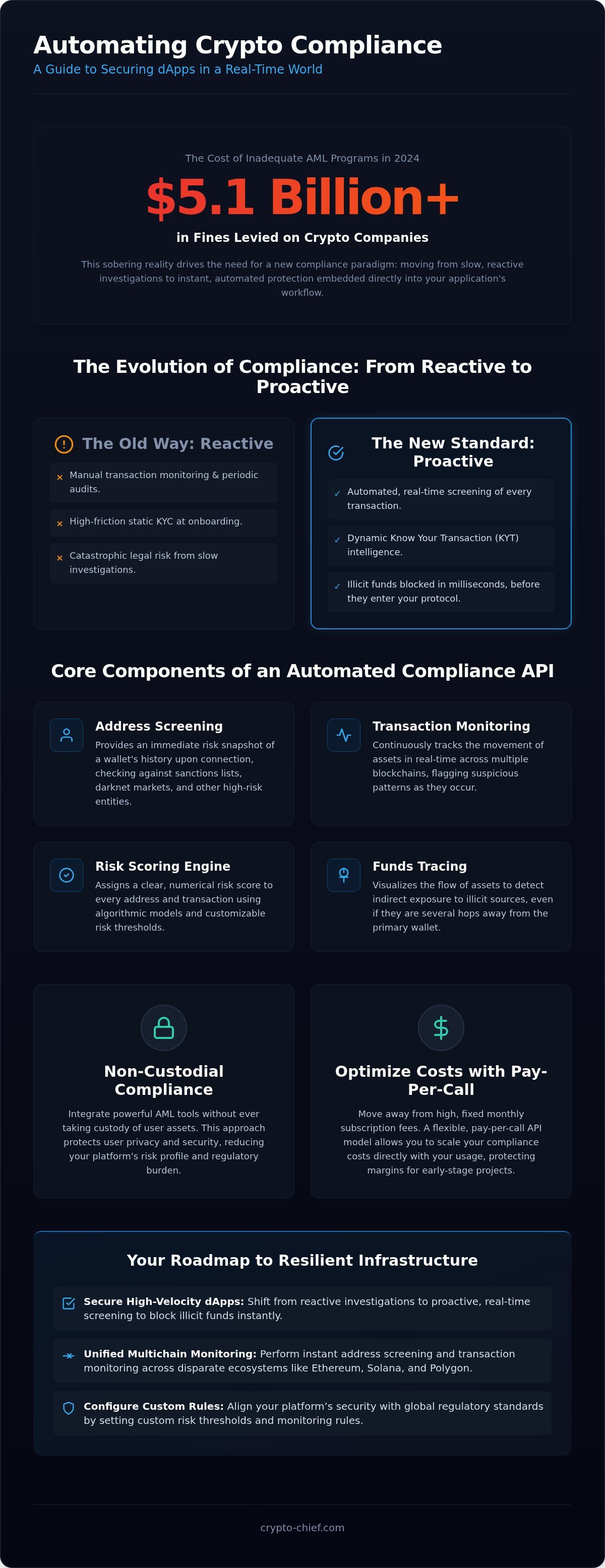
In 2024, crypto companies were hit with over $5.1 billion in fines for inadequate AML programs, a sobering reality that still shapes how we build in 2026. You likely understand the constant pressure to protect your dApp from tainted funds while navigating the complexity of multichain risk monitoring. It's a difficult balance to strike, especially when high monthly subscription fees eat into your margins before you've even scaled. This guide will help you master the integration of an automated crypto compliance api to ensure real-time risk detection without compromising your application's speed.
We'll show you how to implement automated risk scoring for every transaction and leverage cost-effective, non-custodial solutions that grow with your usage. We will break down the technical workflow for seamless API integration, analyze the impact of the latest FATF standards, and provide a roadmap for building a resilient, compliance-ready infrastructure. By moving from centralized gatekeepers to programmable, pay-per-call intelligence, you can focus on your core product while the background infrastructure handles the regulatory heavy lifting. This is about turning compliance from a friction point into a silent, powerful partner for your global growth.
Key Takeaways
- Shift from reactive investigations to proactive, real-time screening to secure high-velocity dApps against illicit funds.
- Master the integration of an automated crypto compliance api to perform instant address screening and multichain transaction monitoring.
- Implement non-custodial compliance strategies that protect user privacy and security without the need to manage or hold assets.
- Configure custom risk thresholds and monitoring rules to align your platform's security with global regulatory standards.
- Scale your project efficiently by replacing high monthly fees with a flexible, pay-per-call pricing model that matches your actual usage.
The Landscape of Automated Crypto Compliance in 2026
By 2026, the era of reactive compliance has ended. Regulatory bodies have moved beyond periodic audits, favoring real-time oversight that demands immediate action. For high-velocity dApps, manual transaction monitoring isn't just inefficient; it's a structural liability that invites catastrophic legal risk. The implementation of an automated crypto compliance api has transitioned from an enterprise luxury to a foundational requirement for any builder interacting with the global financial system. This shift ensures that compliance functions as a silent, background process that protects the integrity of the protocol without introducing user friction.
The regulatory pressure is particularly intense for non-custodial gateways and DeFi protocols. With the EU’s Transfer of Funds Regulation (TFR) now enforcing a zero-threshold policy for transfers between service providers, every single interaction must be screened. Developers must integrate sophisticated Anti-money laundering (AML) software capabilities directly into their smart contract workflows. This structural integrity is what separates sustainable fintech applications from those that will eventually succumb to regulatory enforcement or the infiltration of illicit capital.
From Static KYC to Dynamic KYT
Identity verification at onboarding is no longer sufficient to satisfy global standards. The industry has adopted Know Your Transaction (KYT) as the primary metric for risk management. In 2026, Know Your Transaction (KYT) is the programmatic, real-time verification of fund origins and transaction intent that ensures every on-chain movement adheres to international regulatory frameworks. This dynamic approach allows dApps to prevent the acceptance of sanctioned funds in milliseconds, long before they can contaminate a liquidity pool or a payment gateway.
The Risk of Tainted Funds in 2026
Illicit actors have become increasingly sophisticated, using advanced mixers and chain-hopping techniques to disguise the origin of funds. "Innocent" dApps are often targeted as transit points for these assets, leaving developers vulnerable to "tainted" fund associations that can trigger blacklisting or asset freezes. Failing to screen wallet addresses through a robust AML Intelligence service can lead to severe financial penalties and the loss of banking off-ramps. By integrating an automated crypto compliance api, builders can automate the detection of high-risk patterns and protect their ecosystems from the evolving threats of digital money laundering.
Core Components of an Automated Crypto Compliance API
An automated crypto compliance api functions as a modular intelligence layer, providing developers with the tools to intercept illicit activity before it compromises their protocol. This system relies on four primary pillars: address screening, transaction monitoring, risk scoring, and funds tracing. Address screening provides an immediate snapshot of a wallet’s history at the moment of connection, while transaction monitoring tracks the movement of assets across the ledger in real-time. These components enable deep funds tracing, which visualizes the flow of assets to detect indirect exposure to illicit entities that may be several hops away from the primary wallet.
How Risk Scoring Engines Work
Risk scoring is the analytical heart of the system. It uses algorithmic models to assign a numerical value to every interaction based on historical associations with darknet markets, mixers, or sanctioned VASPs. These behavioral heuristics identify patterns typical of money laundering, such as rapid-fire layering or "peeling" chains, which are often invisible to manual review. This approach aligns with FinCEN's 2019 guidance, which emphasizes that businesses must apply a risk-based approach to their compliance programs. Developers can customize these risk thresholds to match their specific appetite for risk, ensuring that legitimate users aren't blocked by overly aggressive filters.
Multichain Compliance Coverage
Modern dApps rarely live on a single network. The challenge lies in monitoring risk across disparate ecosystems like Ethereum, BNB Chain, Polygon, and Solana simultaneously. A fragmented approach leads to data silos and inconsistent enforcement, which can leave gaps in your security posture. Utilizing a unified architecture is essential for normalizing compliance data across different protocols. This setup allows your automated crypto compliance api to deliver a consistent risk profile regardless of where the transaction originates. By centralizing this intelligence, you maintain structural integrity across your entire multichain footprint. If you're looking to fortify your dApp's defenses, integrating AML Intelligence provides a steady, knowledgeable guide for your compliance journey.
Non-Custodial Compliance: Maintaining Privacy and Security
Building non-custodial dApps presents a unique challenge known as the "Compliance Paradox." You must verify transactions without ever taking custody of user funds. In 2026, solving this requires an automated crypto compliance api that operates at the protocol's edge, screening the flow of value before it interacts with your smart contracts. This agile approach ensures you fulfill global AML/CFT obligations while maintaining the privacy and security that non-custodial users expect. It's a balance of structural integrity and user autonomy that empowers builders to scale without fear.
Integrating AML with Non-Custodial Processing
The most effective way to manage risk in a non-custodial environment is to integrate screening into the initial payment request phase. Instead of waiting for a transaction to hit your wallet, your system should screen the sender's address before generating a deposit address or providing a payment URI. This proactive workflow allows you to automate the rejection of high-risk incoming transactions, effectively preventing "tainted" funds from ever reaching your ecosystem. By leveraging a Non-Custodial Crypto Processing API, you can build a defensive perimeter that respects user sovereignty. This method aligns with the principles established in the foundational 2013 FinCEN guidance, which first clarified that administrators of decentralized virtual currencies have specific regulatory responsibilities. It demonstrates a commitment to stability and performance that appeals to institutional partners.
The Developer’s Responsibility in DeFi
In 2026, the term "decentralized" is no longer a shield against compliance. Regulators increasingly view developers as the architects responsible for the safety of their platforms, whether they hold funds or not. You need a "silent partner" compliance layer that provides robust protection without disrupting the UX or requiring centralized control. Integrating AML Intelligence into your liquidity pools or trading interfaces allows you to monitor for behavioral heuristics that signal sophisticated money laundering. This doesn't mean you're becoming a custodian; it means you're building a resilient infrastructure that can scale globally. It's a practical, everyday tool for the professional developer who understands that uptime and logic are the keys to longevity. By automating these checks, you remove the friction of manual oversight and focus on the creative responsibilities of building your dApp.
Implementation Framework: Integrating Automated Compliance
Integrating an automated crypto compliance api into your technical stack requires a methodical approach that prioritizes both security and system performance. The process begins with authenticating your application and managing your API token balances within the secure dashboard. This prepaid model ensures you maintain control over your overhead while accessing high-level intelligence. Once connected, you must configure your risk thresholds. This involves setting specific parameters for what constitutes a high-risk interaction, allowing you to tailor the monitoring rules to the unique needs of your dApp.
The core of the implementation involves calling the Unified API endpoints for real-time screening. This centralized access point simplifies multichain management, allowing your code to remain clean and maintainable. By sending a request to the screening endpoint, you receive an instant risk score based on the behavioral heuristics discussed in previous sections. To ensure your application handles high volumes without latency, you should set up webhooks for asynchronous transaction risk alerts. This architecture allows your front-end to remain fast while the compliance layer works silently in the background to verify every movement of value.
Leveraging Webhooks for Real-Time Alerts
Efficiency in 2026 demands more than just point-in-time checks. You can use EventStream to trigger compliance checks on every new block, ensuring that your data is always current. For a deep dive into this technology, see our guide to real-time blockchain webhooks. When a webhook delivers a high-risk flag, your system should trigger an automated workflow. Depending on your business logic, this might involve pausing a transaction, flagging a user for manual review, or initiating an automated refund to prevent the funds from ever entering your liquidity pools.
Developer Tools and Documentation
Rapid deployment is facilitated by the Crypto Chief Documentation, which provides granular technical details and code snippets for various environments. Before pushing to mainnet, you can test your integration using the Testnet Faucet to acquire gas fees for simulated transactions. Reliable systems also require robust error handling. You should implement API redundancy and graceful degradation to ensure that if a compliance check fails, your dApp remains functional while maintaining a "safety-first" posture. It's about building a global engine that is both elite and resilient. Ready to secure your infrastructure? Register your developer account and start screening today.
Optimizing Compliance Costs with a Pay-Per-Call Model
Traditional compliance solutions often impose a significant financial barrier on emerging Web3 projects. High monthly subscription fees force developers to pay for capacity they don't yet use, creating a "compliance tax" that drains capital before a dApp achieves product-market fit. By shifting to an automated crypto compliance api built on a pay-per-call model, you align your security expenditures directly with your actual transaction volume. This utility-focused approach ensures that your overhead remains lean during the early stages of development while providing the structural integrity required for enterprise-level operations.
Managing your compliance budget becomes a matter of technical precision rather than speculative forecasting. By utilizing prepaid token balances, you can allocate resources with granular accuracy, ensuring that every call to the AML Intelligence service delivers immediate, actionable value. This model removes the friction of annual contracts and high entry barriers, positioning the service as a silent, powerful partner that supports your growth. When you unify your infrastructure by using a single provider for your RPC Gateway, processing, and AML needs, you further reduce complexity and eliminate the redundant costs associated with managing multiple vendors.
Comparing API Cost Models
Why should a startup with 500 monthly transactions pay the same flat fee as a platform processing 50,000? Tiered monthly plans often lead to wasted resources, whereas a pay-per-request model enables linear scaling that respects your bottom line. This efficiency is particularly evident when you integrate compliance into a broader, high-performance engine. For instance, developers who master RPC request batching for cost reduction understand that every optimization at the infrastructure layer contributes to the long-term sustainability of the project. A unified API reduces the "integration tax" by providing a consistent interface for diverse blockchain tasks, from data retrieval to risk scoring.
Building for the Long Term
Scalability shouldn't require a legal team to renegotiate contracts every time your user base grows. With a pay-per-call automated crypto compliance api, you can scale from 100 to 1,000,000 calls without the administrative friction of traditional enterprise software. This flexibility allows you to focus on your creative responsibilities while the background infrastructure handles the heavy lifting of global compliance. As institutional interest in DeFi continues to rise in 2026, having a robust, affordable, and non-custodial compliance layer is essential for attracting high-value partners. It demonstrates that your protocol is built on logic and structural stability. Ready to secure your dApp with a solution that scales at your pace? Start integrating AML Intelligence today and build with confidence.
Future-Proofing Your dApp Infrastructure
Securing a decentralized application in 2026 requires a shift from manual oversight to programmable, real-time intelligence. You've seen how integrating an automated crypto compliance api allows you to intercept illicit funds at the protocol's edge without sacrificing user privacy or system speed. By moving toward a non-custodial framework and leveraging behavioral heuristics, you ensure your platform remains resilient against evolving regulatory pressures while maintaining the structural integrity your users demand.
Success in the Web3 landscape depends on high-performance engines that scale logically with your growth. Crypto Chief provides the stability you need through a Unified Multichain API and enterprise-grade uptime, all delivered via a flexible pay-per-call pricing model. This approach removes the friction of high monthly fees and allows you to focus on your creative responsibilities. It's time to turn compliance into a silent, powerful partner for your global operations. Register for Crypto Chief and access AML Intelligence now to build a foundation that is both elite and sustainable. Build with confidence, knowing your infrastructure is ready for institutional adoption.
Frequently Asked Questions
What is an automated crypto compliance API?
An automated crypto compliance api is a programmatic interface that enables developers to integrate real-time Anti-Money Laundering (AML) checks into their applications. Unlike manual reviews, this system screens wallet addresses and transactions against global databases in milliseconds. It identifies sanctioned entities, darknet market associations, and stolen funds, allowing dApps to maintain structural integrity and regulatory alignment without human intervention or performance bottlenecks.
How does an AML API detect high-risk transactions?
The system uses behavioral heuristics and algorithmic risk scoring to analyze the flow of value on-chain. It traces funds back through multiple hops to identify indirect exposure to illicit sources like mixers or sanctioned exchanges. By examining historical interactions and transaction patterns, the API assigns a risk score that reflects the probability of illicit activity, helping you block tainted assets before they enter your liquidity pools.
Can I use a compliance API for a non-custodial dApp?
You can implement compliance measures without ever taking control of user assets. A non-custodial approach involves screening sender addresses during the payment request phase or before a smart contract interaction. This ensures you fulfill your regulatory obligations while respecting the privacy and sovereignty of your users. Integrating AML Intelligence allows you to protect your platform while remaining a silent, powerful partner in the background.
What is the difference between KYC and KYT in 2026?
KYC focuses on the identity of the person, while KYT focuses on the movement of the assets. In 2026, KYT has become the gold standard because it provides real-time oversight of fund origins regardless of who the user claims to be. While KYC is a one-time onboarding check, KYT is a dynamic process that monitors every transaction for suspicious behavior throughout the user's lifecycle on the blockchain.
How much does a crypto compliance API cost?
Pricing models vary, but modern providers have moved away from restrictive monthly tiers in favor of utility-focused models. A pay-per-call system allows you to manage your budget with precision by only paying for the specific requests you make. This removes high entry barriers for startups and allows projects to scale their costs linearly as their transaction volume grows. You can manage these expenses through prepaid token balances.
Does integrating an AML API slow down my blockchain application?
High-performance compliance APIs are designed for minimal latency, often delivering results in under 200 milliseconds. By using asynchronous workflows and webhooks, you can ensure that the compliance layer doesn't block the primary user experience. Your automated crypto compliance api should act as a background engine that processes risk data in parallel with your application's logic, maintaining the speed and uptime your users expect from a modern, global dApp.
Which blockchains are supported by automated compliance APIs?
Most leading compliance services offer multichain support through a unified interface. Supported networks typically include:
- Bitcoin and Bitcoin Cash
- Ethereum and its Layer 2 ecosystems
- BNB Smart Chain, Polygon, and Solana
- Tron, Litecoin, and Dogecoin
How do I handle a "high risk" flag from the API?
Your application should have automated workflows to manage different risk thresholds. For a high-risk flag, you might pause the transaction, request additional information, or automatically refund the payment to the source address to avoid contamination. It's essential to define these monitoring rules in your configuration based on your platform's specific risk appetite. This proactive approach ensures you remain compliant with global standards while protecting your protocol's structural integrity.