
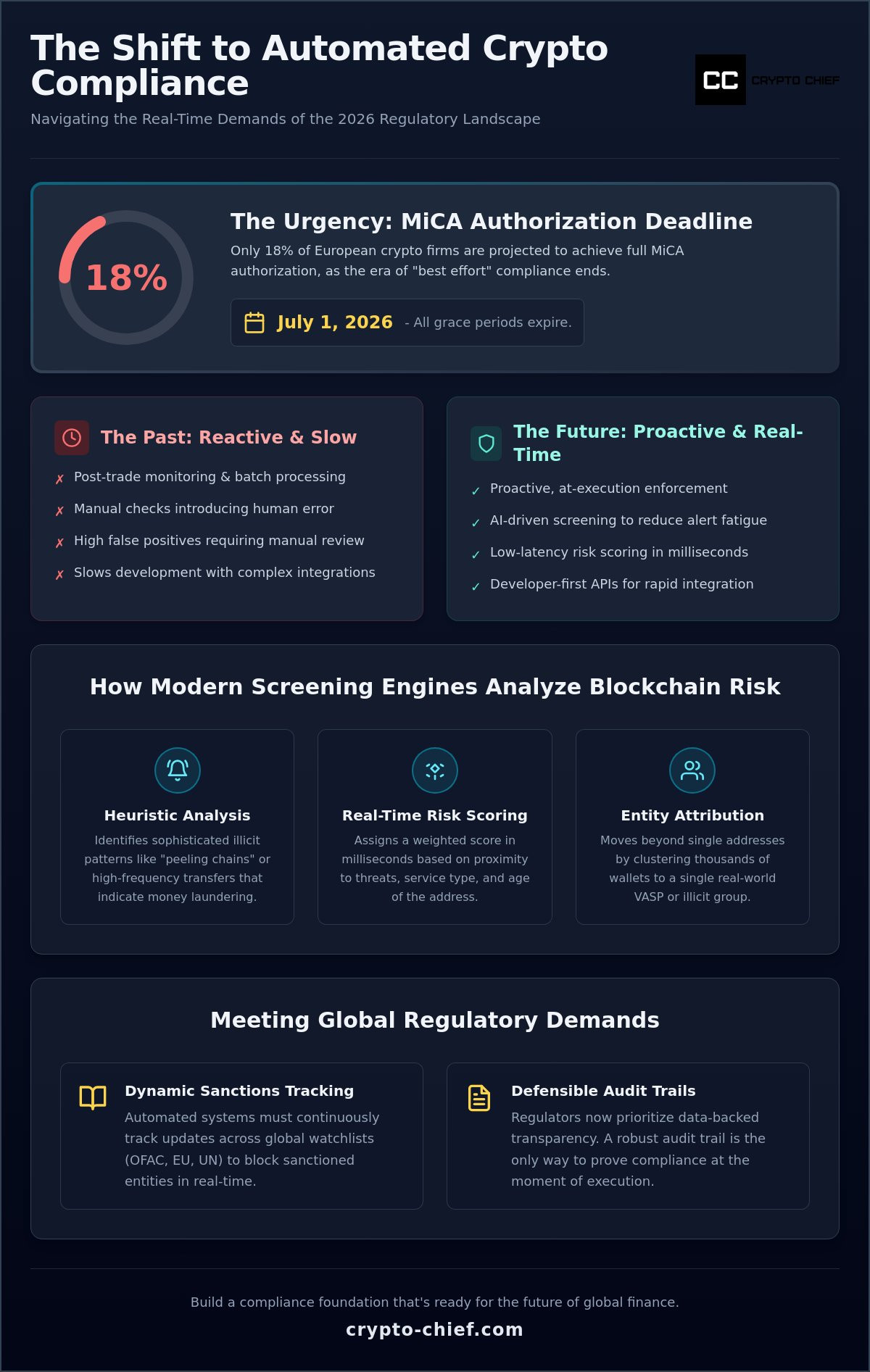
With only 18% of European crypto firms achieving full MiCA authorization by the July 1, 2026 deadline, the pressure to deploy robust, at-execution enforcement has never been higher. You've likely experienced the friction of legacy compliance tools that hide their costs behind enterprise sales cycles or trigger endless false positives that demand manual review. Automated crypto compliance screening shouldn't be a hurdle that slows your development; it should be a silent, powerful partner in your stack. We recognize that architects need stable, high-performance infrastructure that scales without the burden of opaque pricing or complex integration delays.
In this guide, you'll discover how to integrate seamless, real-time AML screening into your dApp using high-performance APIs and a transparent pay-per-call model. We'll explore the methods for achieving low-latency risk scoring and building regulatory-ready audit trails that withstand the most rigorous 2026 audits. From handling the latest OFAC sanctions updates to implementing network-level analysis, this walkthrough provides the blueprint for a compliance layer that's both elite in capability and practical in execution. It's time to move beyond simple address screening and build a foundation that's ready for the future of global finance.
Key Takeaways
- Shift from reactive post-trade monitoring to proactive, at-execution enforcement to meet the rigorous regulatory standards of 2026.
- Leverage automated crypto compliance screening to identify sophisticated illicit patterns through heuristic analysis and precise entity attribution.
- Accelerate your product launch by bypassing legacy sales cycles in favor of developer-first APIs that offer immediate, self-service registration.
- Maintain a frictionless user experience by selecting screening providers that guarantee low-latency response times across multiple blockchain networks.
- Simplify your technical stack with unified infrastructure that integrates high-performance RPC gateways and AML intelligence into a single, scalable foundation.
The State of Automated Crypto Compliance Screening in 2026
The regulatory landscape has undergone a fundamental transformation. As of July 1, 2026, the grace periods for the EU's Markets in Crypto-Assets (MiCA) regulation have expired, leaving no room for ambiguity. For Virtual Asset Service Providers (VASPs), the era of "best effort" compliance is over. Regulators now demand evidence-based proof that controls function in real-time. Automated crypto compliance screening has transitioned from a back-office luxury to a core architectural requirement. Relying on manual checks creates a dangerous bottleneck that stifles dApp scalability and introduces human error into high-velocity environments.
Modern systems must move beyond simple blacklists. In 2026, sophisticated actors use rotating addresses and complex obfuscation techniques. AI-driven engines now play a critical role in reducing alert fatigue by filtering out low-risk transactions and focusing human attention on genuine threats. This evolution in cryptocurrency regulation means that firms must demonstrate proactive enforcement at the moment of execution. Post-trade analysis that identifies illicit activity only after funds have moved is no longer a defensible strategy.
The Move Toward Real-Time Risk Scoring
Speed is the primary metric for user experience in decentralized finance. Batch processing isn't viable when users expect instantaneous settlement. By integrating AML Intelligence directly into the transaction lifecycle, developers can score risk in milliseconds. This real-time approach protects liquidity pools from "poisoned" assets and ensures that decentralized protocols remain compliant without compromising the seamless flow of capital. It's about building a shield that operates at the speed of the blockchain itself.
Global Regulatory Pressures and Sanctions Evasion
Navigating the shifting sands of global sanctions requires a dynamic response. For instance, the July 1, 2026, OFAC update added 134 cryptocurrency addresses linked to ISIL Khorasan to the SDN list, requiring immediate protocol adjustments. Automated systems must track these changes across OFAC, EU, and UN lists simultaneously. Identifying mixers or high-risk entities requires more than a static database. It demands heuristic analysis that maps pseudonymous addresses to known real-world organizations. Establishing a defensible audit trail is the only way to satisfy national security regulators who now prioritize data-backed transparency over simple policy statements.
How Automated Screening Engines Analyze Blockchain Risk
The intelligence layer of a modern dApp doesn't just look at a list of banned addresses; it analyzes behavior. Automated crypto compliance screening utilizes heuristic analysis to identify patterns like "peeling chains" or high-frequency transfers that suggest money laundering. These engines look for the digital fingerprints of illicit activity. By examining the flow of funds across bridges and protocols, architects can maintain cross-chain visibility. This is essential as capital often moves through multiple layers to hide its origin. Without this depth, your protocol remains blind to the "hop" between an illicit source and your user's wallet.
Risk scoring isn't a binary switch. It's a weighted calculation. Engines assign scores based on the proximity to known threats, the type of service involved, and the age of the address. Ignoring these metrics can lead to the severe consequences of crypto compliance failures seen in recent years, where major exchanges faced billion-dollar penalties for inadequate monitoring. A robust scoring framework evaluates the "risk distance" to ensure that your platform isn't inadvertently facilitating the movement of sanctioned funds.
Attribution and Entity Mapping
Address-level checks are often insufficient because actors generate new wallets for every transaction. Entity attribution provides a deeper layer of intelligence by clustering thousands of addresses associated with a single VASP or criminal group. Entity Attribution is the process of linking blockchain addresses to known real-world actors. This mapping allows developers to see the forest, not just the trees. You can learn more about how to integrate these insights through AML Intelligence services that provide real-time data clusters for your dApp.
Configurable Risk Thresholds
Every business has a different risk appetite. A high-volume exchange might have different "Freeze/Release" logic than a small DeFi protocol. Configurable thresholds allow you to define what constitutes a "high-risk" category, such as darknet markets or unlicensed gambling sites. Once the API returns a score, your dApp can automatically execute pre-defined logic to either clear the transaction or flag it for review. This automation ensures that your compliance stays consistent without requiring a manual decision for every single wallet interaction. It's about building a system that acts decisively based on the data you trust.
Key Criteria for Selecting a Compliance Screening Provider
Choosing a partner for automated crypto compliance screening is a strategic architectural decision that impacts both your legal standing and your user retention. In 2026, the baseline for "acceptable" performance has shifted. It's no longer enough to simply check a box; you need an infrastructure that operates with technical precision. If your provider's API adds three seconds of latency to every transaction, you aren't just staying compliant. You're actively driving users away to faster competitors. Speed, data depth, and pricing transparency are the pillars of a modern compliance stack.
Data freshness is equally critical. When OFAC added 134 addresses to the SDN list on July 1, 2026, the risk window for VASPs opened immediately. Providers that take hours or days to index these updates leave their clients exposed to secondary sanctions. You need a partner that treats sanctions data as a real-time feed, not a weekly update. Furthermore, avoid the "enterprise tax" often found with legacy providers. Instead of five-figure annual commitments that lock you in before you've processed a single transaction, look for transparent pay-per-call models. This ensures your overhead scales exactly with your growth, keeping your unit economics healthy from day one.
Multichain and Cross-Chain Capabilities
Screening a single chain creates a massive blind spot in a world where capital is fluid. Modern illicit actors rarely stay on one network; they move through bridges and use wrapped tokens to obfuscate their tracks. Your screening engine must support a broad spectrum, including Ethereum, BNB Chain, Polygon, and Tron, to provide a holistic view of risk. This requirement highlights the deep connection between your compliance layer and your Web3 RPC Gateway. A unified infrastructure ensures that as your RPC nodes fetch transaction data, your AML intelligence is already analyzing the risk, creating a seamless flow from block to bank.
Explainable AI and Attribution Transparency
Regulators in 2026 have moved beyond accepting simple "pass/fail" results. They demand "evidence-based" compliance where you can explain exactly why an address was flagged. Avoiding "black box" logic is essential for surviving an audit. Your provider should offer detailed attribution, showing if a risk score was triggered by a darknet market, a sanctioned exchange, or a high-risk mixer. This transparency reduces the burden on your L1 and L2 compliance teams. By providing clear, automated intelligence for every flag, you reduce manual reviews and ensure your staff focuses only on the highest-priority threats.
Bridging the Gap Between Compliance and Developer Velocity
Legacy compliance providers often operate like old-school banks. They force you through weeks of sales calls, manual onboarding, and rigid contracts before you can even test an endpoint. For a builder in 2026, this friction is unacceptable. High-velocity dApps require developer-first infrastructure where automated crypto compliance screening is available via self-service registration. You shouldn't have to wait for a salesperson to grant you access to a utility that's essential for your product's survival. Immediate API access allows you to move from an idea to a compliant transaction flow in minutes.
Integrating this into your checkout flow is a matter of logic, not bureaucracy. By leveraging AML Intelligence, you can automate risk detection at the exact moment a user initiates a payment. This prevents illicit funds from ever entering your ecosystem, rather than trying to clean them up after the fact. It's about building a shield that works in tandem with your code, not against it.
Integrating AML via Unified APIs
Managing multiple providers for RPC nodes, processing, and compliance creates technical debt. Using a single interface for both processing and compliance simplifies your stack significantly. The workflow is straightforward: a Transaction Request is sent, an AML Screen is performed, and the transaction is either executed or rejected based on the risk score returned. This synchronous approach ensures that every transaction is validated without adding unnecessary complexity to your codebase. For specific implementation details and code snippets, refer to the Crypto Chief Documentation.
Eliminating the "Enterprise Tax"
Many legacy compliance suites demand five-figure annual fees regardless of your actual usage. This "enterprise tax" is a significant barrier for early-stage startups and individual creators who need to maintain lean operations. Pay-per-call pricing is the most scalable model for the Web3 ecosystem because it aligns your costs for automated crypto compliance screening directly with your transaction volume. The pay-per-call model allows developers to scale from zero to millions of requests without upfront commitments. This transparency makes budgeting predictable; you simply calculate your compliance overhead based on your projected user activity.
Ready to start building? You can create your account and get API access immediately to secure your dApp today.
Scaling Compliance with Crypto Chief’s AML Intelligence API
Scaling a decentralized application requires more than just optimized code; it demands a structural foundation that handles growth without increasing technical friction. We provide this through a unified infrastructure where RPC nodes, transaction processing, and AML Intelligence reside in a single, high-performance environment. This integration ensures that automated crypto compliance screening happens at the infrastructure level, maintaining the global uptime and low-latency response times critical for real-time applications. Because our solution is non-custodial, you maintain full control over your private keys while we automate the heavy lifting of risk assessment in the background.
The flexibility of our pay-per-call model means you don't have to worry about the rigid financial commitments that often plague enterprise software. You simply purchase the tokens you need and pay only for the specific checks you perform. This allows your overhead to scale perfectly in tandem with your user base. It's a logic-driven approach that respects both your budget and your time, positioning us as a silent, powerful partner in your project's growth. For teams looking to expand their offering into traditional finance, integrating with a Banking as a Service provider UK like Gemba allows you to launch branded financial services alongside your core dApp. By removing the complexity of compliance, we empower you to focus on the creative side of building your dApp.
The Power of a Unified Web3 Platform
Reducing the number of vendors in your tech stack minimizes points of failure and simplifies your security posture. By using our Unified API, you can normalize data across multiple chains, making it easier to maintain consistent screening policies for Ethereum, Polygon, and beyond. You can further streamline your operations with Real-Time Blockchain Webhooks. These webhooks allow your system to react instantly to on-chain events as they occur, ensuring that your automated crypto compliance screening is always synchronized with the latest ledger activity. This unified approach creates a cohesive narrative for your infrastructure, where every piece works together seamlessly.
Getting Started with AML Intelligence
Speed to market is a competitive advantage that we take seriously. Our platform is built for builders who value logic and efficiency over marketing fluff. You can move from zero to an active API key in minutes through our self-service registration portal. Before you transition to a production environment, you can test your integration using the Crypto Chief Faucet to ensure your workflows are robust and your risk logic is sound. We've already solved the complex problems so you don't have to. Register now to start automating your compliance workflow and provide your dApp with the regulatory-ready foundation it deserves.
Building a Compliant Future with Technical Precision
The regulatory environment of 2026 demands more than just passive monitoring; it requires a proactive, evidence-based approach to risk management. By integrating automated crypto compliance screening directly into your architectural foundation, you ensure that your dApp remains resilient against shifting global sanctions. You've seen how a unified approach to infrastructure simplifies your stack and removes the friction that typically slows down product launches. Transitioning to real-time, at-execution enforcement is no longer a luxury for the few, but a standard for any serious builder.
For these serious builders, regulatory compliance is often the final hurdle before seeking major institutional investment. To understand the fundraising landscape for compliant Web3 firms, learn more about Pre-IPO Hype and their insights on capital raises in 2026.
Our global high-performance infrastructure acts as your silent partner, providing a Unified API for both RPC and AML needs. You don't have to navigate complex enterprise contracts or worry about hidden fees. With zero monthly commitments and our flexible pay-per-call tokens, you can focus on building innovative solutions while we handle the technical complexities of compliance. The future of Web3 belongs to those who build with stability and foresight. Your next compliant transaction starts here.
Start Automating Your Crypto Compliance with Pay-Per-Call AML Intelligence
Frequently Asked Questions
What is automated crypto compliance screening?
Automated crypto compliance screening is the programmatic process of verifying blockchain addresses against global sanctions lists and risk databases in real-time. It replaces slow, manual checks with API-driven logic to ensure every transaction meets regulatory standards before it settles. This system acts as a digital gatekeeper, protecting your platform from interacting with illicit funds without requiring human intervention for every wallet interaction.
How does an AML risk detection API work?
An AML risk detection API acts as an intelligence layer that queries a vast database of tagged blockchain addresses. When your dApp sends a wallet address to the endpoint, the API returns a risk score based on the address's history and proximity to sanctioned entities. It analyzes involvement in high-risk activities, such as mixing services or darknet markets, providing the data needed to make an instant "freeze or release" decision.
Can I use automated screening for DeFi protocols?
Yes, and it's becoming a standard requirement for protocols that want to maintain institutional liquidity in 2026. By integrating automated crypto compliance screening at the frontend or smart contract level, you can prevent sanctioned wallets from interacting with your liquidity pools. This proactive approach helps decentralized protocols navigate the complex global regulatory landscape while maintaining the speed and efficiency users expect from DeFi.
Is pay-per-call pricing better than a monthly subscription for AML?
For most builders, pay-per-call is superior because it aligns your costs directly with your actual transaction volume. Monthly enterprise subscriptions often charge tens of thousands of dollars upfront, which creates a high barrier to entry. Pay-as-you-go models ensure you don't pay for idle capacity, allowing your compliance budget to scale naturally as your user base grows from zero to millions of requests.
How do I handle false positives in automated crypto screening?
You manage false positives by setting configurable risk thresholds that match your specific corporate risk appetite. If an address triggers a flag but doesn't meet your "auto-block" criteria, you can route it to a manual review queue or trigger a secondary verification step. This layered approach ensures that you maintain high security without unnecessarily blocking legitimate users who might have a low-level association with high-risk clusters.
What blockchains are supported by Crypto Chief's AML Intelligence?
Our AML Intelligence service provides comprehensive coverage for the most active networks in the ecosystem. This includes support for Ethereum, BNB Smart Chain, Polygon, Tron, and Bitcoin, along with several other major chains. This multichain visibility is essential for architects who need to track funds as they move across bridges and protocols, ensuring no blind spots exist in your compliance stack.
Do I need a separate provider for sanctions screening and AML?
No, a sophisticated intelligence provider integrates both global sanctions screening and behavioral AML analysis into a single service. This unified approach ensures you're checking against official lists, such as the July 2026 OFAC updates, while simultaneously identifying suspicious patterns like peeling chains. Managing everything through one API reduces technical debt and ensures your compliance data is consistent across all transaction types.
How does automated screening help with regulator audits?
It provides a persistent, data-backed audit trail that satisfies the 2026 demand for evidence-based compliance. Instead of presenting vague policy documents, you can show regulators the specific risk scores and attribution data used for every transaction decision. This level of transparency proves that your controls were functioning correctly at the moment of execution, making the audit process significantly more efficient and defensible.