
With B2B stablecoin volume hitting $5.4 trillion and accounting for 60% of all stablecoin transactions, the shift toward on-chain settlement is no longer a speculative trend; it's a structural reality for the modern enterprise. You likely recognize that traditional wire transfers, often costing up to $80 in combined fees, are becoming obsolete in a global economy. Yet, building a robust B2B crypto payment processing architecture often feels like a choice between expensive, rigid custodial platforms or the complex, high-latency burden of managing your own nodes. You need a solution that offers the control of a non-custodial setup without the friction of enterprise-level overhead.
This guide provides the technical and strategic blueprint you need to master high-performance, non-custodial infrastructure. We'll show you how to move past high monthly subscription fees for low-volume testing by utilizing a predictable, pay-per-call pricing model. You'll learn to integrate a unified API that normalizes data across multiple blockchains, ensuring your platform remains agile as the regulatory environment of 2026, including MiCA and the GENIUS Act, matures. We'll also explore how to automate AML risk scoring for every transaction, turning compliance from a hurdle into a background process that protects your business while maintaining the speed your users expect.
Key Takeaways
- Understand the evolution of B2B crypto payment processing from basic payment buttons to deep, non-custodial infrastructure-as-a-service.
- Architect a high-performance payment workflow that utilizes multichain RPC nodes for reliable transaction monitoring and seamless on-chain confirmations.
- Optimize your operational ROI by replacing rigid monthly subscriptions with a flexible pay-per-call model that offers complete budget predictability.
- Integrate automated AML intelligence into your payment flow to detect high-risk funds and maintain compliance with the regulatory frameworks of 2026.
- Evaluate the benefits of a unified infrastructure partner that combines API processing, RPC connectivity, and risk detection into a single developer-centric environment.
B2B Crypto Payment Processing in 2026: The Shift to Infrastructure-as-a-Service
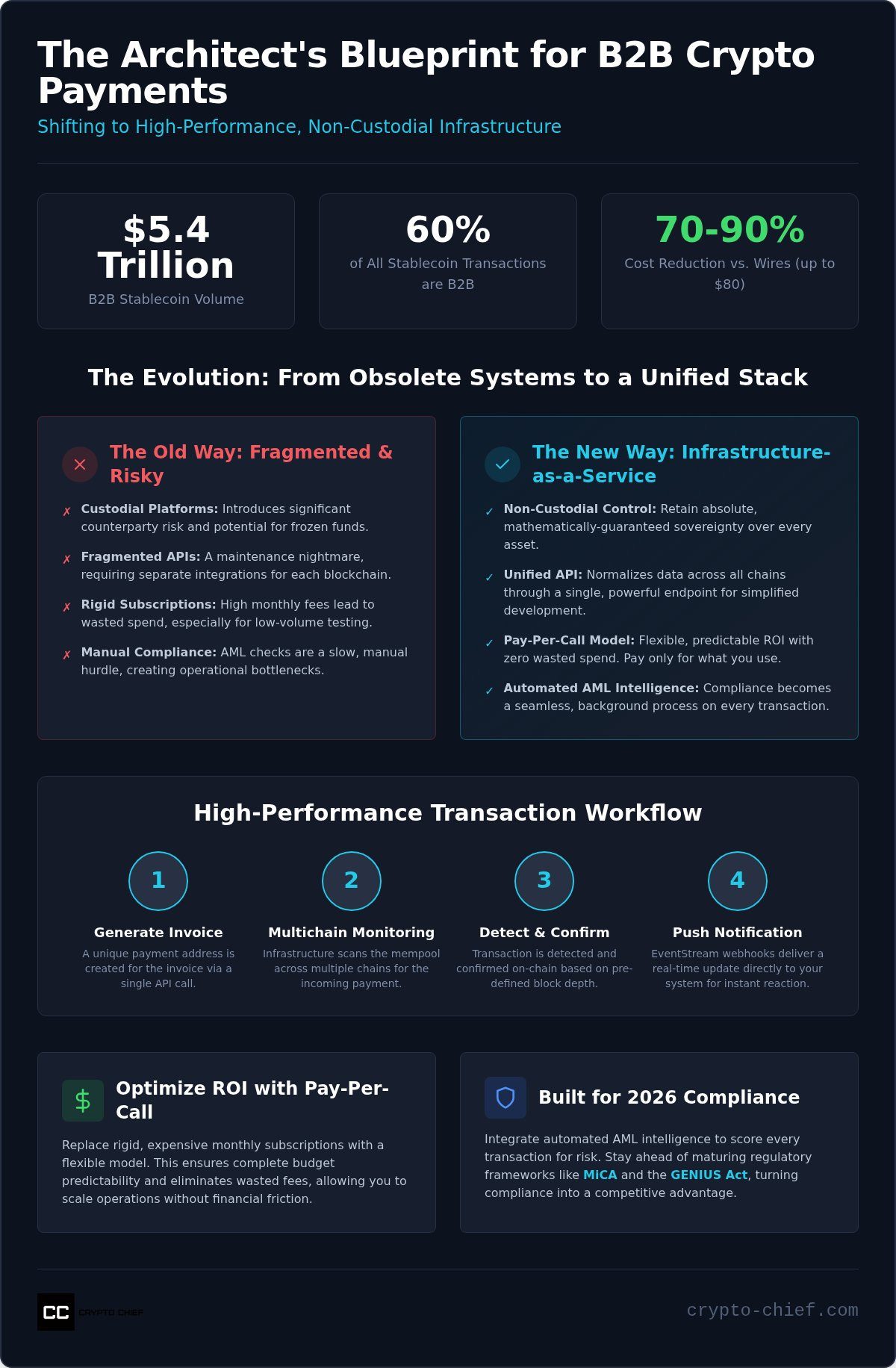
By 2026, the global payment landscape has matured beyond the experimental phase. B2B crypto payment processing now accounts for 60% of all stablecoin transaction volume, signaling a decisive shift from niche utility to core infrastructure. For the modern enterprise architect, crypto is no longer a peripheral "buy button" added to a checkout page. It's a fundamental layer of the financial stack that enables near-instant settlement and reduces international wire costs by 70-90%. This evolution represents a transition toward Infrastructure-as-a-Service (IaaS), where deep Crypto Processing APIs are integrated directly into ERP and treasury systems to handle billions in volume with surgical precision.
The "Unified Web3 Stack" has emerged as the blueprint for this new era. It combines high-performance RPC nodes, real-time on-chain monitoring, and automated risk scoring into a single, cohesive engine. Instead of managing fragmented services for different blockchains, architects now prioritize platforms that act as a silent, powerful partner. This approach allows developers to focus on their core product while the background infrastructure handles the heavy lifting of chain-specific logic and transaction propagation.
Why Non-Custodial Processing Wins for Enterprises
Maintaining control of private keys is the primary directive for enterprise risk management in 2026. Custodial models introduce significant counterparty risk, as the business essentially becomes a creditor to the service provider. By utilizing non-custodial B2B crypto payment processing, companies eliminate the possibility of funds being frozen or lost due to a third-party failure. This architecture also simplifies compliance with the EU’s MiCA and the US GENIUS Act, as the business never "holds" client funds in a traditional sense. Non-custodial processing is the definitive standard for 2026 security because it ensures the business retains absolute, mathematically-guaranteed sovereignty over every asset.
The Role of Unified APIs in Multichain B2B Operations
Fragmentation is the greatest technical hurdle in blockchain commerce. Managing separate integrations for Ethereum, Solana, and various Layer 2 networks creates a maintenance nightmare for engineering teams. A unified API solves this by normalizing transaction data into a standard format, regardless of the underlying chain's architecture. This normalization is essential for accurate accounting and treasury management, where every transaction must be mapped to a fiat-equivalent value for tax reporting. By routing all operations through a single endpoint, such as the one found in the Crypto Chief documentation, dev teams reduce their technical debt and accelerate their time-to-market. It's about building a scalable engine that doesn't break when a new network gains dominance.
Technical Architecture of a High-Performance Processing API
High-performance B2B crypto payment processing requires more than just an API key; it demands a resilient architecture that bridges the gap between off-chain business logic and on-chain state changes. The workflow must be surgical. It begins when your system generates a unique invoice through a single API endpoint. This triggers a monitoring cycle where the infrastructure scans the mempool across multiple chains simultaneously. Once a transaction is detected, the system transitions from pending to confirming based on pre-defined block depth requirements. This entire cycle happens within milliseconds to prevent user drop-off and ensure treasury accuracy.
Efficiency is the hallmark of modern architecture. Old-school polling methods, where your server repeatedly asks "Is it paid yet?", are obsolete in 2026. They waste bandwidth and increase latency. Instead, EventStream webhooks serve as the push-based standard. These notifications deliver real-time updates directly to your listener, allowing your platform to react instantly to on-chain confirmations. When combined with global, low-latency infrastructure, this setup ensures that a regional outage doesn't paralyze your global operations. Architects looking to implement this level of precision can explore the technical documentation to see how these components fit together.
Integrating RPC Gateways for Transaction Validation
A processing API is only as reliable as the data it consumes. By integrating directly with high-performance multichain RPC nodes, you gain visibility into real-time mempool data before it's even finalized in a block. This is critical for ensuring accurate gas estimation for B2B payouts, preventing transactions from getting stuck during periods of high network congestion. For a deeper dive into managing these connections, see our Web3 RPC Gateway guide.
Automating Payouts and Batching for Efficiency
Scale requires automation. For businesses handling high-volume affiliate or vendor settlements, manual processing isn't an option. Modern B2B crypto payment processing APIs allow you to automate these payouts through programmatic triggers. To maintain healthy margins, you can implement request batching. This technique groups multiple transaction requests into a single call, significantly lowering the cumulative network fees paid over time. You can learn more about this strategy in our guide on RPC Request Batching for Cost Reduction.
Optimizing ROI: Comparing Pay-Per-Call vs. Tiered Pricing
Choosing the right financial model for B2B crypto payment processing is just as critical as the technical stack itself. Most legacy providers force businesses into rigid pricing tiers, creating a dilemma where you're either overpaying for unused capacity or facing punitive overage fees during traffic spikes. This "dead zone" in pricing is particularly damaging for B2B platforms where transaction volume can be irregular or seasonal. To maximize ROI, architects are moving toward a utility-based model that treats infrastructure as a variable cost rather than a fixed overhead.
A pay-per-call approach, powered by prepaid token balances, provides 100% budget predictability. Instead of a monthly bill that fluctuates based on complex tier logic, you purchase a balance that is consumed only when your system makes a request. This model allows you to calculate the Total Cost of Ownership (TCO) with surgical precision. To determine your TCO, you must look beyond the base fee and account for developer maintenance, compliance integration, and the cost of idle infrastructure. When these factors are aggregated, the efficiency of a non-custodial, pay-per-call API becomes clear.
The End of Monthly Minimums
Paying for idle infrastructure is a legacy business mistake that modern builders can't afford. In a tiered system, a "free" or low-cost entry point often masks high costs that kick in the moment you exceed a specific threshold. By aligning API expenses directly with product revenue, you ensure that your margins remain protected as you scale. By adopting a pay-per-call model, a scaling dApp ensures that infrastructure costs remain perfectly linear with user growth, eliminating the financial "cliff" typical of tiered subscription renewals.
Budgeting for Global Web3 Infrastructure
Effective budgeting in 2026 requires a unified view of your service consumption. A sophisticated B2B crypto payment processing setup allows you to allocate a single prepaid balance across multiple essential services, including RPC nodes, AML intelligence, and payment processing. This consolidated approach prevents service interruptions by allowing you to monitor usage in real-time through a single dashboard. For detailed call-cost breakdowns and to plan your infrastructure roadmap, you can refer to the Crypto Chief processing documentation. This transparency ensures that your engineering team has the resources they need without the CFO facing unexpected end-of-month surprises.
Security and Compliance: Integrating AML into the Payment Flow
In the high-stakes environment of 2026, compliance isn't just a checkbox; it's a structural requirement. With the EU’s MiCA and the US GENIUS Act now in full effect, B2B crypto payment processing platforms must integrate sophisticated Anti-Money Laundering (AML) intelligence directly into their transaction pipelines. Passive monitoring is no longer sufficient for enterprise-grade operations. Modern architects now build systems that evaluate the risk profile of every incoming wallet address before a transaction is even confirmed, ensuring that compliance is a proactive shield rather than a reactive burden.
Accepting funds from a sanctioned or high-risk source can contaminate your entire treasury, leading to "poisoned" wallets and potential legal freezes. By automating risk assessment within your B2B crypto payment processing workflow, your infrastructure acts as a digital firewall. Real-time funds tracing allows you to satisfy international regulatory standards by documenting the origin of every asset. This level of transparency is essential for maintaining relationships with traditional banking partners and ensuring that your on-chain activities don't create off-chain liabilities.
Automated Risk Scoring for Every Transaction
Efficiency is paramount. By setting specific thresholds for low, medium, and high-risk interactions, developers can automate the decision-making process. For instance, a transaction with a risk score above 70 might trigger an automated account freeze or move the request to a secondary review queue for manual inspection. This level of automation can reduce manual compliance review times by up to 80%, allowing your legal team to focus only on the most complex cases. For a deeper technical implementation of these triggers, consult the Crypto AML Risk Detection API guide.
Tracing Funds and Risk Detection
Visualizing the flow of assets is the only way to detect sophisticated obfuscation techniques like mixers or multi-hop transfers. AML intelligence provides a clear map of asset movement, enabling proactive threat mitigation. Instead of reacting to a regulator's inquiry months later, you can identify and block suspicious activity as it happens. This proactive stance is essential for maintaining the integrity of your platform and ensuring long-term scalability. You can explore these capabilities further through Crypto Chief AML services to build a more secure and compliant financial engine.
Choosing the Right Partner for B2B Crypto Processing
Selecting a partner for B2B crypto payment processing requires looking past the marketing fluff to the underlying architecture. In 2026, the market is saturated with providers, yet few offer the combination of non-custodial security and unified utility required for enterprise scale. Relying on fragmented providers for RPC nodes, AML intelligence, and processing logic creates a fragile stack that’s prone to latency and integration friction. A unified platform eliminates these silos, providing a single source of truth for your financial data and reducing the technical debt associated with managing multiple vendor relationships.
The right partner acts as a silent, powerful engine that has already solved the complex problems of on-chain monitoring and data normalization. This allows your team to focus on the creative and commercial aspects of your platform while the infrastructure maintains stability in the background. As you move toward integration, prioritize providers that value logic, scalability, and uptime over flashy features that lack functional depth. It’s about building a foundation that is both elite in its capabilities and humble in its service-oriented delivery.
The Architect’s Checklist for 2026
Before committing to an infrastructure partner, you must verify that their solution meets the rigorous standards of modern Web3 commerce. Use this checklist to evaluate potential candidates:
- Sovereign Key Management: Confirm the architecture is truly non-custodial. Your business must maintain absolute control over private keys to eliminate counterparty risk.
- Multichain Normalization: Ensure the API supports Ethereum, Solana, and Layer 2 networks through a single, normalized data format to simplify treasury management.
- Predictable Pricing: Avoid budget bloat by selecting a pay-per-call model. Prepaid token balances ensure your expenses scale linearly with your actual usage.
- Integrated Compliance: Verify that AML risk detection is a native part of the payment flow rather than a separate, bolted-on service.
Future-Proofing with Crypto Chief
Crypto Chief serves as the structural foundation for Web3 builders who demand high performance without the overhead of legacy tiered pricing. By providing a unified environment where B2B crypto payment processing, AML intelligence, and multichain RPC services coexist, it removes the friction of managing fragmented documentation. For teams looking to accelerate their roadmap, the Crypto PSP Whitelabel offers a path for rapid market entry without the need to build the core engine from scratch. This allows you to leverage real-time event streaming for a superior user experience while maintaining the security of a non-custodial setup. It's time to build on a foundation designed for the global economy of 2026. Explore the Crypto Chief Processing API to begin your integration.
Architecting the Future of Global Settlement
The transition from legacy wire transfers to on-chain settlement is no longer a matter of "if" but "how" for the modern enterprise. By prioritizing a non-custodial architecture, you ensure that your platform maintains absolute sovereignty over its assets while eliminating the counterparty risks associated with traditional custodial providers. Implementing B2B crypto payment processing through a unified, high-performance infrastructure allows you to bypass the technical debt of fragmented systems and the budget bloat of legacy monthly subscription tiers.
Success in 2026 depends on a silent, powerful partner that provides global uptime, high-performance RPC nodes, and real-time AML intelligence within a single developer-centric environment. You now have the blueprint to integrate automated risk scoring and pay-per-call utility into your product roadmap, ensuring your treasury remains secure and your margins stay protected. It’s time to move from the drawing board to deployment. Start building with Crypto Chief’s Non-Custodial Processing API and secure your place in the evolving landscape of global commerce.
Frequently Asked Questions
What is the difference between custodial and non-custodial crypto processing?
In custodial processing, a third-party provider manages and stores the private keys, essentially holding the funds on your behalf. Conversely, non-custodial B2B crypto payment processing ensures that your business retains absolute control over the private keys. This architecture eliminates counterparty risk, as the provider never touches your assets. It’s the preferred choice for enterprises in 2026 seeking to maintain sovereignty and reduce the regulatory burdens associated with custodial wallet hosting.
How does pay-per-call pricing work for B2B crypto APIs?
Pay-per-call pricing is a utility-based model where you purchase a prepaid token balance instead of paying a fixed monthly subscription. Every request your system makes to the API, whether for transaction monitoring or AML checks, consumes a specific portion of that balance. This approach provides 100% budget predictability and ensures you only pay for the infrastructure you actually use. It’s particularly effective for scaling platforms that want to avoid the expensive overages of tiered pricing.
Can I use a crypto processing API for automated payouts?
Yes, a robust B2B crypto payment processing API allows you to programmatically trigger payouts for vendor settlements, affiliate commissions, or employee salaries. By integrating these calls into your backend logic, you can automate high-volume distributions across multiple chains without manual intervention. This system often supports request batching, which groups multiple payouts into a single on-chain transaction to significantly lower cumulative network fees while maintaining high operational speed and accuracy for your treasury.
Is AML risk detection mandatory for B2B crypto payments?
In 2026, AML risk detection is a structural necessity for any business interacting with digital assets. Regulatory frameworks like the EU’s MiCA and the US GENIUS Act require rigorous monitoring to prevent money laundering and the contamination of corporate treasuries. Using integrated AML intelligence allows you to automatically score incoming funds and block high-risk wallets in real-time. This proactive compliance strategy protects your business from legal liabilities and ensures continued access to traditional banking services.
How do I monitor blockchain transactions in real-time without polling?
Real-time monitoring is achieved through EventStream webhooks, which replace the inefficient practice of constant API polling. Instead of your server repeatedly asking for updates, the infrastructure pushes notifications directly to your listener the moment a transaction is detected in the mempool or confirmed on-chain. This push-based architecture reduces server load, eliminates notification latency, and ensures your platform can react instantly to payment events. It’s a foundational component for delivering a seamless, high-performance user experience.
Does the Crypto Processing API support multiple blockchains simultaneously?
The Crypto Processing API is designed as a unified gateway that supports multiple blockchains simultaneously, including Ethereum, Solana, and various Layer 2 networks. It normalizes transaction data into a consistent format, regardless of the underlying chain's specific architecture. This allows your engineering team to manage all multichain operations through a single endpoint. By removing the need for separate integrations, you reduce technical debt and ensure your platform remains agile as new networks gain market dominance.
What happens if my prepaid API balance runs out?
If your prepaid API balance is exhausted, service requests will typically be paused until the balance is replenished. To prevent interruptions, the platform provides real-time usage monitoring through a centralized dashboard, allowing you to track consumption across all integrated services. You can set up automated alerts or top-up triggers to maintain continuity. This model ensures you never face unexpected overage charges, as the system only executes calls supported by your existing prepaid token balance.
How secure is a non-custodial crypto payment gateway?
A non-custodial gateway is inherently more secure because the service provider never has access to your private keys. Security is managed through mathematical proofs and on-chain logic rather than third-party trust. This architecture prevents risks where a provider’s breach could compromise all client funds. When combined with global uptime and high-performance RPC nodes, a non-custodial setup provides a resilient foundation that protects both your corporate assets and the integrity of your payment pipeline.