
Why is your infrastructure bill still a guessing game when your code is built on absolute precision? For many developers, the frustration of "Compute Units" and "API Credits" has reached a breaking point, particularly when a single resource-heavy call triggers massive overage charges. If you're researching quicknode alternatives pay as you go models, you've likely realized that traditional tiered plans often force you to pay for capacity you don't use or penalize you for the growth you've worked hard to achieve.
It's exhausting to manage multiple vendors for RPC, compliance, and event monitoring while trying to predict monthly costs in a volatile market. We promise that by shifting to a unified, pay-per-call execution environment, you can reduce your Web3 overhead by 60% or more without sacrificing performance. This 2026 guide examines the current landscape, comparing the recent shift toward high-cost flat-rate RPS models against high-performance gateways that offer transparent, prepaid balances and reduced latency for L2s and Solana.
Key Takeaways
- Deconstruct the complexity of "Compute Units" to identify how credit-based billing models often lead to unpredictable overage charges for growing startups.
- Evaluate the best quicknode alternatives pay as you go providers that offer non-expiring token balances and transparent, per-call pricing structures.
- Enhance application performance on high-throughput chains like Solana and TON by leveraging global node distribution and unified API access.
- Streamline your development workflow by integrating RPC access, AML intelligence, and non-custodial processing through a single, secure gateway.
- Transition from resource-intensive legacy polling to real-time event streaming to ensure your dApp remains responsive and cost-efficient.
The Credit Trap: Why Quicknode Alternatives are Moving to Pay-Per-Call
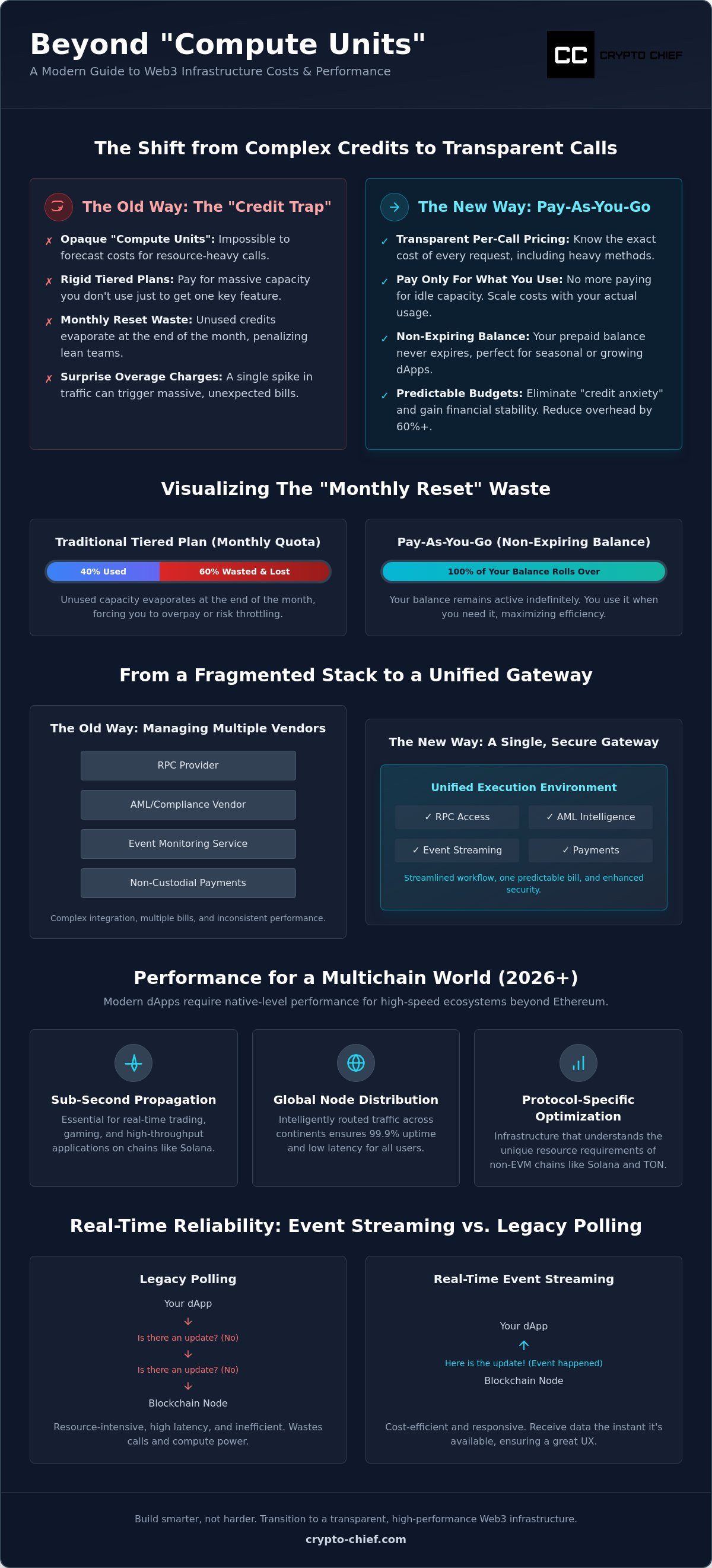
High-throughput startups often find that monthly quotas function as a silent "hidden tax" on their operational growth. Most legacy providers force users into rigid tiers where unused capacity simply evaporates at the end of the billing cycle; this creates a structural inefficiency that penalizes lean development teams. For those seeking quicknode alternatives pay as you go models, the primary objective is to escape this cycle of artificial scarcity and forced upgrades. In the fast-moving landscape of Web3 infrastructure, stability shouldn't come at the cost of overpayment.
The industry currently relies on abstract metrics like "Compute Units" or "API Credits" to mask the true cost of a request. Leading legacy providers maintain complex conversion rates that make forecasting nearly impossible for business architects. A single resource-intensive task can consume dozens of units, which leads to unexpected overage charges that disrupt operational budgets and create friction between engineering and finance departments. Crypto Chief replaces this complexity with a transparent, prepaid token model. Instead of monthly resets, your balance remains active until it's actually consumed by your dApp. This approach replaces fixed-tier waste with prepaid call efficiency, providing a stable foundation for 2026 architectures.
Eliminating the 'Monthly Reset' Waste
Traditional providers often push developers toward "Pro" or "Business" plans to unlock specific features or higher rate limits. You end up paying for millions of requests you never send just to access a higher RPS cap. By using quicknode alternatives pay as you go structures, you decouple feature access from volume. Your tokens stay in your account regardless of traffic fluctuations, which is essential for projects with inconsistent or seasonal usage patterns. One scaling dApp recently reported saving 40% on infrastructure costs simply by moving away from tier-up fees and utilizing non-expiring balances that accommodate their specific growth curve.
Transparent Pricing for Heavy Methods
Heavy RPC methods are the primary drivers of "credit anxiety" in modern development. Calls like eth_getLogs or debug_traceTransaction are notoriously resource-intensive and expensive in weighted credit systems. While some providers use complex math to calculate these costs, a unified pay-per-call model offers much-needed clarity. To further optimize these expenses, developers should explore RPC Request Batching for Cost Reduction to maximize the value of every token spent. This transparency ensures that heavy data indexing doesn't result in a surprise invoice at the end of the month, allowing you to focus on building rather than counting units.
Performance Beyond Ethereum: Multichain Requirements in 2026
In 2026, the decentralized landscape has evolved far beyond Ethereum-centric development. Modern dApps now require native-level performance for high-speed ecosystems like Solana, TON, and various Layer 2 solutions. When evaluating quicknode alternatives pay as you go, the priority must shift from simple connectivity to global node distribution. Latency is the silent killer of user experience; if your RPC provider lacks a presence in the specific geographic regions where your users reside, even the best code will feel sluggish. High-performance applications require specific infrastructure benchmarks:
- Sub-second block propagation: Essential for real-time trading and gaming.
- Geographic redundancy: Nodes distributed across multiple continents to ensure local speed.
- Protocol-specific optimization: Infrastructure that understands the unique resource requirements of non-EVM chains.
Reliability is equally critical. A high-performance Web3 RPC Gateway ensures 99.9% uptime by intelligently routing traffic across a global network of nodes. This structural integrity is what separates hobbyist tools from enterprise-ready infrastructure. As teams scale, they also face increasing pressure from regulators to satisfy Anti-Money Laundering (AML) and sanctions obligations across every chain they support. Infrastructure neutrality is the only way to avoid the biases of ecosystem-specific providers, ensuring your project remains resilient in a fragmented multichain landscape.
High-Performance RPC for L2 and Alternative L1s
Optimizing for high-throughput chains like BNB Smart Chain and Polygon requires more than just a connection. It demands a provider that understands the nuances of each protocol. Many developers fall into the trap of vendor lock-in, where using a provider tied to a specific ecosystem limits their future flexibility. True infrastructure neutrality allows dApp architects to move where the users are without rebuilding their entire backend. If you're ready to build on a more flexible foundation, you can explore our RPC gateway options to see how we handle multichain complexity.
Data Normalization: The Unified API Advantage
Raw RPC data is often messy and inconsistent across different architectures. This is especially true when bridging the gap between EVM and non-EVM chains. Building manual middleware to handle these differences is a waste of engineering resources. By adopting a Unified Web3 Developer Platform, you gain access to normalized data structures that look the same whether you're querying Ethereum or a high-speed L2. This normalization reduces the "Integration Spaghetti" that plagues multichain projects, allowing your team to focus on the frontend experience rather than backend data cleaning. Choosing quicknode alternatives pay as you go models that include these unified tools provides a significant competitive advantage in the 2026 market.
Consolidating the Stack: RPC, AML, and Non-Custodial Payments
Managing a Web3 backend in 2026 often feels like untangling a complex web of disconnected services. Architects frequently juggle separate vendors for RPC access, compliance checks, and transaction execution. This "Integration Spaghetti" introduces hidden costs in the form of maintenance overhead, increased latency, and potential security vulnerabilities. When searching for quicknode alternatives pay as you go, developers are increasingly looking for a unified stack that eliminates these silos. Consolidating your infrastructure allows for a more streamlined deployment process where performance and security are natively integrated from day one.
A single, cohesive dashboard offers a significant competitive advantage for high-growth startups. It provides a holistic view of your operational health, allowing you to monitor traffic patterns alongside compliance risks and payment settlements. This architectural logic reduces the cognitive load on your engineering team. Instead of managing five different API keys and billing cycles, you focus on a single point of truth. This efficiency is why modern dApps are moving away from fragmented service models toward platforms that offer a comprehensive suite of tools.
Automating Compliance at the Infrastructure Level
Security-conscious teams can't afford to treat compliance as an afterthought in a regulated environment. Integrating AML Intelligence directly into the infrastructure layer allows for real-time funds tracing and risk detection. By identifying high-risk wallets at the point of interaction, you protect your platform from illicit activity before it impacts your ecosystem. Utilizing an AML Risk Detection API ensures that your dApp adheres to global standards without requiring a dedicated compliance department. This unified approach can save development teams weeks of integration work, particularly when navigating the requirements of international markets.
Non-Custodial Processing for Modern dApps
Traditional infrastructure often focuses solely on reading chain data, but modern applications must also execute transactions with absolute security. Adopting Non-Custodial Crypto Processing ensures that your users maintain control over their assets while your application handles the complexity of settlement. This model is essential for building user trust and providing regulatory clarity in a non-custodial world. By reducing the friction between a wallet connection and a final transaction, you create a more seamless journey for the end user. This level of technical integration is a core reason why teams are moving toward quicknode alternatives pay as you go models that offer more than just basic RPC endpoints. It's about moving from simple data access to a full execution environment that scales with your user base.
Real-Time Reliability: Event Streaming vs. Legacy Polling
Infrastructure waste often hides in plain sight within legacy Web3 systems. Most developers rely on constant RPC polling to monitor wallet balances or contract events, which results in thousands of redundant API calls that inflate your monthly bill. When auditing quicknode alternatives pay as you go models, the shift from active polling to passive event streaming emerges as a critical cost-saving strategy. Instead of your server asking "is there new data?" every second, your infrastructure should push that data to you only when it matters.
Leveraging Real-Time Blockchain Webhooks allows you to replace inefficient loops with a streamlined, event-driven architecture. Our EventStream service optimizes dApp responsiveness by delivering low-latency notifications directly to your backend. This is particularly vital for DeFi protocols and gaming platforms where a delay of a few milliseconds can result in failed trades or poor user experiences. By offloading the monitoring burden to the provider, you significantly reduce your total API call count and overall infrastructure overhead.
Architecture Shift: From Polling to Streaming
Polling-based dApps frequently fail to scale during periods of high network congestion. When block times fluctuate, a polling loop becomes a bottleneck that chokes server resources. Transitioning to event-driven architecture removes this friction, allowing your system to react only to verified state changes. This mechanism offloads heavy monitoring to the provider, ensuring your application remains performant regardless of traffic volume. It transforms your backend from a reactive system into an efficient, proactive engine.
Ensuring Global Uptime and Redundancy
Reliability requires more than just fast endpoints. A global node network prevents single-point-of-failure issues by routing traffic through healthy clusters. Enterprise applications must implement failover strategies to handle high-volume traffic without interruption. High-availability infrastructure in 2026 is defined by a system's ability to maintain seamless data delivery through automated failover and geographically distributed node clusters, ensuring zero downtime. To begin building on a more resilient foundation, you can register for a Crypto Chief account and deploy your first EventStream today.
Migration Path: Switching from Quicknode to Crypto Chief
Transitioning to quicknode alternatives pay as you go models is a strategic move to reclaim control over your infrastructure budget. While the technical hurdle of switching providers can feel daunting, a methodical approach ensures that your dApp remains online and performant throughout the process. The objective is to move from restrictive monthly tiers to a flexible, execution-focused environment that scales based on actual usage rather than projected quotas. By following a structured migration path, you can eliminate the "credit anxiety" discussed in previous sections while gaining access to a consolidated stack of Web3 tools.
The migration process follows five logical stages to ensure structural integrity and cost efficiency:
- Step 1: Audit current usage. Analyze your existing logs to identify high-volume methods and traffic spikes. This data helps you forecast your initial prepaid token needs.
- Step 2: Generate multichain endpoints. Utilize the Crypto Chief dashboard to create secure endpoints for every chain your project supports, from Ethereum to high-speed L2s.
- Step 3: Update environment variables. Swap your legacy provider URLs with your new endpoints. Conduct latency tests to verify performance improvements across different geographic regions.
- Step 4: Consolidate logic. Integrate your AML compliance and payment processing directly into the unified API to remove the "Integration Spaghetti" of multiple third-party vendors.
- Step 5: Monitor and optimize. Use the dashboard to track your prepaid balance in real time. Implement batching strategies for high-frequency calls to maximize the value of every token.
Zero-Downtime Transition Strategy
Maintaining 100% uptime is paramount for enterprise-grade applications. We recommend using a load balancer to transition traffic between providers incrementally, starting with a small percentage of read-only requests. Before a full production rollout, you should test edge cases and high-throughput scenarios within the Crypto Chief Faucet environment. This allows your team to verify that all Quicknode-specific methods have been correctly mapped to standard JSON-RPC calls, ensuring a seamless experience for your end users.
Finalizing Your Pay-Per-Call Setup
Once your endpoints are live, configure custom alerts for your prepaid API balance to prevent service interruptions. This proactive monitoring ensures you always have the capacity required for unexpected traffic surges. For advanced endpoint mapping or protocol-specific configurations, you can access the Crypto Chief Documentation for detailed technical guides. Moving to a more efficient, transparent infrastructure model is the most effective way to future-proof your project. If you are ready to reduce your overhead and streamline your backend, register now to start your migration and experience the benefits of a true pay-as-you-go model.
Future-Proofing Your Infrastructure for 2026 and Beyond
The transition from rigid, credit-weighted tiers to a transparent execution environment is more than a cost-saving measure; it's a strategic necessity for modern dApp architects. By moving beyond the complexity of monthly quotas and expiring balances, you reclaim the ability to scale your project based on actual performance requirements. We've explored how quicknode alternatives pay as you go models provide the structural integrity needed to handle high-throughput chains like Solana and TON while eliminating the friction of "Integration Spaghetti."
Efficiency in 2026 demands a consolidated approach that pairs high-performance RPC access with integrated AML risk detection and non-custodial processing. This unified strategy reduces operational overhead and allows your engineering team to focus on building unique user experiences rather than managing fragmented vendors. It's time to stop overpaying for unused capacity and start leveraging a foundation built for stability and speed. Switch to Crypto Chief and optimize your Web3 stack to experience the benefits of pay-per-call transparency and a unified multichain API. Your infrastructure should be a silent partner that empowers your growth, not a bottleneck that restricts it. Let's build something resilient together.
Frequently Asked Questions
How does Crypto Chief’s pay-per-call pricing compare to Quicknode’s credits?
Crypto Chief utilizes a transparent, prepaid token model where you only pay for the actual calls your application makes. Unlike Quicknode's credit-based tiers that reset every month, our tokens never expire. This eliminates the "hidden tax" of paying for unused capacity and ensures your infrastructure costs align perfectly with your actual traffic volume.
Is it difficult to switch my dApp from Quicknode to a new RPC provider?
The transition is straightforward because we utilize standard JSON-RPC methods that are compatible with existing Web3 libraries. You simply need to update your environment variables with our multichain endpoints. We recommend an incremental migration strategy using a load balancer to ensure zero downtime while you verify performance improvements.
Does Crypto Chief support all the same networks as Quicknode?
We provide extensive support across both EVM and non-EVM architectures to meet the needs of modern developers. Our gateway includes major networks like Ethereum, BNB Smart Chain, and Polygon, alongside high-performance ecosystems like Solana and TON. This broad coverage makes us one of the most versatile quicknode alternatives pay as you go providers in the 2026 market.
What are the security benefits of using a non-custodial processing API?
Non-custodial processing ensures that your users maintain absolute control over their private keys and assets throughout the transaction lifecycle. Our API facilitates secure execution without ever taking custody of funds, which significantly reduces your platform's regulatory burden. This architecture builds user trust by prioritizing security and decentralization.
How do EventStream webhooks reduce my total infrastructure costs?
EventStream reduces costs by replacing inefficient RPC polling with a passive, push-based notification system. Instead of sending thousands of redundant requests to check for state changes, your backend only receives data when a specific event occurs. This architectural shift drastically lowers your total API call count and minimizes server-side overhead.
Does Crypto Chief offer a free tier or faucet for testing?
We provide a dedicated faucet environment where developers can test their integrations and endpoint configurations without cost. This sandbox is ideal for verifying how your dApp handles high-throughput scenarios or specific contract events. It's a risk-free way to ensure your code is production-ready before you commit to a prepaid balance.
What happens if my prepaid API balance runs out during a traffic spike?
Our dashboard allows you to configure automated alerts that notify your team when your balance hits a predefined threshold. By setting these triggers proactively, you can top up your tokens before they are exhausted. This ensures your application remains online and responsive even during unexpected surges in network activity.
Can I use Crypto Chief for both Ethereum and Solana simultaneously?
Yes, our unified API is designed to handle multiple chains through a single, cohesive interface. You can query Ethereum and Solana data concurrently, which simplifies your backend logic by normalizing data across different architectures. This consolidation is a key advantage for teams building complex, multichain applications in the 2026 landscape.