
Scaling a multichain application shouldn't feel like a high-stakes gamble every time the monthly invoice arrives. If you've spent late nights debugging latency spikes or trying to decipher complex credit-based billing, you know that the wrong infrastructure can quickly become a bottleneck. Have you ever wondered why building on Web3 still feels so fragmented? Finding the right tatum api alternatives isn't just about switching RPC providers; it's about securing a foundation that aligns with your growth rather than penalizing it.
It's a common struggle to balance the need for global reach with the desire for structural integrity. We'll show you how to move beyond the complexity of managing multiple chain-specific APIs by leveraging a unified approach to data across 20+ chains. This comparison details the most reliable, cost-efficient solutions for 2026, focusing on tools that offer seamless integration of processing and AML intelligence to help you build at scale without the traditional overhead. By the end of this guide, you'll have a clear path to reducing your infrastructure costs while maintaining a high-performance, multichain presence. Reliability is no longer optional.
Key Takeaways
- Understand why modern developers are moving beyond rigid tiered subscriptions to better support complex data normalization across emerging L2 chains.
- Define a technical framework for evaluating infrastructure based on RPC Gateway reliability, global distribution, and unified data access.
- Compare the market's leading tatum api alternatives for 2026, highlighting the specific strengths of ecosystem giants and high-speed RPC specialists.
- Identify strategies for cost optimization, including the shift toward pay-per-call models that align infrastructure overhead with actual application usage.
- Discover the advantages of a unified partner that provides non-custodial crypto processing and AML intelligence alongside a high-performance RPC Gateway.
Why Developers Seek Tatum API Alternatives in 2026
The evolution of the Web3 ecosystem into 2026 has moved past the experimental phase into a period of rigorous technical optimization. Developers are no longer satisfied with general-purpose frameworks that offer a broad but shallow feature set. As decentralized applications scale, the friction points within legacy infrastructure become more pronounced. This shift is driving a surge in interest for tatum api alternatives that prioritize performance, granular cost control, and deep multichain integration. Reliability is no longer optional; it is the baseline for survival in a competitive market.
The Limitations of Traditional Web3 Tiers
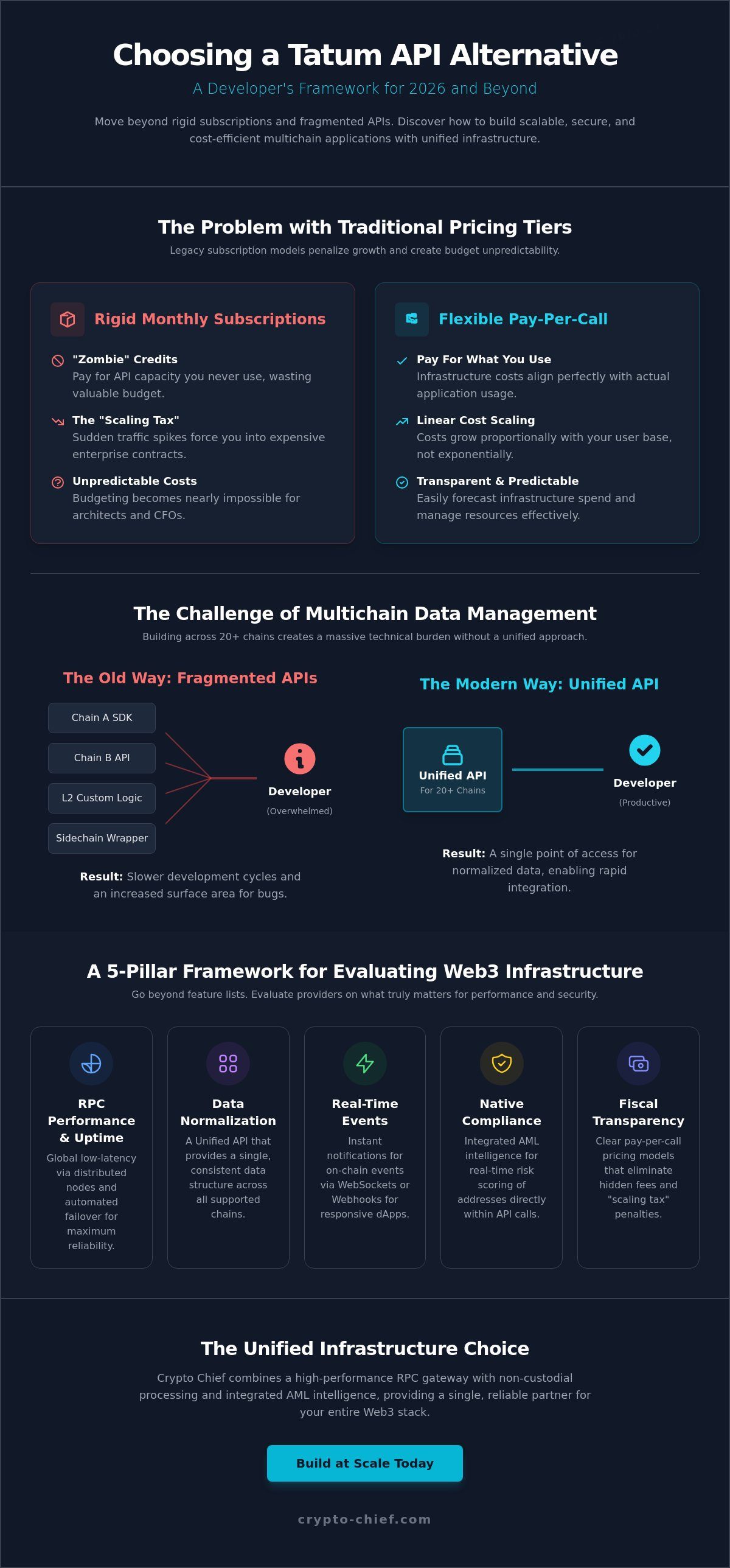
Many legacy providers rely on rigid monthly subscription buckets that don't align with the reality of dApp traffic. These tiers often lead to "zombie" credits where teams pay for capacity they never use. Conversely, when a project experiences a sudden surge, it often hits a "scaling tax." This occurs when a provider forces a transition from a manageable startup plan to an expensive enterprise contract simply because a single rate limit was exceeded. It's a binary system that lacks the elasticity required for modern growth. Why should your infrastructure costs spike exponentially for a linear increase in usage? This lack of flexibility makes budget predictability nearly impossible for CFOs and lead architects alike. Similarly, for those managing physical retail operations in the UK, PurePay Hub provides the transparent payment processing and POS systems needed to maintain a stable bottom line.
Complexity in Multichain Data Management
Building across emerging L2s and sidechains introduces a significant technical burden. Each network has its own architectural nuances, which often forces developers to maintain separate SDKs and custom logic for every new chain integration. This overhead slows down the development cycle and increases the surface area for potential bugs. A high-performance RPC Gateway is only part of the solution. Developers now demand a Unified API that can normalize data across disparate environments, providing a single point of access for everything from balance checks to transaction history. Without this normalization, the complexity of managing 20 or more chains becomes a massive operational drain.
In addition to performance and cost, the demand for integrated security has never been higher. Modern teams require more than just connectivity; they need active protection. Integrating AML Intelligence directly into the infrastructure layer allows for real-time risk scoring without adding latency to the user experience. By moving from general-purpose frameworks to specialized tatum api alternatives, builders can secure their applications while simultaneously lowering their operational overhead. Performance and security must work in tandem to support a truly global, enterprise-ready application.
Evaluating Web3 Infrastructure: A Technical Framework
Choosing between different tatum api alternatives requires a systematic approach that goes beyond comparing simple feature lists. As the Web3 developer landscape matures, the criteria for "best-in-class" infrastructure have shifted from mere connectivity to holistic performance and security. A robust framework evaluates five core pillars: RPC performance, data normalization, real-time event streaming, native compliance, and fiscal transparency. Reliability shouldn't be a variable; it must be the constant that your application is built upon.
RPC Performance and Global Uptime
A distributed node network is essential for minimizing the physical distance between your application and blockchain data. Low latency isn't just a luxury; it's a requirement for user retention in a fast-paced market. You should measure node consistency across various geographic regions to ensure that a user in Singapore experiences the same speed as one in New York. Reliable failover mechanisms are equally critical. If a primary cluster experiences issues, the system must automatically reroute traffic to maintain a seamless experience. When evaluating tatum api alternatives, prioritize those that demonstrate high global uptime and consistent response times across all supported chains.
Integrated AML and Risk Intelligence
Compliance is no longer an optional add-on for serious applications. Modern builders are integrating AML Intelligence directly into their API calls to identify high-risk addresses before they interact with smart contracts. Combining infrastructure and security layers reduces the technical debt associated with managing multiple third-party vendors. It allows you to build a silent, powerful partner into your stack that handles risk detection while you focus on core logic. This integrated approach ensures that security doesn't come at the cost of performance, providing a streamlined path for enterprise-ready dApps.
Beyond simple node access, look for a Unified API that provides normalized data. This simplifies cross-chain development by offering a consistent structure for balances, NFTs, and transaction history. Real-time webhooks, often delivered through an EventStream, allow for immediate monitoring of on-chain activities without the overhead of constant polling. Finally, prioritize pricing transparency. Choosing a high-performance RPC Gateway with a pay-per-call model ensures your costs align perfectly with your active requests. This eliminates the unpredictability of opaque monthly commitments and ensures that your infrastructure overhead remains logical as you scale.
Top Tatum Alternatives for Multichain Development
Identifying the right tatum api alternatives requires a nuanced understanding of your project's specific technical bottlenecks. Professional development requires robust infrastructure that addresses the actual technical challenges for blockchain developers, such as latency, data consistency, and cross-chain interoperability. Builders need tools that act as silent, powerful partners in their stack rather than just simple access points. The market in 2026 offers several distinct paths depending on whether you prioritize raw speed, established reliability, or unified cost efficiency.
QuickNode vs. Specialized Performance
QuickNode has positioned itself as a leader for teams that prioritize high-speed RPC and elastic scaling. Their pricing model is based on compute units and network selection, with published list prices for standard plans ranging from $49 to $999 per month. While they offer impressive performance-tuned dedicated nodes, certain premium add-ons can significantly increase the monthly overhead. For instance, plans that include specialized features like Solana gRPC started in the range of $299–$499 per month as of early 2026. This creates a potential pricing barrier for mid-sized teams that require high-end functionality but don't yet have the budget for enterprise-level agreements, which can often exceed $2,000 per month.
Infura and the ConsenSys Stack
Infura remains a reliable standard for those deeply embedded in the Ethereum ecosystem. Its status as one of the longest-standing providers ensures high reliability and seamless integration with MetaMask, making it a logical choice for Ethereum-centric dApps. However, its historical focus on EVM-compatible chains can be a limitation for modern builders working across a wider variety of protocols. If your roadmap includes non-EVM networks like Bitcoin, Tron, or TON, you may find that Infura's support for these chains is less comprehensive than that of newer, more agile providers. Reliability is their greatest strength, but their breadth across emerging L2s often lags behind competitors focused on multichain normalization.
For enterprises seeking a unified path without the complexity of tiered credits, Crypto Chief offers a compelling alternative. By providing a high-performance RPC Gateway alongside integrated AML Intelligence, it removes the friction of managing separate security and data layers. This approach allows developers to scale using a transparent pay-per-call model, ensuring that infrastructure costs remain logical and aligned with actual usage. Whether you're integrating a Crypto Processing API or managing complex event streams, having a single, authoritative partner ensures structural integrity across the entire development lifecycle. It's about building a foundation that supports growth without the burden of "zombie" subscriptions.
Cost Optimization: The Shift to Pay-Per-Call Pricing
Traditional infrastructure providers often lock teams into rigid monthly tiers that create "zombie" subscriptions. This happens when you pay for a high-volume plan but only utilize a fraction of the allocated credits. When searching for tatum api alternatives, fiscal transparency is just as important as technical uptime. A shift toward pay-per-call models allows for a more logical alignment between your application's activity and its overhead. Stability shouldn't come with a penalty for inefficiency.
How Pay-Per-Call Works for Web3 APIs
This model utilizes prepaid token balances where each RPC request or API call deducts a specific amount from your total. It's a transparent system that eliminates the risk of hidden fees or sudden overage charges. This flexibility is particularly beneficial for projects with seasonal or variable traffic patterns. Why pay for peak capacity during a quiet development cycle? By using a granular deduction system, you ensure that every dollar spent directly supports an active user request. It's a builder-centric approach that respects your budget as much as your code.
Reducing Infrastructure Overhead
Beyond the direct cost of API calls, outsourcing node maintenance significantly reduces devops hours. Maintaining a high-performance RPC Gateway in-house requires constant monitoring and updates across dozens of chains. Choosing a partner with integrated AML intelligence further streamlines the stack by removing the need for separate security vendor contracts. This integration acts as a silent, powerful partner that handles risk detection while your team focuses on core product features. Some industry benchmarks indicate that adopting a pay-per-call model can reduce Web3 API expenses by up to 40% by eliminating the waste inherent in fixed-tier subscriptions.
Budget predictability is a priority for any CFO overseeing a scaling dApp. Prepaid balances provide a clear ceiling on spending while allowing for seamless spikes in traffic without manual plan upgrades. Unified data normalization also saves hundreds of developer hours that would otherwise be spent on custom data parsing logic. It's a comprehensive strategy for sustainable growth that removes friction from the scaling process. Ready to align your infrastructure costs with your actual usage? You can register your account to start building with a more efficient, pay-per-call foundation that grows at your pace.
Crypto Chief: The Unified Infrastructure Choice
The search for tatum api alternatives often ends when developers realize they need more than just node access; they need a unified foundation. Crypto Chief serves as an authoritative expert that has already solved the complex problems of multichain connectivity so you don't have to. It's a high-performance engine designed for those who value logic, uptime, and structural integrity. By consolidating your RPC Gateway, Unified API, and AML Intelligence into one platform, you eliminate the technical debt associated with fragmented infrastructure. It's about building a foundation that supports your creative responsibilities while we handle the background complexity.
Scalability isn't just about handling more traffic; it's about doing so without increasing your operational complexity. Our global node network is strategically distributed to ensure low-latency responses regardless of where your users are located. This allows your application to maintain peak performance during sudden market shifts or viral growth phases. Logic and stability are at the core of our developer-centric approach, ensuring that your infrastructure remains a steady guide throughout your project's lifecycle. We provide the tools you need to scale globally without the friction of legacy systems. To further streamline your business operations beyond the blockchain, you can check out Strictly for a unified payment processing platform, or utilize Wealthreader for advanced banking aggregation in your fintech solutions.
Unified Multichain RPC Gateway
Building on Ethereum, BNB Chain, or Polygon usually requires navigating different architectural hurdles. We simplify this through a single, stable API endpoint that provides high-performance access without the overhead of managing separate chain-specific configurations. Our infrastructure ensures that your data remains accurate and normalized, allowing you to query across multiple chains with consistent developer efficiency. This unified approach removes the traditional barriers to entry for cross-chain dApps, providing a seamless path from development to production.
Security and payment processing are often handled as afterthoughts, yet they are central to a dApp's success. Our non-custodial crypto processing API enables secure, direct payments while maintaining the decentralization your users expect. Combined with real-time blockchain event streaming via EventStream webhooks, your application can react to on-chain changes instantly. This provides a level of responsiveness that legacy providers struggle to match, ensuring your users always have the most current data at their fingertips.
Getting Started with Crypto Chief
Transitioning from Tatum doesn't have to be a complex migration. With our comprehensive documentation, you can integrate our endpoints in minutes. The process is straightforward: set up your first prepaid balance to enable pay-per-call access, configure your EventStream for real-time updates, and deploy. This model ensures you only pay for the value you receive, eliminating the waste of unused monthly credits. You're invited to register your developer account and start building today to experience a more logical, scalable approach to Web3 infrastructure. Reliability is no longer a variable; it's your new baseline.
Secure a Foundation for Scalable Growth
The shift toward specialized Web3 infrastructure is driven by the need for predictable costs and structural integrity. By moving away from rigid subscription tiers and adopting a pay-per-call model, you ensure that every dollar spent directly supports your application's active requests, removing the waste inherent in traditional "zombie" plans. Evaluating tatum api alternatives is no longer just about node access; it's about finding a partner that integrates unified data access with real-time security layers. Reliability is the baseline for success.
We've explored how a global RPC gateway with 99.9% uptime and real-time AML risk detection can remove the friction of managing fragmented services. A unified multichain infrastructure allows you to focus on your core logic while outsourcing the complexity of node maintenance. This professional approach ensures that your overhead remains logical as you scale across 20+ chains. Ready to optimize your development cycle? Build faster with Crypto Chief’s Pay-Per-Call API and secure a steady, knowledgeable partner for your next project. Innovation thrives on a reliable foundation. Your most ambitious builds deserve nothing less.
Frequently Asked Questions
What is the best alternative to the Tatum API for multichain support?
Crypto Chief is a premier choice for developers who require a unified infrastructure that balances performance with cost efficiency. While Alchemy and QuickNode provide extensive tooling, they often involve complex credit systems or high entry costs for specialized features. Finding the right tatum api alternatives depends on whether your project prioritizes deep data normalization across major chains or a broad but shallow connection to hundreds of smaller networks.
How does pay-per-call pricing compare to Tatum’s monthly plans?
Pay-per-call pricing removes the inefficiency of fixed monthly buckets where unused credits simply expire at the end of the billing cycle. Unlike Tatum's tiered plans that might charge for capacity you don't use, a pay-per-call model ensures your overhead aligns perfectly with your actual request volume. It's a logical approach for scaling applications that experience fluctuating or seasonal traffic patterns.
Can I use Crypto Chief for non-custodial crypto payment processing?
Yes, you can utilize our non-custodial Crypto Processing API to manage secure payments without surrendering control of your private keys. This service allows you to integrate payment flows directly into your dApp while funds are routed to your own designated wallets. It provides a silent, powerful partner for your financial operations that respects the decentralized ethos of your project.
Does Crypto Chief support the same blockchains as Tatum?
Crypto Chief provides high-performance access to the most vital networks in the ecosystem, including Ethereum, BNB Smart Chain, Polygon, and Tron. While Tatum offers a wider list of over 100 protocols, we prioritize structural integrity and low latency on the chains that drive the majority of Web3 activity. This focus ensures that your application remains fast and reliable where it matters most.
Is it difficult to migrate from Tatum to another Web3 API provider?
Migrating to another provider is a methodical process that typically involves minimal code changes if the new service utilizes standardized JSON-RPC methods. Most tatum api alternatives offer comprehensive documentation to guide you through updating your API endpoints and request structures. You can often complete a transition in a few hours by simply swapping your connection logic to a more unified data format.
What are the benefits of a unified API over standard RPC nodes?
A Unified API acts as a translation layer that normalizes disparate blockchain data into a single, consistent structure for your application to consume. Standard RPC nodes return raw data that varies significantly from one chain to another, requiring your team to write and maintain custom parsing logic for every integration. Normalization reduces your technical debt and allows for much faster cross-chain development.
How does AML intelligence integrate with blockchain infrastructure?
AML Intelligence is built directly into the API layer to provide real-time risk scoring for every address interacting with your dApp. This integration allows you to identify and mitigate potential compliance risks automatically as transactions occur on the network. It's a sophisticated security feature that functions in the background, ensuring your application stays protected without compromising the user experience.
Is there a free tier or faucet available for testing?
Developers have access to a faucet to obtain testnet assets for rigorous experimentation before moving to a production environment. This allows you to verify your integration with the RPC Gateway and EventStream without any initial financial commitment. It's a practical way to ensure your application's logic is sound and your connection is stable before scaling to live users.
Tags: tatum api alternatives