
The most powerful GraphQL query in the world is useless if your developers spend forty hours a week manually mapping its output to fit a standard schema. When you're scaling a multi-chain dApp, you've likely realized that raw data access is only half the battle. You need structural integrity that remains consistent across seventy different blockchains without the overhead of custom middleware. This comparison of bitquery vs unified api explores whether raw GraphQL primitives or normalized data structures offer the best path to production.
You'll discover how to eliminate manual normalization, reduce latency in real-time event streaming, and secure predictable costs for your infrastructure. We'll break down the technical trade-offs between complex point-based queries and streamlined pay-per-call architectures to help you choose the right foundation for your build. By prioritizing developer efficiency and high-fidelity data, you can stop managing complex infrastructure and start shipping features that matter to your users.
Key Takeaways
- Understand the transition from raw data primitives to normalized objects and why abstraction is becoming the industry standard for reducing developer friction.
- Compare the operational efficiency of the "Call-Receive-Display" cycle against traditional manual processing to significantly accelerate your deployment timeline.
- Evaluate the technical trade-offs of bitquery vs unified api to determine if your project requires granular GraphQL control or ready-to-use data structures.
- Learn how reorg-aware indexing ensures that abstracted data maintains the same high-fidelity accuracy as raw on-chain transactions across multiple networks.
- Discover how a pay-per-call pricing model provides the cost transparency needed to scale multi-chain applications without the unpredictability of complex point-based systems.
The Evolution of Blockchain Data: Bitquery vs. Unified APIs
The landscape of on-chain data has shifted from simple block explorers to sophisticated data engines. Choosing between bitquery vs unified api isn't just a matter of preference; it's a strategic decision that affects your entire development lifecycle. Bitquery provides raw data primitives, which are essential for those who need to see the unvarnished state of the ledger. Conversely, a Unified API offers normalized data objects, which are pre-structured to fit into modern applications without additional coding. This shift toward abstraction reflects a broader industry trend where developers prioritize speed and reliability over manual data management.
Primary personas in this space typically fall into two categories. Data scientists and forensic analysts lean toward Bitquery because they require the flexibility to explore edge cases and custom data relationships. Application developers, however, are the primary audience for Unified APIs. They need a stable foundation that removes the friction of data engineering so they can focus on building user-facing features. By 2026, the expectation for data uptime and global availability has become a baseline requirement that both models strive to meet, though they do so through very different architectural paths.
At its core, an Application Programming Interface (API) serves as the bridge between raw blockchain protocols and the end-user experience. In 2026, the standard for these interfaces has reached a point where 99.9% uptime and global edge availability are no longer luxuries but strict requirements for any production-ready dApp.
What is Bitquery? A Deep-Dive into GraphQL Primitives
Bitquery is built on a GraphQL-first architecture. This design gives you immense flexibility to request exactly what you need, making it a favorite for data scientists and forensic investigators. If you're using tools like Coinpath to trace money flows or conducting deep on-chain analysis, the granular control of GraphQL primitives is invaluable. However, this power comes with a cost. Developers must invest significant time into building and maintaining custom queries. As blockchains undergo upgrades or hard forks, these queries often break, requiring manual intervention to stay current.
What is a Unified API? The Standard for Multichain Normalization
A Unified API simplifies this process by providing a single schema that works across multiple chains. Instead of learning the nuances of EVM logs versus Solana's account model, you get a consistent response every time. This REST-based approach is often more accessible than complex GraphQL structures, allowing teams to move from "Call" to "Display" in minutes. By using pre-indexed and enriched data, these APIs also reduce application latency. You aren't just getting raw numbers; you're getting context-aware data that's ready for your UI, which drastically cuts down on the background infrastructure you need to maintain.
Architectural Comparison: Flexibility vs. Ready-to-Use Data
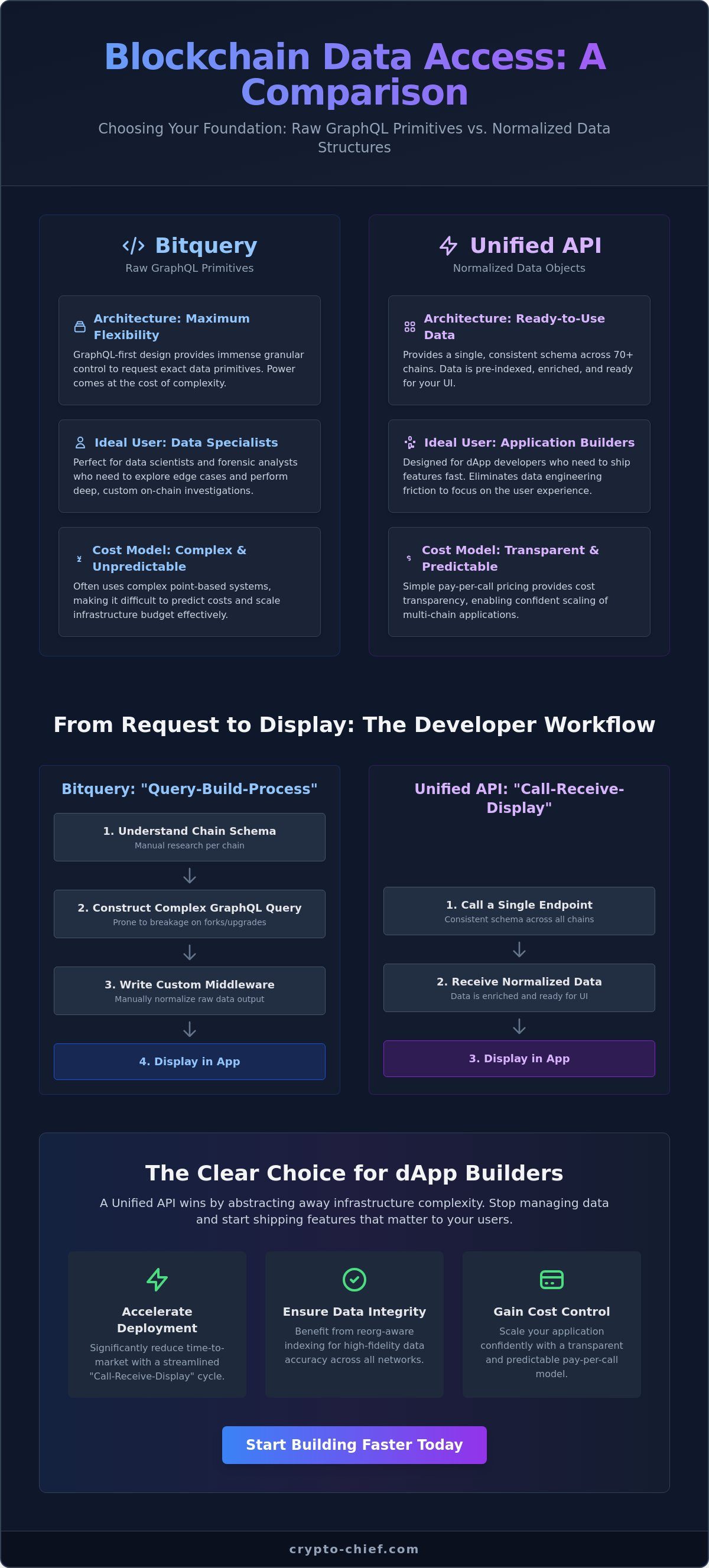
Architecture dictates development velocity. When evaluating bitquery vs unified api, the choice often centers on whether your team needs the raw ingredients of the blockchain or a finished, actionable dataset. Bitquery provides a high degree of granular control, allowing users to define exactly which primitives they want to extract. However, this flexibility requires a significant investment in engineering time. You aren't just fetching data; you're designing the logic to interpret it.
The operational difference is best summarized by the lifecycle of a single request. Bitquery follows a "Query-Build-Process" cycle. Your developers must first understand the specific schema of a chain, construct a complex GraphQL query, and then write custom middleware to normalize the raw output into something your app can use. In contrast, a Unified API utilizes a "Call-Receive-Display" model. Because the data is already normalized, the response is ready for the frontend the moment it arrives. This efficiency is critical for multi-chain dApps where tracking protocol changes across 70+ chains would otherwise consume your entire roadmap.
Handling real-time and historical data requires different architectural strengths. Bitquery excels at historical forensics through its V1 API, but managing the transition to its V2 streaming model adds another layer of complexity for your dev team. A unified approach abstracts these differences away. Whether you're pulling a transaction from three years ago or streaming a live event, the interface remains identical. This consistency allows you to scale your infrastructure without constantly rewriting your data ingestion logic.
GraphQL Query Complexity and Performance Overhead
Power comes with complexity. While GraphQL is expressive, complex nested queries in Bitquery can lead to execution timeouts or high "point" costs that are difficult to predict. This creates a "learning curve tax" where your team spends more time debugging query structures than shipping user features. There's also the persistent risk of breaking changes. When an underlying blockchain updates its schema or a protocol migrates to a new version, raw queries often fail. Maintaining these connections across dozens of networks is an invisible drain on resources that hampers scalability.
The Efficiency of Normalized Data Structures
Standardization is the antidote to fragmentation. Crypto Chief’s Unified API standardizes core events like swaps, transfers, and mints across different virtual machines, ensuring that a transaction on Solana looks identical to one on an EVM chain. This architectural choice enables pre-computed analytics and sub-second response times. For fintech applications and consumer-facing Web3 apps, "interpreted data" has become the gold standard. It removes the need for manual reconciliation, allowing you to focus on the user experience while the platform handles the structural integrity of the underlying data.
Data Accuracy and Reliability: Solving the Multichain Inconsistency Problem
Accuracy is the bedrock of any financial application. A common concern when comparing bitquery vs unified api is whether the abstraction layer compromises the integrity of the underlying on-chain state. It doesn't. In fact, raw data is often more prone to "silent errors" because developers must manually account for chain-specific quirks, such as varying decimal places or inconsistent event logging across different protocol versions. A managed Unified API eliminates these risks by validating and cross-referencing data against multiple sources before it ever reaches your endpoint.
Financial precision requires more than just block data. High-accuracy dApps rely on cross-referenced price feeds to ensure that transaction values are calculated correctly across volatile markets. While Bitquery provides the raw primitives to build these feeds, a Unified API incorporates these enrichments directly into the response object. This reduces the likelihood of discrepancies that occur when developers try to stitch together disparate data sources in a custom middleware layer. You get a single, truthful representation of the market state without the brittle logic of manual reconciliation.
Handling Blockchain Reorgs and Finality
Blockchain networks are not static. Temporary forks, or "reorgs," can invalidate recently processed transactions, leading to catastrophic errors if your system isn't reorg-aware. Bitquery typically requires users to build their own logic to detect and handle these shifts within their GraphQL queries. In contrast, a Unified API uses reorg-aware indexing to signal the exact state of a transaction. Data finality is the point at which a transaction is considered permanently recorded on the blockchain and cannot be reversed or altered. By utilizing EventStream technology, developers receive real-time webhooks that automatically adjust if a block is dropped or replaced during network congestion, ensuring your database always mirrors the true chain state.
Security-Enriched Data: Integrating AML and Risk Assessment
In 2026, data accuracy is incomplete without risk context. Providing institutional-grade services requires "clean" data that has been screened for illicit activity at the moment of ingestion. Bitquery’s Coinpath forensics are excellent for post-incident investigations, but they don't offer the preemptive protection needed for live processing. Integrating real-time AML Intelligence directly into the data flow allows builders to block high-risk transactions before they are finalized. This proactive approach ensures that your dApp remains compliant and secure, transforming a simple data stream into a comprehensive, high-fidelity financial engine that meets the demands of modern business architects.
Cost Optimization and Scalability: Pay-Per-Call vs. Subscription Models
Financial predictability is often the deciding factor in the bitquery vs unified api debate. Technical features are essential for functionality, but the billing structure determines your long-term margins and operational stability. Bitquery utilizes a point-based system that calculates costs based on the complexity of each GraphQL request. While this offers flexibility for researchers performing deep forensics, it introduces significant risk for production applications where query depth can vary based on unpredictable user behavior.
The efficiency of a managed data provider is amplified when you consider the massive infrastructure savings. Offloading the task of data indexing eliminates the need for expensive DevOps teams and massive database clusters. You gain access to a high-performance engine that handles the heavy lifting of seventy blockchains behind the scenes. Having a single balance that covers your RPC Gateway, Unified API, and AML Intelligence further simplifies operations, allowing you to manage your entire stack from one dashboard without juggling multiple subscriptions.
The Problem with Query-Based Pricing
A single inefficient GraphQL query can deplete a monthly point balance in minutes. This lack of transparency makes it difficult for business architects to set reliable budgets, especially when a dApp is in a high-growth phase. Because costs are tied to complexity rather than volume, a small change in your frontend logic could inadvertently double your infrastructure bill. Developers often find themselves over-provisioning or capping usage to avoid sudden service interruptions, which ultimately hurts the end-user experience and limits the scalability of the application.
Pay-Per-Call: The SaaS Standard for Web3
Transparency is the primary benefit of a pay-per-call model. By utilizing a pre-paid API token balance, businesses pay a flat fee for each successful request regardless of how many data fields are returned. This model aligns costs directly with business growth and revenue. If your dApp scales from 100 to 1,000,000 requests, your expenses scale predictably. It's a "set and forget" approach that removes the friction of financial monitoring, allowing you to focus on building features instead of auditing your API usage logs.
- Predictable per-request costs that simplify monthly budgeting.
- No hidden fees for query complexity or nested data structures.
- Unified balance across RPC, Unified API, and AML services.
- Zero infrastructure overhead for multi-chain indexing and maintenance.
Choosing Your Infrastructure: Why Crypto Chief’s Unified API Wins for Builders
Selecting the right infrastructure is the difference between an experimental prototype and a globally available dApp. While Bitquery offers a powerful laboratory for historical forensics, Crypto Chief provides the high-performance engine required for live, commercial-grade applications. The decision in the bitquery vs unified api debate ultimately rests on your project's goals. If your team is conducting deep, niche research into legacy chain states, raw GraphQL primitives serve you well. However, if you're building a scalable, multi-chain product that demands structural integrity and sub-second response times, a normalized approach is the only logical path forward.
Crypto Chief functions as a silent, powerful partner by consolidating the most critical components of the Web3 stack into a single interface. You aren't just getting data; you're gaining access to an all-in-one ecosystem that includes an RPC Gateway, a Unified API, real-time EventStream webhooks, and AML Intelligence. This integrated approach ensures that your application remains lean and fast. By offloading the complexity of multi-chain indexing and risk detection to a dedicated provider, you protect your developers from the burnout of manual data reconciliation and infrastructure maintenance.
A Unified Workflow for Faster Deployment
Efficiency is the primary currency of modern development teams. A single API key unlocks the entire multichain ecosystem, connecting your application to over 70 blockchains without requiring unique integrations for each network. This unified workflow allows you to ship features in days rather than months. Developers also benefit from non-custodial crypto processing capabilities, which allow for seamless transaction management without the legal or technical burdens of custodial hosting. By utilizing a standardized schema, you ensure that your code remains clean, readable, and easy to audit as your project evolves.
Getting Started with Crypto Chief
Transitioning from legacy providers or raw nodes is a straightforward process designed to minimize downtime. The platform is engineered for global scalability, utilizing an edge-optimized network to deliver data with minimal latency regardless of where your users are located. You don't have to worry about the "point-based" unpredictability of other models; instead, you can rely on a transparent, pay-per-call structure that respects your budget. The transition from a research-heavy tool to a production-ready engine represents a major milestone in your project's lifecycle. It's time to stop managing infrastructure and start delivering value.
Scale your infrastructure with Crypto Chief
Optimize Your Development Pipeline for Global Scale
The strategic choice between bitquery vs unified api marks a pivot from manual data engineering toward automated, high-fidelity infrastructure. While raw primitives remain valuable for forensic research, the efficiency of a normalized data structure is essential for production-ready dApps. By adopting a system that standardizes events across seventy blockchains, your team eliminates the friction of manual normalization and reduces the risk of silent data errors during network congestion.
Building on a foundation that combines speed with structural integrity allows you to scale without the unpredictability of complex pricing or maintenance cycles. Build with the high-performance Unified API from Crypto Chief to leverage a transparent pay-per-call pricing model, a global high-performance RPC gateway, and integrated AML Intelligence. This all-in-one suite removes the technical barriers to entry, providing the stability you need to ship faster and manage your entire stack from a single, powerful interface.
Your application deserves a reliable engine that grows alongside your vision. By choosing the right tools today, you ensure that your infrastructure remains a silent, powerful partner in your long-term success. It's time to stop managing data and start building the future.
Frequently Asked Questions
Is a Unified API as flexible as Bitquery’s GraphQL?
A Unified API prioritizes structural consistency over the raw flexibility of custom GraphQL schemas. While Bitquery allows you to define complex, nested queries from scratch, a Unified API provides a standardized schema that works across 70+ blockchains. This trade-off significantly reduces the engineering time spent on data normalization, allowing your team to deploy features faster without managing unique data shapes for every new network.
How does Crypto Chief ensure data accuracy across different blockchains?
Data accuracy is maintained through a combination of reorg-aware indexing and multi-source validation. The platform monitors block finality in real time and cross-references on-chain states across a global network of nodes to filter out inconsistencies. This proactive approach ensures that the data delivered to your application is high-fidelity and reflects the true state of the ledger, even during periods of network instability.
What is the pricing difference between Bitquery and Crypto Chief?
The primary difference lies in predictability and transparency. Bitquery utilizes a points-based system where costs are calculated based on the complexity of each query, making monthly budgeting difficult. In the bitquery vs unified api comparison, Crypto Chief offers a more straightforward pay-per-call model. You pay a flat rate from a pre-paid API token balance for each successful request, regardless of the internal data complexity.
Can I use a Unified API for deep blockchain forensics and money tracing?
Unified APIs are engineered for production-ready applications rather than specialized forensic research. While you can retrieve comprehensive transaction histories and wallet balances, deep money-tracing tools like Bitquery’s Coinpath are designed specifically for investigative use cases. A Unified API is the superior choice for dApps that require clean, interpreted data for swaps, transfers, and real-time user interactions.
Does a Unified API support real-time event streaming like Bitquery?
Yes, the EventStream service provides real-time webhooks that deliver low-latency updates for on-chain events. This functionality mirrors the streaming capabilities of bitquery vs unified api models by pushing data to your endpoint the moment a transaction is detected. It is a critical component for developers building trading bots, wallet trackers, or any application that requires an instant response to blockchain activity.
Why is pay-per-call pricing better for Web3 startups than monthly tiers?
Pay-per-call pricing aligns your infrastructure costs directly with your actual usage and business growth. Monthly subscription tiers often force startups to pay for unused capacity or face service interruptions when they exceed strict limits. A pre-paid balance ensures capital efficiency by allowing you to pay only for the requests your application actually makes, providing a scalable foundation that doesn't penalize early-stage growth.
How does Crypto Chief handle blockchain reorgs in its Unified API?
The platform handles reorgs by continuously monitoring block finality and issuing corrective signals through the EventStream service. If a blockchain undergoes a temporary fork or a block is dropped, the indexing engine automatically adjusts the transaction state. This ensures your application never displays "ghost" transactions, maintaining the integrity of your database without requiring manual intervention from your dev team.
Is Crypto Chief’s API non-custodial?
Yes, all services including the Crypto Processing API and Unified API are strictly non-custodial. The infrastructure provides the data and processing power needed to interact with the blockchain, but it never has access to your private keys or funds. This architecture allows you to maintain full control over your assets while benefiting from the speed and reliability of an enterprise-grade data engine.
Tags: bitquery vs unified api