
Why are Web3 developers still tethered to five-figure enterprise compliance seats when their dApps require technical precision rather than massive overhead? It's a frustrating reality for many builders who find that traditional tools create more friction than they solve. You have likely experienced the headache of trying to sync a standard RPC provider with a rigid monitoring tool, only to have false positives freeze legitimate transactions and drive users away. Integrating a robust blockchain analytics api for aml shouldn't force you to choose between global regulatory alignment and your project's bottom line.
We agree that compliance should be a seamless performance metric, not a manual bottleneck. This reference guide will show you how to master the technical requirements for integrating real-time intelligence into your decentralized applications. You will learn to evaluate providers based on their ability to deliver automated risk scoring and low-latency data. We will also explore how to utilize pay-per-call models to lower operational costs while meeting strict standards like the EU’s MiCA requirements, which demand verification for self-hosted wallets over €1,000 starting July 2026. By the end, you'll have a clear roadmap for building a secure, compliant engine that scales with your growth.
Key Takeaways
- Secure your dApp programmatically by integrating real-time risk intelligence to detect and mitigate illicit on-chain activity before it impacts your ecosystem.
- Evaluate a blockchain analytics api for aml based on its capacity for uniform risk scoring across multiple networks, including EVM and Solana, without compromising transaction latency.
- Reduce operational overhead by transitioning from rigid enterprise subscription tiers to transparent, pay-per-call models that align costs directly with your actual transaction volume.
- Streamline development by automating address screening during critical interaction points, such as deposit and withdrawal initiations, to ensure continuous regulatory alignment.
- Consolidate your technical stack using unified infrastructure that combines high-performance RPC gateways with AML intelligence for a more efficient and stable backend.
What is a Blockchain Analytics API for AML?
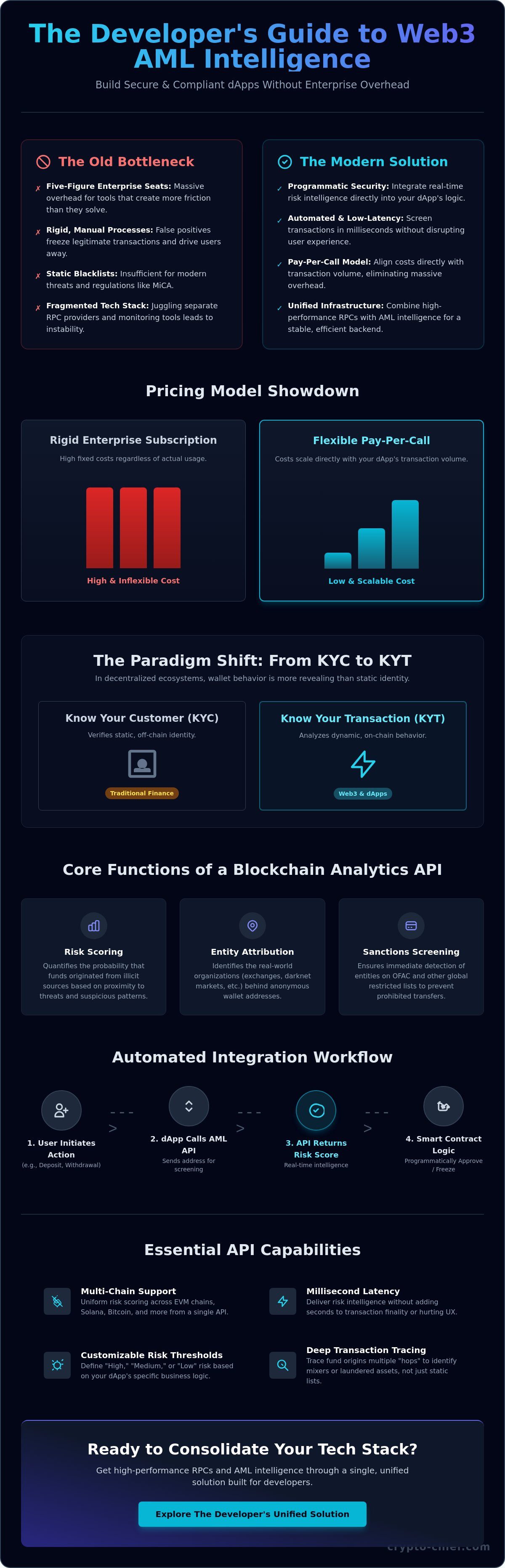
A blockchain analytics api for aml is a programmatic bridge that translates raw on-chain events into actionable risk intelligence. It provides developers with a structured interface to query the risk profile of wallet addresses, smart contracts, and individual transaction hashes in real time. While traditional finance relies heavily on Know Your Customer (KYC) to verify identities, decentralized ecosystems increasingly prioritize Know Your Transaction (KYT). This shift is essential. In a non-custodial environment, the behavior of a wallet and its historical interactions are often more telling than a static identity document.
The underlying technology utilizes sophisticated blockchain analysis to map the movement of funds across complex, often obfuscated networks. It's vital to distinguish between simple address screening and deep transaction tracing. Screening checks a wallet against a list of known bad actors. Tracing, however, follows the "hop" history of funds to identify mixers, high-risk exchanges, or laundered origins. Static blacklists are fundamentally insufficient for modern regulatory standards like MiCA. By the time a manual list is updated, illicit actors have already moved their assets through new, unflagged addresses, making real-time intelligence a necessity rather than an optional feature.
The Core Functions of AML Intelligence
Modern compliance tools must do more than just flag addresses. They must provide context through three primary mechanisms:
- Risk Scoring: This process quantifies the probability that specific funds originated from illicit sources. A score is typically generated based on the wallet's proximity to known threats or suspicious patterns.
- Entity Attribution: This identifies the real-world organizations, such as specific exchanges, darknet markets, or mining pools, behind anonymous wallet addresses.
- Sanctions Screening: This ensures immediate detection of entities on OFAC and other global restricted lists, preventing your application from facilitating prohibited transfers.
Why Developers Need a Dedicated AML API
Integrating a dedicated AML Intelligence solution allows builders to automate the "Freeze/Release" logic in their smart contracts. Instead of pausing an entire protocol for a manual review, your code can programmatically reject or quarantine transactions that exceed a specific risk threshold. This automation is critical for maintaining the high-performance nature of peer-to-peer platforms while fulfilling Virtual Asset Service Provider (VASP) obligations. It allows you to maintain non-custodial integrity and user trust without hiring an army of compliance officers to monitor high-volume transaction flows manually.
Key Features of Enterprise-Grade Compliance APIs
Enterprise-grade performance requires more than just a simple lookup table. A professional blockchain analytics api for aml must handle the complexity of modern multi-asset portfolios without adding seconds to transaction finality. Builders shouldn't have to maintain separate integrations for every new ecosystem they support. A unified interface should provide consistent risk scoring across EVM chains, Solana, and Bitcoin, ensuring that your compliance logic remains stable regardless of the underlying network. This structural integrity is what separates a basic screening tool from a scalable financial infrastructure.
Speed is a non-negotiable metric. If an API request takes several seconds during a checkout process, the user will likely abandon the transaction. High-performance tools deliver results in milliseconds while maintaining the historical depth required to trace fund origins back multiple "hops" to the initial source. This depth is paired with customizable risk thresholds. Every dApp has a different risk appetite, so you need the ability to define what constitutes "High," "Medium," or "Low" risk based on your specific business model and geographic exposure.
Understanding Risk Scoring Methodology
Risk scoring is an objective calculation based on behavioral patterns rather than just static lists. Usage of mixing services or proximity to darknet markets heavily weights the final score. It is important to distinguish between direct and indirect exposure. Indirect exposure is the percentage of funds originating from a high-risk source through intermediaries. This alignment with the FinCEN advisory on virtual currency helps developers identify red flags before they become legal liabilities. You can explore how these scoring parameters are defined in a production environment by reviewing the AML Intelligence technical specifications.
Data Accuracy and Attribution Sources
Reliability depends entirely on the quality of attribution data. Top-tier providers combine proprietary datasets with public open-source intelligence (OSINT) to build a comprehensive map of the crypto economy. Machine learning models now predict malicious actors by identifying anomalous transaction patterns before they're officially flagged by authorities. Frequent updates to VASP risk profiles and exchange deposit addresses ensure that your filters aren't lagging behind the fast-moving nature of on-chain finance. This proactive approach allows developers to build with confidence, knowing their security layers are backed by a sophisticated, global engine.
Evaluating AML Providers: Pay-Per-Call vs. Subscription Models
Traditional compliance vendors often obscure their pricing behind opaque "Contact Sales" buttons, forcing developers into lengthy procurement cycles. This legacy approach frequently involves high monthly retainers and rigid subscription tiers that don't account for the volatile nature of on-chain activity. For a Web3 startup, these hidden costs create significant budgeting uncertainty. A modern blockchain analytics api for aml should function as a utility, scaling dynamically with your project's actual usage rather than imposing a fixed financial burden. When you're forced to pay for a "Pro" tier that includes 5,000 requests but you only perform 1,000, you're effectively subsidizing the provider's overhead at the expense of your own runway.
Pay-per-call models, often powered by tokenized credits or prepaid balances, align your operational expenses directly with your transaction volume. This architecture is particularly superior for decentralized applications experiencing seasonal traffic spikes or rapid growth phases. Instead of negotiating a new contract every time your user base expands, you simply top up your balance. Analyzing the "Cost per Screen" becomes a straightforward exercise in unit economics. This transparency allows business architects to project compliance spending with surgical precision, ensuring that every dollar spent on AML Intelligence provides a measurable return in risk mitigation and regulatory safety.
The Problem with "Contact Sales" Pricing
Budgeting uncertainty is a silent killer for emerging platforms. When pricing isn't public, it's impossible to build an accurate financial model without engaging in weeks of sales calls. Long-term contracts also introduce friction in a rapidly evolving regulatory environment where your technical needs might shift overnight. Self-service API keys have become the preferred standard for professional developers because they allow for immediate testing and deployment. You shouldn't need a legal team just to verify if an API meets your latency requirements.
Budgeting for Compliance in 2026
As we approach the July 2026 MiCA deadline, predicting API call volume based on Daily Active Users (DAU) is critical for global alignment. Developers can optimize their spend by using a Unified API to reduce redundant requests across multiple chains. By caching results for a specific timeframe or triggering screens only during high-value events, you can maintain a lean compliance stack. For a deeper dive into structuring your financial roadmap, consult this guide on Web3 API Pay Per Call Pricing to master the art of cost-effective risk management.
Implementation Guide: Integrating Risk Scoring into Your Workflow
Transitioning from regulatory theory to technical execution requires a methodical approach to backend architecture. Integrating a blockchain analytics api for aml into your dApp ensures that every interaction is vetted against a global intelligence engine before it touches your protocol's liquidity. This process should be asynchronous to maintain low latency, ensuring that the user experience remains fluid while your security layers operate in the background. By following a structured implementation path, you'll build a defensive perimeter that satisfies both internal risk appetites and external legal requirements.
- Step 1: Authenticate and Initialize. Secure your connection to the AML Intelligence endpoint using your unique API key. This initialization should happen at the service layer of your backend to prevent exposing sensitive credentials on the frontend.
- Step 2: Trigger Address Screening. Initiation of a "Deposit" or "Withdrawal" should immediately trigger a request to the screening endpoint. Validating the counterparty address at this stage prevents tainted funds from entering your ecosystem.
- Step 3: Parse and Apply Logic. Your system must parse the returned risk score and apply predefined business logic. You might choose to automatically allow scores below 10, block those above 70, and flag the remainder for manual compliance review.
- Step 4: Log Metadata. Store the compliance data, including the risk score and timestamp, alongside the transaction record. This creates a tamper-proof audit trail for future regulatory inquiries.
- Step 5: Ongoing Monitoring. Use webhooks to receive real-time updates on "watched" addresses. This ensures that if a previously low-risk wallet becomes compromised, your system can react instantly.
Automating the Blocklist with Smart Contracts
Efficient risk management often requires updating contract-level permissions based on API responses. When a wallet is flagged, your backend can trigger a transaction to a "Blacklist" mapping within your smart contract, programmatically preventing the address from interacting with your liquidity pools. Edge cases, such as "Guarded" risk levels, require nuanced handling; perhaps you limit transaction sizes rather than initiating a full block. For a deeper look at these security patterns, refer to this Crypto Transaction Risk Assessment guide to refine your defensive logic.
Combining AML with Real-Time EventStream
Screening only at the point of entry leaves your platform vulnerable to post-deposit contamination. By combining AML intelligence with a real-time EventStream, you can monitor the ongoing behavior of every wallet in your database. If a user's wallet interacts with a mixer or a sanctioned entity 48 hours after their first deposit, a webhook can alert your compliance team to freeze the account. Consolidating your RPC and AML Intelligence into a single provider reduces infrastructure bloat and simplifies your data pipeline, allowing you to focus on building features rather than managing disparate compliance tools. You can register for an API key today to begin testing these integrated workflows in your staging environment.
Crypto Chief AML Intelligence: The Developer’s Unified Solution
Most developers are tired of managing a fragmented technical stack. You shouldn't have to navigate between multiple providers just to verify a transaction and broadcast a block. Crypto Chief solves this by offering a unified infrastructure where high-performance RPC nodes, Unified APIs, and real-time AML data coexist within a single dashboard. This integration removes the friction of cross-provider latency and simplifies your backend architecture. By consolidating these services, you ensure that your dApp operates on a stable, high-performance engine that is both elite in its capabilities and humble in its delivery.
Our transparent pay-per-call model is built specifically for builders. We don't believe in monthly retainers or punishing startups with enterprise-level minimums that drain capital before a project even launches. You only pay for the risk checks you perform, aligning your operational costs directly with your actual transaction volume. This structural efficiency is backed by a global network designed for mission-critical fintech applications. Deploying our blockchain analytics api for aml is straightforward, thanks to our comprehensive technical documentation that provides clear endpoints, precise request parameters, and predictable response structures.
Why Crypto Chief Outperforms Standalone AML Tools
Standalone compliance tools often force you into a custodial mindset or limit your project to a single chain. Crypto Chief is multichain by default, providing uniform risk scoring for Ethereum, BNB Chain, Polygon, and several other major networks from day one. We maintain a strict non-custodial focus. We provide the intelligence you need to make informed decisions, but you always maintain full control over the funds and the smart contract logic. Our built-in scalability ensures that your prepaid token balances grow alongside your application, preventing service interruptions during unexpected traffic spikes.
Getting Started with Crypto Chief AML
Ready to secure your dApp? The process is designed to be frictionless for professional architects. First, create an account at the Crypto Chief Registration portal. Once your account is active, you can purchase API tokens and generate a secure API key in seconds. We recommend testing your first risk screen in the AML Sandbox to ensure your parsing logic is correct before moving to production. Using a professional blockchain analytics api for aml has never been this accessible. Scale your compliance with Crypto Chief AML Intelligence today and join the ranks of developers building the next generation of secure, compliant Web3 finance.
Future-Proof Your dApp with Automated Risk Intelligence
Navigating the shifting regulatory landscape requires a transition from manual overhead to automated precision. Integrating a robust blockchain analytics api for aml is no longer a luxury for Web3 projects. It's a structural necessity for long-term survival in a competitive market. Moving away from opaque enterprise subscriptions toward transparent, pay-per-call models allows you to align costs with actual usage. By unifying your RPC and AML infrastructure, you eliminate technical friction and ensure your application remains responsive under heavy load. This methodical approach to compliance empowers you to focus on core innovation while maintaining global multichain support for enterprise-level scalability.
You don't have to navigate these complexities alone. With a reliable partner providing the intelligence while you maintain non-custodial control, your project is ready for the next wave of institutional adoption. Automate your Web3 compliance with Crypto Chief AML Intelligence and build your platform on a foundation of stability and precision. The infrastructure is ready for you to start building today.
Frequently Asked Questions
What is the difference between an AML API and a regular blockchain explorer?
A regular blockchain explorer provides raw transaction data such as block heights and wallet balances, whereas an AML API delivers an intelligence layer. While an explorer tells you where funds moved, a blockchain analytics api for aml tells you who owns the address and whether the funds originated from illicit sources like mixers or darknet markets. This distinction is critical for developers who need to automate decision-making rather than just display transaction history.
How do blockchain analytics APIs calculate a risk score?
Risk scores are calculated using a weighted algorithm that analyzes behavioral patterns and fund proximity to known illicit entities. The system evaluates factors such as the number of "hops" from a sanctioned wallet, usage of mixing services, and the historical reputation of the address. These variables are aggregated into a numerical score, allowing your dApp to programmatically block or flag transactions based on your specific risk appetite and internal security policies.
Can I use a blockchain analytics API for sanctioned address screening?
Yes, sanctioned address screening is a fundamental capability of enterprise-grade APIs. The system monitors global restricted lists, including OFAC and other international sanctions, to provide immediate alerts if a restricted entity attempts to interact with your protocol. This real-time detection ensures that your platform remains compliant with international law and avoids the legal repercussions of facilitating prohibited financial transfers, protecting your project from significant regulatory risk.
Does using an AML API compromise user privacy in a dApp?
Using an AML API does not compromise user privacy because the analysis focuses strictly on public on-chain activity and historical transaction data. The API identifies the risk level of a wallet address without requiring the user's personal identifiable information (PII). This allows developers to maintain a non-custodial and privacy-centric environment while still fulfilling their regulatory obligations to prevent money laundering and fraud within their decentralized ecosystems.
How much does a blockchain analytics API call typically cost?
The cost of an API call depends on the provider’s pricing model, which typically ranges from high-barrier enterprise subscriptions to flexible pay-per-call structures. Subscription models often require a fixed monthly retainer regardless of volume, while pay-per-call models allow you to pay only for the risk checks you perform. This latter approach is generally more cost-effective for startups and developers who need to manage fluctuating transaction volumes without making a significant upfront financial investment.
Is real-time transaction monitoring required for AML compliance?
Real-time transaction monitoring is becoming a standard requirement under global regulatory frameworks like the EU’s MiCA and FATF recommendations. Screening only at the point of entry is no longer sufficient because a wallet's risk profile can change after a deposit is made. Implementing a blockchain analytics api for aml with real-time monitoring allows your system to detect suspicious activity as it happens, providing a higher level of security and ensuring continuous regulatory alignment.
Which blockchains are supported by Crypto Chief’s AML Intelligence?
Crypto Chief’s AML Intelligence provides comprehensive multichain support for major networks including Ethereum, BNB Smart Chain, Polygon, and Tron. It also covers Bitcoin, Solana, and other prominent ecosystems, ensuring that your compliance logic remains uniform across your entire asset portfolio. This broad coverage allows developers to scale their applications globally without the need for multiple, disparate risk-monitoring integrations, simplifying the overall technical stack for your development team.
How do I handle false positives in automated compliance workflows?
Handling false positives effectively requires a tiered logic system that categorizes risk into "Allow," "Block," and "Review" buckets. Instead of a binary pass/fail, you can set a middle threshold where transactions are temporarily quarantined for manual review by a compliance officer. This nuanced approach prevents legitimate users from being unfairly blocked while still maintaining a robust defense against truly illicit actors, ensuring your user experience remains fluid and professional.