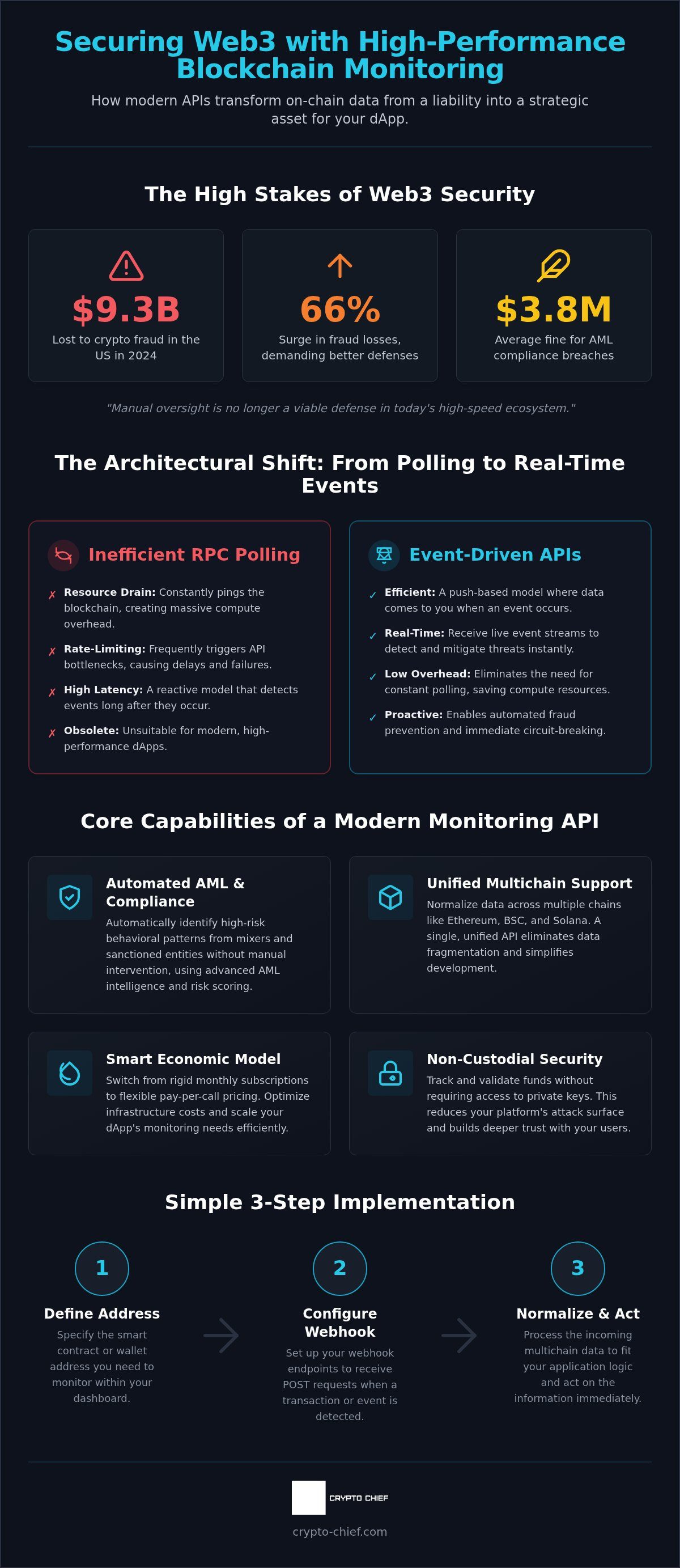
In 2024, losses from cryptocurrency fraud in the US reached a staggering $9.3 billion, a 66% surge that has left developers and compliance officers scrambling for better defenses. You likely recognize that manual oversight is no longer viable in a landscape where regulatory fines for AML breaches averaged $3.8 million just last year. Building a secure dApp requires more than just a connection to the chain; it demands a proactive shield that doesn't compromise your application's performance or your project's budget.
This guide explores how to leverage a high-performance blockchain transaction monitoring api to secure your ecosystem, automate complex compliance workflows, and maintain a competitive edge. By integrating modern API architectures, you can transform transaction data from a liability into a strategic asset. We'll show you how to move beyond high-latency alerts and prohibitive subscription costs that often stifle growth for emerging Web3 platforms.
We'll detail the shift toward unified, pay-per-call models that provide real-time visibility across Ethereum, BSC, and Solana while eliminating the friction of fragmented infrastructure. You'll learn to implement automated risk scoring and real-time notifications that keep your users safe and your operations compliant in an increasingly scrutinized global market. This is about building a foundation that's both elite in capability and efficient in execution.
Key Takeaways
- Understand how a modern blockchain transaction monitoring api provides real-time visibility into ledger activity through automated address watching and transaction status updates.
- Learn why switching from resource-intensive RPC polling to event-driven architectures like EventStream reduces compute overhead and eliminates rate-limiting bottlenecks.
- Discover how to automate compliance using AML Intelligence to identify high-risk behavioral patterns from mixers and sanctioned entities without manual intervention.
- Evaluate the economic advantages of pay-per-call pricing models over rigid monthly subscriptions to optimize your infrastructure costs as your dApp scales.
- Master the integration of unified APIs to normalize data across multiple chains like Ethereum and Polygon, ensuring global reliability through distributed node networks.
What is a Blockchain Transaction Monitoring API?
A blockchain transaction monitoring api is a programmable interface that tracks, analyzes, and delivers real-time alerts on ledger activity. It serves as the digital nervous system for decentralized applications, providing a continuous stream of data regarding address balances, transaction states, and network health. In the sophisticated Web3 landscape of 2026, simple block explorers are no longer sufficient for enterprise needs. Developers now require intelligent, event-driven architectures that can programmatically interpret complex on-chain events as they occur.
The core utility of these APIs extends beyond basic data retrieval. They facilitate deep Blockchain analysis, allowing platforms to automate address watching and risk assessment without manual oversight. By integrating these tools, teams can move from a reactive posture to a proactive security model. Modern monitoring engines provide the granular data necessary to verify incoming funds, update user balances instantly, and trigger smart contract interactions based on specific network conditions.
The Shift from Static Data to Real-Time Intelligence
Querying historical data is akin to reading a ledger after the business day has closed. For modern DeFi and fintech applications, this delay is unacceptable. Real-time latency has become the primary metric for success. High-performance monitoring systems enable developers to receive live event streams, which are critical for detecting and mitigating zero-day exploits before they escalate. When a suspicious pattern emerges, an API-first approach allows for immediate circuit-breaking or automated fraud prevention, protecting both the protocol and its users from evolving threats.
Non-Custodial vs. Custodial Monitoring Approaches
Security-conscious developers increasingly favor non-custodial monitoring. This approach involves tracking and validating funds without ever requiring access to private keys. By utilizing a non-custodial Crypto Processing API, businesses can maintain full visibility and operational control while eliminating the massive security liability associated with fund custody. This architectural choice aligns perfectly with the core Web3 ethos of decentralization. It ensures that while the data is centralized for analysis and reporting, the actual assets remain under the user's control, reducing the platform's attack surface and building deeper trust with the community.
By prioritizing a blockchain transaction monitoring api that emphasizes speed and non-custodial integrity, developers can build more resilient applications. These tools remove the friction of manual polling, allowing teams to focus on their core product while the monitoring infrastructure handles the heavy lifting of network synchronization and data normalization.
Technical Architectures: Webhooks vs. RPC Polling
Traditional RPC polling is a resource drain. It forces your server to ping the blockchain repeatedly to check for updates, creating massive compute overhead and triggering rate-limiting bottlenecks. For a high-performance blockchain transaction monitoring api, this model is obsolete. Modern developers favor push-based architectures where the data comes to them, ensuring they only process information when an actual event occurs. This shift moves the heavy lifting of block-by-block scanning from your infrastructure to a specialized provider.
Implementing a modern monitoring flow follows three straightforward steps:
- Step 1: Define the smart contract or wallet address you need to monitor within your dashboard.
- Step 2: Configure your webhook endpoints to receive POST requests whenever a transaction or event trigger is detected.
- Step 3: Normalize the incoming multichain data to fit your application logic, ensuring your backend can act on the information immediately.
Optimizing for Multichain Environments
Monitoring multiple networks presents a significant data fragmentation challenge. Ethereum, Solana, and Tron each use distinct data formats, which often requires developers to maintain multiple chain-specific libraries. A Unified Blockchain API solves this by normalizing disparate data into a single, predictable JSON schema. This structural integrity reduces developer friction and allows your dApp to scale across new chains without a complete rewrite of your monitoring logic. If you are looking to simplify your infrastructure, you can explore our RPC Gateway for reliable multichain connectivity.
Scaling with EventStream Technology
During periods of high volatility, transaction volumes can spike by orders of magnitude. Real-Time Blockchain Webhooks are designed to handle these massive surges without dropping packets. EventStream is a managed service that pushes on-chain data directly to your backend. A robust blockchain transaction monitoring api must include sophisticated retry logic and delivery guarantees. These features ensure that even if your server experiences a temporary outage, the transaction data is queued and redelivered, maintaining a complete and accurate audit trail for your application. This reliability is the foundation of any enterprise-grade notification system.
AML Intelligence: Automating Risk Scoring and Compliance
Effective compliance in a decentralized environment requires more than a simple list of banned addresses. AML Intelligence represents a necessary shift from reactive blacklisting to proactive behavioral risk scoring. By analyzing the flow of funds across the ledger, a robust blockchain transaction monitoring api identifies connections to illicit sources like mixers, darknet markets, and sanctioned entities. This level of scrutiny is no longer optional. In 2024, crypto companies were fined over $5.1 billion for inadequate Anti-Money Laundering programs, according to data from Sumsub. These figures underscore the critical need for automated Know Your Transaction (KYT) protocols that operate during user onboarding without adding friction to the experience.
Integrating these risk scores into your dApp allows for the automation of fund-freezing or transaction-blocking logic. Instead of relying on manual reviews, your system can programmatically reject deposits that exceed specific risk thresholds. This non-custodial approach ensures that you maintain regulatory integrity without ever taking control of user assets, preserving the privacy and autonomy that Web3 users expect. It positions your platform as a secure, enterprise-ready environment that prioritizes safety as much as scalability.
Behavioral Analytics vs. Static Lists
Static blacklists are inherently flawed because bad actors rotate addresses with high frequency. By 2026, sophisticated techniques like peeling chains and layering have made simple list-based filtering obsolete. Behavioral analytics use machine learning to detect these complex patterns in real-time. Implementing Crypto AML Risk Detection ensures your platform stays ahead of rapid address generation. It provides a dynamic shield that protects your project from regulatory scrutiny by identifying the underlying intent of a transaction rather than just the history of a single wallet. This methodology recognizes that a clean address today could be part of a malicious cluster tomorrow.
Integrating AML into the Checkout Flow
Real-time risk assessment is most effective when integrated directly into the checkout or deposit flow. Before a payment is accepted, the API checks the sender's wallet against a global database of risk signals. You can reduce false positives by configuring tunable risk thresholds that align with your project's specific risk appetite. If a transaction triggers a high-risk alert, the system can automatically flag it for review or block it entirely. This process also builds a comprehensive audit trail, which is essential for filing Suspicious Activity Reports (SAR) and demonstrating compliance to global regulators. It's a methodical way to build a sustainable business in an increasingly regulated global market.
Evaluating API Providers: Cost, Performance, and Coverage
Selecting a blockchain transaction monitoring api in 2026 requires a rigorous assessment of three core pillars: economic transparency, technical performance, and network breadth. Most enterprise providers still hide their pricing behind a "Contact Sales" wall, which creates unnecessary friction for agile development teams. You need a checklist that prioritizes granular data access and high-uptime SLAs. Beyond the basic ability to read a block, an elite provider must deliver sub-second latency, measuring the precise gap between on-chain confirmation and your application's notification. If the notification arrives after the user has already refreshed their screen, the monitoring tool has failed its primary purpose.
Developer experience is the final, often overlooked, differentiator. High-quality documentation and native SDKs for languages like Go and Python reduce integration time from weeks to hours. You should look for providers that offer a unified data format, allowing your team to focus on building features rather than writing custom parsers for every new chain you support. This methodical approach to vendor selection ensures your infrastructure remains a silent, powerful partner in your project's growth.
The Pay-Per-Call Advantage for Scalability
Startups and high-growth dApps often suffer from "sticker shock" when they outgrow fixed monthly subscription tiers. Rigid pricing models force you to pay for unused capacity during quiet periods or penalize you with heavy overage fees during market volatility. Transitioning to Web3 API Pay Per Call Pricing provides a more efficient alternative. By using prepaid token balances, you only pay for the exact volume of transaction checks and alerts your application consumes. This model prevents waste and allows your budget to scale elastically with your actual user activity. You can create a free account today to experience the efficiency of a transparent, usage-based model.
Multichain Infrastructure Requirements
A reliable blockchain transaction monitoring api is only as strong as the nodes powering it. Relying on a robust Web3 RPC Gateway is essential for consistent data sourcing across diverse environments. While coverage for EVM chains like Ethereum RPC and Polygon is standard, true enterprise utility requires support for non-EVM networks like Solana, Bitcoin, and TON RPC. A provider's ability to normalize data from these disparate architectures into a single schema is what separates elite tools from basic explorers. This multichain integrity ensures that your security and compliance protocols remain consistent, regardless of which network your users prefer.
Implementing Monitoring with Crypto Chief
Crypto Chief simplifies the complexities of Web3 infrastructure by consolidating critical tools into a single, high-performance environment. Our blockchain transaction monitoring api provides a unified gateway to our RPC Gateway, AML Intelligence, and EventStream webhooks. This architecture allows your team to move from API Documentation to a production-ready environment in hours rather than weeks. By removing the need to manage disparate services, we act as a silent partner that empowers you to focus on your core application logic.
Global reliability is built into our foundation. We maintain a network of high-uptime nodes distributed across worldwide locations to ensure your monitoring remains uninterrupted. This global reach ensures that whether you're tracking a transaction on Ethereum, Polygon, or TON, the data delivery is consistent and low-latency. Because our platform is entirely non-custodial, you retain absolute control over your private keys and business logic, adhering to the fundamental security principles of the decentralized web.
Getting Started: From Registration to First Event
The journey from registration to your first live event is designed for speed. You can begin by creating an account at our Auth Portal to secure your unique API credentials. Once registered, you can purchase prepaid token balances through our transparent pay-per-call model, which allows you to start making requests immediately without waiting for billing cycles. After your balance is active, setting up your first "Watch" on a specific wallet address or smart contract takes only a few lines of code. This immediate access ensures you can begin testing and deploying your monitoring features without delay.
Customizing Your Monitoring Workflow
A robust monitoring strategy requires more than just raw data. Our platform allows you to customize your workflow by filtering events based on transaction value, asset type, or specific risk scores provided by our AML Intelligence engine. This granularity ensures that your backend only processes the information that's relevant to your specific business needs. If your project requires high-volume throughput or custom enterprise SLAs, our team is available via the Contact Page to discuss tailored solutions. You don't have to build these complex systems from scratch. Start monitoring today by creating a Crypto Chief Account and gain the real-time visibility your dApp deserves.
Securing the Future of Your Web3 Infrastructure
The shift toward real-time, event-driven architectures marks a turning point for decentralized security. You've seen how moving away from resource-intensive RPC polling in favor of EventStream webhooks minimizes latency while maximizing application performance. By integrating a high-performance blockchain transaction monitoring api, you gain the ability to normalize multichain data and automate AML Intelligence without the overhead of manual oversight. This transition isn't just about compliance; it's about building a resilient foundation that protects your users and your protocol from the volatility of the modern on-chain environment.
Scalability shouldn't be a financial burden. Our pay-per-call model ensures you only pay for the capacity you actually use, providing elite infrastructure that remains accessible to teams of all sizes. With a global network of high-uptime nodes and a unified approach to blockchain data, you're equipped to scale across Ethereum, Polygon, and beyond. Take the first step toward a more secure and efficient dApp today. Register for Crypto Chief and Get Started with Pay-Per-Call Monitoring. We're here to help you build the next generation of Web3 with confidence and precision.
Frequently Asked Questions
How does a blockchain transaction monitoring API differ from a block explorer?
A block explorer is a manual tool designed for human visual inspection of specific hashes or addresses. In contrast, a blockchain transaction monitoring api is a proactive, programmable interface that automatically pushes data to your server. It allows your dApp to trigger specific backend actions, such as updating a user balance or sending a notification, the moment an on-chain event occurs. This automation is essential for scaling Web3 operations without constant manual oversight.
Is real-time monitoring necessary for AML compliance?
Real-time monitoring is critical because it allows you to identify and block illicit funds before they are processed or commingled within your ecosystem. Regulatory bodies expect Virtual Asset Service Providers to detect "red flag" behaviors immediately. By using AML Intelligence, you can identify high-risk sources like mixers or sanctioned entities at the moment of the transaction. This proactive approach prevents your platform from inadvertently facilitating money laundering or violating global sanctions regimes.
What is the latency for a typical EventStream webhook notification?
The latency for an EventStream webhook notification is typically sub-second, often arriving within milliseconds of a block confirmation. This speed is achieved through our global high-uptime infrastructure, which monitors the network state continuously across multiple regions. Unlike traditional RPC polling, which introduces delays based on your specific polling interval, our push-based model delivers data as soon as the event is finalized on the ledger, ensuring your application remains synchronized.
Can I monitor multiple blockchains through a single API endpoint?
Yes, you can monitor multiple networks through a single Unified API integration. This architecture normalizes data from disparate chains like Ethereum, BSC, and Polygon into a single, predictable JSON schema. It eliminates the need for your team to maintain different libraries or data parsers for each network you support. By using a blockchain transaction monitoring api with multichain support, you reduce developer friction and can launch on new networks with minimal code changes.
How does pay-per-call pricing save money compared to monthly plans?
Pay-per-call pricing saves money by ensuring you only pay for your actual usage rather than a fixed capacity you might never reach. With prepaid token balances, you aren't locked into expensive monthly tiers that charge for millions of requests you don't use. This model is particularly efficient for startups or projects with fluctuating traffic, as it prevents overpaying during quiet periods while scaling elastically to handle sudden market surges or user growth.
What happens if a transaction is flagged as high-risk by the AML API?
When a transaction is flagged as high-risk by our AML Intelligence engine, your application can execute automated logic based on the specific risk score returned. For example, you might programmatically freeze the deposit, block the transaction, or flag it for manual review by your compliance team. This automated risk scoring creates a clear audit trail for regulators while protecting your platform from exposure to illicit funds or sanctioned entities without manual intervention.
Do I need my own nodes to use a transaction monitoring service?
No, you don't need to maintain your own nodes to use a transaction monitoring service. We provide a managed RPC Gateway that handles all the heavy lifting of network synchronization and data retrieval. This removes the operational burden of managing server uptime, disk space, and complex node updates. You simply connect to our API and receive the data you need, allowing your team to focus exclusively on building your core business logic.
Is non-custodial processing safer for my users?
Non-custodial processing is significantly safer because it eliminates the risk of centralized exchange hacks or internal mismanagement of funds. By using our non-custodial Crypto Processing API, you monitor and validate transactions without ever taking control of the user's private keys. This architecture reduces your platform's attack surface and liability while empowering users to maintain full sovereignty over their assets, which is a core expectation and security standard in the modern Web3 space.