
Why does querying a single wallet balance across twenty different networks feel less like engineering and more like a high-stakes game of data fragmentation? If you've ever tried fanning out RPC requests to a hundred different endpoints, you know the infrastructure quickly becomes a bottleneck of high latency and inconsistent decimals. The real challenge in building a multichain portfolio tracker api isn't just getting the data; it's making sense of it. You're dealing with thousands of DeFi protocols and over 120 blockchains, each with its own quirks, metadata, and transaction formats.
It's frustrating to manage the technical debt that comes with manually mapping every new chain's unique schema. This guide will show you how to architect a scalable solution using a data normalization API to unify these fragmented streams into a single, reliable source of truth. You'll learn how to implement a unified data schema for all assets, reduce your infrastructure overhead with pay-per-call models, and ensure your users receive real-time updates without the typical lag. We'll walk through the structural logic required to build a high-performance engine that handles the complexity so your application doesn't have to.
Key Takeaways
- Master the structural design of a modern tracking system, focusing on the critical role of the data normalization layer in unifying fragmented network streams.
- Learn the precise steps for building a multichain portfolio tracker api that standardizes heterogeneous data, including disparate decimal formats, into a single JSON schema.
- Address the "Fan-Out" challenge to improve application performance while transitioning from expensive subscription models to efficient, pay-per-call pricing.
- Implement a streamlined workflow to configure your target chains and deploy a unified feed that supports real-time balance and transaction updates.
- Scale your infrastructure with confidence by consolidating your RPC gateway and compliance tools into a unified, enterprise-grade development stack.
The Architecture of a Modern Multichain Portfolio Tracker
The landscape of digital asset management has shifted dramatically. By 2026, the average user doesn't just hold ETH; they manage a web of assets across EVM networks, Bitcoin, and emerging non-EVM ecosystems. This complexity means that building a multichain portfolio tracker api is no longer just about fetching a balance. It's about architecting a system that can ingest, process, and display data from dozens of sources simultaneously without sacrificing performance. The goal is to move away from fragmented, chain-specific logic toward a centralized, high-performance engine.
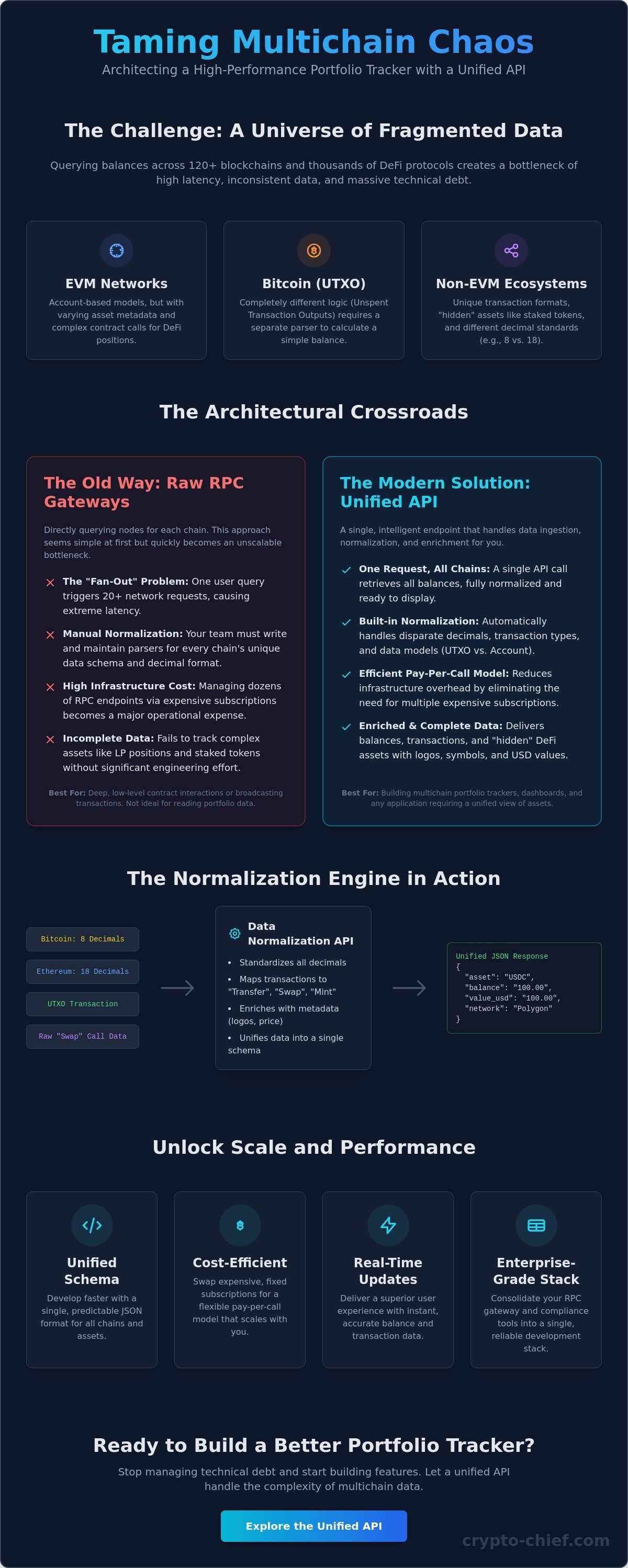
A modern architecture relies on three critical pillars. First, the data ingestion layer must handle the massive "fan-out" of requests to various networks. Second, a robust layer for data normalization is essential to ensure that a USDC balance on Polygon looks and behaves exactly like a USDC balance on Solana. Finally, the user dashboard serves as the presentation layer, turning raw hex strings into human-readable financial insights. Relying on raw RPC calls for this entire stack is a recipe for high latency and infrastructure failure. As your user base grows, the cost and technical debt of maintaining 50+ unique integrations will eventually cripple your development cycle. This is where unified blockchain APIs become the preferred choice for architects who value efficiency over manual maintenance.
The Problem of Blockchain Data Fragmentation
Blockchain data is inherently heterogeneous. EVM chains use an account-based model that is relatively straightforward to query, but Bitcoin uses a UTXO (Unspent Transaction Output) structure that requires a completely different logic to calculate a current balance. Beyond basic transfers, tracking "hidden" assets creates another layer of friction. Staked tokens, liquidity provider (LP) positions, and yield-bearing assets often exist within smart contracts rather than simple wallet addresses. Without a sophisticated normalization engine, your tracker will likely miss these positions, leading to an inaccurate representation of a user's net worth.
Choosing Between Raw RPC and Unified APIs
The choice between infrastructure types depends on your specific use case. Web3 RPC gateways are indispensable when you need deep, low-level contract interactions or need to broadcast transactions with custom parameters. However, for the purpose of building a multichain portfolio tracker api, a unified API is significantly more effective. It abstracts the complexity of different block times and data formats, delivering a standardized JSON response that your frontend can consume immediately. This approach allows you to prioritize user experience and feature development instead of debugging node-specific inconsistencies.
Implementing a Multichain Data Normalization API Strategy
A multichain data normalization api acts as the essential translator for your application. It standardizes heterogeneous blockchain data into a single, predictable JSON schema, allowing developers to focus on building features rather than writing custom parsers for every new chain. When building a multichain portfolio tracker api, you quickly realize that data from one network doesn't naturally align with another. For instance, Ethereum native assets and most ERC-20 tokens utilize 18 decimal places, whereas Bitcoin operates on 8. If your system doesn't account for these differences programmatically, your users will see wildly inaccurate balances. A robust normalization strategy handles these calculations at the API level, ensuring that a balance string is correctly interpreted based on the specific asset's metadata.
Effective tracking also requires metadata enrichment. This involves automatically fetching asset logos, symbols, and current USD valuations to provide a comprehensive financial overview. Beyond balances, you must normalize transaction types across various ecosystems. A "Swap" on an EVM chain might appear as a complex series of contract calls, while a similar action on a non-EVM chain follows a different logic entirely. By mapping these events to a universal set of actions, such as "Transfer", "Swap", and "Mint", you create a consistent user experience regardless of the underlying protocol. Architects often prefer a Unified API to handle this heavy lifting automatically, addressing the fundamental interoperability challenges in blockchain data that often stall development.
The Normalization Layer: Standardizing the Output
The normalization layer is responsible for mapping chain-specific IDs to a universal network registry. This ensures that "Chain ID 1" and "Ethereum Mainnet" are treated as the same entity across your entire database. It also maintains timestamp consistency across different block-time intervals, which is vital for accurate historical charting. Data normalization is the process of converting raw hex data into human-readable, standardized formats. This transformation allows your frontend to render data without needing to understand the underlying cryptographic primitives of each specific chain.
Handling Non-Standard Token Standards
Modern portfolios contain a mix of ERC-20, BEP-20, and SPL tokens. Managing these within a single array requires a normalization engine that can abstract the differences between Ethereum, BNB Smart Chain, and Solana. Tracking NFT floor prices (ERC-721/1155) adds another layer of difficulty, as these assets require specialized valuation logic. Utilizing a scalable blockchain data api automates metadata fetching for these diverse standards, ensuring your portfolio tracker remains performant even as the number of tracked assets grows.
Optimizing Performance and Cost: The "Fan-Out" Challenge
The "fan-out" challenge represents a major architectural bottleneck for modern Web3 applications. When a user opens their dashboard, the application must query balances across twenty or more blockchains simultaneously. This behavior triggers a cascade of API requests, often leading to high latency and skyrocketing infrastructure costs. For developers building a multichain portfolio tracker api, managing this surge is critical to maintaining a responsive user interface. If each login consumes dozens of credits across multiple providers, the unit economics of the application quickly become unsustainable.
Effective optimization requires a shift from fragmented network calls to a centralized gateway. By utilizing global edge caching and multichain gateways, you can drastically reduce the time it takes to populate a user’s total net worth. Caching frequently accessed data, such as token metadata and current market prices, prevents redundant calls to the blockchain, preserving resources for real-time balance updates. Pre-fetching data for active users during low-traffic periods further ensures that the dashboard feels instantaneous upon login.
Pay-Per-Call vs. Tiered Pricing for Developers
Fixed monthly tiers often force developers into a corner. You either pay for "unused" credits during slow periods or face aggressive overage fees when your user base spikes. Crypto Chief’s token-based model offers a more logical alternative, allowing for precise budget forecasting based on actual usage. This pay-per-call approach ensures that you only incur costs when your users are active, providing a much higher ROI for growing dApps. By aligning infrastructure expenses with user engagement, you can scale your application without the fear of linear cost increases.
Latency Reduction via Unified Endpoints
Latency is the enemy of a good user experience. Replacing multiple, network-specific endpoints with a single high-performance gateway eliminates the need for complex client-side request management. Global node distribution ensures that data is fetched from the point closest to the user, significantly cutting down on dashboard load times. To further enhance engagement, integrating EventStream allows for real-time portfolio push notifications. Instead of constantly polling for changes, your application can react instantly to on-chain events, providing the seamless experience that modern Web3 users expect.
Step-by-Step: Building the Unified Portfolio Feed
Transitioning from architectural theory to a functional deployment requires a methodical approach to integration. When building a multichain portfolio tracker api, your primary goal is to minimize the distance between raw on-chain events and the user's screen. By following a structured workflow, you can bypass the common pitfalls of rate limiting and data inconsistency that plague manual RPC integrations. This process centralizes your data flow, allowing your application to scale horizontally as you add support for more networks.
- Step 1: Register for a Crypto Chief API key and fund your balance. This grants access to the full suite of unified endpoints and ensures your infrastructure operates on a predictable, pay-per-call basis.
- Step 2: Define your target chain array. Specify the networks you want to track, such as Ethereum, BNB Smart Chain, and Polygon, to tell the gateway exactly where to look.
- Step 3: Call the balance endpoint using a single wallet address. The gateway handles the fan-out logic, querying multiple chains and returning a consolidated response in milliseconds.
- Step 4: Integrate AML Intelligence to flag high-risk assets. This step is vital for protecting your users from interacting with tainted liquidity or sanctioned entities.
- Step 5: Render the standardized JSON output in your front-end dashboard. Since the data is already normalized, your UI components don't need network-specific logic to display symbols or decimals.
Integrating AML and Risk Scoring
Modern portfolio trackers must prioritize security beyond simple balance fetching. Integrating AML Intelligence allows your application to provide a risk score for every asset in a user's wallet. It's an essential feature for flagging "tainted" tokens or sanctioned addresses directly within the UI. By identifying malicious airdrops and "dust" attacks before a user interacts with them, you build trust and provide a safer environment for digital asset management. High-performance trackers use these risk signals to automatically hide suspicious assets, preventing accidental exposure to fraudulent contracts.
Handling Pagination and Large History Sets
Architecting for power users with thousands of transactions requires a robust strategy for data retrieval. Traditional offset-based pagination often struggles with performance as the dataset grows, leading to slow load times for historical feeds. Using cursors is a more efficient method for multichain feeds, as it provides a stable reference point for the next set of results. This approach, combined with an optimized database layer for fast historical lookups, ensures your dashboard remains responsive even when processing massive transaction volumes across multiple ecosystems. Get started with a Crypto Chief API key to deploy a high-performance feed that scales with your user base.
Scaling with Crypto Chief: The Engine for Web3 Portfolios
Moving from a local prototype to a production-ready application requires more than just functional code. It demands an infrastructure that remains stable under the pressure of global traffic and fluctuating network conditions. When building a multichain portfolio tracker api, your choice of partner determines whether your application scales seamlessly or buckles under the weight of its own data requirements. Consolidating your stack into a single platform allows you to manage your RPC gateway, Unified API, and AML Intelligence through a centralized interface. This architectural cohesion eliminates the friction of managing multiple vendor relationships and ensures that every component of your backend is optimized for interoperability.
Enterprise-grade uptime is the foundation of user trust. Crypto Chief provides the structural integrity needed to support millions of users, utilizing a global node distribution that minimizes latency regardless of where your users are located. The non-custodial architecture ensures that you maintain full control over your application's logic while we handle the heavy lifting of blockchain maintenance and data indexing. Transitioning from a minimum viable product to a market leader becomes a matter of logic and configuration rather than a constant battle with infrastructure bottlenecks. We act as your silent, powerful partner, providing the high-performance engine that drives your Web3 innovation forward.
The Benefits of a Single High-Performance Service
Reducing vendor lock-in is a strategic priority for modern developers. By choosing a multichain-first provider, you avoid the trap of being tied to a single ecosystem or a restrictive pricing tier. Our token-based model simplifies your overhead, offering a single balance that covers all your blockchain infrastructure needs across every supported network. For those requiring deep data calls or custom contract interactions, accessing specialized RPC nodes provides the low-level control necessary for advanced financial tooling. This unified approach streamlines your billing and technical support, allowing your team to focus on the creative responsibilities of product design.
Getting Started with Crypto Chief
The path to deployment is clearly mapped through our comprehensive resources. Review the developer documentation to explore detailed endpoint specifications and integration examples. If your roadmap includes integrated swap features or automated payouts, exploring the Processing API will reveal how to embed financial utility directly into your dashboard. Our documentation is designed for technical precision, ensuring that your implementation of building a multichain portfolio tracker api is both efficient and robust. For unique requirements or high-volume scaling, contacting our support team provides access to custom enterprise solutions tailored to your specific business architecture.
Future-Proofing Your Web3 Infrastructure
Mastering the complexities of the current blockchain landscape requires more than just raw data access. It demands a sophisticated approach to normalization that translates disparate network signals into a unified, actionable feed. By solving the "fan-out" challenge and integrating automated risk scoring, you create a product that is both performant and secure. The journey of building a multichain portfolio tracker api is essentially a transition from managing individual chain integrations to overseeing a centralized, high-performance engine. You now have the structural blueprint to move beyond the limitations of legacy RPC fanning.
With a global high-performance RPC network and a Unified API supporting over 50 blockchains, you can focus on building the features that define your user experience. Our pay-per-call transparent pricing ensures that your infrastructure costs remain predictable as you scale from a prototype to a global application. Start building your multichain tracker with Crypto Chief today and deploy a scalable foundation that removes the friction of fragmented data. The tools are ready; it's time to build the next generation of Web3 portfolio management.
Frequently Asked Questions
What is a multichain data normalization API and why do I need one?
A multichain data normalization API is a specialized middleware that standardizes heterogeneous blockchain data into a single, predictable JSON schema. It's essential because every network has unique data structures, from Ethereum's account-based model to Bitcoin's UTXO system. Without this layer, your application would require custom parsers for every chain, which dramatically increases technical debt and slows down your implementation time.
How do I handle different token decimals across multiple blockchains?
Handling token decimals requires mapping every asset to its specific metadata before rendering the balance. Since Ethereum tokens often use 18 decimals while Bitcoin uses 8, you'd otherwise see wildly inaccurate numbers in your UI. A normalization engine automates this math at the API level, delivering a human-readable string that your frontend can display without any additional client-side processing.
Is it better to use raw RPC nodes or a unified API for a portfolio tracker?
A unified API is almost always the superior choice for portfolio trackers because it eliminates the need to manage dozens of network-specific endpoints. While raw RPC nodes are necessary for complex contract executions, they're inefficient for simple balance lookups across multiple chains. Unified solutions handle the "fan-out" logic and data formatting for you, which significantly speeds up your development cycle.
How much does it cost to build a multichain portfolio tracker API?
The total cost of building a multichain portfolio tracker api varies based on your user volume and the specific networks you track. Modern architectures favor pay-per-call models because they eliminate the waste associated with high-tier monthly subscriptions. By paying only for the data you actually consume, you can forecast your budget with high precision while scaling your infrastructure alongside your user base.
Can I track Bitcoin and Ethereum balances using the same API call?
Yes, you can query Bitcoin and Ethereum balances simultaneously by utilizing a unified gateway. By defining a target chain array in your request, the API fanned out to both networks and aggregates the results into one response. This approach reduces latency and simplifies the logic on your frontend, as you won't need to coordinate separate requests for different network types.
How do I protect my portfolio app from high-risk or sanctioned crypto assets?
Protecting your application requires integrating AML Intelligence to screen for high-risk or sanctioned assets. This tool automatically assigns a risk score to addresses and tokens, allowing you to hide suspicious airdrops or "tainted" liquidity within your interface. It's a critical layer for maintaining user safety and meeting the evolving regulatory standards in major global jurisdictions like the EU and US.
What is the best way to handle real-time transaction alerts for users?
The most efficient way to deliver real-time alerts is through a push-based architecture like EventStream. Polling multiple RPC nodes for updates is resource-intensive and often results in significant notification lag. A dedicated stream listens for on-chain events and pushes them to your application instantly, ensuring your users receive transaction notifications the moment they're confirmed on the network.
Does Crypto Chief support non-EVM chains like Solana or Tron?
Our infrastructure provides comprehensive support for both EVM and non-EVM networks, including Bitcoin and Tron. This broad compatibility is essential for developers building a multichain portfolio tracker api that needs to reach users across the entire Web3 ecosystem. By consolidating these disparate networks into one gateway, you can provide a seamless experience without managing separate integration stacks for each chain.