
Why are you still manually signing transactions and risking private key exposure when 65% of businesses now demand instant settlement? If your current workflow involves high gas fees and the tedious reconciliation of thousands of transaction IDs, you're operating on an architecture that's rapidly becoming obsolete. Integrating a robust bulk crypto payouts api isn't just about efficiency anymore; it's a strategic necessity as the July 2026 MiCA compliance deadline approaches. You need a system that offers the speed of a global engine without sacrificing the security of a non-custodial framework.
Managing mass disbursements should feel like a silent, powerful partnership rather than a constant technical hurdle. It's understandable that you seek full control over your funds without the burden of inflexible monthly subscriptions or the vulnerability of third party custodial gateways. This guide empowers you to master the technical architecture and security protocols required to automate thousands of non-custodial crypto payouts with a single API call, ensuring you maintain structural integrity while achieving global reach. We'll examine the transition from manual batching to high performance RPC infrastructure, detailing how pay per call pricing and real time tracking can transform your disbursement workflow into a seamless, scalable operation.
Key Takeaways
- Understand the strategic shift from manual CSV processing to fully automated, programmatic remittances that reduce operational overhead and eliminate human error.
- Master the technical architecture of a non-custodial bulk crypto payouts api to broadcast thousands of transactions via high-performance RPC nodes without surrendering private keys.
- Navigate the 2026 regulatory landscape, including MiCA compliance requirements, to ensure your mass disbursement system remains secure and legally sound.
- Follow a precise, developer-centric workflow to configure environments and authenticate treasuries for seamless integration into existing business logic.
- Leverage unified infrastructure to normalize multichain data, allowing you to scale global payouts with integrated AML intelligence and predictable pay-per-call pricing.
What is a Bulk Crypto Payouts API and Why Use One?
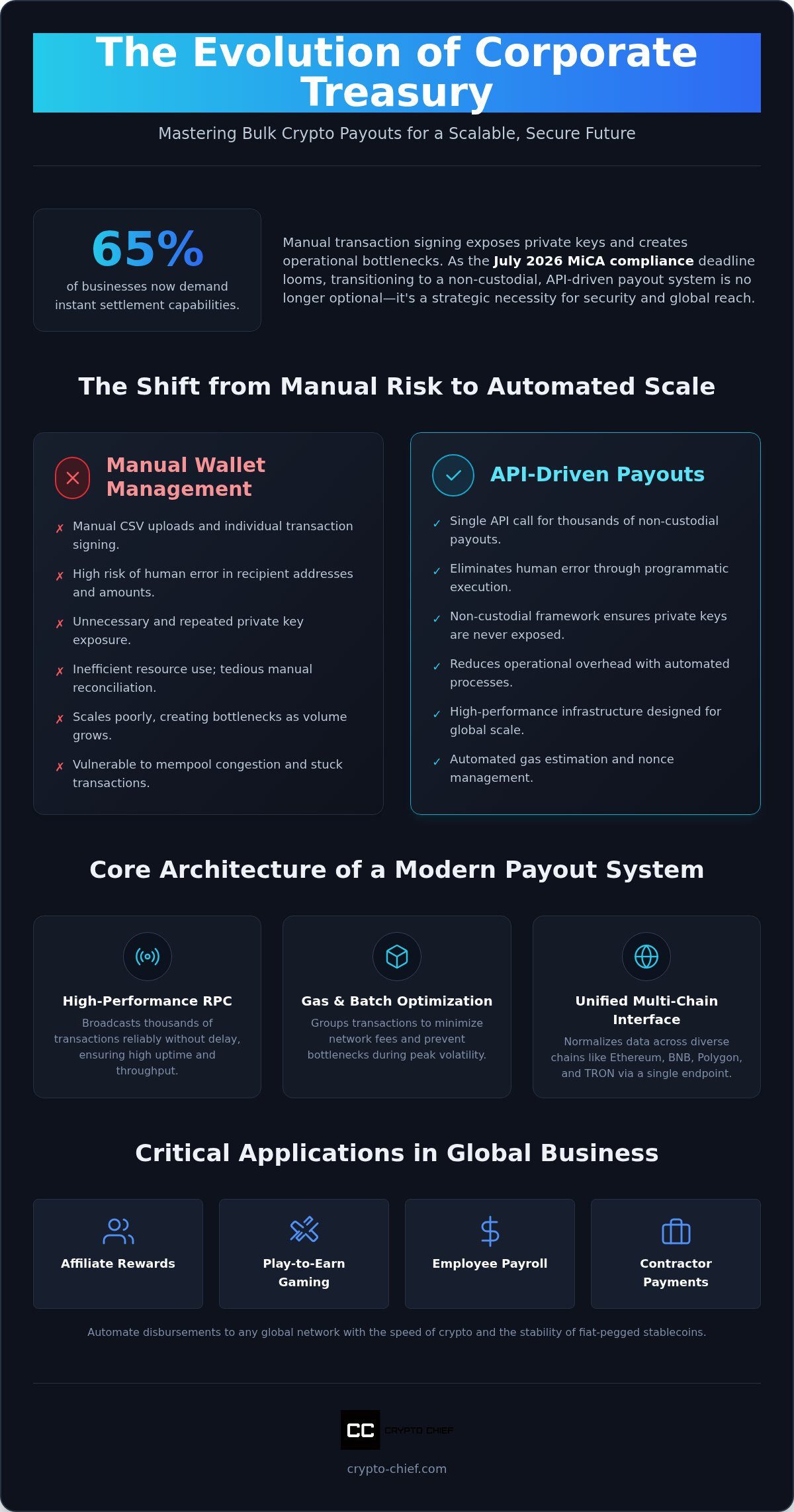
A bulk crypto payouts api represents the evolution of corporate treasury management. It's a programmatic interface that enables businesses to distribute digital assets to thousands of recipient addresses through a single, authenticated batch request. While early adopters relied on manual CSV uploads, the standard in 2026 has shifted toward fully automated, API-driven remittances that integrate directly into the application layer. This transition removes the friction of manual intervention, allowing your software to trigger disbursements based on predefined logic without human oversight.
Distinguishing between a basic wallet "send" function and professional-grade payout infrastructure is vital for scalability. A simple transaction is a localized event; a professional Crypto Processing API is a global engine designed for high-volume environments. Modern businesses utilize these systems across several critical sectors:
- Affiliate Rewards: Instant, programmatic distribution of commissions to a global network of partners.
- Play-to-Earn Gaming: Real-time asset transfers to players as they hit specific in-game milestones.
- Employee Payroll: Automated monthly or bi-weekly disbursements to a distributed, international workforce, often sourced through AI-driven platforms like BlueBridge Group Placement Corp.
- Contractor Payments: Seamless settlement for freelance services across multiple geographic borders.
For organizations looking to unify these automated financial workflows with broader workforce oversight, check out Trinity One to see how an AI-native operating system can bridge the gap between machine tasks and people management.
The Efficiency Gap: Manual vs. API-Driven Payouts
Manual wallet management is a liability. When an internal team manually signs transactions, they invite human error and unnecessary private key exposure. It's an inefficient use of resources that scales poorly as your user base grows. Automated systems close this gap by handling the heavy lifting of RPC gateway communication in the background. Professional infrastructure automates gas estimation and nonce management, ensuring transactions don't get stuck in the mempool during periods of peak network congestion. This automation reduces operational overhead significantly, as it eliminates the need for treasury teams to verify each individual transaction hash manually. You're left with a clean, high-performance system that maintains uptime and structural integrity regardless of transaction volume.
Solving the Global Remittance Problem
Blockchain technology bypasses the legacy SWIFT network and its associated international clearing delays. By integrating a bulk crypto payouts api, you're essentially building a private, global payment rail that operates 24/7. Stablecoins have become the primary medium for these disbursements because they provide the predictable value required for accounting and tax reporting. They offer the speed of crypto with the stability of fiat, making them the preferred choice for cross-border settlements. In the context of modern financial engineering, a bulk payout serves as the fundamental technical primitive that translates complex batch logic into scalable, on-chain execution.
The Technical Architecture of Mass Disbursements
The integrity of a mass disbursement system depends entirely on the underlying infrastructure that bridges your application logic with the blockchain. Developers require a bulk crypto payouts api that balances high-speed broadcasting with absolute security. At the core of this architecture are high-performance RPC nodes. These nodes serve as the entry point for your transaction batches, ensuring that thousands of individual transfers are propagated across the network without delay. Relying on a unified interface allows you to normalize data across diverse chains like Ethereum, BNB Smart Chain, Polygon, and TRON, eliminating the need to maintain separate codebases for each protocol.
Efficiency in 2026 is defined by gas optimization. While sequential broadcasting is a common starting point, professional-grade systems prioritize batching strategies. By grouping transactions into a single batch request, you reduce the cumulative data footprint on the ledger. This approach minimizes total network fees and simplifies nonce management. It's a structured method that prevents the bottlenecking often seen when individual transactions compete for block space during periods of high volatility.
RPC Gateway Integration for Reliable Broadcasting
A low-latency web3 rpc gateway is essential for high-volume payout windows where timing is critical. Network congestion can lead to dropped transactions or frustrating delays if your gateway lacks the necessary throughput. High-performance gateways manage these bursts by utilizing distributed node networks that offer global uptime. They are designed to handle network re-orgs gracefully, ensuring that your disbursement events remain stable even when the underlying chain experiences temporary instability. For developers, this means the infrastructure acts as a silent partner that manages the complexities of broadcasting so you can focus on your core product.
Security Protocols and Private Key Sovereignty
Security in mass disbursements is built on the principle of non-custodial sovereignty. You should never be required to surrender your private keys to a third party. Modern API flows are architected so that the service facilitates the transaction construction and broadcasting while the user retains absolute control over the signing process. This non-custodial model is often enhanced by multi-sig approvals for high-value batches, adding a layer of internal governance to the automated workflow. Before any funds leave your treasury, integrating AML Intelligence allows for real-time risk detection and funds tracing. This proactive screening ensures that your payouts remain compliant with global standards, protecting your business from interacting with high-risk addresses. If you're ready to build a more resilient system, you can explore our RPC Gateway to ensure your next batch is delivered with precision.
Custodial vs. Non-Custodial: Choosing the Right Infrastructure
Web3-native firms are increasingly prioritizing sovereignty over convenience. Why trust a third party with your treasury when you can maintain direct control? The "Trust Factor" is no longer a philosophical preference; it's a structural requirement for businesses operating under the MiCA regulation framework in 2026. Non-custodial payout systems allow you to act as your own bank, ensuring that your funds remain under your exclusive control until the moment they are broadcasted via a bulk crypto payouts api. This architectural choice provides the operational flexibility needed to navigate a volatile market, allowing for instant pivots without the delays of centralized approval queues.
The True Cost of Custody
Custodial models often present a facade of simplicity while masking significant operational friction. Hidden fees, such as restrictive withdrawal limits, unfavorable FX spreads, and mandatory holding periods, can quietly erode your margins. There's also the persistent shadow of counterparty risk. If a processor encounters a liquidity event or technical insolvency, your assets are trapped in their ecosystem, potentially for years. This is why a non-custodial crypto payment api has become the industry standard for 2026. It removes the middleman entirely, allowing for instant treasury management where you can move assets between protocols or wallets without waiting for third-party intervention. You maintain the keys; you maintain the power.
Pay-Per-Call: The Developer’s Budgeting Advantage
Traditional SaaS models often force businesses into rigid monthly subscriptions that don't align with actual usage. During development phases or low-volume cycles, these "zombie" costs accumulate without providing value. A more logical approach utilizes pay-per-call API usage fees backed by prepaid token balances. This model ensures you only pay for the infrastructure you consume, providing a grounded, utility-focused alternative to bloated retainers. It's an empowering shift for architects who need to reduce web3 api expenses while maintaining the ability to scale instantly. When your application triggers a massive disbursement event, the system responds with high-performance broadcasting; when it's idle, your budget remains untouched. This level of predictability is a silent advantage in the competitive landscape of 2026, where resource efficiency is just as vital as technical performance.
Integrating a Bulk Payout API: A 5-Step Workflow for Developers
Moving from infrastructure design to active deployment requires a methodical approach. Integrating a bulk crypto payouts api into your stack isn't just about sending a request; it's about building a resilient pipeline that handles authentication, compliance, and confirmation in a single, unified flow. This process ensures that your application can manage high-volume disbursements with the precision of a professional treasury system.
- Step 1: Environment Setup — Start by configuring your RPC nodes and generating secure API keys. This foundation ensures your requests are broadcasted through a high-performance gateway that maintains global uptime.
- Step 2: Treasury Authentication — Connect your non-custodial wallet to the processing interface. This step ensures you maintain private key sovereignty while allowing the API to construct and sign the necessary batch transactions.
- Step 3: Payload Construction — Define the JSON request. You'll need to specify recipient addresses, asset types, and precise amounts while accounting for different token decimals.
- Step 4: AML Screening — Run automated risk assessments on all recipient addresses. Utilizing AML Intelligence at this stage prevents your treasury from interacting with sanctioned or high-risk entities.
- Step 5: Execution and Monitoring — Broadcast the batch and trigger monitoring systems. Once the call is made, your focus shifts to tracking finality across the network via event streams.
Constructing the Batch Payout Request
A professional bulk crypto payouts api simplifies multichain logic by providing a standardized JSON-RPC structure for multi-send functions. Whether you're dealing with ERC-20, BEP-20, or TRC-20 standards, the workflow remains consistent across different protocols. You must handle varying decimal places for different tokens to ensure absolute precision in every transfer. A typical payload for a 1,000-address disbursement consists of an array of objects where each entry maps a unique recipient address to a hex-encoded value representing the specific token amount. This structure allows the engine to process the entire batch as a single technical primitive, reducing the complexity of your application code. To further streamline your development when interacting with external trading environments, you can check out Siebly.io JavaScript SDKs for a more unified approach to exchange-based asset management.
Tracking thousands of events simultaneously requires more than just manual polling. Using real-time blockchain webhooks allows your system to receive instant notifications as transaction finality is achieved on-chain. This event-driven approach automates reconciliation by mapping txids directly back to your internal database IDs, providing a clear audit trail for every disbursement. It also provides a vital safety net for handling failed transactions or low gas price stalls without manual intervention. If a transaction fails to confirm within a specific block window, your webhook listener can trigger an automatic retry or adjust gas parameters dynamically. Ready to streamline your deployment? You can register for an API key today and start building your first batch.
Scaling Global Payouts with Crypto Chief’s Unified Infrastructure
Scaling a disbursement system from a few dozen recipients to a global network requires infrastructure that grows without increasing complexity. Crypto Chief acts as the silent, powerful partner for your financial architecture, providing the high-performance engine necessary to drive massive operations. By integrating a bulk crypto payouts api through a unified platform, you ensure that your backend remains lean while your reach expands across multiple protocols. This structural integrity is vital for businesses that value uptime and logic over flashy, speculative features.
Reporting becomes a significant bottleneck as transaction volume increases. Disparate data formats across Ethereum, BNB Smart Chain, and Polygon often force developers to build complex translation layers. The Unified API normalizes these disparate data points into a single, cohesive format, allowing your accounting team to reconcile multichain transactions without manual intervention. This level of technical precision ensures that your reporting is as scalable as your payouts, providing a clear source of truth for every asset moved across your treasury.
Compliance is the final pillar of a scalable disbursement strategy. As you move into high-volume production, the risk of interacting with sanctioned or high-risk wallets increases. Integrated AML Intelligence automates the screening process, acting as a proactive shield for your business. It prevents payouts to restricted addresses before they are broadcasted, ensuring that your global operations remain within regulatory boundaries without slowing down the execution speed of your batch requests.
Unified Web3 Infrastructure: One API, Every Chain
Maintaining separate node clusters for every blockchain you support is an operational drain. Crypto Chief removes this friction by providing a unified gateway to the most relevant networks in the industry. Whether you are broadcasting on Tron or Polygon, the integration remains consistent. EventStream serves as the central nervous system of this infrastructure, providing real-time data for all payout events. This ensures that your system always has an accurate, up-to-the-second view of transaction statuses across the entire multichain landscape. Developers can access the full technical specifications at docs.crypto-chief.com for immediate implementation.
Future-Proofing Your Disbursement Strategy
The Web3 landscape moves fast. New L2 solutions and emerging chains can disrupt your workflow if your infrastructure is too rigid. A single integration point allows you to adapt to these shifts without rewriting your core payout logic. Scalability should not come with the burden of high overhead; the pay-per-call model ensures that your expenses align perfectly with your growth. This logical approach to budgeting allows you to scale from sandbox testing to high-volume production with total financial predictability. If you're ready to modernize your treasury, you can register for your Crypto Chief API key and start automating your global disbursements today.
Modernizing Your Global Disbursement Pipeline
Mastering mass disbursements in 2026 requires more than just a connection to the blockchain; it demands a robust architecture that prioritizes both security and operational efficiency. You've explored how a non-custodial framework preserves treasury sovereignty while high-performance RPC nodes ensure your batch transactions reach the network without delay. By shifting to a pay-per-call model, you eliminate the friction of bloated subscriptions and align your infrastructure costs directly with your actual usage. It's a strategic move that ensures your budget doesn't accumulate unnecessary overhead during low-volume cycles.
Integrating a professional bulk crypto payouts api is the final step in future-proofing your business against the complexities of a multichain landscape. This transition allows you to focus on your core product while the background infrastructure handles the heavy lifting of compliance and real-time monitoring. You're now equipped with the technical workflow needed to scale from initial sandbox testing to high-volume production with absolute precision. High-performance infrastructure remains the silent partner that empowers your global growth.
Start Automating Bulk Payouts with Crypto Chief and leverage a system built for stability and global reach. Build with confidence knowing your infrastructure is as resilient as your vision.
Frequently Asked Questions
How do I automate bulk crypto payouts safely?
Automating mass disbursements safely requires a non-custodial architecture where you retain absolute control over your private keys. By integrating a professional bulk crypto payouts api, you can programmatically sign batches within your own secure environment before broadcasting them through high-performance RPC nodes. This method eliminates the risk of third party fund mismanagement and ensures that your treasury remains under your exclusive governance while benefiting from automated execution and real time monitoring.
What is the difference between custodial and non-custodial payout APIs?
The primary distinction lies in who maintains control of the private keys and the underlying assets. In a custodial model, the provider holds your funds and executes transactions on your behalf, introducing significant counterparty risk and potential withdrawal delays. Conversely, a non-custodial API facilitates the construction and broadcasting of transactions while you maintain sovereign control of your keys. This empowers your business with instant liquidity and structural independence from the service provider's solvency.
Can I send bulk payments across different blockchains simultaneously with one API?
Yes, a Unified API allows you to normalize multichain data into a single, cohesive workflow for various protocols like Ethereum, Polygon, and Tron. Instead of managing separate clusters for each network, you send a standardized batch request to the gateway. The infrastructure then handles the specific protocol logic in the background, ensuring that your disbursements are executed across diverse chains without the need for multiple, complex integrations or separate, redundant codebases.
How are transaction gas fees handled in a bulk payout API?
Professional payout infrastructure automates the process of gas estimation and nonce management to prevent transactions from stalling during network congestion. By utilizing batching strategies, the system groups multiple transfers into a single on-chain event, which significantly reduces the cumulative cost per recipient. You pay the network fees directly from your non-custodial wallet, while the API service typically operates on a transparent pay per call model using prepaid token balances.
What are the security risks of mass crypto disbursements for businesses?
The most significant risks include private key exposure, manual reconciliation errors, and interaction with high-risk or sanctioned addresses. Using a professional API mitigates these threats by removing manual intervention and providing programmatic signing in a secure environment. Additionally, integrating automated screening tools ensures that your treasury doesn't interact with illicit entities, protecting your business from regulatory penalties while maintaining the structural integrity of your global payment pipeline and internal financial records.
How do I reconcile thousands of crypto transactions for accounting and tax purposes?
Efficient reconciliation relies on real time event streaming and webhooks that map transaction IDs back to your internal database in seconds. Instead of manual exports, the API provides a normalized data feed that tracks the finality of every disbursement across different chains. This automated reporting creates a clear audit trail for tax purposes, allowing your accounting team to verify thousands of payments through a single source of truth without manual verification or spreadsheet errors.
Is there a limit to how many addresses I can include in a single API call?
While specific network limits vary by blockchain protocol, professional API engines are designed to handle thousands of addresses by intelligently batching requests. For instance, some platforms allow up to 300 payouts per file for manual CSV uploads, but programmatic bulk crypto payouts api calls can scale much higher through sequential or parallel batching logic. This flexibility ensures that your application can handle massive distribution events without hitting the throughput bottlenecks associated with legacy systems.
How does AML screening work during the bulk payout process?
AML screening acts as a proactive shield by performing real time risk assessments on every recipient address before the funds are broadcasted. The system utilizes AML Intelligence to cross-reference addresses against global sanction lists and high-risk clusters. If a recipient is flagged, the API can automatically pause that specific payout while allowing the rest of the batch to proceed, ensuring your disbursements remain compliant with international regulatory standards like the EU's MiCA framework.
Tags: bulk crypto payouts api