
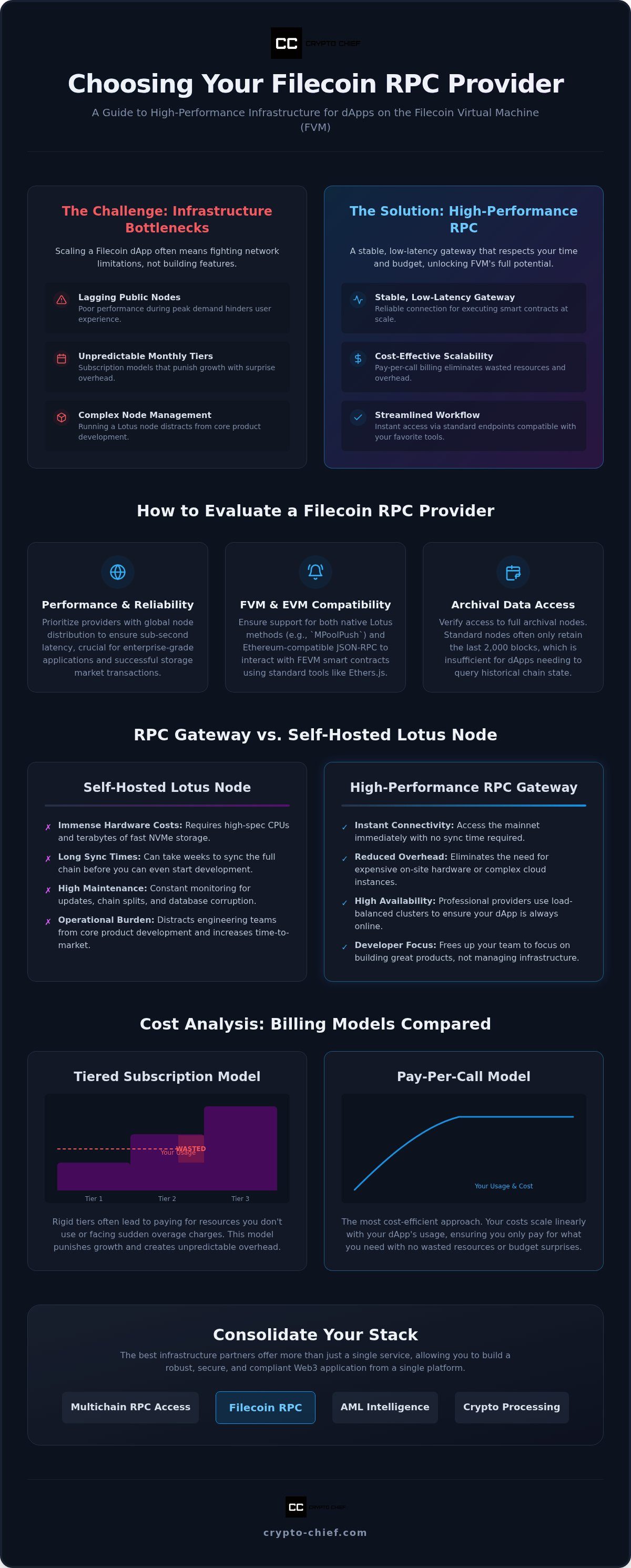
Scaling a decentralized application on Filecoin shouldn't feel like you're fighting the network's own architecture. While the Filecoin Virtual Machine (FVM) has unlocked massive programmability, the background infrastructure often remains the primary bottleneck for production-ready builds. You've likely felt the friction of public nodes that lag during peak demand, or perhaps you've struggled to find a filecoin rpc provider with a subscription model that doesn't punish your growth with unpredictable monthly tiers. Managing complex storage deals and executing smart contracts requires more than just a simple connection; it demands a stable, low-latency gateway that respects your engineering time and your budget.
This guide helps you navigate the technical landscape to choose a high-performance partner that balances speed, FVM compatibility, and cost-effective scalability. We will examine how to transition away from the heavy overhead of running a Lotus node toward a streamlined, pay-per-call infrastructure that secures your dApp's performance as we approach the Solstice network upgrade in late 2026. By the end, you'll understand how to optimize your stack for a future where storage and compute truly converge.
Key Takeaways
- Bridge the gap between storage and compute. Understand why selecting a high-performance filecoin rpc provider is essential for executing FVM smart contracts at scale.
- Prioritize reliability. Evaluate infrastructure based on global node distribution to maintain sub-second latency for enterprise-grade production environments.
- Optimize your budget. Compare the cost-efficiency of pay-per-call billing against traditional tiered subscriptions to eliminate wasted resources and unpredictable overhead.
- Streamline your workflow. Simplify integration by utilizing secure HTTPS and WSS endpoints compatible with standard Filecoin development kits.
- Consolidate your stack. Discover the advantages of a unified platform that integrates multichain RPC access with essential AML intelligence and crypto processing.
Understanding Filecoin RPC Infrastructure and the FVM
Remote Procedure Call (RPC) acts as the essential communication protocol that allows your application to interact with the blockchain. Instead of processing the entire chain history locally, your code sends requests to a remote server. This server, managed by a professional filecoin rpc provider, executes the command and returns the necessary data. It is the difference between building your own power plant and simply plugging into the grid to power your home. This bridge is what makes decentralized applications (dApps) functional for the end user.
The Filecoin ecosystem has matured significantly, transitioning from a specialized decentralized storage protocol into a fully programmable Layer 1 blockchain. This shift was driven by the Filecoin Virtual Machine (FVM), which introduced smart contract capabilities to the network. By 2026, the network's value proposition isn't just about data persistence; it's about the logic that governs that data. Developers now use RPCs to trigger automated storage deals, manage liquid staking protocols, and govern decentralized autonomous organizations (DAOs) directly on the storage layer.
Lotus Full Nodes vs. RPC Gateways
Running a local Lotus node remains the most decentralized approach, yet it presents immense technical hurdles for most teams. The hardware requirements are substantial, often demanding high-spec CPUs and terabytes of fast NVMe storage just to maintain state synchronization. Managing a full node involves constant monitoring for chain splits, software updates, and potential database corruption. These operational burdens distract from core product development and increase the time to market.
RPC gateways abstract these complexities by providing a stable interface for developers. By using an external filecoin rpc provider, you gain several advantages:
- Instant Connectivity: Access the mainnet immediately without waiting weeks for a full node to sync.
- Reduced Overhead: Eliminate the need for expensive on-site hardware or high-maintenance cloud instances.
- High Availability: Professional providers use load-balanced clusters to ensure your dApp remains online even during network spikes.
The Shift to FVM Compatibility
The introduction of the FVM changed the requirements for background infrastructure. Modern developers don't just need to check storage deals; they need to interact with the Filecoin EVM (FEVM). This allows for the execution of Solidity-based smart contracts on top of the storage market. In 2026, a capable provider must support Ethereum-compatible JSON-RPC methods. This ensures that standard tools like Hardhat, Foundry, or Metamask work seamlessly with the network. For technical implementation details, you can explore the documentation to see how these methods are structured for high-performance execution.
How to Evaluate a Filecoin RPC Provider
Selecting a filecoin rpc provider requires a deep look beyond simple uptime percentages. While high availability is a baseline requirement for any production environment, the geographical distribution of nodes directly impacts the performance of storage deal negotiations. High latency can lead to failed storage market transactions, especially when interacting with storage providers across different global regions. Organizations like the Filecoin Foundation emphasize the importance of a robust, decentralized network, and your choice of provider is the primary link to that stability. Beyond real-time performance, you must verify archival data access. Many standard nodes only retain the last 2,000 blocks. If your dApp needs to query historical chain state or verify older storage deals, access to archival nodes is non-negotiable.
Native Filecoin vs. Eth RPC Methods
The FVM's dual nature creates a unique technical challenge for developers. You need a provider that handles both native Lotus methods and the Ethereum-compatible JSON-RPC layer. While EthSendRawTransaction is standard for smart contract interaction, you'll still need MPoolPush for specific native message types. A high-tier filecoin rpc provider ensures that storage deal information remains accessible via standard Web3 libraries like Ethers.js, bridging the gap between decentralized storage and traditional EVM tooling. You can review the full method support list to ensure your specific technical requirements are met before deployment.
Scalability and Rate Limiting
Public endpoints are notorious for restrictive rate limits that can throttle your application during critical updates or network congestion. Production-grade infrastructure must offer burst capacity to handle sudden spikes in request volume without dropping connections. If you're building a high-volume platform, look for providers that move beyond restrictive tiered limits toward more flexible billing models. This ensures that your dApp remains responsive during the anticipated network version 29 Solstice upgrade in late 2026, where increased on-chain activity is expected to test the limits of weaker infrastructure. Reliability under load is what separates an elite service from a hobbyist tool.
Cost Analysis: Pay-Per-Call vs. Tiered Subscription Models
Financial planning for Web3 infrastructure has evolved significantly as we move through 2026. While many developers begin their journey using public Filecoin Mainnet RPC Endpoints, scaling a production-grade dApp requires a more predictable and efficient billing structure. The traditional SaaS model, built on rigid monthly tiers, often fails to align with the erratic traffic patterns of decentralized storage markets. You shouldn't have to pay for ten million requests when your current deployment only utilizes two million. This "shelfware" effect drains capital that could be better spent on smart contract audits or user acquisition. When you calculate the total cost of ownership (TCO), the delta between a flat-fee subscription and a flexible model can represent a substantial portion of your operational budget.
A high-performance filecoin rpc provider that utilizes a pay-per-call model offers a superior alternative for both startups and enterprise architects. Instead of monthly commitments, you maintain a prepaid balance where every API call is deducted with surgical precision. This ensures that your infrastructure costs scale linearly with your actual user base, rather than jumping in expensive increments. It's a grounded, utility-focused approach that treats RPC access like a commodity service rather than a luxury subscription. By 2026, the market demand has shifted toward these transparent models, as they allow developers to accurately forecast expenses based on projected dApp usage rather than arbitrary tier boundaries.
The Advantages of Pay-Per-Call
Prepaid balances allow for complete transparency in token-based charging. When you remove the pressure of "use it or lose it" monthly limits, you can focus on optimizing your code rather than monitoring your request quotas. This model is particularly effective for FVM developers who may experience bursts of activity during high-volume storage deal cycles but remain quiet during off-peak hours. It empowers builders to experiment without the fear of triggering a massive bill for a service they've only just begun to scale.
Hidden Costs in Web3 Infrastructure
Beyond the base request fee, developers must account for archival node surcharges and data egress fees that often lurk in the fine print. The true cost of an unreliable filecoin rpc provider isn't just the invoice; it's the lost revenue caused by downtime in decentralized storage marketplaces. In 2026, cost-efficiency is defined as the ability to maintain high-performance uptime with zero wasted request capacity through a unified, pay-per-call billing system. For teams looking to integrate these services alongside other financial tools, exploring a crypto processing API can further consolidate your operational overhead into a single, manageable platform.
Integrating Filecoin RPC into Your Development Workflow
Seamless integration transforms a simple endpoint into a functional backbone for your application. Once you've selected a filecoin rpc provider, the first step involves configuring your environment with compatible SDKs such as Filecoin.js or the native Lotus API client. You'll primarily interact with two protocol types: HTTPS for stateless JSON-RPC queries and WSS (WebSockets) for real-time state subscriptions. Security remains paramount in 2026. Don't hardcode your API keys directly into client-side scripts. Instead, utilize environment variables and server-side proxies to shield your credentials from unauthorized access. Regular monitoring of response times and success rates ensures that your infrastructure keeps pace with the network's evolving demands.
Reliability under pressure is the hallmark of a professional build. As you move from testnet to mainnet, your integration strategy must account for the unique data structures of the Filecoin protocol. This means moving beyond simple balance checks to managing complex sector states and miner reputations. A well-integrated stack doesn't just pull data; it anticipates the needs of the FVM by maintaining a clean, low-latency connection to the chain state at all times.
Backend Integration with JSON-RPC
Formatting requests for Filecoin-specific Lotus methods requires attention to detail, especially when handling CID (Content Identifier) structures. Unlike standard Ethereum transactions, storage workflows are inherently asynchronous. Your backend must account for the delay between message submission and on-chain finality. Implementing robust fallback mechanisms is essential for mission-critical applications. If your primary filecoin rpc provider experiences a momentary delay, your system should automatically pivot to a secondary endpoint to maintain service continuity and data integrity.
Webhooks and Event Streaming
Real-time monitoring of chain events is no longer a luxury; it's a requirement for modern dApps. Automating responses to successful storage deals or FVM contract triggers allows for a more responsive user experience. By leveraging real-time blockchain webhooks, you can build an event-driven architecture that reacts instantly to network state changes without constant polling. This reduces unnecessary API overhead and improves overall system efficiency. To begin building your high-performance infrastructure today, you can access premium Filecoin nodes through our unified developer platform.
Crypto Chief: A Unified Infrastructure for Filecoin Developers
Building a sophisticated decentralized storage application requires a foundation that handles more than just simple data queries. Crypto Chief serves as a high-performance filecoin rpc provider that consolidates the fragmented needs of modern Web3 engineering into a single, cohesive environment. By moving away from isolated services, you eliminate the friction of managing multiple API providers and disconnected billing cycles. It acts as a silent, powerful partner that has already solved the complex problems of node maintenance so you don't have to. This unified approach allows your team to focus on FVM smart contract logic while the platform maintains global availability and structural integrity.
The transition from a prototype to a production-ready dApp often reveals hidden complexities in security and financial handling. Most developers find that a standalone RPC connection isn't enough to sustain a commercial ecosystem. You need a way to verify the legitimacy of incoming funds and a mechanism to process payments without introducing third-party custody. Crypto Chief addresses these practical challenges by offering a suite of tools designed for builders who value uptime, scalability, and logic over marketing fluff. It is a steady, knowledgeable guide that empowers you to build with the confidence of an elite enterprise.
Beyond Simple RPC Endpoints
The platform extends its utility far beyond standard node access by providing a comprehensive toolkit for financial integrity. Developers can seamlessly integrate non-custodial crypto processing to handle on-chain payments directly within their dApp, ensuring that users retain control of their assets. For applications operating in increasingly regulated environments, the AML Intelligence API provides automated risk detection to flag suspicious activity before it reaches your smart contracts. Detailed technical specifications for all supported methods are available at docs.crypto-chief.com, offering a clear, methodical path for rapid deployment.
Reliability and Performance in 2026
In 2026, uptime is the primary currency of trust in the decentralized storage market. Crypto Chief provides elite global performance that supports enterprise-level Filecoin applications, ensuring that storage deal negotiations and FVM contract executions never stall due to regional outages or network congestion. Cost optimization is built directly into the service through a unified Web3 developer platform that utilizes a transparent pay-per-call model. This system uses a prepaid balance to ensure you only pay for the exact volume of requests your application generates. It allows you to scale from a lean MVP to a massive global production environment with total cost predictability and zero wasted resources.
Scaling with Precision in the FVM Era
The shift toward a programmable Filecoin network has redefined the standards for production-grade infrastructure. Success in this environment requires a balance of low-latency execution, archival data access, and a cost model that aligns with your actual growth. By moving away from the overhead of local nodes and the limitations of tiered subscriptions, you secure a foundation that is both resilient and economically sound. The complexity of the Filecoin Virtual Machine demands a partner that offers more than just a simple connection; it requires a platform built for the rigorous demands of decentralized storage.
Choosing a specialized filecoin rpc provider involves finding a partner that understands the nuances of the FVM. A unified developer platform that combines high-performance RPC access with AML intelligence and crypto processing ensures your application is ready for the complexities of the 2026 landscape. This strategic consolidation simplifies your workflow, allowing you to deploy faster and scale with confidence. When your infrastructure is a silent, powerful partner, you can focus entirely on the logic of your dApp.
Build faster with Crypto Chief’s high-performance Filecoin RPC and leverage our pay-per-call pricing to eliminate monthly tiers and wasted resources.
The infrastructure for the next generation of decentralized storage is ready. It's time to start building.
Frequently Asked Questions
What is a Filecoin RPC provider?
A filecoin rpc provider is a service that hosts and maintains full nodes, offering a gateway for developers to interact with the blockchain without local hardware. These providers handle the technical complexities of chain synchronization and state management. By using a professional provider, you gain high-performance access to the Filecoin mainnet through secure HTTPS or WSS endpoints, allowing your dApp to query block data or submit messages with minimal latency.
How do I connect my dApp to the Filecoin mainnet?
You connect by integrating the provider's unique API endpoint into your application's configuration using a standard Web3 library or a Filecoin-specific SDK. Typically, this involves setting up an environment variable for your secure HTTPS URL and including your API key in the request headers. Once connected, your application can send JSON-RPC requests to interact with the FVM, manage wallet balances, or monitor the status of on-chain messages across the network.
Is there a free Filecoin RPC endpoint for testing?
Yes, many infrastructure providers offer public, read-only endpoints for initial testing and development purposes. However, these free services often come with strict rate limits and lack the archival data access required for production environments. For reliable development in 2026, most teams utilize a professional filecoin rpc provider that offers a pay-per-call model. This allows for low-cost experimentation while ensuring the high throughput and stability needed for a production-ready dApp launch.
What is the difference between Filecoin RPC and IPFS?
Filecoin RPC is a protocol used to interact with the blockchain's state and consensus layer, whereas IPFS is a peer-to-peer network for content-addressed data storage and retrieval. While both belong to the same ecosystem, an RPC provider allows you to execute smart contracts and manage storage deals on-chain. In contrast, IPFS focuses on the distributed transport of data. You often use both together to store data on IPFS and secure its persistence via Filecoin.
Does Filecoin support the Ethereum JSON-RPC API?
Yes, Filecoin provides native support for the Ethereum JSON-RPC API through the Filecoin Virtual Machine (FVM). This compatibility allows developers to use familiar Ethereum tools, such as Hardhat, Foundry, and Ethers.js, to deploy and interact with smart contracts on the network. A modern provider ensures that both native Lotus methods and Ethereum-compatible calls are supported, bridging the gap between decentralized storage and the broader EVM ecosystem for seamless integration.
How much does a Filecoin RPC provider cost?
Costs vary significantly between providers, but the industry has shifted toward more transparent models in 2026. Traditional providers often use tiered subscription plans that charge a flat monthly fee regardless of actual usage. In contrast, Crypto Chief utilizes a pay-per-call API model where you maintain a prepaid balance. This approach ensures you only pay for the specific requests your application makes, eliminating the wasted overhead associated with unused capacity in rigid monthly tiers.
What is the Filecoin Virtual Machine (FVM) and how does it affect RPC?
The FVM is a WASM-based execution environment that brings smart contract programmability to the Filecoin network. It affects RPC by introducing new Ethereum-compatible methods and requiring nodes to handle complex contract state transitions. For developers, this means your chosen provider must support the FEVM (Filecoin EVM) to execute Solidity contracts. In 2026, robust FVM support is essential for automating storage markets and building decentralized finance protocols directly on top of the storage layer.
Can I use a Filecoin RPC provider for storage deals?
Yes, you can use an RPC provider to programmatically manage storage deals by interacting with the built-in storage market actors. Through specific Lotus API methods like ClientStartDeal, your application can negotiate terms with storage providers and monitor deal status on-chain. Professional gateways abstract the complexity of these interactions, allowing you to automate data persistence workflows without the hardware overhead of running a local node or managing the underlying storage deal state manually.
Tags: filecoin rpc provider