
By March 31, 2026, the crypto payment landscape will undergo a fundamental shift that effectively turns one of the world's largest processors into a traditional bank. As you weigh the merits of the coinbase commerce api vs non-custodial gateways, you aren't just choosing a tool; you're deciding who holds the keys to your business's financial future. You've likely built your current infrastructure on the promise of decentralized efficiency, only to find that the new Coinbase Business model requires you to surrender private keys and navigate strict regional eligibility. It's a significant pivot for any builder who values the core principles of blockchain technology and global accessibility.
This transition changes everything for developers who prioritize sovereignty and performance. You will discover why the shift to custodial business accounts introduces unnecessary counterparty risk and how non-custodial APIs offer a more flexible alternative for modern enterprises. We will examine the operational benefits of maintaining self-custody, from near-instant settlement directly to your wallet to avoiding the service interruptions that now affect users outside the United States and Singapore. This guide provides a clear path to maintain your structural integrity with a builder-centric approach that replaces complex custodial migrations with lean, high-performance infrastructure.
Key Takeaways
- Prepare for the March 31, 2026, sunset of the Coinbase Commerce portal and understand how the transition to a custodial model impacts your legacy integrations.
- Evaluate the fundamental architectural differences between the coinbase commerce api vs non-custodial alternatives to determine which model best aligns with your commitment to self-sovereignty.
- Compare the financial implications of percentage-based transaction fees against a more predictable pay-per-call pricing structure that decouples your overhead from your business volume.
- Identify the geographic and regulatory constraints of the new Coinbase Business platform and learn how to maintain global service without regional eligibility restrictions.
- Explore how to future-proof your tech stack by unifying processing, RPC gateway access, and real-time event streaming into a single, non-custodial integration.
The 2026 Shift: Coinbase Commerce vs. Coinbase Business
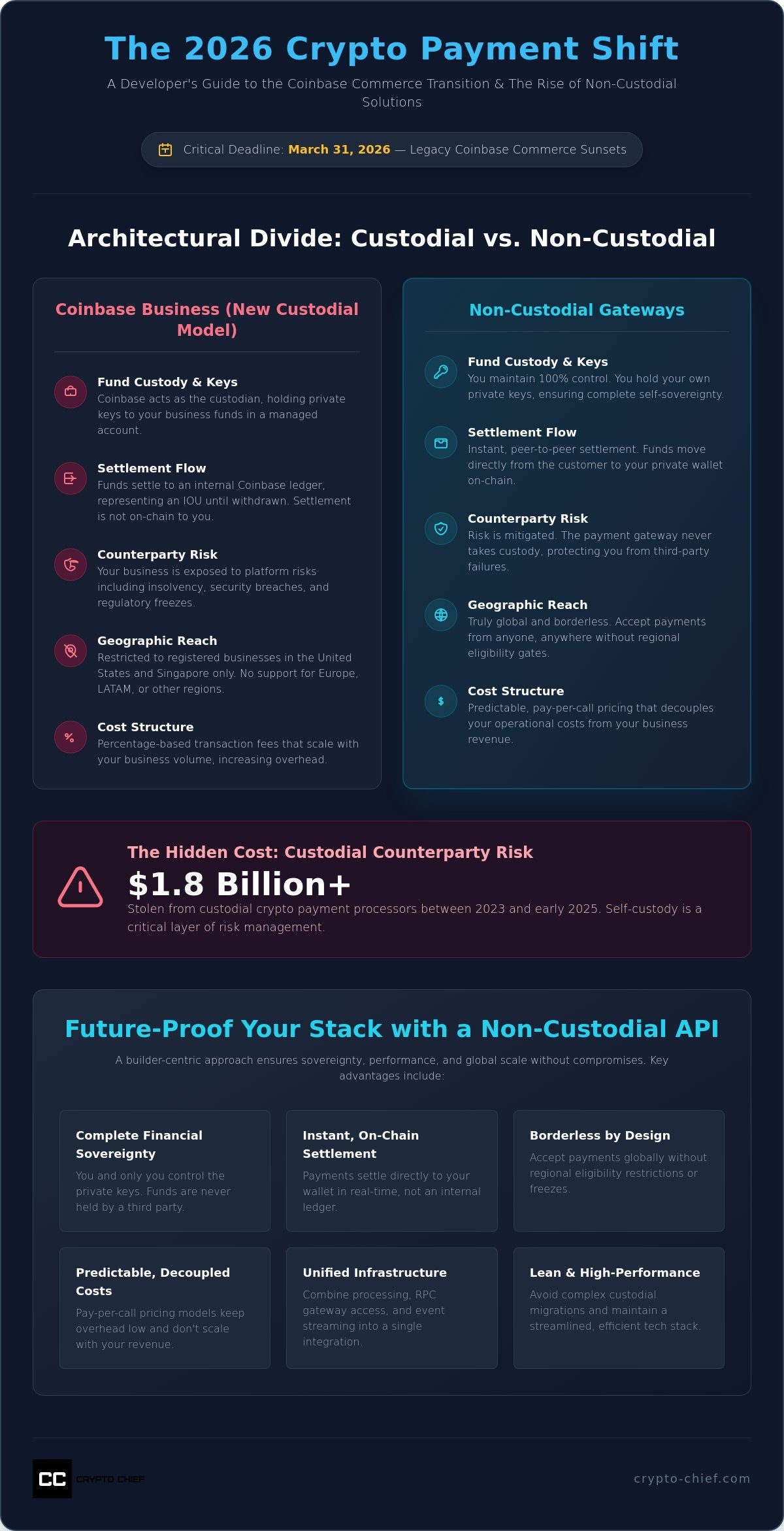
March 31, 2026, marks the end of an era for the original Coinbase Commerce portal. After this date, the legacy interface becomes permanently inaccessible, forcing a mandatory migration to the new Coinbase Business platform. This isn't a simple UI refresh; it's a fundamental structural pivot from a merchant-controlled environment to a managed operating account model. In this new ecosystem, Coinbase acts as the custodian of your business funds, a move that fundamentally changes the debate of coinbase commerce api vs non-custodial solutions for modern enterprises.
If you currently manage funds through the legacy Commerce dashboard, you must initiate withdrawals before the sunset date. Failing to do so could complicate your access to capital as the platform transitions to its new custodial architecture. This shift highlights a growing divide in the digital economy. On one side, we see managed banking services that prioritize regulatory ease for specific jurisdictions. On the other, Web3 infrastructure solutions prioritize technical sovereignty and direct ownership of assets. To understand why this distinction is vital, consider the basic mechanics of a Cryptocurrency wallet. Direct control over private keys ensures that no third party can freeze your assets or restrict your access based on internal policy changes.
What is Changing for Developers?
Engineering teams face a significant technical overhaul during this transition. The new platform replaces legacy API keys with JWT-based authentication, requiring a rewrite of many existing connection strings. Beyond security protocols, the backend logic shifts toward a stablecoin-first approach, primarily focusing on USDC. While this simplifies reporting, it disrupts automated workflows for those relying on native assets. When analyzing the technical trade-offs of the coinbase commerce api vs non-custodial stack, the loss of direct key management is often the most significant hurdle. If your settlement logic depends on immediate on-chain confirmation to a private address, the custodial delay inherent in a managed account will likely require a complete rethink of your transaction handling. For developers who also build tools for derivative markets, you can visit SPX to SPY Converter to integrate real-time strike price data into your financial workflows.
The Regional Eligibility Gap
The most immediate hurdle for many users is geographic. As of July 2026, Coinbase Business availability is restricted to registered businesses in the United States and Singapore. International merchants operating in Europe, Latin America, or other parts of Asia are essentially being offboarded from the ecosystem. For global dApps, this creates a critical dilemma: wait for expanded support that may never arrive or migrate to a borderless Crypto Processing API. Non-custodial APIs remain the only viable choice for businesses that need to accept payments from a global customer base without hitting regional roadblocks or eligibility freezes.
Custodial vs. Non-Custodial: The Architectural Divide
The architectural choice between a coinbase commerce api vs non-custodial gateway defines your relationship with your capital. Ownership is binary. Either you control the private keys to your business treasury, or you entrust that responsibility to a third party that manages a collective pool of assets. In the new Coinbase Business model, the platform holds the "keys to the kingdom," effectively turning your crypto assets into an IOU on an internal ledger. This differs fundamentally from non-custodial systems where funds move directly from the customer to your private wallet address without an intermediary stopping point.
This distinction isn't just philosophical; it's a matter of risk management. Between 2023 and early 2025, over $1.8 billion was stolen from custodial crypto payment processors through high-profile hacks. When you use a custodial provider, you're exposed to counterparty risk, including platform insolvency, security breaches, or regulatory freezes that can lock your operational capital. Non-custodial APIs mitigate this by ensuring that you're the only entity with the power to move or spend your funds. Settlement happens on-chain in real time, rather than waiting for a platform's internal batching or withdrawal windows. This level of professional oversight is also critical in logistics, where the Certified Claims Professional Accreditation Council, Inc. (CCPAC) provides the accreditation necessary to manage freight claims and minimize operational risk.
The Case for Self-Custody in 2026
Direct-to-wallet payments represent the technical ideal of Web3. By eliminating the middleman, you reduce the attack surface of your financial stack. You aren't just securing your own funds; you're also protecting your brand from the fallout of a third-party platform's failure. This model also provides superior integration flexibility. Instead of being forced into a rigid, branded checkout flow, a raw API allows you to build bespoke, white-label experiences that keep your users within your own ecosystem. It's about maintaining a seamless journey from cart to confirmation.
Understanding the Custodial Trade-off
The appeal of the "all-in-one" custodial model usually centers on simplified reporting and compliance. However, this often leads to vendor lock-in and a loss of granular control over your data. You don't have to sacrifice compliance to maintain sovereignty. Modern non-custodial solutions like Crypto Chief provide the necessary infrastructure to handle global payments while keeping you in the driver's seat. You can integrate sophisticated AML Intelligence to monitor transactions for risk without ever surrendering custody of your assets. This approach balances the need for institutional-grade security with the technical freedom that developers require to scale globally. If you're ready to build on a foundation that prioritizes your autonomy, consider exploring how a unified, non-custodial stack can simplify your operations.
API Performance and Cost: Managed Fees vs. Pay-Per-Call
Profitability in the Web3 space often hinges on the efficiency of your underlying stack. When analyzing the coinbase commerce api vs non-custodial landscape, the most immediate difference appears on your balance sheet. Managed platforms typically rely on percentage-based transaction fees, which can erode margins as your business scales. For instance, the new Coinbase Business model charges a 1% fee on completed payment link transactions. While this might seem negligible for small volumes, high-growth merchants find that these costs scale linearly with their success, creating a perpetual tax on every dollar earned.
Beyond the surface level transaction fees, managed systems often introduce friction through withdrawal charges and internal ledger delays. In contrast, the pay-per-call revolution offers a cleaner financial model. By using prepaid API tokens, you decouple your operational costs from your transaction volume. You pay for the infrastructure you consume, rather than the value of the assets moving through it. This shift allows for more predictable budgeting. You can forecast expenses based on projected API calls rather than trying to guess how much a percentage-based cut will impact your bottom line during a market surge.
Efficiency through Infrastructure
A unified API approach streamlines multichain operations by aggregating data into a single, performant endpoint. This reduces the technical debt associated with managing separate integrations for every network you support. Reliability is further bolstered by dedicated RPC Gateways, which serve as the high-speed bridge between your application and the blockchain. Whether you're querying data via Ethereum RPC or processing high-frequency transactions on Polygon RPC, direct infrastructure access ensures that your services remain responsive. This level of granular control is rarely available in "all-in-one" managed solutions, which often prioritize platform stability over individual developer flexibility.
The Developer's ROI
Time-to-market is a critical metric for any engineering team. While managed SDKs promise a quick start, they often lock you into a cycle of platform-driven migrations. The 2026 sunset of Coinbase Commerce serves as a stark reminder that building on a proprietary layer puts your timeline at the mercy of the provider's roadmap. Stable, non-custodial infrastructure provides a more resilient foundation, reducing the long-term maintenance costs associated with forced updates. Pay-per-call is a utility-based pricing model that charges only for active requests. This ensures that you aren't paying for idle capacity, allowing you to optimize your return on investment as you build and scale your global dApp. For businesses managing diverse portfolios alongside their tech stack, TradingPRO offers specialized trading infrastructure that complements a performance-driven approach to finance.
Strategic Selection: When to Choose Non-Custodial over Coinbase
Selecting a payment infrastructure requires a cold-eyed assessment of your long-term roadmap. To simplify this process, PaySelect helps businesses compare and select the most suitable payment gateways and cross-border solutions. The decision between the coinbase commerce api vs non-custodial gateways often boils down to a single question: do you prioritize regulatory convenience or technical sovereignty? While managed accounts offer a familiar banking experience, they introduce a layer of platform risk that can disrupt your operations without warning. The 2026 migration deadline serves as a primary example of how a third party's strategic pivot can force an entire ecosystem to rebuild their financial stack from the ground up.
Your geographic footprint is perhaps the most decisive factor. If your customer base or business registration lies outside the United States or Singapore, the new Coinbase Business model is effectively closed to you. For international merchants, non-custodial APIs aren't just an alternative; they're a necessity for maintaining global service. This borderless nature ensures that your ability to accept payments is never throttled by a provider's regional licensing constraints or shifting policy focus. It's a matter of ensuring that your business remains operational regardless of where your customers are located.
Risk profiles also dictate this choice. Can your business afford a custodial freeze or a platform-wide outage? When you rely on a managed ledger, you're at the mercy of the provider's uptime and internal security protocols. Non-custodial systems allow you to bypass these centralized points of failure. By interacting directly with the blockchain, you ensure that your treasury remains accessible even if a service provider experiences technical difficulties or regulatory pressure. To complement this sovereign approach, check out IronClad Family to learn how to organize and protect your other critical digital assets and documents.
Ideal Use Cases for Non-Custodial APIs
Decentralized Finance (DeFi) protocols remain the strongest candidates for self-custody. These platforms require absolute on-chain transparency and instant settlement to maintain liquidity. Similarly, global e-commerce brands serving regions with limited banking access rely on the permissionless nature of blockchain to bypass legacy hurdles, much like how the Quality Comprehensive Health Center provides essential support for underserved populations by removing barriers to care.
When Coinbase Business Makes Sense
Managed solutions have their place, particularly for early-stage startups based in the US or Singapore that require integrated fiat off-ramps from day one. If your team lacks internal Web3 development resources to securely manage private keys, a custodial partner can bridge that gap. However, even these businesses should maintain an exit strategy to avoid future lock-in. For a deeper dive into building a resilient tech stack, consult The Architect’s Guide to a Unified Web3 Developer Platform in 2026. If you're ready to bypass regional restrictions and reclaim control of your treasury, integrate our non-custodial processing API to secure your global operations.
Future-Proofing with Crypto Chief’s Non-Custodial API
Navigating the technical landscape of the coinbase commerce api vs non-custodial models reveals that sovereignty is often the best defense against platform volatility. As the 2026 deadline approaches, developers need more than just a replacement; they require an upgrade that unifies their entire stack. Staying at the forefront of these architectural shifts is easier when engaging with the developer community at athens.cityjsconf.org, where JavaScript and AI experts share strategies for building resilient systems. By consolidating your infrastructure, you can manage crypto processing, RPC gateway access, and compliance monitoring through a single, high-performance interface. This approach removes the friction of managing disparate services while ensuring you never surrender control of your business treasury.
Real-time responsiveness is the hallmark of a mature Web3 application. Through EventStream, you can implement sophisticated webhooks that provide instant payment confirmation across multiple chains. This eliminates the polling delays common in custodial systems and allows for a more reactive user experience. Maintaining rigorous compliance standards doesn't require a custodial middleman. You can integrate AML Risk Detection directly into your transaction flow, allowing you to screen for illicit activity while keeping your funds in your own private wallet. This balance of security and autonomy is essential for scaling in an increasingly regulated environment.
Integration Workflow Overview
Migration is a logical, step-by-step process. You begin by setting up a non-custodial wallet and generating a unique API key within your dashboard. Once authenticated, you can configure webhooks to monitor multichain events, ensuring your backend is always synchronized with the ledger. For those coming from a legacy environment, the Crypto Chief Documentation provides comprehensive quick-start templates that mirror familiar patterns while introducing superior flexibility. This streamlined path ensures that your transition is completed long before the Commerce portal becomes inaccessible.
The Infrastructure Advantage
Mission-critical applications require a foundation built on global uptime and architectural resilience. By leveraging high-performance RPC nodes, you ensure that your dApp remains responsive even during periods of intense network congestion. Whether you are scaling a prototype or managing an enterprise-level platform, multichain support for Bitcoin, BNB, Tron, and other major networks allows you to meet your customers wherever they transact. For a deeper technical dive into optimizing your setup, see our Non-Custodial Crypto Payment API: The Developer’s Guide to Secure Web3 Processing. Adopting this infrastructure-first approach replaces the uncertainty of managed banking with the reliability of a unified tech stack that scales alongside your vision.
Securing Your Sovereign Tech Stack
The 2026 sunset of legacy commerce tools represents a clear fork in the road for digital merchants. While the shift toward custodial banking may offer convenience for some, it fundamentally compromises the technical sovereignty that defines the Web3 era. By evaluating the coinbase commerce api vs non-custodial alternatives, you've seen that maintaining control over your private keys is the only way to eliminate counterparty risk and avoid geographic service interruptions. True global accessibility requires infrastructure that isn't tethered to regional banking licenses. For businesses navigating these borderless markets, block3finance.com offers the crypto accounting expertise and global research needed to maintain a clean and compliant financial profile.
You can scale your global operations without the burden of regional eligibility or the overhead of percentage-based transaction fees. Our infrastructure provides the structural integrity you need to handle processing, RPC gateway access, and AML intelligence through a single, performant integration. This pay-per-call model ensures that your costs remain predictable as you expand into new markets. It's time to build on a foundation that values your autonomy and your bottom line.
Build your non-custodial payment infrastructure with Crypto Chief and secure your business against platform-driven volatility. Your vision deserves a silent, powerful partner that empowers your growth without restrictions.
Frequently Asked Questions
Is Coinbase Commerce still self-custodial in 2026?
No, the self-custodial version of Coinbase Commerce effectively ends on March 31, 2026. After this deadline, the platform transitions entirely to the Coinbase Business model, which is a custodial service. This means Coinbase holds the private keys to your business funds. If you value self-sovereignty, you'll need to move to a non-custodial provider to maintain direct control over your treasury assets. This transition marks a fundamental shift from user-controlled infrastructure to a managed model.
What is the difference between a custodial and non-custodial crypto API?
A custodial API involves a third party holding your private keys, while a non-custodial API allows you to maintain full ownership of your assets. This architectural difference is the core of the coinbase commerce api vs non-custodial debate, as it determines your exposure to counterparty risk and platform freezes. In a custodial model, the provider acts as a financial intermediary. Non-custodial systems facilitate direct on-chain transactions where you retain exclusive control. It's about choosing between banking and infrastructure.
Can I use Coinbase Business if my company is registered outside the US or Singapore?
No, Coinbase Business is currently restricted to registered entities in the United States and Singapore as of July 2026. This geographic limitation is a major factor when weighing coinbase commerce api vs non-custodial alternatives. Merchants outside these jurisdictions must seek borderless solutions. Non-custodial APIs allow you to reach a global audience without the regional roadblocks found in centralized custodial models. This ensures your global dApp remains operational regardless of where you're registered.
How do I migrate my legacy Coinbase Commerce API integration?
Migrating a legacy integration requires a significant technical overhaul because the new Coinbase Business platform uses a different authentication architecture. You'll need to replace legacy API keys with JWT-based authentication and update your backend to handle custodial settlement logic. Many developers find this an opportune time to switch to a more stable, non-custodial infrastructure that avoids the risk of future platform-driven sunsets or forced migrations. It's a chance to build a more resilient financial foundation.
What are the benefits of a pay-per-call pricing model for crypto processing?
A pay-per-call model decouples your operational overhead from your transaction volume by charging only for active infrastructure usage. Instead of losing a percentage of every sale to the processor, you pay only for the API calls your application makes. This utility-based approach provides superior cost predictability for high-volume merchants. It ensures that your margins remain intact during market surges, as you aren't penalized for processing larger payments. It is a lean, performance-oriented financial structure.
Does a non-custodial API provide AML and risk detection features?
Yes, sophisticated non-custodial APIs offer integrated AML Intelligence to monitor on-chain activity for risk. You can screen incoming transactions against global sanctions lists and detect illicit patterns without surrendering custody of your assets. This allows your business to maintain high compliance standards while preserving the security benefits of self-custody. It proves that regulatory oversight and technical sovereignty can coexist within a modern, builder-centric tech stack. Security and compliance no longer require a custodial middleman.
What happens to my funds if I don't migrate from Coinbase Commerce by March 31, 2026?
If you fail to withdraw funds or migrate before the March 31, 2026, deadline, the Commerce portal will become permanently inaccessible. While Coinbase may provide a recovery path through their primary support channels, your immediate access to capital will be disrupted. For those who may need to manage unexpected liquidity issues during this time, QuickCashDirect provides access to short-term financial solutions like cash advances. It's critical to move your assets to a secure, private wallet well before this date to ensure continuous liquidity and avoid the complexities of legacy account recovery. Proactive treasury management is essential for avoiding operational downtime.
Which blockchains are supported by non-custodial processing APIs?
High-performance non-custodial APIs typically offer multichain support across major networks including Bitcoin, Ethereum, BNB Smart Chain, Polygon, and Tron. Some specialized providers also support emerging chains like TON or Litecoin. This broad coverage allows you to reach a global audience without being locked into a single ecosystem. By utilizing a unified API, you can manage these diverse assets through a single integration point while maintaining full control over each wallet. It is a scalable solution.