
Your search for a decentralized payment gateway might lead you to a platform that no longer aligns with the "not your keys, not your coins" ethos. With the 2026 transition of Coinbase Commerce into a custodial business model, the technical landscape has shifted beneath the feet of many dApp developers. Choosing between the coinbase commerce api vs non-custodial processing is no longer just about ease of use; it's a fundamental decision regarding who controls your liquidity and how much of your margin is sacrificed to transaction fees.
You likely built on Web3 to escape the restrictive fees and geographic gatekeeping of traditional finance, yet you're now facing 1% transaction costs and platform-specific silos that limit your reach. This article clarifies the structural divide between Coinbase’s managed infrastructure and true non-custodial processing. You'll discover how to regain control over your private keys, reduce overhead through pay-per-call models, and implement multichain support that extends far beyond the Ethereum and Base ecosystems. We will compare the latest 2026 API updates and architectural trade-offs to help you build a more resilient, cost-effective payment stack.
Key Takeaways
- Understand the structural shift in the coinbase commerce api vs non-custodial processing debate, where the 2026 transition to custodial services forces a choice between platform convenience and true financial sovereignty.
- Evaluate how a smart contract factory pattern impacts your control over funds compared to direct, non-custodial infrastructure that keeps you in possession of your private keys.
- Learn to bypass the limitations of stablecoin-first platforms by utilizing a unified API that normalizes data across diverse chains like Bitcoin, TRX, and TON.
- Discover the cost benefits of a pay-per-call model that eliminates high transaction percentage fees, allowing for better margin preservation as your dApp scales.
- Identify why integrating AML intelligence and real-time event streaming directly into your payment stack removes the technical friction of managing fragmented third-party tools.
Defining the Landscape: Managed vs. Pure Non-Custodial Processing
The 2026 digital economy demands a precise understanding of asset ownership. While many platforms claim to offer decentralized solutions, the technical reality often involves a "middle-man" that complicates the coinbase commerce api vs non-custodial processing choice. For a developer, the primary distinction lies in where the logic of the transaction resides: within a third-party managed environment or your own sovereign architecture. You don't just need a way to accept payments; you need a stable foundation that respects your technical autonomy.
A traditional Cryptocurrency exchange typically operates on a custodial basis, holding funds in internal ledgers. In contrast, non-custodial processing ensures that payments move directly from the customer to a wallet you control. However, even within the non-custodial category, "managed" solutions like Coinbase utilize smart contract factories that can introduce platform-specific friction. Developers are increasingly migrating toward infrastructure-level models to ensure business continuity. When evaluating the coinbase commerce api vs non-custodial processing, the deciding factor is often whether you want a partner that manages the "how" or a tool that provides the "where". True sovereignty means your ability to access funds never depends on a third party's proprietary recovery tools or their specific geographic availability.
How Managed Non-Custodial Systems Work
Managed solutions simplify onboarding by handling contract deployment. These systems typically rely on seed phrases or encrypted backups stored within the platform’s ecosystem. While this reduces technical burden, it creates a trade-off in flexibility. You are often restricted to the platform's specific dashboard for fund recovery and payouts. This model works for basic needs but lacks the granular control required for complex dApps needing custom on-chain triggers.
The Pure Non-Custodial Infrastructure Model
Pure infrastructure models prioritize direct interaction with blockchain nodes. By utilizing Web3 RPC gateways, developers monitor the ledger in real-time without granting a processor access to private keys. This architecture forms the basis of non-custodial processing that remains censorship-resistant. Building with sovereign APIs allows for a payment flow independent of any single entity's operational status. You own the infrastructure and the data.
Coinbase Commerce API: Technical Architecture and Constraints
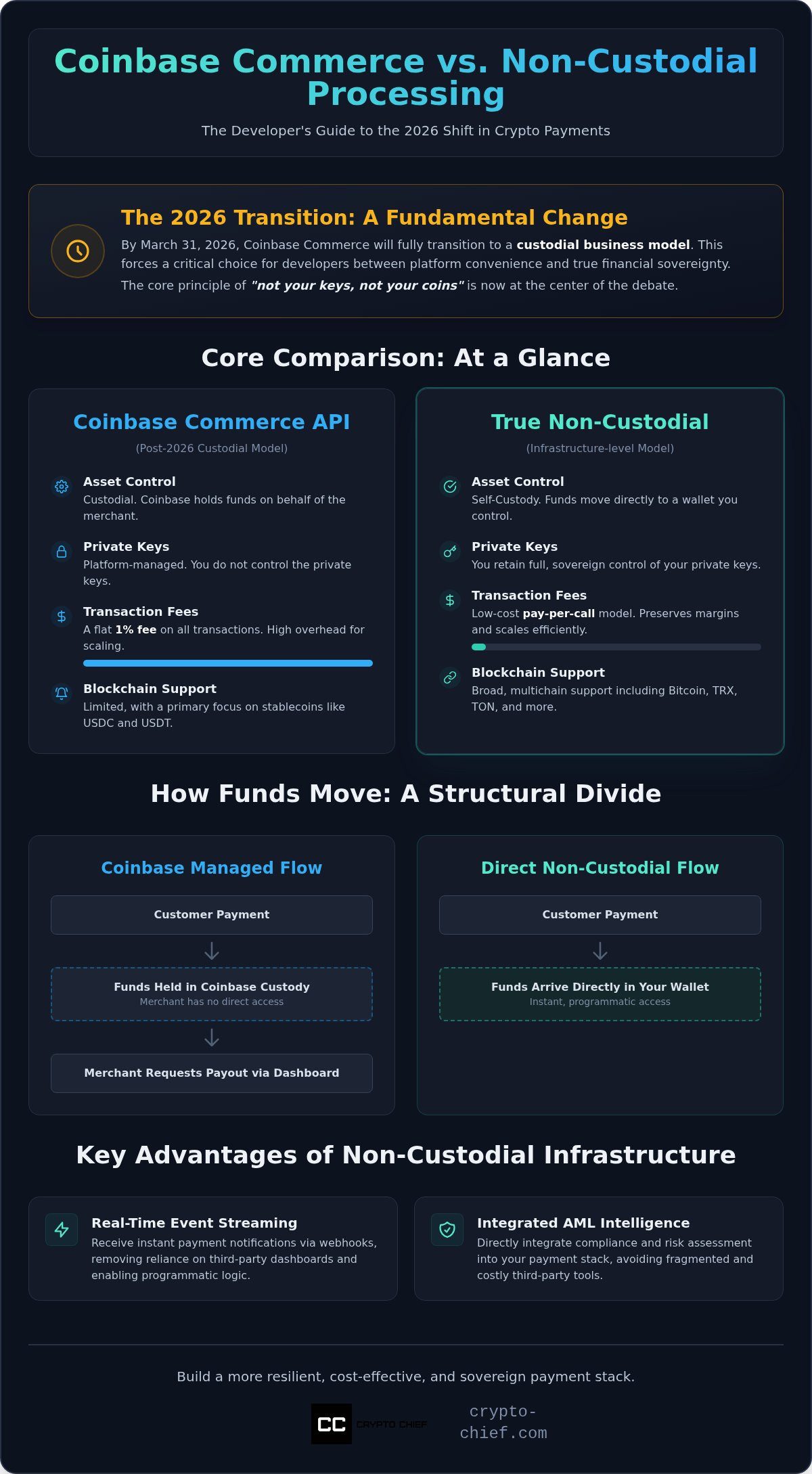
Analyzing the coinbase commerce api vs non-custodial processing requires a look at the massive architectural shift that occurred in early 2026. With the forced migration of all merchants to the Coinbase Business platform by March 31, 2026, the underlying philosophy of the service changed. What was once a self-custodial tool has transitioned into a custodial environment where Coinbase holds funds on behalf of the merchant. This change fundamentally alters how developers interact with the API, moving away from decentralized control toward a managed, stablecoin-first ecosystem focused primarily on USDC and USDT.
Integration now requires navigating the new Payment Link APIs, which utilize JWT-based authentication instead of the legacy header-based keys. While this provides a standardized enterprise experience, it introduces significant friction for builders who value the basics about cryptocurrency ownership. You no longer manage a seed phrase; you manage a platform account. This shift simplifies the experience for traditional retail but creates a bottleneck for dApps that require programmatic, non-custodial payouts without the 1% transaction fee overhead typically found in these managed environments.
The Forwarding Contract Mechanism
Technically, the platform still utilizes a smart contract factory pattern for payment detection. By leveraging the create2 opcode, the system generates predictable deposit addresses for each transaction without requiring an on-chain deployment until funds are actually received. However, this efficiency comes at a cost. Once a customer pays, the merchant must "flush" these tokens from the temporary forwarding address to a main wallet, incurring additional gas fees that eat into thin margins. Furthermore, this architecture is strictly optimized for EVM chains, leaving developers in the dark if they need to support Bitcoin, TON, or other non-EVM networks within a single integration.
Platform Lock-in and Ecosystem Risks
The transition to Coinbase Business has introduced geographic and compliance-based constraints that didn't exist in the legacy non-custodial version. Currently, the platform is restricted to registered entities in the United States and Singapore. For a global dApp, this creates a fragmented user experience where customers in unsupported regions are simply blocked. Relying on a single entity's uptime and regional licensing status introduces a centralized point of failure. If you prefer to avoid these platform-specific silos, exploring a more flexible non-custodial processing API can provide the multichain reach your project needs to scale globally.
Core Comparison: Coinbase Commerce vs. Direct Non-Custodial Processing
The technical divergence in the coinbase commerce api vs non-custodial processing debate centers on the location of the private keys and the resulting regulatory implications. When you utilize a managed service, you're essentially outsourcing your financial sovereignty to a third party that must adhere to strict compliance protocols. This is where FinCEN's regulatory framework for virtual currencies becomes a critical consideration. Custodial processors act as money transmitters, which introduces platform-wide restrictions that can impact your dApp’s availability. Direct non-custodial processing, however, keeps the developer in control of the infrastructure, ensuring that user funds move directly to a wallet you own without an intermediary holding the assets.
Monitoring these transactions also highlights a major functional gap. The Coinbase API often relies on polling or proprietary webhooks that are tied to their managed ledger. In contrast, a developer-first approach utilizes real-time blockchain webhooks that listen to the network itself. This provides immediate, unfiltered data across a much broader spectrum of assets. While Coinbase has narrowed its focus to a curated list of stablecoins, true non-custodial infrastructure provides multichain RPC access, allowing you to support diverse ecosystems like Polygon, BNB Chain, or even Bitcoin within a single unified logic.
Technical Flexibility and Scalability
Building a seamless user experience requires a checkout flow that doesn't force a platform redirect. Managed gateways often mandate a "Coinbase-branded" interface, which can disrupt the user journey and lower conversion rates. By owning the processing layer, you can customize every pixel of the transaction flow. High-volume applications further benefit from RPC request batching, which optimizes network calls and reduces latency. This level of granular control allows you to automate complex payout logic that simple "charge" objects cannot handle.
The Cost of Convenience
The economic impact of your choice becomes clear as your transaction volume grows. A 1% fee might seem negligible for small startups, but it becomes a massive drain on margins for high-ticket items or high-frequency dApps. Non-custodial models replace these percentage-based taxes with a predictable pay-per-call structure. You pay for the infrastructure you use, not the value of the assets you process. This eliminates the hidden costs of "flushing" tokens from forwarding contracts, as payments settle directly in your primary wallet without secondary gas expenditures.
Advanced Selection Criteria: Beyond Simple Payments
Selecting a payment infrastructure requires looking past the initial checkout screen. When you weigh the coinbase commerce api vs non-custodial processing, the long-term viability of your dApp depends on how you handle risk and cost at scale. Most managed gateways, including the 2026 Coinbase Business iteration, enforce a flat 1% transaction fee. For high-ticket items or enterprise-scale volume, this percentage-based model becomes an unsustainable tax on your growth. In contrast, developer-first infrastructure utilizes a pay-per-call model with pre-paid API tokens. You pay for the data processing, not a slice of your revenue. This distinction allows you to forecast operational costs with technical precision rather than fluctuating market values.
Developer experience also hinges on documentation quality and SDK availability. A robust non-custodial setup provides the tools to build custom risk-scoring logic and automated compliance workflows directly into your stack. This removes the need for platform-specific dashboards, allowing your team to manage everything through a single, unified interface. By decoupling the processing logic from the custodial layer, you gain the freedom to optimize your backend for speed and global reach without the friction of platform-specific limitations.
Integrating AML Intelligence
Modern non-custodial setups don't operate in a regulatory vacuum. You must protect your business from illicit funds without sacrificing your non-custodial status. Implementing AML risk detection allows you to screen incoming transactions against global watchlists in real-time. By using crypto AML risk detection APIs, you can assign risk scores to every deposit. This automation enables you to flag high-risk transfers before they hit your secondary systems, balancing compliance with the privacy-centric nature of decentralized finance. You retain custody of the assets while maintaining the structural integrity required for institutional partnerships.
Multichain Data Normalization
Fragmentation is the enemy of efficient development. Maintaining separate codebases for Bitcoin, TRX, and TON creates a massive technical debt that slows down your release cycle. A unified API solves this by standardizing transaction data across disparate networks. Whether you're tracking a stablecoin transfer on Polygon or a native asset on a non-EVM chain, the payload remains consistent. This normalization means your backend logic doesn't need to change every time you add support for a new chain. You get the reach of a multichain ecosystem with the simplicity of a single integration.
Scaling your dApp shouldn't mean compromising on control or profitability. If you're ready to move beyond restrictive gateways, you can start building with a non-custodial processing API that prioritizes your technical freedom.
Scaling with Crypto Chief: The Developer-First Alternative
The choice between the coinbase commerce api vs non-custodial processing essentially dictates the ceiling of your project's growth. While managed gateways provide an immediate, off-the-shelf experience, they often introduce architectural silos that become technical debt as you scale. Crypto Chief offers a developer-first alternative that prioritizes sovereign infrastructure over platform-locked convenience. By utilizing a non-custodial processing API, you maintain absolute control over your private keys while benefiting from an enterprise-grade backend that handles the heavy lifting of blockchain monitoring.
Builders require more than just a payment gateway; they need a comprehensive ecosystem that supports the entire lifecycle of a transaction. Crypto Chief integrates an RPC Gateway, AML Intelligence, and real-time event streaming into a single, cohesive environment. This unified approach eliminates the need to stitch together fragmented third-party services, reducing the complexity of your stack and the potential for integration failures. You gain a silent, powerful partner that ensures your dApp remains performant, global, and resilient.
Unified Infrastructure for Modern dApps
Operational efficiency starts with reducing the distance between your application and the blockchain. By using the same provider for your RPC nodes and payment processing, you significantly lower latency and improve data consistency. Our high-performance webhooks deliver real-time updates through the EventStream, ensuring your backend reacts instantly to on-chain movements without the overhead of constant polling. You can also deploy AML intelligence directly within your payment flow to protect your platform from high-risk assets without sacrificing the non-custodial nature of your architecture.
Cost Optimization Strategy
The financial logic of 2026 favors infrastructure that scales with usage, not revenue. Percentage-based transaction fees, like the 1% standard found in custodial models, act as a tax on your success. Crypto Chief replaces this with a transparent pay-per-call model using pre-paid API tokens. This allows for predictable budgeting where costs are tied strictly to technical performance. The pay-per-call model is the most efficient way to scale Web3 apps in 2026 because it ensures your margins remain protected as your transaction volume increases. Whether you're launching an MVP or managing enterprise-level traffic, your fee structure remains consistent and fair.
Transitioning to a more robust infrastructure is a straightforward process designed for technical teams. You can move from registration to your first API call in minutes, gaining immediate access to a multichain environment built for high-performance builders. It's time to reclaim your technical autonomy and build on a foundation that understands the practical challenges of the modern Web3 landscape.
Building for Sovereign Scale in 2026
The evolution of the coinbase commerce api vs non-custodial processing landscape has made one thing clear: developers who prioritize technical autonomy and cost efficiency are moving toward infrastructure-level solutions. By choosing a pure non-custodial path, you eliminate the 1% transaction tax and regain absolute control over your private keys. You aren't just selecting a processor; you're establishing a foundation that supports multichain expansion without platform-imposed limits or geographic restrictions. This shift ensures your business continuity remains independent of any single entity's operational status.
Integrating AML risk detection and RPC gateways into a single stack removes the friction of managing fragmented third-party tools. Crypto Chief provides this unified experience through a pay-per-call model that protects your margins as your dApp scales. It's time to move beyond the constraints of managed gateways and embrace a system built specifically for builders. Register for Crypto Chief and start building today to secure 100% non-custodial infrastructure for your project. Your project deserves a partner that values uptime, logic, and your right to own your data. Let's build the future of decentralized finance together.
Frequently Asked Questions
Is Coinbase Commerce truly non-custodial?
No, the 2026 transition to Coinbase Business has made the service custodial by design. While the legacy version allowed for self-custody, the current platform holds merchant funds in its own accounts, requiring users to trust a central entity with their liquidity. If your architecture demands absolute ownership, you should evaluate the coinbase commerce api vs non-custodial processing to ensure your private keys remain under your direct control at all times.
What is the main difference between managed and pure non-custodial processing?
Managed processing involves a third-party platform that handles contract deployment and fund management, often introducing regional restrictions and custodial risks. Pure non-custodial processing uses infrastructure that interacts directly with the blockchain without holding user assets. In this model, you maintain the private keys and direct access to your funds. This approach provides greater technical flexibility and protects your project from platform-specific outages or policy shifts that could freeze your payouts.
Can I use a non-custodial API for multichain payments?
Yes, a unified non-custodial API allows you to support multiple blockchains through a single integration. While managed gateways often limit you to a curated list of stablecoins on specific chains, infrastructure providers offer multichain RPC access. This enables your dApp to accept payments on networks like Bitcoin, Ethereum, TON, and Polygon simultaneously. Standardizing this data through one interface reduces technical debt and allows you to scale your reach across different ecosystems efficiently.
How do pay-per-call API fees compare to transaction percentage fees?
Pay-per-call models are generally more efficient for high-ticket items and high-volume projects. Transaction percentage fees, such as the 1% charged by Coinbase Business, act as a tax on your revenue that increases as you grow. In contrast, pay-per-call pricing uses pre-paid API tokens to cover the cost of the infrastructure you consume. You pay for the data processing and network monitoring, ensuring your margins remain protected regardless of the value of the assets being moved.
How do I handle AML compliance with a non-custodial gateway?
You can integrate AML Intelligence directly into your payment stack using specialized risk detection APIs. These tools screen incoming transaction hashes against global watchlists to assign a risk score before you accept the funds. This automation allows you to maintain a non-custodial architecture while meeting regulatory standards. By flagging illicit funds programmatically, you protect your business from legal risks without ever granting a third-party processor custody of your digital assets or your users' funds.
What happens if a non-custodial infrastructure provider goes offline?
Your funds remain safe because the provider never holds your private keys. If the infrastructure provider experiences downtime, your ability to monitor new transactions might be temporarily interrupted, but your existing balance is always accessible through any standard blockchain wallet. This is a significant safety advantage over custodial models. In a custodial setup, an outage or platform lock could prevent you from accessing your liquidity until the provider restores service or updates their internal ledgers.
Do I need my own RPC nodes to use a non-custodial processing API?
No, you don't need to maintain your own nodes if you use a provider that includes an RPC Gateway. The API acts as the bridge between your application and the blockchain, handling the heavy lifting of node maintenance and data normalization. This allows you to benefit from the performance and security of dedicated infrastructure without the high operational costs and technical complexity of running your own validator or full-node hardware in-house.
Can I automate refunds with the Coinbase Commerce API?
Automation is limited in the current custodial Coinbase Business environment. Because Coinbase manages the funds, refunds often require manual intervention through their dashboard or specific API calls that are subject to platform approvals. In a pure non-custodial setup, you can programmatically trigger refunds directly from your own wallet using your private keys. This level of control allows for more complex, automated logic within your dApp's smart contracts or backend systems without any middle-man interference.