
Scaling a global SaaS platform is a feat of modern engineering, yet even the most sophisticated architectures often crumble under the weight of manual ledger entries. You've likely felt the friction of matching fragmented TXIDs across multiple chains, realizing that a robust crypto payment reconciliation API for SaaS is no longer a luxury but a core infrastructure requirement. It's a common frustration: the blockchain never sleeps, but your manual reconciliation process certainly does. Relying on human intervention to bridge the gap between on-chain events and your internal database isn't just unscalable; it is a direct threat to your financial integrity.
This guide empowers you to eliminate that friction by mastering the implementation strategies for high-performance reconciliation engines. We will break down the technical requirements for building a unified data source that handles real-time event streaming and automates matching with surgical precision. You'll learn how to navigate the 2026 regulatory landscape, including the fair value reporting requirements of FASB ASU 2023-08, while maintaining a non-custodial architecture that preserves control. From reducing audit overhead to solving the latency of confirmed transactions, this is your blueprint for a self-healing financial stack.
Key Takeaways
- Understand why traditional SaaS ledgers fail in Web3 and how to implement a "Three-Way Match" to ensure data integrity between invoices and the blockchain.
- Discover how to architect a high-performance crypto payment reconciliation API for SaaS that normalizes raw multichain data into actionable JSON for your backend.
- Evaluate the security trade-offs between custodial and non-custodial reconciliation models to maintain sovereignty over your platform's private keys.
- Learn a step-by-step blueprint for integrating RPC gateways and EventStream webhooks to automate real-time transaction detection and matching.
- Explore how a unified infrastructure reduces operational overhead and provides a single source of truth for financial auditing and compliance.
The SaaS Reconciliation Challenge: Why Crypto Payments Demand Technical Precision
For a SaaS architect, the ledger is the source of truth. In a traditional fiat environment, bank feeds and payment processors provide a structured flow of data that matches neatly with internal accounts. The decentralized world is different. In this context, crypto payment reconciliation is the rigorous process of aligning immutable on-chain transaction data with your internal SaaS ledger entries. It's the bridge between raw blockchain events and your financial reporting. Without a dedicated crypto payment reconciliation API for SaaS, this bridge often consists of manual spreadsheets and error-prone TXID matching, which creates significant operational drag.
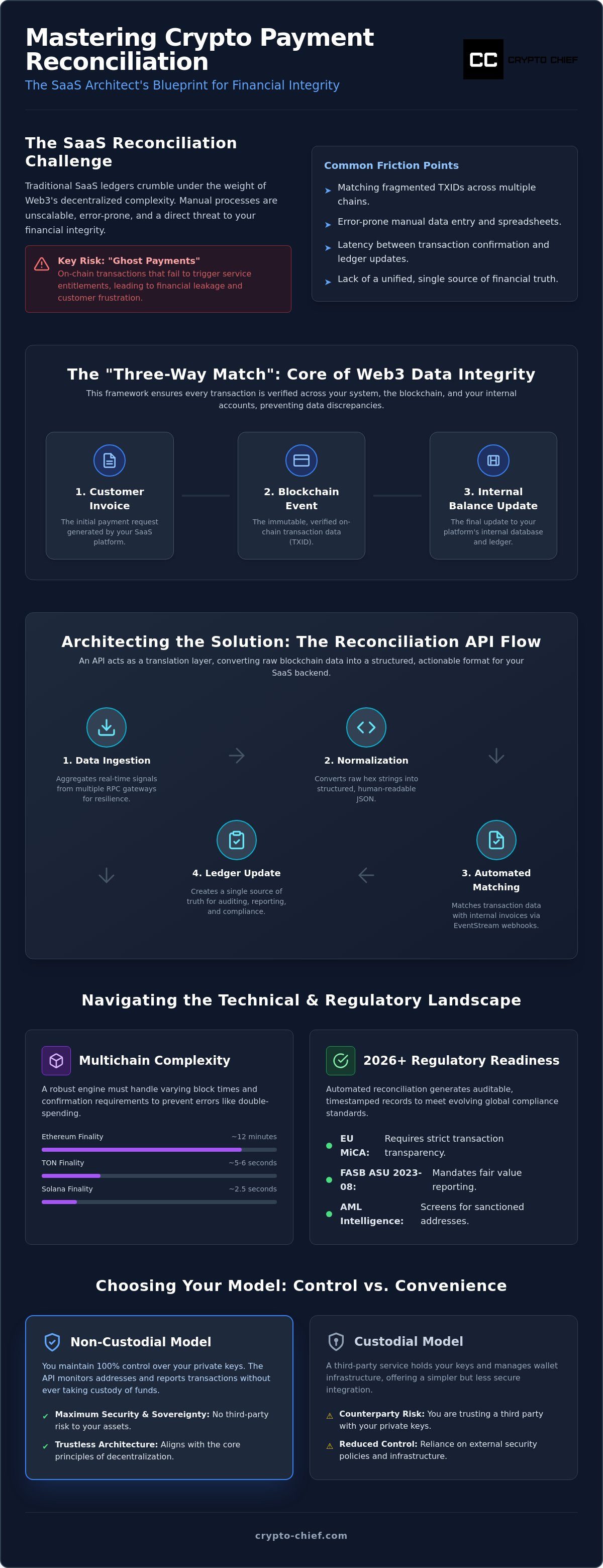
High-performance platforms rely on the "Three-Way Match" in Web3 to maintain integrity. This framework requires your system to verify three distinct data points: the initial customer invoice, the verified blockchain event, and the subsequent internal balance update. If any of these nodes fail to synchronize, you risk "ghost payments." These are transactions that occur on-chain but never trigger the corresponding service entitlement in your software. This results in financial leakage, frustrated users, and a nightmare for your accounting team during month-end closes. Automated reconciliation mitigates these risks by ensuring that every satoshi or wei is accounted for in real-time.
The Complexity of Multichain Data
SaaS platforms rarely limit themselves to a single network. Managing the architectural differences between Ethereum, Solana, and TON requires sophisticated data handling. Ethereum transactions might take several minutes to reach finality, while Solana operates in seconds. Your reconciliation engine must account for these varying block times and confirmation requirements to prevent double-spending or premature service delivery. Cryptocurrency tracing techniques are essential here to identify "internal transactions" within smart contracts, which often don't appear in standard block explorers but represent actual value transfers. Relying on a single RPC node is a single point of failure; if that node lags, your financial data becomes stale and unreliable.
Regulatory and Audit Requirements in 2026
The regulatory landscape has matured significantly. As of July 2026, the EU's MiCA regulation is fully active, requiring crypto-asset service providers to maintain strict transaction transparency. Your reconciliation workflow must now incorporate AML Intelligence to ensure that incoming funds aren't linked to sanctioned addresses. Under the FASB ASU 2023-08 standards, companies must measure crypto assets at fair value, making real-time data ingestion critical for accurate tax reporting. By generating auditable, timestamped records that satisfy both internal stakeholders and external auditors, you transform your payment stack from a technical hurdle into a competitive, compliant advantage.
Architecting the Flow: How Crypto Payment Reconciliation APIs Function
Architecting a reliable financial stack requires moving beyond basic transaction monitoring. A dedicated crypto payment reconciliation API for SaaS acts as a sophisticated translation layer between the raw, chaotic state of the blockchain and your application's structured database. It begins with data ingestion, where the API aggregates real-time signals from multiple RPC gateways. This ensures that even if one node lags, your financial data remains accurate and resilient. By pulling from a distributed network of nodes, the system maintains a high-fidelity view of the ledger that single-node setups simply can't match.
The next phase is normalization. Blockchain data arrives as raw hex strings; for a standard SaaS backend, this is unusable noise. The API converts these strings into human-readable JSON, mapping specific fields like sender, recipient, value, and gas fees into your internal schema. This level of technical precision is vital for the financial reporting of cryptocurrency, as accountants require clear, timestamped evidence of every movement to satisfy fair value measurement standards. By using a non-custodial processing model, you ensure that while the data is being reconciled, the funds remain under your direct cryptographic control, removing the counterparty risk inherent in centralized gateways.
Before an entry is marked as reconciled, the API applies confirmation logic. You must define finality thresholds based on the specific risk profile of the transaction. For example, you might require 12 confirmations on Ethereum but only a single confirmation on a high-speed Layer 2. This logic prevents the system from triggering service access based on orphaned blocks or chain reorganizations.
From Raw Transaction to Reconciled Entry
The journey from a user's wallet to a confirmed subscription follows a rigorous three-step path. First, your system monitors specific addresses or smart contract events via EventStream. This eliminates the need for constant, resource-heavy polling. Second, the API validates the transaction hash and value against the expected invoice amount. Finally, once the finality threshold is met, the system triggers an automated update to the user’s SaaS subscription status. This seamless loop removes manual friction entirely, ensuring that users get instant access the moment their payment is verified.
Unified API vs. Fragmented RPC Calls
Managing individual node connections for every chain you support is a recipe for technical debt. A Unified Blockchain API provides a single interface that abstracts away the quirks of Bitcoin, BNB Chain, and Polygon. It reduces latency by leveraging a global high-performance network, ensuring that your reconciliation data is consistent regardless of the underlying protocol. This structural integrity allows a SaaS platform to scale globally without expanding its accounting team. For developers looking to streamline this process, exploring a robust Crypto Processing API is the logical next step in building a resilient financial engine.
Evaluating Reconciliation Models: Non-Custodial Control vs. Centralized Ease
Choosing between custodial and non-custodial models isn't merely a technical detail; it's a foundational decision that impacts your platform's long-term viability. Custodial APIs often appeal to teams seeking rapid deployment, but they come with significant trade-offs. By handing over control, you introduce counterparty risk and often find yourself locked into higher fee structures that eat into your margins. A non-custodial crypto payment reconciliation API for SaaS offers a superior alternative for architects who prioritize structural integrity. This model ensures that while the API provides the necessary data for reconciliation, your platform remains the sole custodian of its assets.
Accounting teams are particularly sensitive to these architectural choices. The financial reporting implications of using a non-custodial setup are generally more favorable, as it provides a direct, untampered link between your wallet and your financial statements. This transparency is vital for satisfying the fair value requirements of 2026 standards. It allows for a cleaner audit trail where every transaction is verifiable on-chain without the obfuscation of a third-party intermediary's internal ledger.
Scaling your operations from 100 to 1,000,000 transactions per day requires an infrastructure that doesn't buckle under load. A pay-per-call pricing model is often the most efficient path for growing SaaS businesses. Unlike rigid monthly tiers that charge for capacity you don't use, this model allows you to scale costs directly with your transaction volume. It ensures that your infrastructure expenses remain proportional to your revenue, providing a sustainable path for global expansion.
Security and Ownership
Non-custodial processing has become the gold standard for privacy-conscious SaaS platforms. By avoiding a centralized storage of user funds, you effectively eliminate your platform's "honeypot" risk. This makes your infrastructure a less attractive target for malicious actors while ensuring you don't fall under the same regulatory scrutiny as custodial exchanges. Implementing Crypto Processing that integrates directly with your existing wallet architecture ensures that security isn't sacrificed for the sake of automation. It's about building a silent, powerful partner into your financial stack that respects your sovereignty.
Cost Optimization for High-Volume SaaS
Managing expenses in Web3 requires a shift in how you view infrastructure costs. Percentage-based fees can quickly become unsustainable as your transaction volume grows, especially for enterprise-tier SaaS subscriptions. Flat API request costs, paired with prepaid token balances, offer a more predictable way to budget for your reconciliation needs. RPC request batching can further lower reconciliation expenses by grouping multiple data queries into a single call, significantly reducing the total number of API requests your backend needs to perform. This level of efficiency is what separates elite service providers from generic gateways.
Implementation Blueprint: Integrating Real-Time Reconciliation into Your SaaS Stack
Deploying a high-performance stack requires a systematic approach. To bridge the gap between volatile blockchain events and the rigid requirements of your SaaS database, you need an architecture that prioritizes uptime and data accuracy. Integrating a robust crypto payment reconciliation API for SaaS into your existing infrastructure involves five critical steps. This blueprint ensures that your financial ledger remains synchronized with the blockchain without manual intervention.
- Step 1: Set up a Web3 RPC Gateway to ensure reliable, low-latency access to blockchain data across multiple networks.
- Step 2: Configure EventStream webhooks to listen for specific transaction patterns, such as transfers to your platform's deposit addresses.
- Step 3: Implement a dedicated listener service within your backend to receive and process incoming webhook payloads immediately.
- Step 4: Use the Unified API to fetch additional metadata, such as gas fees and block timestamps, which are essential for comprehensive audit logging.
- Step 5: Automate error handling to manage edge cases like dropped transactions or chain reorganizations, ensuring your ledger eventually reaches a consistent state.
Configuring Webhooks for Reliability
Webhooks are the heartbeat of real-time reconciliation, but they require careful configuration to handle the realities of distributed systems. You must implement retry logic with exponential backoff to manage temporary network failures. Idempotency keys are equally vital; they prevent double-reconciliation if your server receives the same webhook notification more than once. During periods of extreme market volatility, your infrastructure must scale to handle high-traffic spikes without losing data. Before deploying to production, thoroughly test your integration using a Testnet Faucet to simulate various transaction scenarios without risking real capital.
Handling Discrepancies and Edge Cases
In a global SaaS environment, users will inevitably make mistakes. Your system must be prepared for instances where a customer sends the wrong amount or uses an unsupported network. Automating refund triggers or partial payment alerts allows you to maintain a high level of customer service without manual oversight. Security remains a top priority during this process. By using AML Intelligence, you can automatically flag and pause reconciliation for high-risk transactions that originate from sanctioned or suspicious addresses. This proactive approach protects your platform's integrity and ensures compliance with global financial regulations. To begin building your resilient financial engine, register for your API credentials and start integrating today.
Scaling with Crypto Chief: High-Performance Infrastructure for SaaS Financial Integrity
Building a resilient financial stack requires an engine that matches the speed of global commerce. Crypto Chief stands as the architect’s choice for a non-custodial crypto payment reconciliation API for SaaS, providing the structural integrity needed to handle complex on-chain data without the risks of centralized fund management. By maintaining a non-custodial architecture, we ensure your platform remains the ultimate authority over its assets while our infrastructure handles the heavy lifting of data ingestion and normalization. It's a partnership designed to remove technical friction, allowing your team to focus on core product innovation rather than the nuances of blockchain synchronization.
The power of our platform lies in its unified nature. Instead of managing fragmented connections to various node providers and webhook services, you access a single, high-performance environment for RPC, EventStream, and Processing. This integration eliminates the data silos that often lead to reconciliation errors. Our global network ensures low-latency performance for your international users, providing the uptime and reliability that enterprise-tier SaaS platforms demand. Whether you're processing a handful of monthly subscriptions or millions of daily transactions, our infrastructure scales dynamically to meet your load requirements.
A Unified Solution for Developers
Eliminating vendor sprawl is critical for maintaining a clean, maintainable codebase. By utilizing one API for all your blockchain needs, you reduce the complexity of your integration and simplify your long-term maintenance. You can access detailed Documentation to accelerate your deployment, moving from sandbox testing to production with confidence. Our platform provides comprehensive multichain support for Ethereum, BNB Chain, Polygon, and several other major networks, ensuring your SaaS remains accessible to users regardless of their preferred ecosystem. This breadth of coverage allows you to expand your market reach without rewriting your reconciliation logic for every new chain.
Future-Proofing Your SaaS Platform
The blockchain space evolves rapidly, but your financial infrastructure shouldn't be fragile. We handle protocol updates and chain reorganizations on our end, so your reconciliation flow remains uninterrupted by external network changes. This stability is vital as your user base grows from ten early adopters to ten million global customers. A significant advantage of our model is the pay-per-call API structure. Unlike traditional subscription tiers that force you to pay for idle capacity, our pricing scales directly with your usage. This ensures your infrastructure costs remain lean during early growth while providing predictable budgeting as you reach enterprise scale. To begin building your self-healing financial stack, register your account and start building with our pay-per-call API today.
Mastering Modern Financial Integrity
Achieving technical precision in your financial stack requires moving past the inefficiencies of manual matching. By implementing a high-performance crypto payment reconciliation API for SaaS, you align your platform with the rigorous transparency standards of the 2026 regulatory landscape. This guide has detailed how non-custodial architectures and automated event streaming protect your platform from financial leakage while ensuring you remain the sole authority over your assets. Transitioning to a unified data source isn't just about efficiency; it's about building a foundation that supports global scale without compromising on security.
Reliability doesn't have to be complex or expensive. With a Unified API supporting 10+ major blockchains and real-time EventStream webhooks maintaining 99.9% uptime, your infrastructure is built to scale alongside your user base. You can eliminate the burden of hidden monthly fees by leveraging a transparent pay-per-call model that aligns costs directly with your transaction volume. Start building with Crypto Chief’s non-custodial processing API today and transform your payment ledger into a resilient, self-healing engine. Your journey toward a frictionless, global financial future starts with a single, stable integration.
Frequently Asked Questions
What is the difference between a crypto payment gateway and a reconciliation API?
A crypto payment gateway primarily focuses on the frontend transaction, while a crypto payment reconciliation API for SaaS serves as the backend bridge that aligns blockchain events with your internal database. Gateways handle the "how" of receiving funds, but the reconciliation API handles the "where" and "why" of your accounting ledger. It ensures that every confirmed transaction is mapped to a specific invoice, providing the financial integrity needed for audit-ready reporting.
Is a non-custodial reconciliation API more secure for my SaaS?
Non-custodial reconciliation APIs are significantly more secure because your platform retains full control over its private keys. By using a non-custodial model, you eliminate the counterparty risk associated with third-party wallet hosting and avoid creating a centralized "honeypot" for attackers. This architecture allows you to automate financial tracking while ensuring that funds remain in your direct cryptographic possession at all times.
How does pay-per-call pricing benefit a scaling SaaS platform?
Pay-per-call pricing allows you to align your infrastructure expenses directly with your actual transaction volume. For a scaling SaaS, this model removes the burden of high, fixed monthly subscription tiers that often charge for unused capacity. It provides a predictable, usage-based cost structure where you only pay for the specific data requests and reconciliation events your platform requires to function.
Can I reconcile payments across multiple blockchains like Ethereum and Solana simultaneously?
You can reconcile payments across Ethereum, Solana, and other major chains simultaneously using a Unified API. This single interface abstracts the technical differences between various protocols, allowing your backend to receive normalized JSON data regardless of the underlying network. It simplifies your architecture by providing a consistent stream of transaction metadata from a single high-performance endpoint.
What happens if a blockchain transaction is delayed or a reorg occurs?
If a transaction is delayed or a chain reorganization occurs, the API manages the confirmation logic to ensure data consistency. You can set specific finality thresholds that must be met before a transaction is marked as reconciled in your ledger. This prevents your system from granting service access based on orphaned blocks, ensuring that only verified, permanent transactions trigger subscription updates.
Do I need to run my own nodes to use a crypto reconciliation API?
You don't need to run your own nodes to use a professional reconciliation API. The provider manages the global RPC infrastructure and node maintenance for you, delivering high-fidelity blockchain data via their own gateways. This removes the operational overhead of syncing and securing nodes, allowing your engineering team to focus entirely on building and scaling your core SaaS product.
How does real-time event streaming improve the user experience for my SaaS customers?
Real-time event streaming significantly improves user experience by providing instant service activation the moment a transaction hits the mempool or reaches initial confirmation. Instead of forcing users to wait for manual verification or slow polling cycles, webhooks push data directly to your backend. This creates a seamless, "instant-on" feel for your subscription services, which is a critical differentiator in a competitive market.
Is it possible to automate AML checks during the reconciliation process?
Automating AML checks is an essential part of a modern reconciliation workflow. By integrating AML Intelligence into your listener service, you can automatically screen incoming transaction hashes for links to sanctioned or high-risk addresses. If a transaction flags as suspicious, the system can pause the reconciliation process, protecting your platform from regulatory risk and ensuring full compliance with global financial frameworks.