
Your business growth shouldn't be a liability for your profit margins. While traditional payment gateways often take a larger cut as your volume increases, the most efficient way to scale is to treat your infrastructure as a utility. Most developers and business architects agree that evaluating crypto processing api pricing remains a primary friction point. They're tired of hidden monthly minimums and percentage-based fees that feel like a revenue tax. You've likely felt the frustration of paying for unused credits in a fixed subscription tier or watching a portion of every transaction disappear into a processor's pocket.
This 2026 guide promises to reframe your approach to Web3 economics by introducing the pay-per-call model. We'll explore how shifting to a granular, prepaid token balance eliminates the success tax and provides predictable costs across your entire stack. We'll also examine the structural advantages of a non-custodial architecture, which removes custodial risk while providing a unified billing experience for both transaction processing and AML intelligence. By the end of this article, you'll have a blueprint for a lean, high-performance payment engine that rewards your success instead of taxing it.
Key Takeaways
- Identify the structural differences between tiered, percentage-based, and pay-per-call models to find the most efficient crypto processing api pricing for your specific business needs.
- Eliminate the "success tax" of percentage-based fees by transitioning to a utility-driven cost structure that scales predictably as your transaction volume grows.
- Leverage a non-custodial architecture to reduce technical complexity, enhance security, and lower the compliance overhead typically associated with custodial solutions.
- Audit your current Web3 integration to uncover hidden costs from redundant API calls and optimize performance through event-driven webhook monitoring.
- Consolidate your infrastructure spend by using a unified prepaid balance that covers transaction processing, AML intelligence, and RPC gateway requests.
Beyond the 1%: Understanding the Real Cost of Crypto APIs
The market for Web3 integration is maturing. In 2026, the discussion around crypto processing api pricing has evolved from simple feasibility to long-term economic efficiency. Most providers bucket their costs into three distinct pillars: percentage-based, tiered-subscription, and pay-per-call. While the first two dominate legacy marketing, developers are increasingly moving toward infrastructure-as-utility models that offer better granular control.
Understanding these pillars is vital for protecting your bottom line. Percentage models charge a slice of your revenue. Tiered plans offer monthly buckets of requests. The pay-per-call approach, however, treats every interaction as a discrete, low-cost event. This shift reflects a broader trend where businesses prioritize stability and performance over the convenience of all-in-one fees that often hide true operational costs.
The Hidden Impact of Transactional Percentage Fees
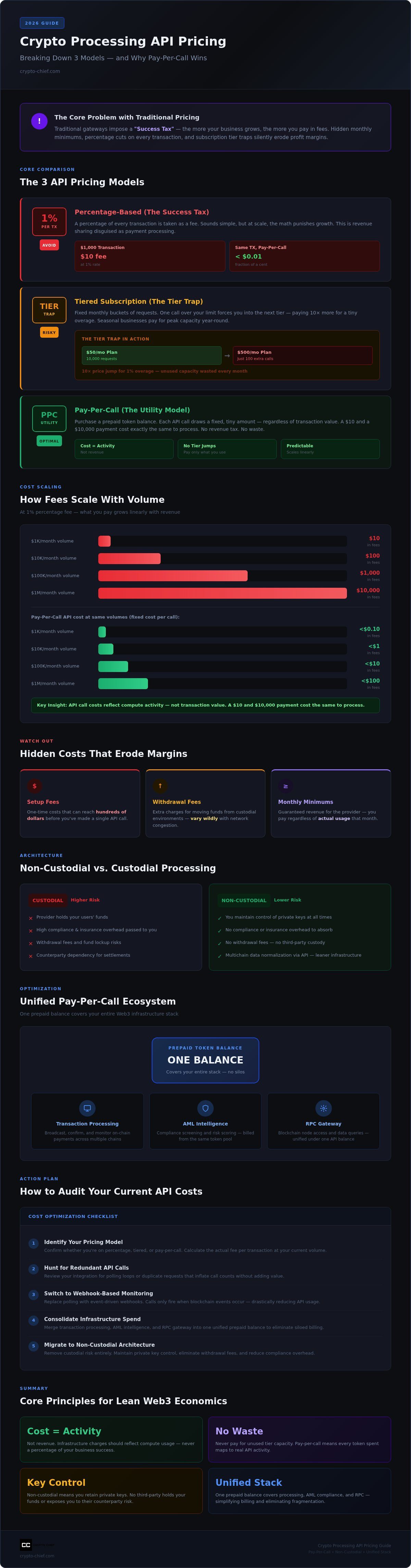
Industry leaders often promote a 1% fee as the standard for simplicity. It sounds accessible, but the math quickly turns against high-volume or high-ticket businesses. For example, a $1,000 transaction processed at a 1% rate costs your business $10. In a non-custodial processing environment using a fixed API call, that same transaction costs a fraction of a cent. For low-margin sectors like consumer electronics or travel, losing a full percentage point to a gateway is unsustainable. The Success Tax is the increasing marginal cost of processing as business volume grows.
Subscription Bloat: The Cost of Unused API Capacity
The "Tier Trap" remains a significant hurdle for scaling dApps. You might find yourself on a $50 monthly plan that permits 10,000 requests. If your traffic spikes and you hit 10,100 requests, you're frequently forced into a $500 monthly tier just to cover that minor overage. You end up paying for thousands of unused credits every month. This inefficiency is particularly punishing for seasonal businesses that experience high volatility. They're forced to pay for peak capacity during their slowest months, leading to significant subscription bloat and wasted capital.
Beyond the headline rates, look for friction points that erode your margins. These include:
- Setup Fees: One-time costs that can reach hundreds of dollars before you've even made a single call.
- Withdrawal Fees: Additional charges for moving funds out of custodial environments, which can vary wildly based on network congestion.
- Minimum Monthly Spends: Guaranteed revenue for the provider that you must pay regardless of your actual usage.
By identifying these hidden layers, you can transition to a model that values logic and scalability over predictable but expensive billing cycles.
The Mechanics of Pay-Per-Call Pricing in Web3 Infrastructure
The shift toward a pay-per-call model represents a fundamental change in how developers perceive infrastructure costs. Instead of committing to rigid monthly tiers or sacrificing a percentage of every transaction, businesses purchase a prepaid token balance. This balance acts as a utility reservoir. Every request, whether it's a balance check or a transaction broadcast, draws a fixed amount from that pool. This approach ensures that your crypto processing api pricing remains strictly aligned with your technical activity rather than your financial success.
Non-custodial processing further simplifies this equation. Because the service doesn't hold user funds, it avoids the massive compliance and insurance overheads that custodial providers often pass on to their clients. It's a leaner way to operate. You maintain control of your private keys while the API handles the heavy lifting of multichain data normalization, ensuring that your background infrastructure remains powerful yet invisible.
Decoupling Processing from Revenue
Technically, a crypto payment isn't a transfer of value within the API's internal database; it's a sequence of blockchain events. An RPC call identifies an incoming transaction, and a webhook confirms the block depth. From a compute perspective, processing a $10 payment costs exactly the same as processing a $10,000 payment. Pay-per-call pricing respects this reality. It allows you to scale without being penalized for high-ticket sales or increasing volume. For a deeper look at this architecture, you can explore Crypto Chief Processing to see how non-custodial tools streamline your stack.
Efficiency Through Event-Driven Architecture
How much are you paying for silence? Traditional polling requires your server to ask the API "Did the payment arrive yet?" every few seconds. If a customer takes five minutes to pay, you might execute hundreds of redundant, paid requests. This is where real-time EventStream webhooks change the game. Instead of constant polling, your system waits for a single, decisive notification from the API. This event-driven approach drastically reduces your total request volume. It ensures that every token spent from your balance contributes directly to a successful user outcome rather than just checking an empty address.
Managing separate budgets for RPC nodes, AML checks, and payment processing is a logistical burden. A unified model consolidates these services into a single point of management. You can use one balance to verify a user's wallet against sanctions lists via AML Intelligence and then process their transaction using the same pool of tokens. This synergy creates a frictionless environment for business architects who value logic, scalability, and cost-efficiency.
Comparing Pricing Models: Tiered vs. Percentage vs. Pay-Per-Request
Selecting a crypto processing api pricing structure requires a deep dive into your projected transaction lifecycle. Most businesses start with percentage-based models because they seem risk-free. If you don't sell, you don't pay. However, this logic fails as soon as you achieve product-market fit. When your transaction volume doubles overnight, a percentage-based model effectively doubles your infrastructure bill, even though the underlying compute requirements remain largely identical. Scaling shouldn't hurt your margins.
Tiered subscriptions attempt to solve this by offering predictability, yet they introduce the "Zero Usage" penalty. If your dApp experiences a quiet month, you're still billed for a capacity you didn't utilize. Monthly resets ensure that any unused requests simply vanish. In contrast, the pay-per-request model uses a perpetual balance. Your tokens don't expire. This creates a true utility environment where costs only occur in direct response to activity, providing a safety net for both seasonal fluctuations and rapid growth phases.
Total Cost of Ownership (TCO) Breakdown
The true cost of an API isn't just the sticker price; it's the cumulative expense over a fiscal year. Consider the inflection point where percentage fees begin to cannibalize profits. For high-ticket items, a standard 1% fee can quickly exceed the cost of the entire server stack. By shifting to a fixed cost per API call, the marginal cost of processing an additional transaction drops toward zero. This allows business architects to redirect capital toward user acquisition rather than infrastructure maintenance.
- Percentage Model: Costs scale linearly with revenue, penalizing growth.
- Tiered Model: Costs are static but often include "dead" capacity that is paid for but never used.
- Pay-Per-Request: Costs scale with technical activity, ensuring maximum capital efficiency.
Handling Multichain Complexity Without Cost Spikes
Many legacy providers gate specific blockchains behind premium tiers. You might find that basic Ethereum support is included, but accessing Solana or BNB Smart Chain requires a significant monthly upgrade. This fragmentation forces developers to manage multiple subscriptions or settle for limited reach. A unified API removes these barriers by normalizing costs across all supported networks. Whether you're broadcasting on a Layer 2 or a legacy chain, the cost per request remains consistent. This transparency is vital when integrating AML Intelligence for Compliance, as it allows you to run wallet checks across diverse chains using the same unified token balance.
Managing multichain integrations shouldn't involve complex mathematical hurdles. By using a model that treats every blockchain event as a discrete utility request, you gain the flexibility to pivot between networks without renegotiating your contract or jumping to a higher price bracket. It's a logical, builder-centric approach to Web3 infrastructure.
How to Audit and Optimize Your Crypto API Usage Costs
Optimizing your infrastructure requires a shift from passive consumption to active management. Even with the most competitive crypto processing api pricing, inefficient implementation can lead to technical debt and inflated costs. A thorough audit focuses on reducing the total volume of requests while maintaining high data integrity. This involves identifying redundant calls, consolidating multichain providers, and ensuring that every API request serves a specific business outcome.
Consolidating your stack through a multichain RPC gateway is a powerful first step. Instead of managing separate API keys and billing cycles for Ethereum, Polygon, and BSC, a unified gateway allows you to route all traffic through a single endpoint. This reduces the administrative overhead of managing multiple infrastructure providers. It also ensures that your prepaid balance is utilized efficiently across your entire application ecosystem rather than being fragmented across several stagnant accounts.
Technical Optimization Strategies for Developers
Developers should prioritize request batching to minimize network overhead and token consumption. By grouping multiple JSON-RPC calls into a single request, you can fetch balance data or transaction statuses for dozens of addresses simultaneously. This drastically lowers the cost per data point. Implementing a local cache layer for static blockchain data, such as contract ABIs or historical headers, further reduces the need for external API calls. For a technical deep dive, explore this guide on RPC Request Batching for Cost Reduction to see how to implement these patterns in your codebase.
Cost-Effective AML Integration
Integrating compliance checks directly at the user entry point prevents the processing of illicit transactions that could trigger expensive downstream investigations. Pay-per-call AML is particularly superior for startups and mid-sized dApps compared to monthly compliance subscriptions. With a subscription, you pay for a fixed capacity that may never be fully utilized. A utility-based model ensures that you only pay for a check when a new wallet interacts with your system. This screening at the "front door" protects your reputation and your budget by filtering out high-risk actors before they consume processing resources.
Efficiency is a choice. You can continue with legacy models that penalize your growth, or you can build on a foundation designed for performance. If you're ready to modernize your stack, integrate a cost-efficient processing API that respects your bottom line.
Scaling with Crypto Chief: A Unified Pay-Per-Call Ecosystem
Crypto Chief provides a comprehensive foundation for Web3 developers who prioritize structural integrity and logical cost management. By consolidating transaction processing, AML intelligence, and RPC gateway access into a single, high-performance engine, the platform addresses the fragmentation that often inflates crypto processing api pricing. This unified approach doesn't just simplify your tech stack; it fundamentally changes the economics of Web3 integration by removing the friction of managing multiple vendors and disparate billing cycles.
The platform acts as a silent, powerful partner for your development team. It provides the stability of an enterprise-ready service while remaining practical for individual creators. Because every component of the ecosystem operates on the same pay-per-call logic, you gain a level of transparency that is often missing in traditional gateway models. You are no longer guessing what your monthly bill will be; you are simply consuming a utility as your application requires it.
The Power of a Unified Web3 Platform
Managing fragmented infrastructure is a significant drain on dev-ops resources. When your team has to juggle separate API keys, rate limits, and documentation styles for blockchain data and payment confirmation, the risk of technical debt increases. Crypto Chief eliminates this complexity through a single, normalized interface. For a detailed technical overview of how to integrate these services, refer to the Crypto Chief Developer Docs. This consolidation allows architects to focus on user experience while the platform handles the background heavy lifting. For more on this strategy, read The Architect’s Guide to a Unified Web3 Developer Platform.
Non-Custodial Processing as a Competitive Advantage
The non-custodial nature of the platform is a strategic asset for cost-conscious businesses. Traditional custodial gateways often charge a premium to cover their extensive insurance and regulatory overhead. By utilizing a non-custodial architecture, you eliminate this "custodial premium" entirely. Settlement happens direct-to-wallet, which significantly improves your business liquidity and removes the withdrawal fees typically associated with moving funds out of a third-party environment. It's a faster, more secure way to handle global payments without sacrificing control of your private keys. Start building with Crypto Chief today to experience this efficiency firsthand.
The prepaid token balance model is particularly effective for global development teams. Instead of dealing with monthly invoices that vary based on fluctuating exchange rates or unexpected traffic spikes, teams can purchase a fixed balance that stays active until used. This provides a predictable budgeting framework for project managers. Whether you are a solo creator or an enterprise-grade operation, the path to scaling is clear. You can begin with free testing via the testnet faucet and scale your balance as your application gains traction, ensuring your infrastructure always supports your growth without taxing it.
The Technical Requirements of 2026
The Web3 environment of 2026 demands a shift from legacy billing to granular utility. You've seen how traditional models often impose a success tax on your growth, while tiered subscriptions lead to wasted capacity. Evaluating crypto processing api pricing isn't just about the lowest headline rate; it's about finding a partner that rewards your efficiency. By auditing your implementation and embracing an event-driven architecture, you can significantly reduce your operational overhead.
Transitioning to a pay-per-call model allows you to consolidate your stack while maintaining a strictly non-custodial environment. This architecture eliminates custodial risks and provides a unified billing experience for RPC, AML, and transaction processing through a single prepaid utility balance. Your infrastructure should be a silent, powerful engine that supports your creative vision without taxing your revenue. It's time to move beyond the limitations of legacy gateways and build for the future with a platform designed for builders.
Scale your Web3 infrastructure with Crypto Chief's Pay-Per-Call API
Frequently Asked Questions
What is pay-per-call pricing for crypto APIs?
Pay-per-call pricing is a granular utility model where businesses only pay for the specific requests they execute. Instead of committing to fixed monthly subscriptions, you purchase a prepaid token balance that acts as a reservoir for your activity. Every interaction, such as broadcasting a transaction or checking a wallet balance, deducts a set amount from this pool. This approach ensures your expenses align perfectly with your technical usage rather than your revenue.
How do percentage-based crypto processing fees compare to API call costs?
Percentage-based fees function as a revenue tax, often taking 1% or more of every transaction regardless of the underlying technical effort. In contrast, fixed API call costs treat processing as a compute event. When evaluating crypto processing api pricing, you'll find that a fixed request cost is significantly more efficient for high-ticket items. A $1,000 payment costs the same to process as a $10 payment when you pay per request, protecting your profit margins.
Are there monthly minimums for using the Crypto Chief API?
There are no monthly minimums or mandatory subscription tiers when using the platform. The model is designed to eliminate the "Tier Trap" where users pay for unused capacity. Your prepaid token balance remains active and does not expire at the end of the month. This flexibility is ideal for seasonal businesses or startups that need to manage their capital without the pressure of guaranteed monthly revenue for the provider.
Can I use the same prepaid balance for both RPC nodes and crypto processing?
Yes, you can utilize a single unified balance to power your entire Web3 infrastructure. This includes multichain RPC gateway requests, transaction processing, and AML intelligence checks. Consolidating these services into one prepaid pool reduces dev-ops overhead and simplifies your budgeting process. You don't have to manage multiple invoices or fragmented accounts across different providers. Everything is handled through a single, high-performance interface that tracks your total utility consumption.
Is non-custodial crypto processing more expensive to integrate?
Non-custodial processing is generally more cost-effective because it removes the "custodial premium" associated with holding user funds. Since the service doesn't manage private keys or host wallets, it avoids the massive insurance and compliance costs that custodial providers pass on to their users. Integration is streamlined through a unified API that handles data normalization. This architecture allows for direct-to-wallet settlement, which improves your liquidity and eliminates the withdrawal fees common in custodial environments.
What happens if my prepaid API balance runs out?
If your prepaid balance reaches zero, the API will stop executing new requests and return a specific error code. To ensure uninterrupted service for your users, you should monitor your balance through the developer dashboard or set up automated alerts. Because the model is based on utility, you can top up your balance at any time to restore functionality. This ensures you only pay for what you actually use while maintaining full control over your infrastructure spending.
How do webhooks help in reducing crypto processing costs?
Webhooks reduce costs by replacing continuous API polling with real-time, event-driven notifications. Instead of your server repeatedly asking the API for updates on a transaction status, which consumes tokens for every call, the system waits for a decisive event. When the blockchain confirms the payment, the EventStream sends a single webhook to your server. This drastically lowers your total request volume and ensures that every token spent from your balance directly supports a successful outcome.
Do I pay extra for accessing different blockchains like Solana or Ethereum?
You don't pay a premium to access different networks like Solana, Ethereum, or BSC. The unified API normalizes crypto processing api pricing across all supported blockchains. While some legacy providers gate specific chains behind higher subscription tiers, this utility-based model treats every blockchain event as a standard request. This transparency allows you to build multichain applications without worrying about complex price brackets or unexpected cost spikes when you expand to new networks.