
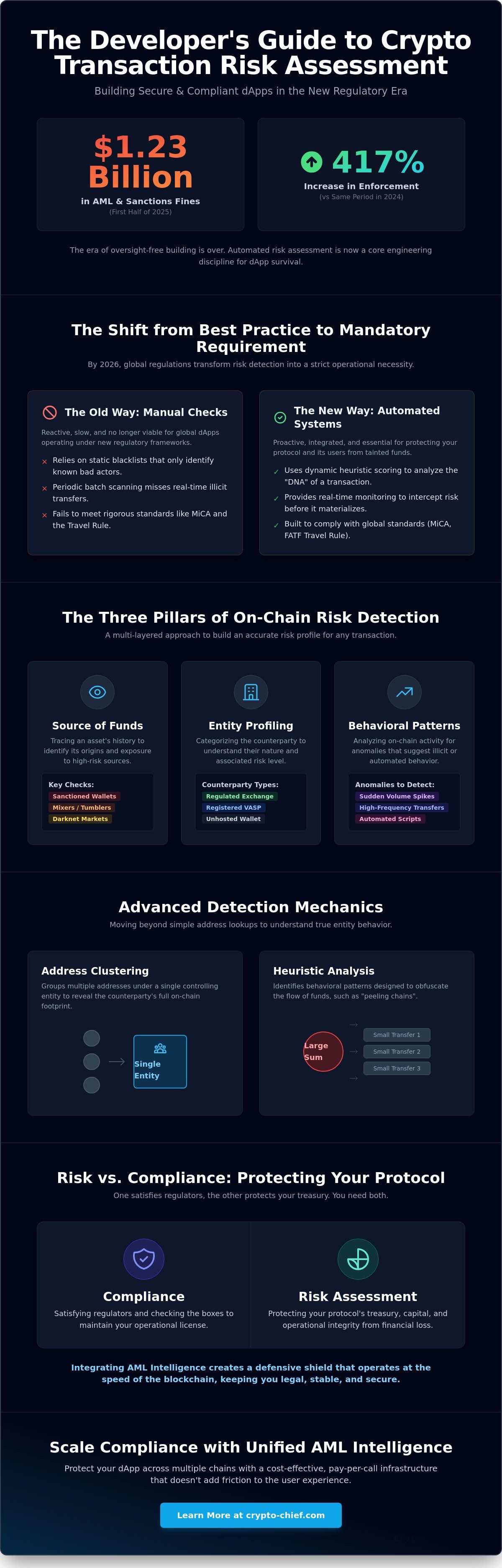
Regulators issued $1.23 billion in AML and sanctions fines during the first half of 2025, a staggering 417% increase over the same period in 2024. For developers, this surge in enforcement signals that the era of oversight-free building has officially ended. You recognize that building a secure, compliant dApp is essential for long-term survival, but the fragmentation of multichain data and the prohibitive cost of enterprise tools create significant friction. Mastering crypto transaction risk assessment is no longer just a legal hurdle; it's a core engineering discipline that ensures your platform doesn't unknowingly facilitate illicit transfers.
This guide provides a technical roadmap to help you evaluate, score, and automate blockchain risk detection with precision. You'll learn how to implement a reliable risk scoring framework and build cost-effective compliance infrastructure that scales with your user base. We'll explore the logic behind real-time heuristic analysis and transaction monitoring, giving you the tools to protect your dApp while meeting the rigorous standards of global regulations like MiCA and the FATF Travel Rule. It's time to move beyond manual checks and integrate automated security directly into your transaction flow.
Key Takeaways
- Understand how 2026 global regulatory standards transform automated risk detection from an optional feature into a core requirement for sustainable dApp development.
- Master the technical mechanics of address clustering and heuristic analysis to expose sophisticated fund-masking techniques like peeling chains.
- Define critical risk indicators, including direct exposure to sanctioned entities and high-risk mixers, to refine your crypto transaction risk assessment methodology.
- Learn to implement an automated risk-scoring workflow that queries real-time data to protect your platform without adding friction to the user experience.
- Discover how to leverage unified AML Intelligence to scale compliance across multiple chains while optimizing costs through a precise, pay-per-call infrastructure.
What is Crypto Transaction Risk Assessment?
At its core, crypto transaction risk assessment is the systematic evaluation of the legitimacy and safety of blockchain addresses and the assets they carry. It's the digital gatekeeping layer that determines whether a transaction should be processed or flagged for further review. Unlike traditional finance, where banks handle the heavy lifting, Web3 builders are now responsible for ensuring their protocols don't become conduits for illicit activity in crypto. This requires a shift from reactive monitoring to proactive, technical defense.
By 2026, this process will transition from a recommended best practice to a strict operational necessity. With the EU's MiCA regulation entering its final grandfathering phases and Australia's Travel Rule coming into force on July 1, 2026, manual checks are no longer viable for global dApps. Developers must implement automated systems that go beyond static blacklists. While a blacklist only identifies known bad actors, dynamic heuristic risk scoring analyzes the "DNA" of a transaction to predict risk before it materializes. This approach prevents tainted funds from entering your ecosystem, protecting your protocol from being blacklisted by major exchanges or targeted by law enforcement.
The Three Pillars of On-Chain Risk
Modern risk detection relies on three distinct layers of data to build an accurate profile of a transaction. First, we examine the Source of Funds. This involves tracing the asset's history to ensure it didn't originate from mixers, high-risk darknet markets, or sanctioned wallets. Second, we use Entity Profiling to categorize the counterparty. We determine if the sender is a regulated exchange, a registered VASP, or an unhosted wallet. Finally, we analyze Behavioral Patterns. We look for technical anomalies like sudden spikes in transaction volume or high-frequency transfers that suggest automated money laundering scripts rather than organic user behavior.
Risk vs. Compliance: Why Builders Need Both
It's vital to distinguish between compliance and risk. Compliance is about satisfying the regulator and checking the necessary boxes to maintain your license. Risk assessment, however, is about protecting your protocol's treasury and operational integrity. High-risk transactions often lead to frozen accounts, fraudulent disputes, and significant financial loss. By integrating AML Intelligence directly into your architecture, you create a defensive shield that operates at the speed of the blockchain. This integration doesn't just keep you legal; it keeps your infrastructure stable and your capital secure. It allows you to focus on building features while the background engine handles the complexity of global security standards.
The Mechanics of Blockchain Risk Detection
Effective crypto transaction risk assessment requires moving beyond simple address lookups to understanding the broader entity behavior. While a single wallet address provides a snapshot, the underlying mechanics of risk detection involve analyzing the entire transaction graph. This starts with address clustering. This process uses sophisticated algorithms to group multiple public keys under a single controlling entity. For example, when a user provides multiple inputs from different addresses into a single transaction, clustering logic identifies them as belonging to the same wallet. This provides a more accurate view of the counterparty's total footprint and potential exposure to illicit sources.
Heuristic analysis takes this a step further by identifying behavioral patterns designed to evade detection. A common tactic is the "peeling chain," where a large sum of assets is moved through a series of rapid, smaller transfers to obscure the original source. Detecting these patterns is critical, especially as the U.S. Treasury's DeFi Risk Assessment highlights how illicit actors frequently exploit the speed and pseudonymity of decentralized protocols. To counter this, developers must prioritize real-time monitoring over periodic batch scanning. If you're only checking wallet balances once a day, you'll miss the window to intercept a high-risk transfer before the funds are swapped or moved across a bridge.
How Data Normalization Improves Accuracy
Multichain protocols face a significant hurdle: inconsistent data formats. Ethereum's account-based model differs fundamentally from Bitcoin's UTXO structure, and Solana's account architecture adds another layer of complexity. Raw RPC data is often too fragmented for deep risk intelligence because it lacks the context needed for cross-chain analysis. Utilizing a Unified Blockchain API standardizes these inputs, ensuring your risk scoring engine receives clean, comparable data regardless of the source network. This normalization is the foundation of a reliable security stack.
The Role of Event Streaming in Risk Mitigation
Latency is the enemy of security. To minimize the time between a transaction occurring and a risk decision being made, builders are increasingly turning to event-driven architectures. By integrating Real-Time Blockchain Webhooks into your security dashboard, you can trigger an automated AML check the moment a transaction is detected on-chain. This allows your system to make "stop-payment" decisions in milliseconds, preventing high-risk assets from being integrated into your protocol's liquidity pools. If you're looking to streamline this process, exploring a dedicated RPC Gateway can provide the high-performance throughput needed for consistent monitoring.
Core Indicators of High-Risk Transactions
Identifying a high-risk transaction requires a granular understanding of on-chain behavior. While we previously discussed the mechanics of clustering, the actual execution of a crypto transaction risk assessment relies on specific, quantifiable indicators. These signals act as the logic gates for your security engine, allowing you to filter out noise while isolating genuine threats. This technical framework aligns with broader global perspectives, such as the IMF's Crypto-Risk Assessment Matrix, which highlights how macrofinancial stability depends on robust micro-level monitoring.
When you build your detection logic, your system should automatically flag the following red flags:
- Sanctions Exposure: Direct or indirect interaction with OFAC-sanctioned wallet addresses. Even if the funds are three or four "hops" away from a sanctioned source, the risk level remains elevated.
- Mixer Interaction: Transfers originating from or destined for known high-risk mixers like Tornado Cash. These services are primary tools for obscuring the trail of stolen or illicit funds.
- Burner Wallet Activity: Newly created addresses that receive high-value incoming transfers almost immediately. Legitimate users typically have a visible history of smaller interactions before moving significant capital.
- High-Velocity Sequences: Rapid sequences where funds move through five or more wallets within minutes. This behavior is a hallmark of automated laundering scripts designed to stay ahead of manual investigators.
- Known Malicious Contracts: Any interaction with addresses linked to phishing drainers or documented "scam" contracts. Given that over $50 billion in on-chain activity was linked to illicit actors in 2024, these signatures are more common than many developers realize.
Red Flags for Merchant Gateways
For those building payment solutions, indicators often manifest as behavioral anomalies. Unusual transaction sizes that deviate from a customer's established history are immediate red flags. We also monitor for "smurfing" attacks, where an actor attempts to bypass detection thresholds by breaking a large sum into multiple smaller transfers from different addresses. Multiple failed attempts to send funds from various wallets often suggest a user is testing which of their "tainted" accounts can bypass your security filters.
Entity Attribution: Knowing Your Counterparty
Attribution is the process of putting a name to a hash. It's the difference between flagging a withdrawal to a regulated exchange and blocking a transfer to a P2P mixer. Effective attribution requires precise VASP (Virtual Asset Service Provider) tagging to ensure your dApp remains compliant without alienating legitimate users. You can streamline this by using the Crypto Chief AML API for real-time entity lookup. This provides the metadata necessary to distinguish between low-risk institutional liquidity and high-risk illicit actors, allowing your crypto transaction risk assessment to be both accurate and efficient.
Automating Risk Scoring within Your dApp Workflow
Manual compliance reviews don't scale for automated DeFi or payment protocols. To maintain a competitive edge, you must integrate crypto transaction risk assessment directly into your code. This automation transforms raw blockchain data into actionable logic, allowing your dApp to respond to threats in milliseconds without human intervention. By following a structured five-step workflow, you can build a defensive layer that is both robust and developer-friendly.
- Step 1: Capture the Sender Address. Retrieve the user's wallet address through your frontend provider or directly from your RPC gateway during the connection phase.
- Step 2: Query the Risk Scoring API. Send the address to a specialized intelligence engine to retrieve a numerical risk value, typically ranging from 0 to 100.
- Step 3: Define Threshold Logic. Implement conditional logic to handle the response. You might block transactions with a score above 80, while flagging those above 50 for manual oversight.
- Step 4: Log the Risk Report. Store the API response and the resulting decision in your database. This ensures auditability and provides a clear record for future regulatory inquiries.
- Step 5: Trigger Automated Alerts. Use webhooks to push notifications for high-risk flags to your team's Discord or Slack channels, ensuring immediate awareness of suspicious activity.
Pre-Transaction vs. Post-Transaction Checks
Timing is critical when deploying risk logic. A pre-transaction check validates the address before the user can even click "Send," providing a seamless UX by preventing failed transactions. In contrast, a post-transaction check monitors the transaction hash once it hits the mempool, which is essential for capturing real-time behavioral shifts. For platforms utilizing Non-Custodial Crypto Processing, these integrated checks are vital. They ensure that funds are vetted before they ever touch your protocol's smart contracts.
Building a Compliance Audit Trail
Regulators require more than just a "blocked" or "allowed" status; they need to see the methodology behind your decisions. Storing risk scores in your database provides the necessary documentation for potential Suspicious Activity Report (SAR) filings. These API responses serve as verifiable proof of due diligence, demonstrating that your platform actively identifies and mitigates risk. If you are ready to implement a professional-grade security layer, you can start by integrating AML Intelligence to automate your compliance pipeline today.
Scaling Compliance with Crypto Chief’s AML Intelligence
Scaling a dApp requires an infrastructure that grows alongside your user base without introducing unsustainable overhead. While many legacy providers lock teams into rigid annual contracts, Crypto Chief’s AML Intelligence offers a more agile alternative. We provide a high-performance API designed for low-latency production environments, allowing you to integrate crypto transaction risk assessment directly into your existing stack. Our non-custodial philosophy ensures that you maintain absolute control over your private keys; we simply provide the comprehensive data required to stay secure and compliant.
Our infrastructure delivers unified access to risk data across several major networks, including Ethereum, BNB Smart Chain, and Polygon. This cross-chain visibility is essential for modern protocols that operate in a fragmented liquidity environment. By centralizing your risk intelligence through a single endpoint, you reduce the complexity of your backend and ensure a consistent security posture across every chain you support. You don't have to build separate monitoring tools for each network; the engine handles the heavy lifting in the background.
Cost Optimization for Growing dApps
The primary barrier to professional compliance is often the high cost of enterprise retainers. We eliminate this friction through a Pay-Per-Call model. Instead of paying for a massive monthly subscription you might not fully utilize, you maintain a prepaid token balance and only pay for the assessments you actually perform. This allows you to budget with precision as your transaction volume scales. Pay-per-call efficiency ensures that your security budget is always a direct reflection of your actual network activity.
Getting Started in Minutes
We've optimized the onboarding process to respect the developer's time. You can begin with our comprehensive documentation, which provides the technical specifications needed for a seamless API integration. If you want to verify the logic before moving to production, you can test your integration using the Crypto Chief Faucet to simulate on-chain events. This builder-centric approach ensures you can move from a sandbox environment to a fully compliant live dApp with minimal friction. The tools are ready; the logic is proven. Register your account and secure your dApp today to ensure your crypto transaction risk assessment meets the highest industry standards.
Future-Proofing Your On-Chain Security
The transition from manual oversight to automated, data-driven defense is no longer a luxury for Web3 projects; it's the standard for operational survival. By mastering crypto transaction risk assessment, you move beyond basic compliance and build a protocol that is inherently resilient against illicit fund flows. You've seen how heuristic analysis and real-time monitoring can expose sophisticated threats before they compromise your ecosystem. Now, the focus shifts to execution and choosing the right infrastructure to support your growth.
Crypto Chief provides the high-performance tools you need to scale without the burden of enterprise retainers. With global multichain coverage and enterprise-grade heuristic analysis, our engine delivers the precision required for modern dApps. Our pay-per-call pricing model ensures you only pay for the intelligence you use, maintaining efficiency as your transaction volume expands. Take the next step in securing your platform's future. Secure your dApp with Crypto Chief AML Intelligence and build with the confidence that your security stack is ready for whatever comes next.
Frequently Asked Questions
What is a crypto transaction risk assessment?
A crypto transaction risk assessment is the technical process of analyzing blockchain data to determine the probability that a transaction involves illicit activity. It goes beyond simple address lookups by examining the historical flow of funds, the reputation of associated entities, and behavioral patterns. This analysis provides a risk score that helps developers decide whether to accept, flag, or block a specific interaction within their dApp.
Is risk assessment mandatory for all crypto businesses?
Yes, risk assessment is becoming a global requirement as regulators tighten oversight of virtual asset service providers. By 2025, 85 jurisdictions had passed Travel Rule legislation, and the EU's MiCA regulation now enforces strict transaction monitoring standards. Failing to implement these checks can lead to significant fines and may prevent your platform from accessing essential banking or exchange services.
How does a risk scoring API calculate a score?
The API calculates a score by aggregating data from sanctions lists, known criminal wallet databases, and heuristic modeling. It analyzes the proximity of a wallet to high-risk entities, such as darknet markets or mixers, across multiple "hops" on the blockchain. This data is then processed through an engine that assigns a numerical value, typically from 0 to 100, representing the overall risk level.
Can I check the risk of a transaction before it is confirmed?
You can perform a pre-transaction check by screening a user's wallet address at the moment they connect to your frontend. This proactive approach allows you to block high-risk actors before they even initiate a transfer. By validating the counterparty early in the workflow, you prevent tainted assets from interacting with your protocol's liquidity pools or smart contracts.
What are the most common red flags in crypto transactions?
Common red flags include direct exposure to sanctioned addresses, funds originating from obfuscation services like mixers, and rapid sequences of transfers known as peeling chains. In a professional crypto transaction risk assessment, newly created wallets that receive high-value deposits without prior history also trigger high-risk alerts. These indicators suggest that an actor is attempting to bypass standard security filters.
How much does automated AML risk assessment cost?
Costs depend on the volume of transactions you process and the specific pricing model of your intelligence provider. Many modern developers prefer a pay-per-call structure because it eliminates the need for expensive, fixed-rate monthly retainers. This model is particularly efficient for growing dApps, as it ensures you only pay for the actual risk queries your system performs during production.
Does risk assessment work across different blockchains?
Yes, unified AML intelligence provides comprehensive coverage across major networks including Ethereum, BNB Smart Chain, and Polygon. This cross-chain visibility is vital because illicit actors often move assets between different protocols to hide their tracks. A multichain risk engine standardizes this data, allowing you to maintain a consistent security policy regardless of which network your users prefer.
Will risk assessment slow down my users’ transactions?
No, high-performance risk APIs are engineered for low-latency environments and typically deliver responses in milliseconds. When integrated correctly via webhooks or backend calls, these checks happen almost instantaneously in the background. You can maintain a fast, seamless user experience while ensuring that every transaction processed by your dApp meets the highest security and compliance standards.