
Why are you still paying for idle capacity while your dApp hits rate-limits during peak network congestion? Many developers find that traditional tiered plans fail to scale alongside the 6,200 TPS throughput potential of the network, leading to inconsistent performance when it matters most. When you rely on linea rpc nodes that lack native support for zkEVM-specific gas estimation, your users suffer through failed transactions and unnecessary latency. It's a common frustration for architects who need high-level stability but find themselves trapped by legacy infrastructure models that prioritize monthly billing over actual performance.
This guide will help you master the technical nuances of Linea infrastructure, ensuring you can achieve sub-millisecond latency and predictable billing through a more logical, pay-per-call approach. We'll explore how to optimize your dApp for the specific demands of the current zkEVM environment, moving from rigid systems to a high-performance RPC Gateway that scales as you do. By the end of this article, you'll understand how to eliminate the friction of monthly overhead while maintaining the structural integrity required for enterprise-grade applications. We'll examine the shift toward specialized providers that prioritize uptime and logic to ensure your multichain integration remains seamless and cost-effective.
Key Takeaways
- Understand the technical role of RPCs within the zkEVM state and how they facilitate the Zero-Knowledge proof cycle for secure transaction processing.
- Master specialized methods like
linea_estimateGasand the 'Finalized' tag to ensure accurate user fees and definitive state certainty. - Evaluate the performance gap between public endpoints and enterprise-grade linea rpc nodes to secure your dApp against downtime and data inconsistency.
- Implement a pay-per-call infrastructure model to gain granular control over your operational costs while achieving sub-millisecond transaction latency.
- Discover how globally distributed node networks and request batching can stabilize your infrastructure during high-volume network congestion.
Understanding Linea RPC Nodes: The Backbone of zkEVM Scalability
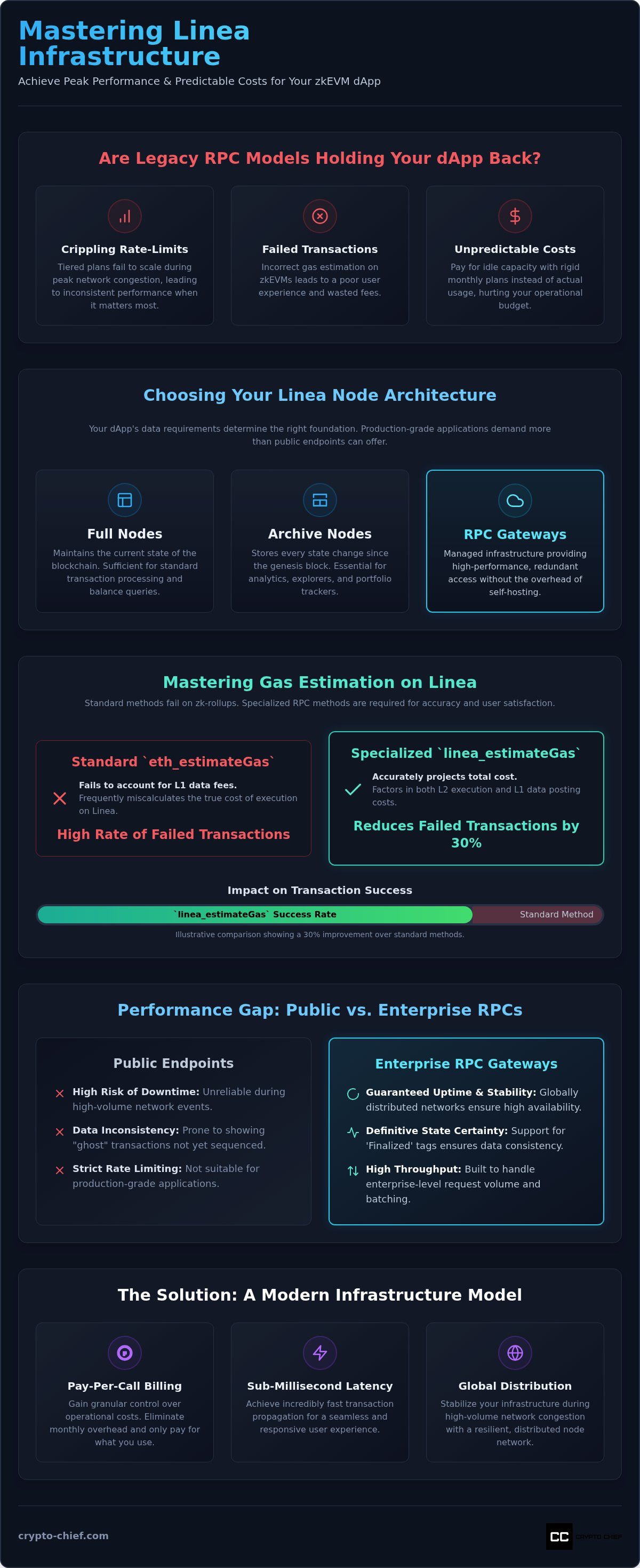
Linea RPC nodes serve as the essential communication bridge between your decentralized application and the network's state. Without these endpoints, a dApp cannot broadcast transactions or query the ledger. In the context of a zkEVM, the node's role extends beyond simple data relay. It acts as the entry point for data that will eventually be processed through a zero-knowledge proof cycle, ensuring that every off-chain computation is cryptographically verified before reaching Ethereum's mainnet. With the network surpassing 300 million total transactions by mid-2026, high-performance infrastructure has become the baseline for maintaining user retention in a competitive multichain market.
Choosing the right node architecture depends on your specific data requirements. While public endpoints might suffice for initial prototyping, production-grade applications require a more robust foundation. The distinction between node types remains vital for architectural planning:
- Full Nodes: These maintain the current state of the blockchain and are sufficient for standard transaction processing and balance queries.
- Archive Nodes: Essential for platforms requiring historical data, such as portfolio trackers or analytics tools, as they store every state change since the genesis block.
- RPC Gateways: These offer a managed layer of RPC Gateway infrastructure, providing high-performance access and redundancy without the technical debt of self-hosting.
The Role of JSON-RPC in the Linea Ecosystem
JSON-RPC acts as the standardized language that allows diverse frontends to interact with the Linea rollup. When a user initiates a swap or mints an asset, the dApp sends a request to the node to handle state queries or broadcast the signed transaction to the sequencer. For modern applications, WebSocket (WSS) support is a technical requirement. It enables real-time updates, allowing your interface to reflect balance changes or contract events instantly without the latency of constant polling. This responsiveness is critical for maintaining a seamless user experience during periods of high network activity.
Why zkEVM Infrastructure Differs from Standard L1 Nodes
Building on a zkEVM introduces unique architectural challenges that standard Layer 1 nodes don't face. The RPC layer must manage the nuances of batching and sequencing data before it's committed to Ethereum. Because Linea reaches soft finality in about one second but requires more time for L1 settlement, your linea rpc nodes must handle data consistency across these different levels of certainty. Enterprise-grade endpoints ensure that your dApp doesn't display "ghost" transactions that haven't been properly sequenced. This structural integrity is what separates a hobbyist project from a production-ready enterprise solution.
Specialized Linea API Methods and zkEVM Performance Nuances
Standard JSON-RPC methods often lack the granularity required for high-performance zk-rollups. While eth_estimateGas is the industry standard, it frequently miscalculates the true cost of execution on Linea because it fails to account for the dynamic L1 data fee. High-frequency trading platforms and complex DeFi protocols require linea rpc nodes that support the native linea_estimateGas extension. This specialized method provides a more accurate projection of the total transaction cost by factoring in both the L2 execution fee and the cost of posting data to the Ethereum mainnet. By leveraging advanced zkEVM technology, developers can ensure their applications remain responsive even during periods of intense network activity.
Mastering Gas Estimation on Linea
Accurate fee prediction is a prerequisite for a positive user experience. Implementing linea_estimateGas reduces failed transactions by 30% compared to standard estimation methods by providing a realistic ceiling for gas limits. Because Linea bundles transactions to inherit Ethereum's security, the gas price can fluctuate based on L1 data availability. Architects should always implement a 10-15% gas buffer in their smart contract calls to account for these micro-fluctuations between the estimation and execution phases. This proactive approach prevents the frustration of "out of gas" errors that plague less optimized dApps.
Latency Benchmarks: Public vs. Private Endpoints
Performance on a zk-rollup is measured by state certainty and response time. In 2026, the median transaction fee on Linea remains low at approximately $0.00986, but this cost efficiency is lost if your provider suffers from high Time to First Byte (TTFB) latency. Public endpoints often suffer from the "noisy neighbor" effect, where unrelated traffic spikes cause rate-limiting and inconsistent state queries. For production environments, a dedicated RPC Gateway eliminates these bottlenecks by providing isolated resources and predictable throughput.
This isolation is particularly vital when monitoring state certainty. While Linea achieves soft finality in roughly 1 second, your linea rpc nodes must accurately distinguish between different state tags to prevent front-end data inconsistencies:
- Latest: Reflects the most recent block produced by the sequencer, suitable for non-critical UI updates.
- Finalized: Indicates the state has been proven and recorded on the Ethereum mainnet, essential for high-value financial settlements.
Crypto Chief ensures full support for these Linea-specific method extensions, providing the structural integrity required for enterprise-scale deployment. By utilizing a high-performance gateway, you can maintain sub-millisecond precision across all state queries, ensuring your dApp remains stable regardless of network congestion.
Evaluating Node Providers: Public Endpoints vs. Enterprise RPC Gateways
Selecting between public infrastructure and dedicated gateways isn't just about budget. It's about stability. Public endpoints found on directories like Chainlist are excellent for testing, but they lack the structural integrity required for production environments. When you rely on free linea rpc nodes, you're competing for bandwidth with thousands of other users. This leads to the "noisy neighbor" effect, resulting in intermittent rate-limiting and data inconsistency that can disrupt your dApp's logic. For an architect, these "free" resources often carry hidden costs in the form of lost users and failed transactions.
Security is another critical factor that often goes overlooked. Unauthenticated public nodes are inherently vulnerable to man-in-the-middle (MITM) attacks. A malicious or compromised provider could feed your application incorrect state data or manipulate transaction outcomes, leading to catastrophic financial losses. To mitigate this, enterprise-grade providers offer authenticated access and encrypted communication channels. Choosing a provider must be based on a rigorous framework that prioritizes request volume handling, verified uptime SLAs, and a proven track record of security.
The Production Checklist for Linea Architects
Uptime is the most visible metric of success. In 2026, a 99.9% uptime guarantee is no longer sufficient for high-volume Web3 applications. It allows for nearly nine hours of downtime annually, which is unacceptable for DeFi protocols or gaming platforms. You need a Web3 RPC Gateway that offers higher availability through a redundant, globally distributed network. This distribution reduces latency by routing requests to the nearest healthy node, ensuring a responsive experience for a worldwide user base regardless of their geographic location.
Support and Documentation Depth
Integration speed depends heavily on documentation quality. A provider should offer developer-centric guides that cover Linea-specific nuances, such as gas estimation and state tags. When things go wrong during a network upgrade or a high-congestion event, 24/7 technical support becomes a mandatory requirement. You need a partner committed to the Linea ecosystem, one that proactively updates its infrastructure to support new network versions like the Beta v5.2 release. Evaluating a provider's commitment involves looking at their history of uptime and their responsiveness to the unique technical challenges posed by zkEVM architecture.
Optimizing dApp Performance on Linea: Latency and Cost Management
Performance optimization is a dual-track challenge. It requires sub-millisecond response times and a pricing model that doesn't penalize growth. For dApps built on linea rpc nodes, achieving this balance often involves moving away from rigid subscription tiers. By implementing middleware caching and granular monitoring, you can identify redundant calls that inflate costs without adding value to the user experience. Caching strategies at the middleware layer act as a buffer, serving frequent state queries locally to minimize the load on your primary endpoints. This reduces the frequency of hits to the blockchain state while maintaining data freshness for your users.
Monitoring and analytics tools are essential for identifying these inefficiencies. Tracking your RPC usage in real-time allows you to pinpoint which smart contract functions are the most resource-intensive. This data-driven approach enables you to refine your request patterns, ensuring that every call to the Linea network is necessary and optimized for speed. When you understand exactly how your application interacts with the blockchain, you can make informed decisions about where to apply batching or local caching to streamline performance.
The Pay-Per-Call Advantage for Scaling dApps
Monthly subscriptions often act as an "idle infrastructure tax" where you pay for capacity that sits unused during off-peak hours. The pay-per-call model is the most efficient way to scale during volatile traffic spikes because it ensures that your infrastructure costs align perfectly with your actual usage. By utilizing pre-paid tokens, architects can establish a predictable budgeting framework that eliminates the risk of hidden overage fees or sudden service suspensions. This model empowers builders to focus on engineering rather than managing the financial overhead of unused server capacity, providing a more logical foundation for long-term growth.
Multichain Efficiency with a Unified Gateway
Managing separate providers for Linea, Ethereum, and Polygon introduces unnecessary technical overhead and fragmented billing. A unified RPC Gateway simplifies the developer workflow by providing a single endpoint for multichain data. This consolidation allows for more effective RPC request batching, which reduces the total call volume by combining multiple queries into a single payload. It removes the friction of maintaining separate API keys and different rate-limit configurations across various networks, allowing your team to deploy faster and with greater structural integrity.
To optimize your dApp's performance and eliminate wasted infrastructure spend, register for a pay-per-call RPC account today and gain immediate access to high-performance Linea endpoints.
Scaling with Crypto Chief: High-Performance Linea Infrastructure
Crypto Chief acts as a silent but powerful partner for architects who prioritize uptime and logic over marketing fluff. By providing high-performance linea rpc nodes across a globally distributed network, we eliminate the latency issues that often plague regional providers. Our infrastructure is built with structural integrity at its core, ensuring that your dApp remains responsive during high-volume sequencing events. Beyond simple data relay, we offer deep integration with EventStream, allowing you to track on-chain events in real-time with zero-latency webhooks. This non-custodial, builder-centric approach removes the friction of managing complex server environments, letting you focus on developing core features without the distraction of infrastructure maintenance.
Unified Infrastructure for Modern Builders
The modern Web3 stack requires more than just a gateway. It demands a cohesive ecosystem where security and performance are integrated by design. By combining our RPC Gateway with AML Intelligence and a robust Crypto Processing API, we provide a single-source solution for enterprise dApps. You don't need to manage multiple accounts or fragmented billing cycles. A single API token balance powers all your services, allowing you to utilize our Unified API for multichain data normalization alongside your Linea endpoints. This consolidation ensures that your technical stack remains lean and your operational costs stay predictable through our pay-per-call model.
Getting Started with Crypto Chief
Transitioning to an elite infrastructure provider is a straightforward process designed to minimize developer friction. You can generate your first high-performance Linea endpoint in just a few minutes. First, register your account through our secure portal and add pre-paid tokens to your unified balance to enable pay-per-call access. Once your account is active, you can select Linea from our supported chains and generate your unique RPC URL. Finally, update your dApp's configuration to point to your new private gateway to begin enjoying sub-millisecond latency.
Our Developer Documentation provides comprehensive guides on implementing specialized methods and batching requests for maximum efficiency. If you're ready to secure your infrastructure for the next phase of zkEVM growth, register your account and start building on Linea today.
Securing Your Infrastructure for the Next Phase of zkEVM Growth
The evolution of zkEVM technology has transformed the requirements for production-grade infrastructure. Architects must now prioritize specialized methods and state certainty tags to maintain a competitive user experience. Moving away from rigid subscriptions in favor of a pay-per-call model ensures that your costs scale precisely with your actual traffic. This transition eliminates the "idle infrastructure tax" while providing the structural integrity needed for high-volume applications. It's time to move beyond the limitations of shared public endpoints and legacy providers that prioritize monthly billing over performance.
Optimizing your linea rpc nodes for speed and cost is no longer optional for enterprise builders. By leveraging a globally distributed network with a 99.99% uptime guarantee, you can deliver the sub-millisecond latency your users expect. Crypto Chief provides this foundation through a Unified Multichain API and transparent billing with no hidden fees. Scale your Linea dApp with Crypto Chief’s high-performance RPC Gateway and build with the confidence that your infrastructure is ready for the next phase of network growth. We've simplified the complex technical layers so you can focus on what matters: your code.
Frequently Asked Questions
What is a Linea RPC node and why do I need one?
A Linea RPC node acts as the essential communication bridge between your decentralized application and the zkEVM state. You need one to query blockchain data, such as account balances and smart contract states, and to broadcast signed transactions to the network's sequencer. Without a reliable connection to linea rpc nodes, your dApp cannot interact with the ledger or provide real-time updates to your users. High-performance nodes ensure these interactions happen with sub-millisecond latency.
How do I connect my MetaMask wallet to the Linea network?
You can connect MetaMask to Linea by adding the network details manually in the wallet settings. You'll need the RPC URL provided by your gateway, the Chain ID 59144, and the currency symbol ETH. Once these parameters are saved, MetaMask can communicate with the network through your chosen endpoint. Using a private RPC URL instead of a public one helps you avoid transaction queuing and rate-limiting during periods of high network activity and congestion.
What is the difference between a public and private Linea RPC endpoint?
Public endpoints are shared resources available to the general community, which often leads to rate-limiting and inconsistent performance during peak congestion. In contrast, a private RPC endpoint offers dedicated bandwidth and authenticated access for your specific application. Private gateways provide superior security by reducing the risk of man-in-the-middle attacks and ensuring that your data queries aren't slowed down by other users on the same infrastructure. This isolation is critical for production-grade stability.
How much does a Linea RPC provider cost in 2026?
Pricing for Linea infrastructure in 2026 typically follows two models: tiered monthly subscriptions or flexible pay-per-call systems. Tiered plans often charge for a set volume of requests, which can lead to wasted spend on idle capacity. Modern providers like Crypto Chief utilize a pay-per-call model where you only pay for the specific requests your dApp makes. This approach uses pre-paid tokens to provide a predictable budgeting framework without the burden of hidden monthly fees or overage charges.
Does Linea support the same JSON-RPC methods as Ethereum?
Linea is designed for high EVM compatibility, meaning it supports the standard JSON-RPC methods used by Ethereum. However, it also includes specialized extensions that are vital for zkEVM performance. Methods like linea_estimateGas are essential because they account for the unique costs of L1 data availability that standard Ethereum methods might overlook. Using these specific extensions ensures your dApp provides accurate fee estimations and avoids the high failure rates associated with underpriced transactions during batching cycles.
Can I run my own Linea node locally?
You can run a local Linea node, but it requires significant hardware resources and ongoing technical maintenance. Estimates for self-hosting in 2026 suggest costs between $120 and $220 per month for basic operations, excluding the time required for synchronization and software updates. Most enterprise architects prefer a managed linea rpc nodes provider to eliminate this overhead. Managed gateways offer better global distribution and redundancy than a single local instance can provide, ensuring higher uptime for your users.
What is the pay-per-call model for Web3 APIs?
The pay-per-call model is a utility-based pricing structure where you're charged only for the actual requests your application executes. Instead of committing to a rigid monthly tier, you purchase pre-paid API tokens that are deducted as you make calls to the RPC Gateway. This model eliminates the "idle infrastructure tax" and provides granular cost control. It's particularly effective for dApps with fluctuating traffic, as your expenses align perfectly with your real-world usage patterns.
How does the linea_estimateGas method improve my dApp?
The linea_estimateGas method improves your dApp by providing highly accurate transaction fee projections that account for both L2 execution and L1 data costs. Standard estimation methods often ignore the complexities of zk-rollup data posting, leading to failed transactions when gas limits are set too low. By using this specialized method, you can reduce transaction failure rates by approximately 30%. This precision creates a smoother user experience and prevents the loss of funds on reverted executions.
Tags: linea rpc nodes