
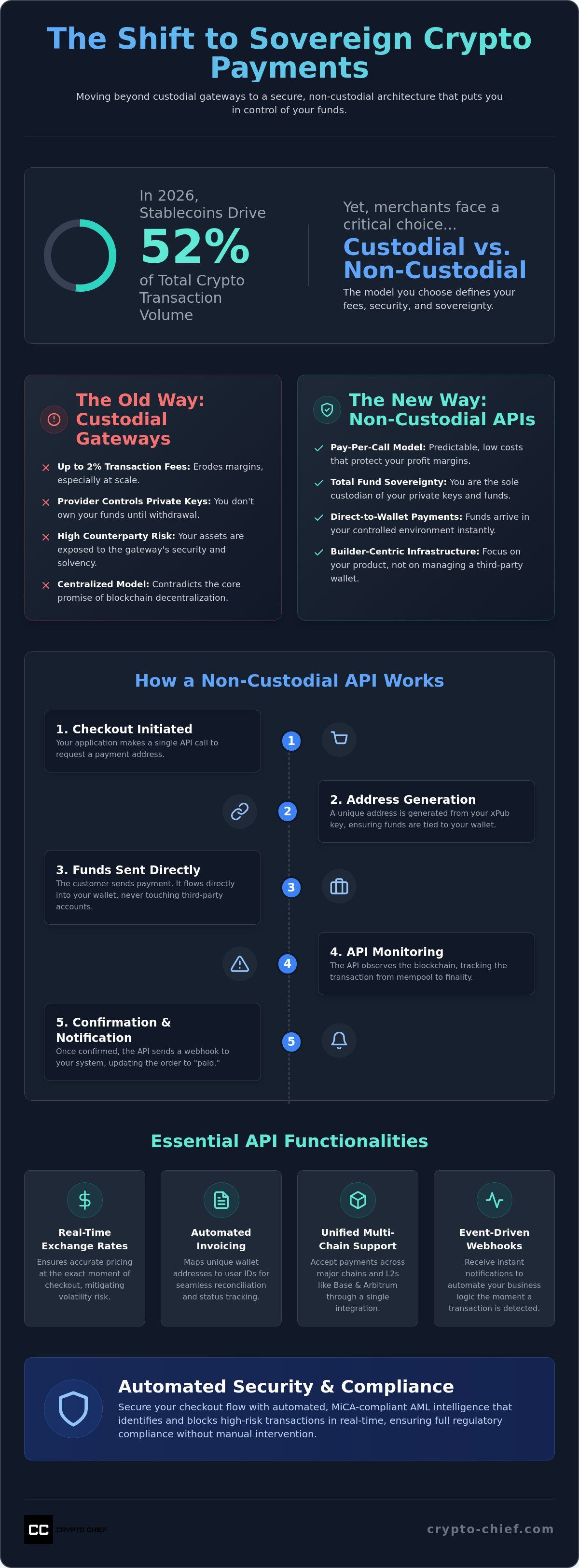
In 2026, stablecoins account for 52% of total crypto transaction volume, yet many merchants remain tethered to custodial gateways that charge up to 2% per transaction while controlling their private keys. You recognize that the core promise of blockchain is sovereignty, but the reality of fragmented multichain support and delayed payment notifications often forces businesses back into centralized, high-fee models. It's a common struggle for developers who need to balance enterprise-grade security with a seamless user experience. Integrating a robust accept crypto payments api shouldn't mean sacrificing your margins or your autonomy.
This guide will help you master the technical and financial architecture of non-custodial crypto payment APIs to build secure, scalable, and cost-effective blockchain checkout experiences. You'll learn how to move beyond legacy gateways toward a more resilient, builder-centric infrastructure. We will examine the shift toward pay-per-call token models, the necessity of MiCA-compliant AML intelligence, and the strategies for implementing unified RPC gateways that ensure global uptime for your application.
Key Takeaways
- Establish total fund sovereignty by transitioning to a non-custodial architecture that ensures you remain the sole custodian of your private keys.
- Evaluate the financial advantages of a pay-per-call model over traditional percentage-based fees to protect your margins during high-volume scaling.
- Master the technical nuances of an accept crypto payments api to bridge decentralized networks with your core business logic via high-performance RPC gateways.
- Secure your checkout flow with automated AML Intelligence that identifies and blocks high-risk transactions in real-time, ensuring full regulatory compliance.
- Streamline your infrastructure by utilizing a unified platform that offers real-time event streaming and normalized data across multiple blockchain networks.
What is an Accept Crypto Payments API?
At its core, an accept crypto payments api is a programmatic interface that enables a digital platform to interact directly with various blockchain networks. It functions as a specialized payment service provider by abstracting the complexities of distributed ledgers into manageable endpoints. Instead of managing raw node connections or manually parsing block data, your application makes simple requests to generate unique deposit addresses, monitor incoming mempool activity, and trigger automated business logic upon confirmation. This architecture acts as the vital bridge between the decentralized, trustless nature of the blockchain and the structured, database-driven environment of a traditional enterprise backend.
As we move through 2026, the industry has shifted away from the experimental phase of crypto acceptance. The emergence of robust regulatory frameworks has turned what was once a niche feature into a standardized enterprise requirement. Modern businesses no longer view crypto as a speculative asset but as a high-performance settlement layer. Implementing a robust accept crypto payments api allows companies to bypass the friction of legacy banking systems, offering near-instant global settlement and reduced counterparty risk. The API handles the heavy lifting of address management and transaction monitoring, allowing your team to focus on the core product experience.
The Evolution of Blockchain Payment Infrastructure
Early adopters were once forced to manually verify transactions by checking block explorers; a process that was both slow and prone to human error. Today, automated workflows are the baseline. This shift has been accelerated by the dominance of stablecoins, which now represent the majority of on-chain transaction volume. The rapid expansion of Layer 2 solutions like Base and Arbitrum has also solved the persistent issue of high gas fees. These networks allow for micro-transactions that were previously unfeasible on the Ethereum mainnet, making crypto a viable alternative for daily retail and SaaS subscriptions.
Core Functionalities for Modern Businesses
A sophisticated Crypto Processing API must provide more than just a connection to the chain. It needs to handle the heavy lifting of financial logistics and security. Key components include:
- Real-time exchange rate calculation: This ensures dynamic pricing matches market volatility at the exact moment of checkout.
- Automated invoice generation: This maps unique wallet addresses to specific user IDs for seamless reconciliation and status tracking.
- Non-custodial wallet support: This ensures that funds flow directly to your controlled environment, maintaining total sovereignty over your assets.
- Event-driven notifications: Utilizing technical documentation for webhooks allows your system to update order status the moment a transaction is detected in the mempool.
Technical Architecture: How Non-Custodial APIs Work
The architecture of a non-custodial accept crypto payments api is built on the principle of fund sovereignty. Unlike custodial gateways that act as intermediaries, a non-custodial system ensures the provider never has access to your private keys. When a user initiates a checkout, your application calls the Crypto Processing API to generate a unique deposit address. This address is derived from your extended public key (xPub), meaning funds land directly in your wallet. The API acts as a sophisticated observer, not a participant in the movement of value. It's a clean, secure separation of concerns.
Detection begins the moment a transaction enters the mempool. High-performance infrastructure monitors the network, identifying the specific hash associated with your generated address. It's a complex dance of data synchronization. The system must track the transaction from its unconfirmed state through multiple block confirmations to reach finality. Finality varies by chain; for instance, a transaction on Polygon might require more confirmations than one on Ethereum to be considered immutable. The API signals completion only when these specific safety thresholds are met, protecting you from double-spending or orphaned blocks. This ensures that when your backend receives a "paid" status, the value is truly settled.
The Role of RPC Nodes in Payment Processing
Reliable payment detection depends entirely on the quality of the connection to the blockchain. While public nodes are accessible, they often suffer from rate-limiting and high latency, which can lead to missed payments or delayed notifications. Enterprise-grade infrastructure utilizes dedicated RPC Gateway endpoints to ensure 99.9% uptime and sub-second data propagation. For a deep dive into how these connections function as the backbone of Web3, consult our Web3 RPC Gateway guide. High-speed nodes are the only way to maintain a responsive checkout experience for a global audience.
EventStream and Real-Time Webhooks
Efficiency in a modern checkout flow requires real-time data delivery. Constantly polling an API for status updates is resource-intensive and slow. Instead, sophisticated systems use Real-Time Blockchain Webhooks to push notifications to your server the instant an event occurs. This EventStream approach is critical for handling chain reorganizations (reorgs). If a block is dropped and a transaction is "undone," the webhook system alerts your backend immediately. This level of precision ensures you don't ship a product before the payment is truly secure. If you're ready to build, you can start your integration today and experience this infrastructure first-hand.
API Models Compared: Custodial vs. Pay-Per-Call
Selecting an accept crypto payments api often involves a fundamental choice between convenience and control. Custodial models act as a middleman, holding your funds in their wallets before settling them to your account. While this simplifies the initial setup, it introduces significant counterparty risk. If the provider faces a liquidity crisis or regulatory freeze, your revenue is trapped. Conversely, a pay-per-call model operates on a non-custodial basis, ensuring that every transaction lands directly in your sovereign wallet. You don't just manage the payment; you own the underlying asset from the moment it hits the chain.
Percentage-based fee structures, common in custodial gateways, effectively penalize your growth. As your transaction volume or ticket price increases, your infrastructure costs balloon proportionally. In the current market, fees for custodial services typically range from 0.5% to 2% per transaction. For a high-ticket item, even a 1% fee can translate to hundreds of dollars for a single transaction. This is a legacy mindset inherited from traditional finance. A modern accept crypto payments api should function like a utility. By shifting to a model where you pay for infrastructure access rather than a slice of your revenue, you decouple your operational costs from your sales performance.
Financial Impact Analysis for Enterprises
For high-performance dApps and global retailers, the ROI of switching to a fixed API token balance is immediate. Instead of losing a fixed percentage to a gateway, businesses can budget for a specific number of requests. This cost-per-request efficiency is particularly transformative for processors handling billion-dollar volumes, where even a 0.5% fee represents millions in lost margin. Pay-per-call models provide the predictability required for long-term financial planning, allowing you to scale your transaction count without a linear increase in overhead. You aren't paying for the value of the transaction; you are paying for the technical call that confirms it.
Security and Compliance Architecture
Non-custodial processing eliminates the honeypot risk associated with centralized payment hubs. Since the API provider doesn't store private keys, there is no central vault for attackers to target. This architecture inherently improves your security posture while simplifying regulatory reporting. A Unified API further streamlines this by offering a normalized data structure across multiple blockchains. You get a single, consistent schema for Bitcoin, Ethereum, and stablecoins, which reduces the complexity of your compliance engine and internal accounting. This structural integrity ensures your platform remains resilient as you expand into new multichain environments.
Integration Blueprint: Security and AML Compliance
By July 2026, the transitional period for MiCA provisions has expired, making robust compliance the baseline for any enterprise accept crypto payments api integration. The global landscape has shifted. With the FATF Travel Rule now active in 85 jurisdictions, accepting on-chain payments without a real-time risk assessment is no longer a viable business strategy. It's a significant liability. Security in this environment requires a layered approach that combines cryptographic sovereignty with automated regulatory intelligence. You must ensure your system can identify the source of funds before they are reconciled into your accounting ledger.
Effective security starts at the gateway. You should implement a "least privilege" model for your API keys, ensuring that your processing credentials cannot be used to modify account settings or access sensitive treasury data. IP whitelisting and periodic key rotation are essential practices for maintaining a hardened perimeter. While the accept crypto payments api handles the technical communication with the blockchain, your backend must remain the authoritative source for transaction validation. This separation of concerns prevents a single point of failure from compromising your entire financial stack.
Automated Risk Detection with AML Intelligence
Modern checkout flows must integrate risk scoring directly into the transaction lifecycle. By utilizing an AML Risk Detection API, your application can automatically scan incoming transaction hashes against global watchlists and known high-risk entities. You have the power to set specific thresholds; for instance, you might automatically flag or block funds originating from sanctioned mixers while allowing low-risk retail transfers to proceed. For a granular look at implementing these protocols, our Crypto AML Risk Detection guide provides the technical framework for automated compliance. You can secure your infrastructure with AML Intelligence to ensure your business remains resilient against evolving regulatory demands.
Building a Robust Checkout Workflow
A seamless user experience is built on technical reliability. Your UI should offer clear wallet connection options and dynamic QR codes that include the exact payment amount and destination address. Handling edge cases is where most integrations fail. You need to design fail-safes for underpayments, where the user sends less than the invoiced amount, and overpayments, which require a simple mechanism for returning excess funds. Non-custodial architectures excel here. Because you maintain control of the private keys, you can trigger automated refunds or payouts directly from your own wallet without waiting for a third-party processor to approve the movement of your capital.
Scaling with Crypto Chief’s Processing Infrastructure
Scaling a global enterprise in 2026 requires more than just a simple gateway; it demands a unified foundation that remains resilient under heavy load. Crypto Chief provides a comprehensive ecosystem where your accept crypto payments api works in direct coordination with enterprise RPC nodes and real-time AML intelligence. This integration eliminates the administrative friction of managing multiple vendors and fragmented billing cycles. By consolidating your infrastructure under a single pre-paid API token balance, you gain unparalleled visibility into your operational costs while ensuring maximum uptime for your international user base. Our global node distribution ensures low-latency performance, providing the sub-second responsiveness that modern consumers expect from a professional checkout experience.
The platform is designed to act as a silent, powerful partner in your growth. We've solved the complex problems of blockchain data normalization and high-availability node management so your team can focus on building your core product. A unified stack offers several strategic advantages for high-volume applications:
- Operational Simplicity: Manage processing, RPC access, and AML risk scoring through a single dashboard and balance.
- Predictable Scaling: The pay-per-call model ensures your costs remain tied to actual infrastructure usage rather than fluctuating with market prices or transaction values.
- Global Reach: Utilize a high-performance engine that supports multichain environments with consistent reliability across all major time zones.
- Developer-Centric Logic: Access sophisticated tools and documentation designed by builders who understand the practical challenges of Web3 integration.
Unified Web3 Infrastructure for Architects
Architects building for a multichain future need reliable, low-latency access to diverse networks without the overhead of maintaining individual node clusters. Whether you are querying Ethereum, BNB Chain, or the Bitcoin network, our unified gateway provides a consistent and hardened connection. This structural integrity allows you to leverage real-time event streaming for instant payment confirmations, moving your users from checkout to fulfillment without unnecessary delay. Our accept crypto payments api allows you to scale from a small-scale prototype to enterprise-grade volume seamlessly, ensuring your infrastructure is never the bottleneck in your expansion strategy.
Next Steps: From Sandbox to Production
Transitioning from a development sandbox to a live production environment should be a methodical and risk-free process. You can begin by testing your specific workflows and edge-case handling using the Crypto Chief Faucet, which provides the necessary resources to ensure your logic handles real-world blockchain events correctly. For teams requiring bespoke configurations or specialized infrastructure, Web3 infrastructure experts are available to consult on custom white-label solutions tailored to your brand’s unique requirements. To begin your build immediately, consult the full technical reference in our API Documentation and experience the stability of a truly professional processing stack.
Future-Proofing Your Digital Settlement Layer
The transition toward non-custodial architecture is no longer a luxury; it's a fundamental requirement for any enterprise seeking to maintain fund sovereignty in 2026. By moving away from legacy custodial gateways, you eliminate counterparty risk and reclaim total control over your private keys. Adopting a sophisticated accept crypto payments api that utilizes a pay-per-call model ensures your infrastructure costs remain predictable, allowing you to scale your application without the burden of percentage-based fees that penalize high-volume success.
Integrating a unified stack that combines high-performance RPC gateways with real-time AML intelligence provides the structural integrity needed for global commerce. You don't have to manage fragmented vendors when a single, powerful platform handles the technical complexity of multichain processing. It's time to shift from experimental setups to a stable, builder-centric foundation that supports your long-term vision. Start building with Crypto Chief’s Processing API today and experience the efficiency of a silent, reliable infrastructure partner. We are here to help you build what's next.
Frequently Asked Questions
What is a non-custodial crypto payment API?
A non-custodial API facilitates the technical detection of blockchain transactions without ever taking possession of your funds. Unlike custodial services that hold capital in their own accounts before settlement, this architecture ensures that payments flow directly from the customer to your sovereign wallet. You maintain total control over your private keys, which eliminates the counterparty risk associated with centralized intermediaries.
How do pay-per-call API fees compare to transaction percentage fees?
Pay-per-call models treat your infrastructure as a utility by charging a fixed cost for each technical request rather than a percentage of your revenue. Traditional gateways often take between 0.5% and 2% per transaction, which significantly reduces margins for high-ticket or high-volume businesses. By utilizing an accept crypto payments api with a predictable token balance, you decouple your operational expenses from your sales performance.
Can I accept stablecoins like USDT and USDC with an API?
Yes, modern processing infrastructure provides native support for major stablecoins across multiple blockchain networks including Ethereum, Polygon, and BNB Smart Chain. Stablecoins represent over 50% of the total crypto transaction volume in 2026, making them a critical requirement for any merchant. The API abstracts the underlying token standards, allowing you to manage various assets through a single, unified interface.
Do I need my own RPC nodes to accept crypto payments?
You don't need to maintain a private node cluster if you utilize a provider that offers an integrated RPC gateway. Running your own nodes is resource-intensive and requires constant monitoring to ensure global uptime and data consistency. A professional API service provides enterprise-grade node access as part of its foundation, delivering the high-speed connectivity required for reliable payment detection.
How does an AML API protect my business from tainted crypto?
An AML Intelligence API scans incoming transaction hashes against global watchlists and blockchain analytics databases in real-time to identify illicit activity. It provides a risk score for every payment, enabling your system to automatically block funds originating from mixers or sanctioned addresses. This automated detection is essential for maintaining compliance with current regulatory frameworks like MiCA and the FATF Travel Rule.
What happens if a customer sends the wrong amount to the payment API?
Your backend should utilize the granular data provided by the API to handle underpayments and overpayments through automated logic. The system identifies the exact amount received in the mempool and triggers a specific webhook to update the order status. You can then programmatically request the remaining balance from the user or initiate a partial refund directly from your controlled wallet.
Is it possible to automate crypto payouts using the same API?
Yes, a comprehensive accept crypto payments api includes endpoints that allow you to programmatically broadcast transactions for vendor settlements or user withdrawals. This functionality enables you to manage both incoming revenue and outgoing expenses from a single platform. Since the environment is non-custodial, your application remains the authoritative entity that signs and authorizes every movement of capital on the chain.
How long does it take to integrate a crypto payment gateway API?
A standard integration can typically be completed within a few business days by a developer using documented RESTful endpoints and webhooks. The process involves generating API keys, mapping unique deposit addresses to your user IDs, and configuring event streams for real-time notifications. Utilizing a sandbox environment or a faucet for initial testing ensures that your checkout logic is fully hardened before going live.