
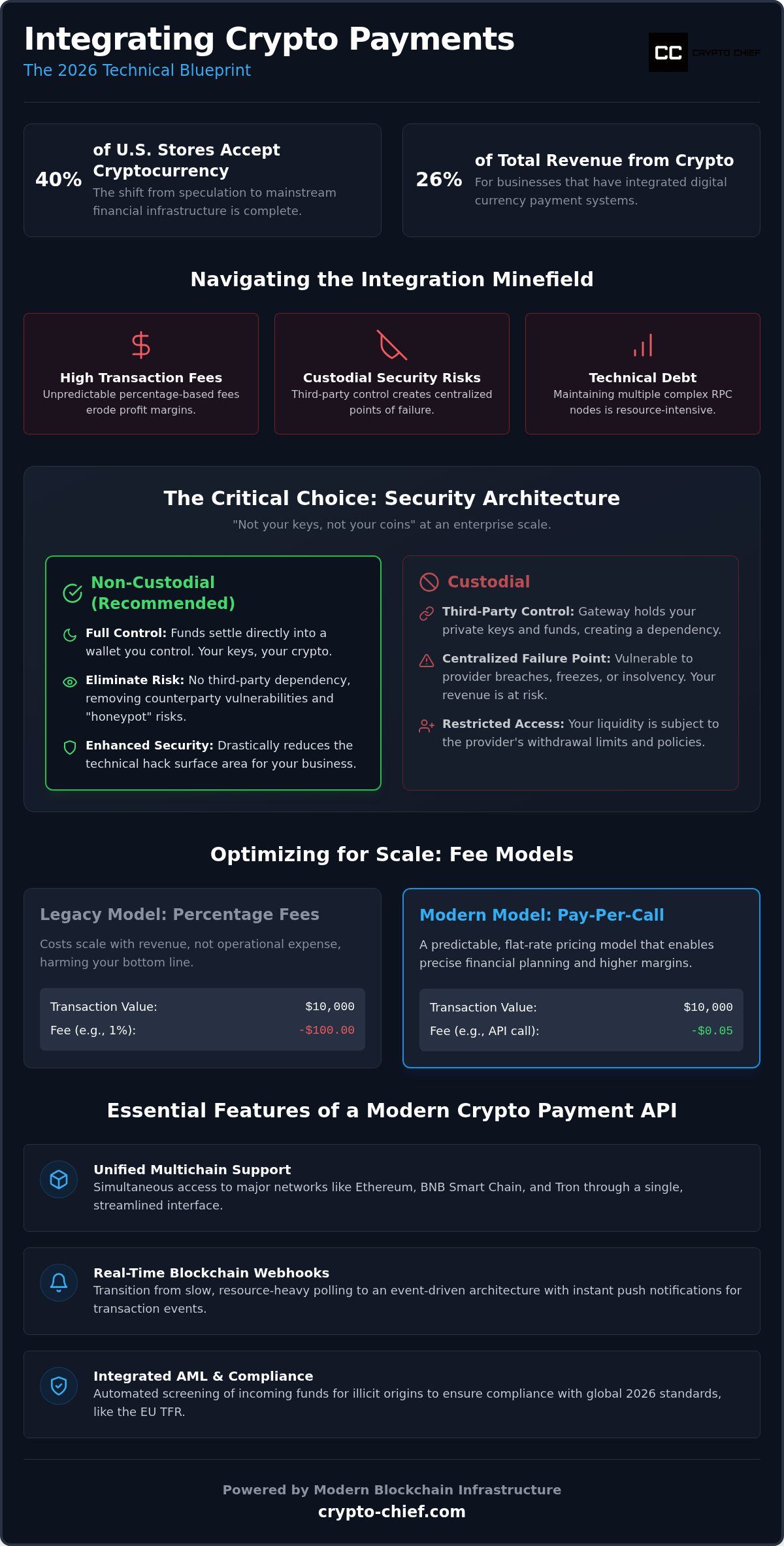
Did you know that 40% of U.S. stores now accept cryptocurrency, and for those that have implemented these systems, crypto transactions account for up to 26% of their total revenue? You likely recognize that the shift from digital speculation to legitimate financial infrastructure is the defining trend of 2026. This evolution is driven by the demand for unified financial management, as seen with platforms like ellicash.com that facilitate international transfers and global investments. However, the practical reality of learning how to integrate crypto payments on website api often involves navigating a minefield of high transaction fees, custodial security risks, and the technical debt of maintaining multiple RPC nodes. You shouldn't have to choose between global reach and your bottom line.
This guide provides the technical blueprint to master a non-custodial architecture where funds flow directly to your wallet without intermediary holding periods. We promise to detail the cost-optimization strategies and unified workflows necessary to build a high-performance gateway that remains resilient under pressure. You will gain a clear understanding of pay-per-call pricing models, real-time AML compliance integration, and the streamlined logic required to handle multichain transactions through a single, sophisticated interface. From navigating the latest EU Transfer of Funds Regulation to implementing automated event streaming, we cover the essential pillars of modern blockchain commerce.
Key Takeaways
- Learn why non-custodial architectures are the preferred standard for maintaining full control over private keys and eliminating third-party security risks.
- Discover how to integrate crypto payments on website api through a methodical approach that connects your platform directly to global blockchain networks.
- Transition from unpredictable percentage-based fees to a pay-per-call model, enabling more precise financial planning and improved profit margins.
- Simplify your technical stack by utilizing a unified API that provides simultaneous access to multichain RPC nodes and real-time AML intelligence.
- Master the implementation of automated transaction monitoring to ensure seamless compliance with 2026 global regulatory standards like the EU TFR.
What is a Crypto Payment API and How Does it Work in 2026?
A crypto payment API is the programmatic connective tissue between your digital platform and the decentralized ledger. Unlike the static "Pay" buttons of the early blockchain era, a modern API functions as a sophisticated payment gateway that automates the entire transaction lifecycle. It allows your backend to generate unique deposit addresses, monitor network states, and confirm payment finality without manual intervention. By 2026, this technology has evolved from a simple bridge into a robust infrastructure layer that handles the complexities of multichain interactions, gas price fluctuations, and real-time data normalization.
To effectively integrate crypto payments on website api, you need a system that understands more than just "send" and "receive." Modern payment flows now leverage Layer 2 scaling solutions and smart contracts to ensure micro-payments are economically viable. The API acts as an orchestrator, translating low-level blockchain data into actionable insights for your business logic. It's the difference between guessing if a transaction succeeded and having a verified, immutable record of settlement.
For specialized online retailers, such as those where you can learn more about Try The CBD and their variety of hemp-derived products, this level of transactional clarity is essential for building long-term customer trust and operational stability.
In the same way that transactional clarity builds trust in business, relationship intelligence is becoming a vital tool for personal security; to see how this technology is applied to romantic connections, you can check out CheriPic.
The Mechanism of API-Driven Crypto Processing
The core of this process involves a deep interaction with a Web3 RPC gateway. Instead of your server straining to maintain a full node, the API queries high-performance nodes to verify transaction data across various chains. Efficiency is the priority here. While legacy systems relied on resource-heavy polling, where your server repeatedly asks a node for updates, modern developers utilize a real-time blockchain webhook. This event-driven architecture ensures your system receives an instant push notification the moment a transaction hits the mempool or reaches a specific confirmation depth. It's faster, cheaper, and significantly more reliable for enterprise-scale operations.
Key Features to Look for in a Modern API
When you decide to integrate crypto payments on website api, the architecture you choose defines your long-term security. A non-custodial setup is now the industry standard for professional builders. This ensures that funds settle directly into your private wallets, removing the risk of a third-party processor freezing your assets. Additionally, a unified API must provide seamless multichain support for networks like Ethereum, BNB Smart Chain, and Tron through a single interface. Security isn't just about keys; it's about compliance. Leading APIs now include integrated AML risk detection. This feature automatically screens incoming funds for illicit origins, protecting your business from regulatory friction and ensuring every transaction meets global 2026 standards.
Architecting for Security: Non-Custodial vs. Custodial Integration
Security architecture is the most critical decision you'll face when you decide to integrate crypto payments on website api. The industry remains divided between custodial and non-custodial models, but the technical community has increasingly moved toward the latter. Custodial gateways act as intermediaries, holding your private keys and your funds on their own infrastructure. This creates a centralized point of failure. If the provider experiences a breach, a regulatory freeze, or financial insolvency, your business revenue remains at risk. Research into crypto risks and harms highlights how counterparty vulnerability often stems from these third-party dependencies.
Developers now prioritize non-custodial workflows to uphold the "not your keys, not your coins" principle at an enterprise level. In this model, the API facilitates the transaction, but the funds settle directly into a wallet you control. This eliminates the "honeypot" effect associated with central platforms. By removing the intermediary, you reduce your technical hack surface and ensure that your liquidity is never subject to a third party’s withdrawal limits or internal policies.
The Benefits of Non-Custodial Crypto Processing
Adopting a non-custodial approach offers three primary advantages for high-volume platforms. First, it enables immediate settlement. Funds go directly to your cold or hardware wallet—or a self-custody crypto wallet with debit card for immediate access to capital—without waiting for platform-specific payout cycles. Second, it provides total autonomy. You don't have to worry about account freezes during periods of market volatility. Finally, it drastically reduces risk. Since the platform never holds your assets, a compromise of the service provider's backend doesn't lead to a loss of your business capital. This structural integrity is why professional architects choose to integrate crypto payments on website api using direct-to-wallet protocols.
Implementing Zero-Trust Security Patterns
Maintaining security requires more than just choosing the right architecture; it demands rigorous backend protocols. You should implement whitelisted withdrawal addresses to ensure that even a compromised API key cannot redirect your payouts. Use role-based access control (RBAC) to limit which team members can modify payment configurations or view sensitive transaction data. You'll also want to secure your webhook endpoints with HMAC signature verification to prevent spoofing attacks. Non-custodial processing represents the definitive standard for enterprise security in 2026. If you're ready to build on a foundation of stability, exploring a Crypto Processing API designed for builders is the logical next step.
Optimizing for Scale: Pay-Per-Call vs. Percentage Fee Models
Traditional payment processors often rely on percentage-based commissions, a model that scales poorly for high-ticket transactions. When you integrate crypto payments on website api, you have the opportunity to break away from this legacy tax on your growth. A merchant processing small $10 payments might find a 0.5% fee acceptable, but as transaction values increase, these costs eat into margins unnecessarily. For a $10,000 settlement, that 0.5% fee totals $50, even though the technical work performed by the API remains identical to a $1 transaction. Efficiency demands a more logical approach to infrastructure costs.
Predictable budgeting becomes nearly impossible when your service fees fluctuate based on the value of the goods you sell. You also have to distinguish between network gas fees, which are paid to blockchain miners, and the service fees paid to your API provider. By choosing a model that charges per request rather than per dollar, you gain a transparent view of your operational overhead. This shift allows you to treat payment processing as a manageable utility expense rather than a revenue-sharing agreement that penalizes your success.
The Pay-Per-Call Advantage for Developers
Crypto Chief utilizes a prepaid token balance model where you only pay for the specific resources you consume. This approach is the cornerstone of blockchain api cost optimization. Instead of losing a significant percentage on a single high-value transaction, your cost is limited to the price of the API calls required to generate an address and confirm the payment. This enables you to integrate crypto payments on website api with the confidence that your expenses won't explode as your business scales to handle larger global settlements, providing the necessary stability for fintech platforms like ducapp.com to facilitate secure money transfers.
Efficiency in Multichain Environments
Managing multiple chains often leads to fragmented billing and redundant costs. Utilizing a unified Web3 developer platform allows you to consolidate your RPC requests, payment monitoring, and AML intelligence into a single, streamlined billing system. Batching these requests further reduces the number of calls needed, driving down the cost per transaction even further. Pay-per-call pricing decouples transaction value from processing costs. This architecture ensures that your infrastructure remains lean and performant, even when handling thousands of concurrent users across different blockchain networks.
Step-by-Step: Integrating Crypto Payments via API
To successfully integrate crypto payments on website api, you must follow a methodical deployment pipeline that prioritizes security and data integrity. It begins with generating your API credentials within your dashboard and establishing a prepaid balance to fuel your requests. This model ensures you have constant access to the infrastructure without the friction of monthly subscriptions or unpredictable percentage deductions. By establishing this foundation, you prepare your environment for high-performance transaction handling across multiple chains.
Phase 1: Backend Setup and Authentication
Start by securing your API tokens. You should never hardcode these into your client-side scripts; instead, store them in environment variables on your server to prevent exposure. Your next step involves initializing the connection to the RPC gateway. This connection allows your backend to communicate directly with the decentralized ledger. You'll need to select your target chains, such as Ethereum, Polygon, or Tron, depending on your user base's preferences. Using a unified interface simplifies this process, as it normalizes data from diverse networks into a single, predictable format for your business logic.
Phase 2: Monitoring and Confirmation
Real-time awareness is non-negotiable for a professional user experience. Configure your listener for EventStream webhooks to receive push notifications the moment a transaction occurs. Unlike resource-heavy polling, this event-driven approach respects your server's limits while providing instant updates. You must also account for blockchain-specific nuances like confirmation counts and potential chain re-orgs. For example, a transaction on a Layer 2 might require fewer confirmations than one on Bitcoin to be considered final. Once the required depth is reached, your system can trigger automated customer notifications and update the order status in your database.
Before moving to production, you must implement AML Intelligence to screen incoming funds for high-risk origins. This automated check protects your platform from regulatory friction by providing real-time risk scoring for every deposit. Finally, validate every part of your workflow on a testnet. Using an Ethereum Sepolia faucet allows you to simulate real transactions without risking actual capital. Rigorous testing ensures that when you finally integrate crypto payments on website api in a live environment, your gateway performs with enterprise-grade reliability. Ready to begin? You can create your developer account and start building today.
Why Crypto Chief is the Infrastructure Choice for Global dApps
Crypto Chief represents a paradigm shift in how developers integrate crypto payments on website api. Most providers treat payment gateways as isolated tools, leaving architects to stitch together disparate services for RPC access and compliance. This fragmented approach creates technical debt and increases the risk of downtime. By providing a unified infrastructure, we eliminate the friction of managing multiple vendors. You gain a single point of entry for high-performance RPC nodes, real-time event streaming, and automated risk scoring, all while maintaining absolute financial sovereignty through a non-custodial architecture.
Efficiency is built into the core of our platform. We've replaced the traditional percentage-based fee model with a transparent pay-per-call structure. This ensures that your costs remain predictable even as your transaction volume scales globally. When you integrate crypto payments on website api with our stack, you aren't just adding a checkout button; you're deploying an enterprise-grade engine designed for the demands of 2026. Our system acts as a silent, powerful partner that handles the heavy lifting of blockchain communication, allowing your team to focus on the creative aspects of your application, while an agentic platform like GraiaCX manages the complexities of AI-driven customer engagement across voice and chat.
A Complete Web3 Stack Under One Roof
Integrating AML intelligence directly into your payment flow ensures that every incoming transaction is screened against global risk databases instantly. This proactive stance on compliance reduces the risk of regulatory friction without slowing down the user experience. Performance is further optimized by our dedicated Ethereum RPC nodes and Tron RPC nodes, which provide the low-latency data required for instant confirmation. Our network extends beyond the most common chains to include specialized support for TON RPC and Bitcoin Cash, allowing you to reach diverse global markets through one unified API.
Getting Started with Crypto Chief
We've designed our onboarding process to respect your time. You can explore our comprehensive documentation for detailed quick-start guides, endpoint specifications, and integration patterns. Once you're ready to build, the registration process allows you to obtain your API keys and initialize your test environment in minutes. For enterprises requiring bespoke configurations or high-volume throughput, we invite you to contact our team for a custom Web3 solution. Whether you're a solo creator or a global enterprise, we provide the stability and logic needed to scale your digital economy with confidence.
Future-Proof Your Payment Infrastructure
The decision to integrate crypto payments on website api marks a transition from basic transactional logic to a sophisticated, sovereign financial architecture. By prioritizing non-custodial security, you ensure that your business remains the sole custodian of its assets, effectively removing the vulnerabilities inherent in third-party hosting. This structural integrity, combined with a predictable pay-per-call pricing model, allows you to scale without the burden of escalating percentage-based fees that often penalize growth.
Modern commerce requires a unified approach where payments, multichain RPC access, and real-time AML intelligence exist within a single, performant ecosystem. You've now gained the technical blueprint to deploy a gateway that is both resilient and legally compliant. The tools required to build this foundation are accessible, reliable, and designed for enterprise-grade scalability. It's time to move beyond legacy limitations and embrace a builder-centric infrastructure that respects your margins and your autonomy.
Start Building with Crypto Chief’s Non-Custodial API
We look forward to supporting the high-performance applications you'll create on this stable foundation.
Frequently Asked Questions
Is it better to use a custodial or non-custodial crypto payment API?
Non-custodial APIs are the preferred choice for professional developers because they ensure you maintain absolute control over your private keys. While custodial services simplify initial setup, they introduce counterparty risks where your funds could be frozen or lost due to provider issues. A non-custodial architecture allows payments to settle directly into your own wallet, upholding the essential principle of financial sovereignty.
How much does it cost to integrate crypto payments via API?
Costs depend heavily on whether you choose a percentage-based or request-based billing model. Traditional processors often charge a flat 1% commission on every transaction, which scales poorly as your revenue increases. Alternatively, a pay-per-call model allows for superior cost optimization by charging only for the technical requests your system makes. This approach decouples your infrastructure expenses from the total dollar value of your sales.
Can I accept multiple cryptocurrencies through a single API integration?
Yes, you can accept hundreds of different assets through a single integration by utilizing a Unified API. This interface normalizes data across disparate networks like Ethereum, BNB Smart Chain, and Tron, allowing your backend to interact with various blockchains through a consistent set of endpoints. It's the most efficient way to integrate crypto payments on website api without building separate logic for every individual network.
How do I handle AML and KYC compliance when accepting crypto payments?
Compliance is managed through automated risk scoring and real-time intelligence tools that monitor the blockchain. In 2026, global regulations like the EU Transfer of Funds Regulation require verification for transfers regardless of the amount. You should implement an API that provides instant risk scores for incoming transactions to ensure you aren't accepting illicit funds. This helps you stay aligned with international standards like the US Travel Rule.
What is the difference between an RPC gateway and a payment gateway?
An RPC gateway provides the raw communication link to a blockchain node, allowing you to broadcast transactions or query ledger data directly. A payment gateway is a higher-level abstraction that includes business logic for address generation and status monitoring. While you can build a payment system using only an RPC gateway, a dedicated processing API handles the complex automation and webhook logic required for enterprise reliability.
How long does it take to confirm a crypto payment on a website?
Confirmation times depend on the specific blockchain and the number of network confirmations your business requires for finality. Transactions on Layer 2 networks or high-throughput chains like Tron often finalize in seconds. In contrast, Bitcoin or Ethereum mainnet transactions might take ten to thirty minutes depending on network congestion and the gas fees paid by the sender to prioritize their transaction in the mempool.
Do I need to run my own node to integrate crypto payments?
You don't need to maintain your own node infrastructure to integrate crypto payments on website api. Running a full node is resource-intensive and requires constant maintenance to ensure uptime and synchronization. Most developers prefer using a managed RPC gateway or a unified processing API. These services provide reliable access to blockchain data without the overhead of hardware management or complex DevOps requirements.
What happens if a customer sends the wrong amount of crypto?
Your backend logic should be designed to handle discrepancies in the sent amount through automated detection. If a customer sends less than the required total, the system should mark the payment as partially paid and prompt the user for the remaining balance. Conversely, overpayments should be flagged for manual or automated refunds. A professional API provides real-time event streaming that allows your system to detect these conditions instantly.