
What if your production application is making decisions based on stale data because a node missed a single event during a routine update? Most developers understand the frustration of building on infrastructure that feels fragile. You've likely dealt with the headache of node downtime, the lag of transaction notifications, and the sticker shock of tiered API plans that don't scale with your growth. It's a common struggle to monitor ethereum events real time without sacrificing performance or overextending your budget.
We agree that your focus should remain on building great products, not managing the complex plumbing of the blockchain. This guide provides a technical roadmap to move beyond manual polling and unreliable connections. You'll learn the most efficient ways to capture live on-chain events, ranging from raw WebSockets to scalable, event-driven streaming solutions. We'll examine how to implement a production-ready listener that reduces infrastructure overhead and leverages a pay-per-call model to optimize your operational costs. This article details the exact steps to build a resilient system that thrives on the 2026 Ethereum network.
Key Takeaways
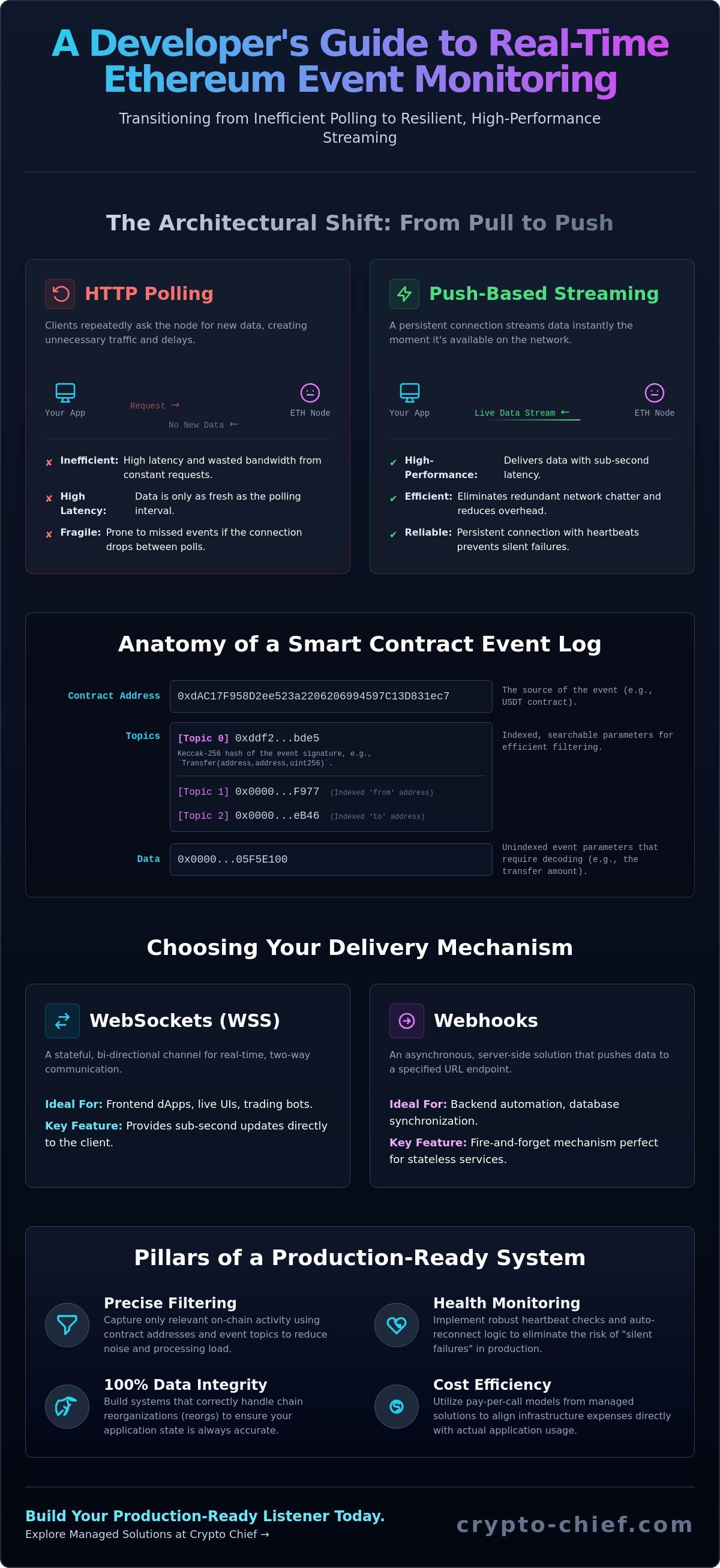
- Master the architectural shift from inefficient HTTP polling to high-performance, push-based WebSockets for instantaneous data delivery.
- Discover how to configure precise filter criteria, including contract addresses and event signatures, to ensure you only capture relevant on-chain activity.
- Implement robust health monitoring and heartbeat checks to eliminate the risk of silent failures in your production environment.
- Learn the most reliable techniques to monitor ethereum events real time while maintaining 100% data integrity across diverse node infrastructures.
- Evaluate the cost-efficiency of managed solutions like EventStream, which utilizes a pay-per-call model to align infrastructure expenses with actual usage.
The Architecture of Real-Time Ethereum Event Monitoring
Ethereum events are not just side effects of code execution; they are the primary communication layer for the decentralized web. When a Smart contract executes logic, it emits logs that reside within the transaction receipt on the blockchain. These logs provide a permanent, searchable record of specific actions, such as a token transfer or a price update in a liquidity pool. For developers, the ability to monitor ethereum events real time is the difference between a responsive application and a disconnected interface.
Legacy systems often relied on HTTP polling, where a client repeatedly asks a node for new data. This approach is inherently inefficient, introducing high latency and unnecessary bandwidth consumption. Modern architectures have shifted toward push-based models, utilizing persistent connections to stream data the moment it hits the mempool or a block. Real-time data is the lifeblood of high-frequency DeFi protocols, NFT minting platforms, and instant wallet notifications. Without it, users face delayed feedback, leading to failed trades or missed opportunities in volatile markets.
Reliability remains a significant hurdle. Network latency can delay notifications, while chain reorganizations (reorgs) might cause an event to be "undone" after your system has already processed it. This "Missing Event" problem occurs when a node falls out of sync or a connection drops without a proper heartbeat mechanism. Building a production-ready listener requires accounting for these edge cases to ensure data integrity remains absolute even during network turbulence.
Understanding Smart Contract Logs and Topics
The Ethereum Virtual Machine (EVM) organizes event data into a structured format composed of the contract address, topics, and data. Topics act as indexed keys that allow for efficient filtering, whereas the data field contains unindexed parameters that require manual decoding. Topic 0 is the keccak-256 hash of the event signature, serving as the unique identifier for the event type itself. By filtering for specific topics, you can isolate relevant transactions from the noise of the entire network, ensuring your application only processes the data it needs.
WebSockets (WSS) vs. Webhooks for Event Delivery
Choosing the right delivery mechanism depends on your infrastructure's specific needs. WebSockets (WSS) provide a stateful, bi-directional channel ideal for frontend dApps that require sub-second updates for user interfaces. In contrast, webhooks offer an asynchronous, server-side solution that pushes data to a specific URL, making them perfect for backend automation and database synchronization. Both methods rely on high-performance Ethereum RPC nodes to maintain the connection and broadcast the logs as they are generated. Leveraging a professional RPC Gateway ensures that these connections remain stable even during periods of extreme network congestion, providing a reliable foundation for your event-driven architecture.
Comparing Tools for Monitoring Ethereum Events
Selecting the right implementation tool is a strategic decision that directly impacts both engineering velocity and long-term operational stability. While the underlying architecture remains consistent, the choice between raw protocols and managed services determines how much technical debt your team will inherit. To monitor ethereum events real time, developers must balance the control of self-hosted listeners against the reliability of enterprise-grade infrastructure. In a multichain environment, this complexity multiplies as each network introduces unique block times and finality rules.
Raw JSON-RPC Subscriptions
The eth_subscribe method is the standard gateway for developers who prefer a hands-on approach. By passing the logs parameter, you can receive a stream of event data filtered by address or specific topics. However, this flexibility comes with significant maintenance overhead. Maintaining a persistent, stateful WebSocket connection requires custom logic to handle intermittent network drops and node-side timeouts. You don't just need to listen; you must also manage the subscription lifecycle. Research into event-driven EVM transaction security monitoring highlights the necessity of low-latency responses to prevent malicious exploits, yet raw connections often struggle with "silent failures" where the stream stops without an explicit error. Furthermore, developers must implement complex logic to handle chain reorganizations, ensuring that orphaned transactions aren't mistakenly processed as finalized state changes.
Managed Event Streaming Services
Managed infrastructure has become the preferred choice for production-ready applications. These services act as a silent partner, handling the complexities of automatic retries, deduplication, and connection persistence. Integrating these streams with Unified APIs ensures that your data schema remains consistent across multiple chains, removing the friction of disparate data formats. Many developers are shifting toward pay-per-call models to reduce idle costs. This model is efficient. It ensures you only pay for the events you actually receive rather than maintaining expensive, underutilized node clusters. Solutions like EventStream simplify this entire process by providing a high-performance bridge between on-chain activity and your backend. For those requiring high-performance infrastructure without the management burden, exploring a dedicated RPC Gateway can provide the necessary stability to scale with confidence.
The transition from raw methods to managed services reflects a broader trend toward specialization in Web3 development. By offloading the plumbing of event delivery, you can dedicate your resources to building the unique features that define your product. Whether you are tracking DeFi liquidations or NFT transfers, the goal remains the same: 100% data integrity at a predictable cost.
Step-by-Step: Implementing a Real-Time Event Listener
Moving from architectural theory to a functional implementation requires a methodical approach. A production-ready listener is not just about receiving data; it's about processing it reliably without introducing bottlenecks into your application. By following a structured deployment cycle, you can monitor ethereum events real time while ensuring your backend remains resilient to network fluctuations. We've simplified this process into five decisive steps to help you deploy your listener with confidence.
- Step 1: Obtain API Credentials. Access your provider dashboard to generate a unique API key. This credential acts as your secure gateway to the blockchain, allowing the RPC nodes to authenticate your subscription requests.
- Step 2: Define Filter Criteria. Specify the contract address and the event signatures you wish to track. Using a library like Ethers.js v6.16.0 or Web3.py v7.16.0, you will define the topics that tell the node exactly which logs to push to your client.
- Step 3: Configure Destination. Choose your delivery method. For serverless architectures, provide a Webhook URL; for low-latency frontend applications, initialize a WebSocket client.
- Step 4: Implement the Listener. Write the logic to handle incoming JSON payloads. This code should parse the log data, decode the hex values into human-readable formats, and trigger your internal business logic.
- Step 5: Verify the Integration. Use a testnet like Sepolia to trigger a transaction that emits your target event. Confirm that the payload arrives at your destination with all expected parameters intact.
Defining Complex Filters for Specific Events
Precision is the key to cost-efficiency. Instead of listening to all activity on a contract, you can use indexed parameters to isolate specific high-value transactions, such as ERC-20 'Transfer' events involving significant "whale" movements. By filtering for a specific 'To' or 'From' address directly at the node level, you reduce the volume of data your server must process. Implementing Real-Time Anomaly Detection requires this level of granularity, as catching malicious exploits often depends on identifying specific patterns in event data before they can impact your protocol's security.
Handling Webhook Payloads and Retries
Reliability in a distributed system depends on how you handle failures. When using webhooks, your endpoint must be idempotent to prevent duplicate processing if a provider sends the same event twice during a retry cycle. Security is equally paramount. You must verify the cryptographic signatures included in the webhook headers to ensure the data originated from your trusted provider. For detailed schemas and specific field definitions, consult the Crypto Chief documentation. This resource provides the structural clarity needed to build a robust handler that maintains 100% data integrity even during periods of high network congestion.
Ensuring Reliability and High Availability in 2026
Building a basic listener is a start, but maintaining it in a production environment requires a shift toward high-availability infrastructure. Most guides focus on manual JavaScript listeners that break when a single node fails. To monitor ethereum events real time at scale, you must account for the reality of network instability and node maintenance cycles. The most dangerous scenario is the silent failure. This occurs when your WebSocket connection remains open, but the data stream has stalled without throwing an error.
Implementing a robust heartbeat mechanism is the first line of defense. By periodically checking the connection status or comparing the latest received block height against a known source, you can detect hangs and trigger an automatic reconnection. Reliability isn't just about code; it's about the underlying infrastructure that supports your application. If your stream drops, you need a system that notices immediately and acts to restore the data flow.
Redundant Node Architectures
Relying on a single node is a central point of failure that your architecture cannot afford. Distributing your requests across a global RPC gateway ensures that your application remains online even if a specific regional cluster experiences downtime. Automatic failover mechanisms allow your system to seamlessly transition from a failing node to a healthy one without dropping the event stream. Global load balancers manage Ethereum request traffic by routing calls to the most responsive available instance.
Data Integrity and Reorg Protection
Speed must be balanced with finality. While you want to monitor ethereum events real time, processing an event the moment it appears carries the risk of chain reorganizations. A reorg happens when a node switches to a different version of the blockchain history, potentially making your processed event invalid. Configuring a specific confirmation depth allows you to wait until a block is sufficiently "buried" under newer blocks to be considered final. In 2026, even with faster finality through upgrades like Glamsterdam, checking the "removed" flag in your event logs is essential. This flag indicates that a log previously sent to you has been reverted, allowing your system to undo any state changes and maintain absolute data integrity.
If your system does experience a brief outage, your architecture must include a strategy for backfilling missed data. By tracking the last processed block number, you can query for logs between that point and the current head upon reconnection. This ensures no transaction goes unnoticed. For developers who prioritize uptime, integrating a professional Ethereum RPC Gateway provides the redundant foundation necessary to achieve 99.9% availability in a production environment.
Scalable Event Monitoring with Crypto Chief EventStream
Building a listener is the first step, but scaling it to handle millions of transactions requires an enterprise-grade engine. EventStream is designed as a high-performance, real-time blockchain event service that removes the friction of manual infrastructure management. It provides a unified interface to monitor ethereum events real time across Ethereum, Polygon, and BSC, ensuring your application remains responsive regardless of the network. By shifting the burden of connection persistence and data deduplication to a managed service, your team can focus on core product innovation rather than low-level plumbing.
The service acts as a silent, powerful partner in your stack. It integrates seamlessly with our broader ecosystem, including the Unified API and RPC Gateway, to provide a cohesive development experience. Whether you're tracking DeFi liquidity or managing a high-volume NFT marketplace, the goal is consistent: 100% data integrity with zero infrastructure fatigue. In a market where Ethereum maintains a dominant 60% share across stablecoins and DeFi, having a reliable way to stream this data is non-negotiable for professional builders.
Cost Optimization for High-Volume dApps
Efficiency is the cornerstone of a sustainable Web3 business. Many providers force developers into rigid, tiered subscription models where you often pay for unused capacity or face steep overage fees. EventStream utilizes a decisive pay-per-call model, ensuring you only pay for the events your application actually receives. This approach is significantly more efficient than monthly overhead plans. By filtering events at the infrastructure level, you further reduce expenses by only processing the data that meets your specific criteria. You can scale from 100 to 1,000,000 events without the need to manually upgrade tiers or renegotiate contracts, providing the financial predictability required for long-term growth.
Advanced Security and AML Integration
Real-time detection is only valuable if it triggers immediate action. EventStream allows you to initiate AML risk assessments the moment a suspicious event is detected on-chain. This automation is critical for fund tracing and identifying high-risk contract interactions before they can compromise your platform's integrity. By combining event monitoring with AML Intelligence, you create a proactive security posture that meets the rigorous demands of the 2026 regulatory environment. It's a builder-centric solution that handles the complexity of compliance so you don't have to. Register now to start monitoring Ethereum events with the precision and scale that EventStream provides.
Future-Proofing Your Event-Driven Architecture
Mastering the transition from inefficient polling to high-performance streaming allows your application to respond to on-chain activity with surgical precision. You've learned how to structure complex filters, implement redundant node architectures, and protect your data integrity against chain reorganizations. Implementing a robust system to monitor ethereum events real time is a foundational requirement for production-grade reliability in 2026. By offloading the complexity of connection management and data deduplication, you can dedicate your resources to building the unique logic that defines your product.
Our ecosystem is designed to be your silent, powerful partner. We provide the structural integrity you need through our Unified Multichain API and a Global RPC Gateway that ensures 99.9% uptime. Whether you are automating fund tracing with AML Intelligence or scaling a global dApp, our platform removes the friction of background infrastructure. It's time to move beyond fragile listeners and embrace a more resilient approach. Streamline your Web3 infrastructure with Crypto Chief EventStream and build with the confidence that your data is always accurate and available. Your next breakthrough is waiting; we're here to ensure the foundation is solid.
Frequently Asked Questions
What is the difference between eth_getLogs and eth_subscribe?
eth_getLogs is a pull-based method used to query historical logs within a specific block range, making it ideal for data backfilling and auditing. In contrast, eth_subscribe is a push-based mechanism that uses a persistent WebSocket connection to stream new logs the moment they're generated. Choosing between them depends on whether you need a snapshot of the past or a continuous, live feed of the present.
How can I monitor Ethereum events in real time without a WebSocket?
You can monitor ethereum events real time using Webhooks if you prefer a stateless, server-side architecture over persistent WebSockets. Webhooks push data to a predefined URL on your server, which removes the need for your application to maintain a constant connection. This approach is highly efficient for asynchronous processing and integrates seamlessly with serverless functions or traditional RESTful backends that require high availability.
Can I monitor events from multiple smart contracts with one API call?
Yes, you can monitor multiple smart contracts by passing an array of addresses into the address parameter of your filter. This allows you to consolidate your monitoring logic into a single subscription rather than maintaining individual connections for every contract. It simplifies your infrastructure and reduces the number of active subscriptions you need to manage, which is particularly useful for tracking activity across related protocols.
What happens to my event listener during an Ethereum network reorg?
During an Ethereum network reorganization, a previously emitted log might be reverted if its block is replaced by a different chain segment. Professional event listeners handle this by checking the removed field in the JSON payload, which is set to true when a log is being undone. Implementing logic to detect this flag ensures your application doesn't permanently record state changes that the network has officially discarded.
How much does it cost to monitor high-frequency events like Uniswap trades?
Monitoring high-frequency events like Uniswap trades can be expensive if you use a tiered subscription plan with rigid monthly limits. A more scalable approach is the pay-per-call model, where costs are directly proportional to the volume of events you actually receive. This ensures you aren't paying for idle time, though you should implement strict filters at the infrastructure level to avoid processing unnecessary data noise.
Is it possible to filter smart contract events by a specific user's address?
You can filter events by a specific user address if that address is defined as an indexed parameter in the smart contract's event signature. These indexed parameters appear as topics in the log structure, allowing you to monitor ethereum events real time for a specific wallet without ingesting every transaction. This level of granularity is essential for building personalized notification systems or tracking high-value whale movements.
How do I ensure I don't miss events if my server goes down?
Ensuring 100% data integrity during server downtime requires a combination of persistent block tracking and automated backfilling. When your server returns online, your system should query eth_getLogs for the gap between the last processed block and the current network height. Alternatively, using a managed service like EventStream can handle retries and queuing, providing a reliable buffer that prevents data loss during brief connection outages.
Does monitoring events real-time require a full node?
No, you don't need to maintain your own full node to monitor live on-chain activity. Most developers utilize a professional RPC Gateway, which provides reliable access to the network through a managed API. This removes the massive hardware and maintenance overhead associated with running a node while offering higher uptime and better global reach for your application's event-driven features and real-time notifications.