
Your Web3 infrastructure bill isn't rising because of your user growth; it's rising because of your architecture's inefficiencies. Most developers accept that managing multiple blockchain apis means dealing with opaque compute unit multipliers and paying for high-tier monthly plans that never reach full capacity. It's frustrating to watch your overhead climb while your actual throughput remains stagnant. You've likely felt the friction of architectural bloat as you juggle various individual chain RPCs, each with its own billing quirks and performance bottlenecks.
You can reclaim control over your bottom line without compromising the elite-level speed your dApp requires. This guide will show you how to master the technical and architectural strategies needed to slash your blockchain infrastructure costs while maintaining structural integrity. We'll explore how shifting to a unified API model and utilizing real-time event streams can drastically reduce request volume and eliminate redundant polling. By the end of this article, you'll have a clear roadmap for achieving predictable month-over-month spend and a significantly higher performance-to-cost ratio.
Key Takeaways
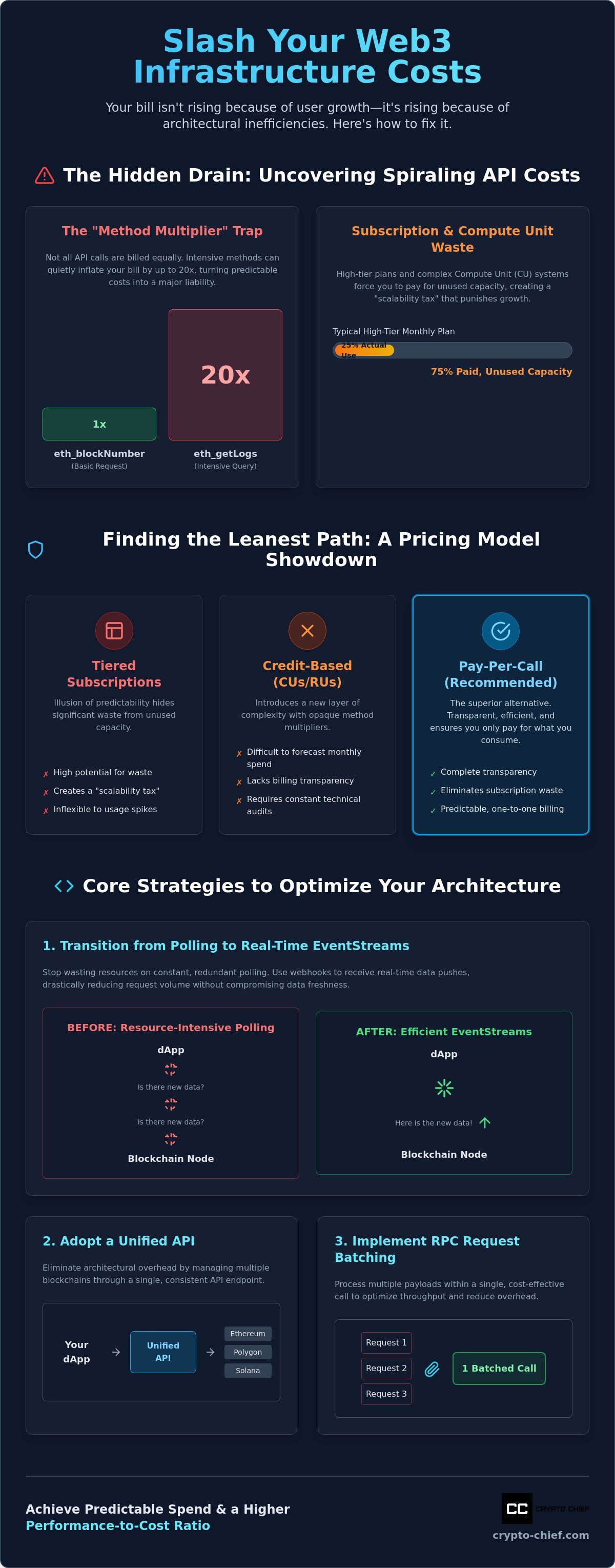
- Identify and neutralize the "method multiplier" trap where specific calls, such as eth_getLogs, quietly inflate your billing by up to 20x.
- Transition from resource-intensive polling to real-time EventStream webhooks to drastically reduce request volume without compromising data freshness.
- Simplify your development workflow by managing multiple blockchain apis through a Unified API to eliminate the architectural overhead of individual chain integrations.
- Compare the long-term efficiency of transparent pay-per-call models against the hidden costs of credit-based systems and underutilized monthly tiers.
- Optimize throughput by implementing RPC request batching, allowing your application to process multiple payloads within a single, cost-effective call.
The Hidden Drain: Why Web3 API Expenses Spiral in 2026
The promise of Web3 development often clashes with the harsh reality of the monthly infrastructure bill. By 2026, the global Web3 market is projected to reach $6.75 billion, yet much of this capital is being siphoned away by inefficient architectural choices. When you're managing multiple blockchain apis, the costs aren't just a matter of request volume; they're a matter of complexity. Most developers start with a simple plan, only to realize that their "unlimited" requests are throttled by hidden multipliers that punish sophisticated data retrieval. This fragmentation across different provider dashboards creates a massive operational overhead that drains your team's time and budget before you've even scaled.
The "Method Multiplier" is the primary culprit behind these spiraling costs. While a basic eth_blockNumber call might count as a single unit, more intensive methods like eth_getLogs can cost 20 times more. This isn't just a minor surcharge. It's a structural trap. If your dApp relies on heavy event filtering or constant polling to maintain a real-time UI, your bill can climb into the thousands. This architectural inefficiency is often exacerbated by subscription waste, where you're forced into high-tier monthly plans but only use a fraction of the capacity, essentially subsidizing the provider's idle hardware.
Understanding Compute Units vs. Raw Requests
The industry has largely moved away from counting simple requests. Instead, providers use Compute Units (CUs) or Resource Units (RUs) to measure the actual load on their nodes. This shift changed how we interact with an application programming interface (API) in the blockchain space. Archive and trace calls, which require the node to traverse historical state, are heavily weighted to reflect their computational intensity. Method weighting is the primary cause of budget overruns because it decouples your actual usage from your perceived request count, making monthly spending almost impossible to forecast without deep technical audits.
The Scalability Tax: When Success Becomes Expensive
Viral growth should be a milestone, not a financial crisis. In traditional tiered models, hitting a traffic spike often forces an immediate, manual upgrade to a significantly more expensive plan. You're left paying for unused requests that expire at the end of the month, creating a "scalability tax" that punishes efficient builders. For Web3 startups in 2026, predictable pricing is the most critical metric for survival. Without it, a successful launch can become an architectural liability. Leveraging a high-performance RPC Gateway that offers transparent pricing is the only way to ensure success doesn't break the bank.
Comparing Web3 Pricing Models: Finding the Leanest Path
The legacy approach to Web3 infrastructure usually involves tiered subscriptions. While these plans offer the illusion of predictability, they often lead to significant waste. You're forced to choose between a plan that's too small, leading to mid-month service interruptions, or a plan that's too large, where you pay for capacity that sits idle. For startups managing multiple blockchain apis, this "fixed limit" model creates a financial ceiling that doesn't account for the rhythmic nature of dApp usage. You shouldn't have to pay for a "Scale" tier during a quiet development week just to ensure you're covered for a potential weekend traffic spike.
Credit-based systems, often labeled as Request Units (RU) or Compute Units (CU), were designed to be more equitable, but they introduced a new layer of complexity. Calculating the weighted cost of every individual call requires constant monitoring and technical audits. It's difficult to forecast your monthly burn when an archive call costs significantly more than a standard request. This lack of transparency makes it nearly impossible for business architects to maintain a lean budget. Direct, token-based billing has emerged as the superior alternative, offering a prepaid balance model that ensures you only pay for what you consume. It eliminates surprise end-of-month invoices and provides a clear, one-to-one relationship between your requests and your spend.
The Pay-Per-Call Revolution
Utilizing pay as you go RPC nodes removes the friction traditionally associated with infrastructure scaling. In this model, transparency is the priority. There are no hidden multipliers or complex unit conversions to track. This level of clarity is especially empowering during the build and test phase. Developers can iterate quickly, making thousands of calls without the fear of triggering a plan upgrade or a massive overage fee. It's a supportive framework that allows you to focus on your code's performance rather than your provider's billing logic.
Total Cost of Ownership (TCO) Analysis
When evaluating infrastructure, many teams consider self-hosting nodes to avoid external fees. However, a true TCO analysis reveals that the hidden costs of maintenance often outweigh the savings. Managing your own nodes requires dedicated engineering hours for synchronization, security patches, and hardware upgrades. A managed RPC gateway provides built-in global load balancing and failover redundancy that would be prohibitively expensive to build in-house. By offloading these responsibilities to a specialized provider, you reduce your operational bloat and ensure elite-level uptime. If you're ready to stabilize your overhead, consider provisioning your first high-performance node through a model built for modern builders.
Technical Strategies to Minimize Request Volume
Architectural efficiency is the most effective way to protect your infrastructure budget. While selecting a transparent pricing model is vital, your application's request logic ultimately dictates the bottom line. When managing multiple blockchain apis, developers often fall into the trap of redundant data fetching, which leads to unnecessary network overhead and increased latency. By refining how your dApp interacts with the blockchain, you can maintain elite performance while significantly lowering your monthly call volume.
Optimization starts with consolidation. Instead of firing off individual requests for every data point, you should implement JSON-RPC batching to combine multiple calls into a single payload. This approach doesn't just reduce the number of requests; it streamlines the communication between your client and the node provider. Additionally, implementing client-side caching strategies ensures that frequently accessed data, like token metadata or historical balances, is stored locally rather than refetched on every page reload. These small technical adjustments create a ripple effect of cost savings across your entire stack.
Batching and Polling Optimization
Batching is a powerful tool for reducing network congestion. By grouping several eth_call or eth_getTransactionReceipt requests into one array, you minimize the handshake overhead associated with multiple HTTP connections. For a deep dive into implementation, refer to our RPC request batching guide. It's also critical to address the polling anti-pattern. Polling a node every 12 seconds to check for new blocks is a legacy habit that creates constant, low-value traffic. It's an inefficient use of resources that adds up quickly across thousands of active users, especially when multichain data normalization could handle these checks more elegantly.
Leveraging Webhooks for Efficiency
The most impactful shift you can make is moving from a "pull" to a "push" architecture. Our real-time blockchain webhooks allow you to receive instant notifications only when specific smart contract events occur. This eliminates the need for 90% of your current polling requests. Consider the math: checking a wallet balance 1,000,000 times through polling is far more expensive than receiving 1,000 webhook triggers only when a transaction actually happens. Setting up event listeners for your smart contracts ensures your dApp remains responsive without the bloat of constant, empty requests. This transition is essential for any team managing multiple blockchain apis at scale and looking to maximize their performance-to-cost ratio.
The Unified API Advantage: Reducing Architectural Overhead
Managing multiple blockchain apis often feels like maintaining a fleet of disparate vehicles. Each chain possesses its own RPC quirks, unique data formats, and inconsistent response structures. This fragmentation forces your development team to write and maintain custom translation layers for every new network you support. A Unified API serves as a sophisticated translation engine, providing a single, standardized point of entry for multichain data. It removes the friction of integration by normalizing the output, ensuring your frontend receives clean data regardless of the underlying protocol.
The primary benefit of this approach is the immediate reduction in request bloat. Consider the process of fetching a user's balance across Ethereum, BNB Smart Chain, and Polygon. The traditional method requires three separate RPC calls, three open connections, and three independent error-handling routines. With a Unified API, you execute a single request. The platform handles the multichain aggregation and returns a consolidated response. This efficiency doesn't just simplify your code; it directly lowers your monthly infrastructure spend by slashing the total volume of calls processed by your backend.
Beyond simple request reduction, a unified interface eliminates the need for expensive, custom-built data indexing layers. Many teams spend hundreds of engineering hours building internal databases to track multichain states and event logs. By offloading this complexity to a provider that specializes in high-performance data normalization, you reclaim your team's time. You can focus on building unique features for your dApp instead of managing the plumbing of the blockchain's raw data.
One Call, Multiple Chains
The contrast between the standard development path and the unified approach is stark. In a fragmented environment, your application must juggle various endpoints and handle diverse JSON structures, which increases the likelihood of bugs during network upgrades. Conversely, Unified APIs handle the data translation internally. By consolidating multiple RPC interactions into one, you create a leaner architecture. This reduction in complexity lowers long-term maintenance costs and ensures your application remains agile as the Web3 ecosystem expands.
Integrating AML and Compliance Efficiently
Compliance is often treated as a separate, costly silo within the development stack. Many dApp builders pay for external AML providers, which introduces another layer of API expenses and integration debt. Integrating AML Intelligence directly into your infrastructure allows you to streamline risk assessments. You're no longer paying for redundant data transfers between your RPC provider and a compliance vendor. This unified platform usage reduces transaction risk assessment costs and ensures your dApp remains secure without the typical financial burden of a secondary compliance provider. To see how this consolidation can benefit your project, register for our Unified API access and start building with a leaner stack.
Optimizing with Crypto Chief: High-Performance Infrastructure
Achieving a lean, high-performance architecture requires more than just technical strategies; it necessitates a foundation built on transparency and structural integrity. Crypto Chief provides the necessary tools for managing multiple blockchain apis without the financial friction common in the legacy market. By eliminating the method multiplier trap and hidden fees, our infrastructure ensures that your monthly spend remains entirely predictable. Whether you are scaling a viral dApp or iterating on a prototype, our platform acts as a silent, powerful partner that handles the complexities of the backend so you can focus on your core product.
Our global RPC Gateway offers ultra-low latency across 70+ chains, providing the speed and global reach required for enterprise-ready applications. When combined with our Unified API and EventStream webhooks, you possess a complete toolkit designed specifically for cost-conscious builders. This synergy allows you to reduce request bloat and eliminate the need for expensive third-party indexing services. Additionally, our non-custodial crypto processing allows you to lower transaction gateway expenses, ensuring that you retain control over your funds while avoiding the high percentage-based fees often charged by custodial competitors.
Built for Builders, Priced for Scale
Our prepaid token system is designed to give you total control over your infrastructure budget. You don't have to worry about surprise overage charges or being forced into a higher subscription tier during a traffic spike. We provide high-performance Ethereum and Polygon endpoints that maintain elite-level uptime even under heavy load. If you are ready to test the efficiency of our network, you can start for free with our prepaid faucet to experience the performance-to-cost ratio firsthand.
Transitioning to a Leaner Stack
Migrating from a legacy provider to a more efficient model is a straightforward process. Our infrastructure is designed for compatibility, allowing you to swap out your existing RPC endpoints with minimal code changes. You can access our comprehensive documentation for a 5-minute integration guide that covers everything from basic requests to advanced event streaming. Simplifying the way you are managing multiple blockchain apis is the most effective way to protect your margins in 2026. Register your account and start optimizing your Web3 expenses today.
Architecting for Scalable Efficiency
The transition to a leaner infrastructure is a strategic necessity for any project aiming for long-term viability. By identifying the silent drain of method multipliers and shifting from resource-heavy polling to real-time event streaming, you can reclaim your infrastructure budget for actual innovation. Simplifying the technical burden of managing multiple blockchain apis through a unified interface doesn't just reduce your monthly bill; it significantly strengthens your overall system performance. You deserve an infrastructure partner that prioritizes transparency and structural integrity over opaque credit systems or wasteful monthly tiers.
Crypto Chief provides the elite foundation required to build with absolute confidence. Our global high-performance RPC network and Unified multichain API for 70+ chains eliminate architectural bloat, while our transparent prepaid token billing ensures you only pay for the exact resources you consume. It's time to move beyond managing legacy overhead and start focusing on the unique features that set your dApp apart. Start optimizing your Web3 infrastructure with Crypto Chief’s pay-per-call API today and secure the elite-level reliability your users expect. Your most efficient and high-performing build is just a single integration away.
Frequently Asked Questions
What is the most effective way to reduce Web3 API expenses?
The most effective way to reduce Web3 API expenses is to transition from fixed monthly tiers to a transparent pay-per-call model. This shift ensures you only pay for actual consumption rather than subsidizing unused capacity in a high-tier plan. Additionally, implementing technical optimizations like request batching and real-time webhooks can drastically lower the total volume of calls your application makes to the blockchain.
How do method multipliers affect my monthly RPC bill?
Method multipliers inflate your bill by assigning higher "Compute Unit" weights to complex requests. While a standard block height check might count as one unit, an archive call or an event log filter can cost 20 times more. This weighting often leads to budget overruns because your perceived request count doesn't align with the actual resource consumption tracked by your provider.
Is pay-per-call pricing better than tiered monthly plans for startups?
Pay-per-call pricing is generally superior for startups because it offers the flexibility needed during the build and test phases. Startups often have fluctuating traffic; tiered plans force them to pay for expensive limits they rarely reach. By using a prepaid token system, you maintain total control over your burn rate without the risk of surprise overage fees or service interruptions.
Can I use webhooks to lower my blockchain data costs?
You can use webhooks to lower costs by replacing constant polling with a push-based event system. Instead of checking a node every few seconds for transaction updates, webhooks notify your server only when a specific event occurs. This architectural change can eliminate up to 90% of redundant requests, significantly reducing the overhead involved in managing multiple blockchain apis across different networks.
What is the difference between a standard RPC call and a Unified API request?
A standard RPC call interacts with a single chain's raw data format, requiring you to handle specific protocol quirks for each network. In contrast, a Unified API request provides a standardized, normalized response across various blockchains. This allows you to fetch data from multiple chains simultaneously using a single endpoint, which reduces code complexity and minimizes the total number of connections your dApp maintains.
How does request batching help in saving infrastructure costs?
Request batching helps save costs by combining multiple JSON-RPC calls into a single HTTP payload. This technique reduces the network handshake overhead and allows the provider to process several requests as a single unit. By grouping calls like account balances and transaction receipts together, you decrease the total request count recorded by your provider, directly lowering your operational expenses.
Does using a multichain gateway increase latency while saving money?
Using a high-performance multichain gateway typically doesn't increase latency if the provider utilizes a geo-distributed node network. In many cases, it actually improves performance by routing requests to the nearest available node. You gain the financial benefit of consolidated billing and reduced architectural bloat without sacrificing the elite-level speed required for a production-ready decentralized application.
How do I track my API usage to prevent overspending?
You can track usage by utilizing provider dashboards that offer real-time visibility into your request volume and credit consumption. The most reliable way to prevent overspending when managing multiple blockchain apis is to use a prepaid token balance system. This model ensures your service only runs as long as your balance allows, effectively capping your monthly spend and eliminating the risk of unexpected end-of-month invoices.