
Can your current infrastructure survive a network that processes over 3.7 billion transactions in a single month? As Solana moves toward the Alpenglow upgrade and 150-millisecond finality times, the challenge to monitor solana events real time has evolved from a simple data task into a complex engineering hurdle. You've likely felt the frustration of WebSocket connections dropping during peak congestion or watched your overhead skyrocket due to constant RPC polling. It's a common struggle for builders who need precision without the firehose effect draining their resources.
This guide provides a definitive architectural blueprint to master real-time Solana monitoring in 2026. We'll move beyond the limitations of legacy systems to establish a stable, low-latency stream that prioritizes structural integrity and performance. You'll learn how to implement a sophisticated pay-per-call model using EventStream, allowing you to filter for specific program IDs and instruction logs with surgical accuracy. By the end of this article, you'll have the tools to transform a chaotic data flow into a scalable, cost-efficient engine for your application.
Key Takeaways
- Understand the architectural trade-offs between WebSockets, webhooks, and RPC polling to select the optimal latency profile for your specific build.
- Learn how to monitor solana events real time by implementing precise filters for Program IDs and account notifications, effectively eliminating the network "firehose" effect.
- Reduce infrastructure overhead by transitioning from rigid monthly subscription tiers to a more sustainable and predictable pay-per-call cost model.
- Streamline your monitoring pipeline using the EventStream API to automate data normalization and remove the burden of managing persistent WebSocket connections.
- Strengthen your application’s security and compliance by integrating real-time event streams with automated AML Intelligence for on-chain transaction monitoring.
Understanding the Solana Event Architecture
To monitor solana events real time, you must first understand that the Solana blockchain operates as a high-speed state machine where every state transition triggers a potential notification. Unlike legacy blockchains that process transactions serially, Solana’s Sealevel runtime handles thousands of smart contract calls concurrently. This parallel architecture means that events are emitted in a high-velocity stream rather than a predictable, sequential queue. For developers, this creates a massive volume of data that requires sophisticated filtering to remain actionable and cost-efficient.
Efficiency in monitoring depends heavily on your choice of commitment level. While the network currently targets a 400ms block time, the upcoming Alpenglow upgrade is designed to push transaction finality toward 150ms. If you subscribe to "Confirmed" notifications, you receive data as soon as a supermajority of the cluster has voted on the bank. If you wait for "Finalized" status, you gain absolute certainty at the cost of several seconds of latency. Legacy polling methods, which involve repeatedly querying an RPC Gateway, simply cannot keep pace with this throughput. By the time a poll request returns, the network state has likely shifted multiple times, making push-based architectures the only viable path for modern builds.
Program Logs and Instruction Data
Program logs are the heartbeat of on-chain activity. When a smart contract executes, it emits log messages that describe state changes, such as "Transfer" or "Initialize". Decoding these strings allows you to track specific instruction data without the overhead of parsing every transaction in a block. Remember that BPF (Berkeley Packet Filter) programs define exactly what is visible in these logs. If a developer didn't instrument the code to emit a specific log, that event remains invisible to standard listeners. Identifying instruction-level data ensures you only capture the specific logic branches relevant to your application, reducing the "firehose" effect.
Account and Token Program Monitoring
Real-time tracking of SPL Token accounts is a requirement for modern DeFi protocols and automated trading systems. By subscribing to account notifications, you can monitor AccountInfo changes the moment they occur on-chain. This is particularly vital for tracking balance fluctuations or ownership transfers in high-liquidity pools. Because the network processes millions of account updates, Pubkey filtering is your most effective tool for noise reduction. Without strict filters, your infrastructure would be overwhelmed by irrelevant data, leading to increased latency and unnecessary compute costs that scale poorly as your user base grows.
Monitoring Methodologies: WebSockets vs. Webhooks vs. RPC Polling
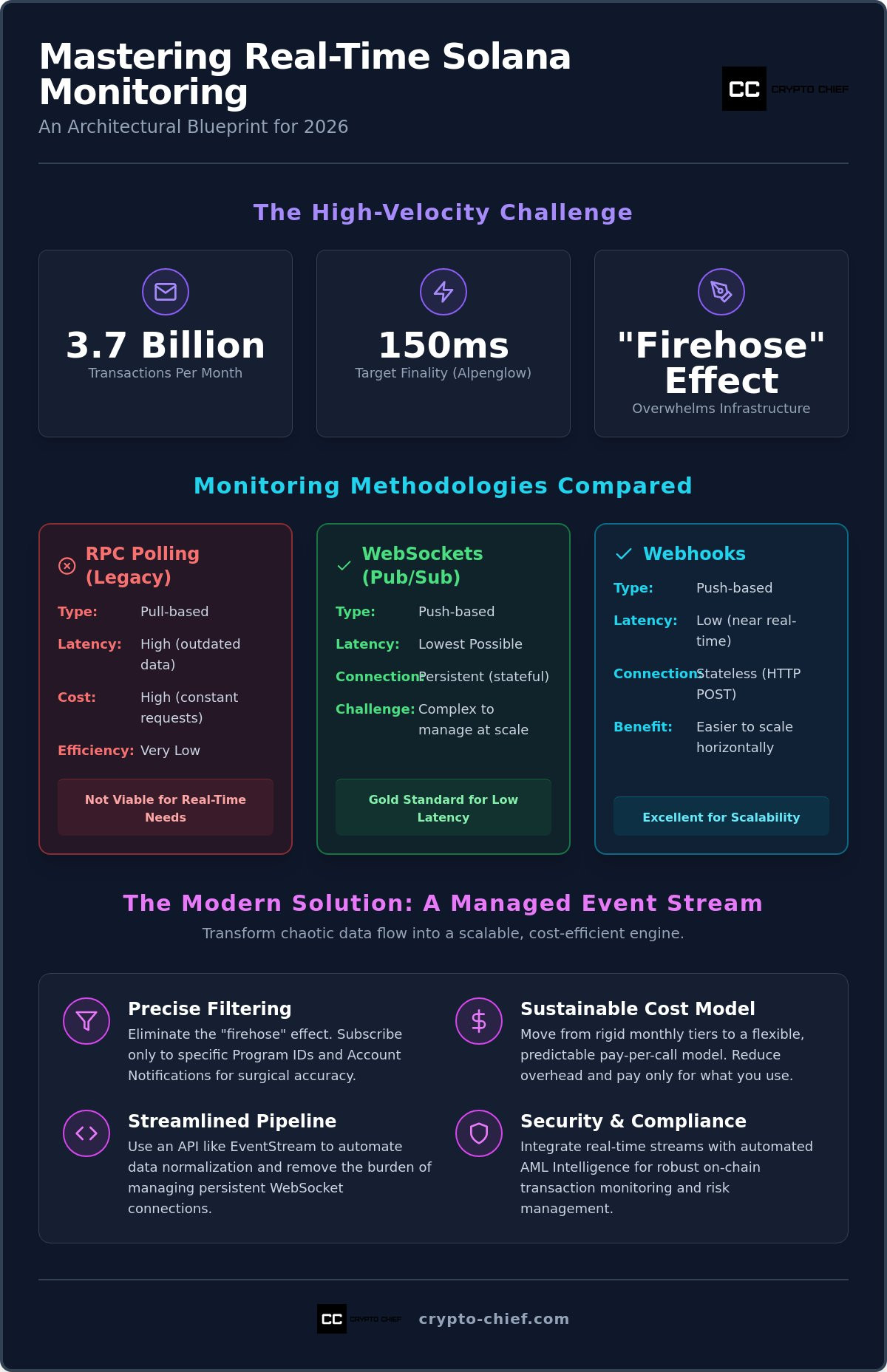
Choosing the right methodology to monitor solana events real time requires a clear understanding of the trade-offs between push-based and pull-based systems. Traditional RPC polling, while simple to implement, is inherently a pull-based mechanism that struggles under the weight of Solana's high-velocity state changes. With the network recording over 3.7 billion non-vote transactions in June 2026, the overhead of constant polling creates significant network congestion and unnecessary compute costs. Pulling data every few hundred milliseconds is no longer a viable strategy for developers who demand high precision and low latency.
In contrast, push-based systems like WebSockets and webhooks offer a direct stream from the cluster to your application. This shift is critical for use cases like liquidation bots or high-frequency DEX aggregators, where every millisecond counts. A Solana blockchain technology review highlights that as transaction finality approaches the 150-millisecond mark following the Alpenglow upgrade, the window for reaction becomes razor-thin. If your infrastructure relies on stateless requests, you risk missing critical state transitions that occur between your polling intervals. For those seeking the most robust foundation, utilizing a high-performance RPC Gateway ensures that your monitoring stack can handle the massive throughput projected for the remainder of 2026.
WebSocket Subscriptions (Pub/Sub)
WebSockets remain the gold standard for applications requiring the absolute lowest possible latency. By implementing logsSubscribe or accountSubscribe, your server maintains a persistent connection that receives instant updates the moment a transaction is confirmed. However, this persistence comes with an engineering cost. You must manage complex reconnection logic and WebSocket heartbeats to account for network jitter or cluster instability. This methodology is best suited for trading interfaces where a live, millisecond-accurate data feed is the primary requirement for the user experience.
Webhook-Based Event Streaming
Webhooks offer a compelling alternative by providing a stateless, event-driven architecture that scales effortlessly with network demand. Instead of maintaining a fragile persistent connection, your infrastructure receives a POST request only when a specific event occurs. This approach is ideal for serverless environments, such as AWS Lambda or Edge functions, where keeping a socket open is both difficult and expensive. By using an automated EventStream, you can offload the burden of connection management while ensuring you never miss a critical on-chain notification.
Technical Implementation: Subscribing to Solana Events
Moving from architectural theory to a functional build requires a methodical approach to connection management. To monitor solana events real time, your first priority is securing a high-performance Solana RPC provider that offers the throughput necessary for 2026 network speeds. Once your endpoint is active, you must define your filter criteria with surgical precision. This involves specifying a Program ID to listen for smart contract interactions or an Account Pubkey to track specific wallet changes. Without these filters, your application would ingest a massive volume of irrelevant data, leading to increased latency and unnecessary infrastructure costs.
The technical handshake begins with a JSON-RPC request to establish a subscription. Upon a successful request, the cluster returns a unique subscription ID that you must store and manage within your application state. This ID is your key to identifying incoming data packets and eventually unsubscribing when the stream is no longer required. Data returned from these subscriptions is typically base64-encoded to preserve integrity during transit. Your backend must decode this payload into a human-readable JSON format, allowing your logic to parse instruction data or account state changes without delay.
Filtering for Efficiency
Precision filtering is the most effective way to manage egress costs and compute resources. By utilizing memcmp (memory comparison) filters, you can narrow your monitoring to specific data offsets within an account. This is particularly useful for tracking specific fields in a DeFi vault or a governance proposal. Additionally, applying regex filtering to program logs allows you to capture only specific events, such as a "Buy" or "Sell" instruction, while ignoring the noise of auxiliary logs. This granular control ensures you only pay for the data that actually drives your application logic.
Error Handling and Data Integrity
In a high-throughput environment, connection stability is never guaranteed. You must implement robust retry logic that utilizes exponential backoff to handle failed WebSocket handshakes or temporary network jitter. Maintaining data integrity also requires verifying event sequence numbers to ensure no packets were dropped during periods of high congestion. For mission-critical builds, you can cross-reference your event stream with a Unified API to validate that the on-chain state matches your local event records. This dual-layered approach provides a level of certainty that single-source monitoring cannot match.
Performance and Cost Optimization in 2026
Operating a high-performance monitoring stack in 2026 requires a shift from simple connectivity to aggressive cost optimization. With the Solana network recording a record 3.77 billion non-vote transactions in June 2026, the sheer volume of data can quickly overwhelm a development budget if not managed with precision. Fixed-tier monthly subscriptions often lead to significant waste, as you either pay for unused capacity during quiet periods or face throttled connections when market volatility spikes. For non-critical data that doesn't require sub-millisecond updates, implementing RPC request batching is an essential strategy to reduce overhead without sacrificing the depth of your historical data.
Geography dictates performance. When you attempt to monitor solana events real time from a server located halfway across the globe, the physical speed of light introduces a latency floor that no software optimization can overcome. As the Alpenglow upgrade pushes transaction finality toward 150 milliseconds, every network hop becomes a competitive disadvantage. Reducing this latency requires a global node distribution that places your monitoring logic as close to the cluster's leaders as possible. By leveraging a geographically distributed RPC Gateway, you ensure that your application receives state updates with minimal delay, maintaining a critical edge in high-frequency environments.
The Pay-Per-Call Advantage
The traditional subscription model is increasingly incompatible with the erratic nature of blockchain data. A pay-per-call model, powered by prepaid API tokens, provides the granular scaling necessary for modern builds. This approach eliminates "zombie" infrastructure costs by ensuring you only incur expenses when your monitoring bots actually receive or request data. It allows for high predictability in monthly expenses, as you can align your token consumption with historical event frequency. This structural flexibility is vital for creators who need to scale their monitoring capabilities instantly during high-traffic events without renegotiating fixed contracts.
Global Infrastructure and Uptime
Uptime is the foundation of any reliable monitoring service. Relying on a single point of failure is a risk that sophisticated architects cannot afford. Utilizing multichain gateways provides the necessary redundancy to keep your event streams active even during localized cluster instability. You should consistently monitor the health and latency of your endpoints via the Crypto Chief documentation to ensure your stack remains optimized for the current network state. Maintaining this level of structural integrity ensures that your application remains responsive and accurate, regardless of global network conditions.
Streamlining Solana Monitoring with Crypto Chief
Building a custom monitoring stack is often a significant distraction from your core product logic. To monitor solana events real time without the constant burden of infrastructure maintenance, you need a solution that abstracts the complexity of the Sealevel runtime. Crypto Chief provides this via EventStream, a specialized webhook service designed to handle the heavy lifting of connection persistence and data filtering. By offloading the management of WebSocket heartbeats to our global engine, you can focus on building features while we ensure your data stream remains stable and accurate.
Security and compliance are no longer optional for enterprise-grade dApps in 2026. Integrating your event streams with AML Intelligence allows you to screen incoming transactions against global risk databases in real time. This proactive approach to compliance protects your protocol from illicit activity without introducing friction into the user experience. When combined with our non-custodial Crypto Processing API, you gain a unified platform for real-time payment confirmations that remains completely secure and under your control.
This level of compliance is a prerequisite for projects focusing on the tokenization of real-world assets; to see how STO Foundation facilitates these compliant investment offerings, read more.
New developers can explore these capabilities immediately by utilizing a free balance from the Crypto Chief faucet. This allows you to test your webhook configurations and verify data accuracy before committing to a production-scale build. It is a practical, risk-free way to experience the performance of our global RPC Gateway first-hand without any initial capital commitment.
Unified Event Normalization
Data fragmentation is a significant hurdle when scaling across multiple networks. Our Unified API transforms raw, chain-specific logs into standardized JSON, providing a consistent experience whether you are monitoring Solana, Ethereum, or BNB Smart Chain. This normalization layer simplifies your backend logic, as your application only needs to handle a single data format for all Web3 interactions. Most developers find they can integrate a new dApp and begin receiving normalized events in under five minutes, drastically reducing the time-to-market for complex monitoring tools.
Next Steps for Developers
Getting started is a methodical process designed for speed. First, you must register for an account and generate your unique API keys via the developer dashboard. Once your account is active, you can define your filter criteria and establish your first webhook endpoint in under five minutes. This streamlined workflow ensures that your application is ready to handle real-time Solana events with professional-grade stability and cost efficiency. Register now to start monitoring Solana events and join the elite group of builders who prioritize performance and logic over infrastructure management.
Mastering the Speed of Solana
Precision matters. The shift toward 150-millisecond finality on Solana requires an infrastructure that prioritizes logic over brute-force polling. You've discovered how a transition to event-driven architectures, supported by precise filtering and global node distribution, effectively eliminates the data firehose effect. By choosing to monitor solana events real time through a stateless, webhook-first approach, you protect your application from the fragility of persistent connections while maintaining the lowest possible latency.
Efficiency is the new standard. Crypto Chief provides the structural integrity required for these mission-critical builds. Our pay-per-call pricing model ensures 100% cost efficiency by scaling your expenses alongside your actual network usage. This performance is coupled with a Unified API that supports Solana, Ethereum, and more than 10 other chains, all while maintaining enterprise-grade uptime.
The foundation for your next high-performance dApp is ready. Start Streaming Solana Events with Crypto Chief. We look forward to seeing what you build on this reliable foundation.
Frequently Asked Questions
What is the fastest way to monitor Solana events in real time?
The fastest way is using a push-based architecture like WebSockets or high-performance webhooks. These methods allow your application to receive notifications immediately as state changes occur on-chain, bypassing the latency inherent in traditional polling. For developers who want to monitor solana events real time without managing persistent socket connections, utilizing a specialized service like EventStream offers a low-latency alternative that scales automatically with network throughput.
How do I filter Solana logs for a specific smart contract?
You filter logs by providing the Program ID of the target smart contract during the subscription handshake. When using the logsSubscribe method, you can specify an array of addresses to ensure your stream only includes events emitted by those specific programs. This targeted approach significantly reduces the volume of data your backend must process, allowing you to isolate relevant instructions like token swaps or minting events from the broader network noise.
Can I monitor Solana token transfers without running a full node?
Yes, you can monitor all token activity by connecting to a high-performance RPC Gateway. Professional providers handle the resource-heavy requirements of running validator-grade hardware, giving you access to the same real-time data streams via simple API calls. This allows you to track SPL Token balance changes and ownership transfers with enterprise-grade reliability while keeping your own infrastructure lightweight and focused on your application's core logic.
What is the difference between Solana logsSubscribe and accountSubscribe?
The primary difference lies in the type of data being tracked. logsSubscribe monitors the execution of instructions and the resulting program logs, which is ideal for capturing specific on-chain events or errors. In contrast, accountSubscribe listens for changes to the actual state data or balance of a specific account. Use logs for action-oriented notifications and account subscriptions for tracking state-heavy transitions like price updates or vault balance shifts.
How much does it cost to monitor high-volume Solana data?
Costs vary significantly based on your provider's pricing model. While some legacy services use fixed monthly tiers that can be wasteful, a pay-per-call model ensures you only pay for the specific data packets your application consumes. This is particularly beneficial on Solana, where transaction volume can spike unexpectedly. By using a prepaid token system, you maintain full control over your budget while ensuring your monitoring remains active during periods of peak market volatility.
How do I handle WebSocket disconnections in Solana dApps?
Handling disconnections requires implementing robust reconnection logic with exponential backoff and active heartbeat monitoring. You should listen for the "close" and "error" events on your socket and attempt to re-establish the connection after a short delay. To ensure data integrity during the downtime, it's a best practice to cross-reference the missed slot range using a Unified API once the connection is restored, preventing any gaps in your event history.
Is there a way to receive Solana event notifications via Webhooks?
Yes, you can receive event notifications via webhooks by utilizing a service like EventStream. This approach replaces the need for a persistent, stateful WebSocket connection with a stateless POST request sent directly to your server. It's the preferred method for developers using serverless architectures or those who want to avoid the engineering overhead of managing socket lifecycles while still maintaining the ability to monitor solana events real time.
What commitment level should I use for real-time event monitoring?
The "Confirmed" commitment level is generally recommended for real-time applications because it provides a balance of speed and reliability. It notifies you once a supermajority of the cluster has voted on the bank, which usually happens within a few hundred milliseconds. If your application requires absolute certainty where a transaction can never be rolled back, use "Finalized," though this will introduce several seconds of additional latency to your monitoring stream.