
Scaling a dApp across twenty blockchains should not feel like managing twenty different startups. Most developers believe that expansion requires a linear increase in infrastructure, but the reality is that it requires a smarter abstraction layer. If you’re currently juggling a dozen API keys and struggling with inconsistent data formats between EVM and non-EVM protocols, you’ve likely hit the wall of the fragmentation crisis. Building a high-performance multichain rpc architecture in 2026 isn’t about simply hosting more nodes; it’s about mastering the intelligent routing and data normalization that sits above them.
We understand that unpredictable subscription tiers and high latency in cross-chain fetching are more than just nuisances. They are structural bottlenecks that prevent global scale. In this article, you’ll learn how to architect a unified gateway that provides a single endpoint for all blockchain interactions while maintaining sub-50ms response times. We’ll break down the technical requirements for low-latency gateways and show you how to transition to a predictable, usage-based model that aligns with your growth. From optimizing your backend for global reach to ensuring structural integrity across diverse protocols, this is your blueprint for a silent, powerful infrastructure partner.
Key Takeaways
- Understand the fundamental transition from self-hosted local nodes to managed cloud providers that serve as the backbone of modern Web3 development.
- Learn how to implement intelligent load balancing and geographic routing to ensure your dApp maintains high performance across a global node cluster.
- Discover why a unified multichain rpc architecture is the most effective solution for solving the fragmentation crisis and simplifying cross-chain data fetching.
- Master developer frameworks for cost optimization, including request batching and event-driven webhooks, to reduce API call volume by up to 90%.
- Explore how to integrate advanced security and real-time data streaming into your infrastructure using a scalable, pay-per-call service model.
The Evolution of Multichain RPC Architecture
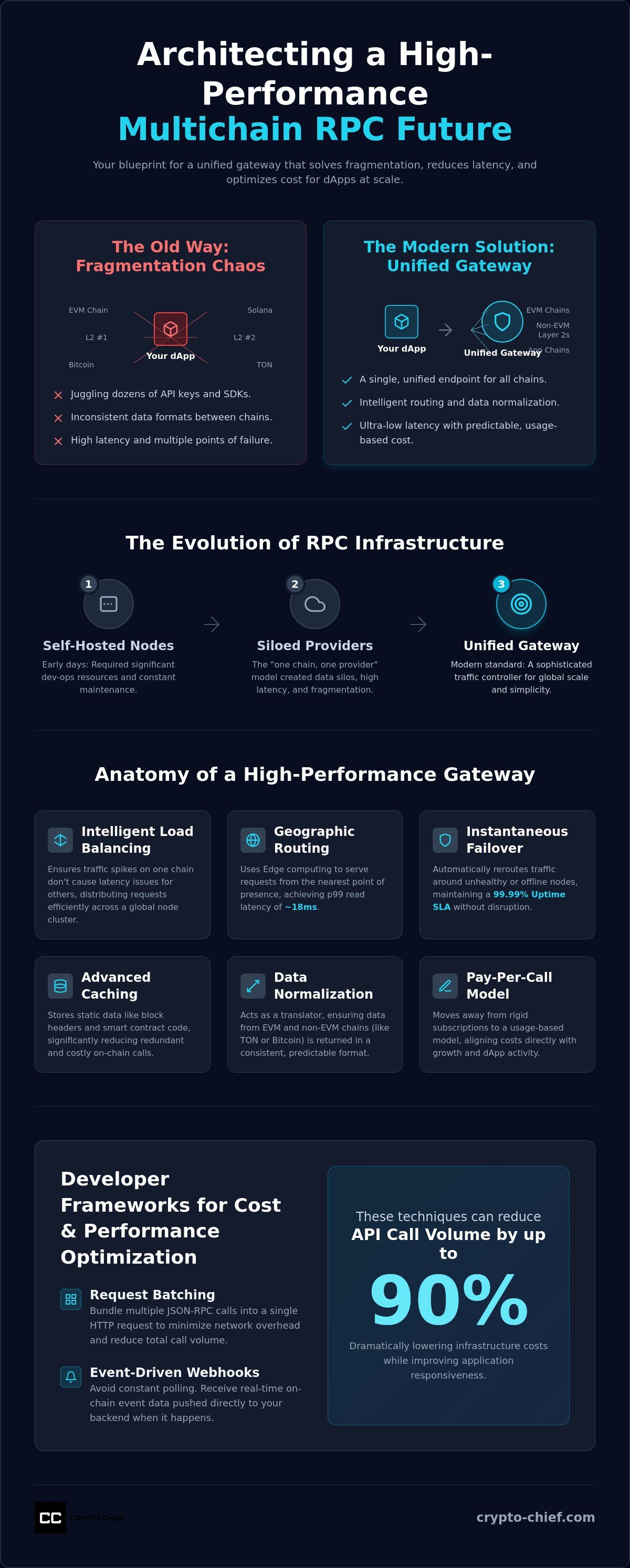
The landscape of blockchain infrastructure has undergone a fundamental transformation. In the early days of Web3, developers typically managed their own local nodes, a process that required significant dev-ops resources and constant maintenance. Today, multichain rpc architecture has emerged as the standard structural design, allowing decentralized applications to communicate with multiple blockchain networks through a single, streamlined interface. This transition relies on the core principles of a Remote Procedure Call (RPC); however, it elevates the concept to handle the immense scale of modern ecosystems. The gateway now acts as a sophisticated traffic controller, translating data formats and routing requests across a global network of nodes.
The traditional "one chain, one provider" model is failing. As dApps expand to support ten or more protocols, managing siloed connections becomes a liability. These fragmented systems introduce latency and create data silos that hinder the user experience. A modern architecture must act as a translator, ensuring that a request for a balance on Ethereum returns data in a format consistent with a similar request on a non-EVM chain like TON or Bitcoin. This level of abstraction is no longer a luxury; it is a requirement for any project aiming for global reach.
From Single-Chain to Cross-Chain Complexity
The explosion of Layer 2 solutions and specialized app-chains has created a density of networks that early infrastructure was never designed to handle. Developers often find themselves buried under technical debt, forced to manage a dozen different SDKs and maintain separate authentication headers for every new chain they integrate. This overhead slows down the shipping cycle and introduces multiple points of failure. The Multichain Fragment problem occurs when a dApp’s backend becomes a brittle collection of disparate API keys and incompatible data schemas that stall horizontal scaling. Solving this requires moving away from individual node management and toward a unified logic layer.
The Rise of the Unified Gateway
A unified gateway serves as a silent partner in the development process. By providing a single endpoint for all interactions, it removes the friction of protocol-specific nuances. This abstraction layer allows builders to focus on their core product logic while the infrastructure handles the complexities of node health, rate limiting, and data normalization. In 2026, the industry has largely moved away from rigid, tiered subscription models that penalize growth. The shift toward granular, pay-per-call access ensures that developers only pay for the exact resources they consume. This model provides the predictability and structural integrity needed to build enterprise-ready applications that remain agile in a rapidly shifting market. For developers scaling compute-intensive AI services alongside their dApps, you can visit eCircles LLC to explore high-performance GPU infrastructure.
Core Components of High-Performance RPC Gateways
Achieving high performance in a multichain rpc architecture requires a shift from simple connectivity to active orchestration. A gateway isn't just a tunnel; it's a decision engine that manages global request distribution. Intelligent load balancing ensures that traffic spikes on one chain don't cascade into latency for others, while geographic routing uses Edge computing to serve requests from the nearest point of presence. This proximity-based approach is critical for reducing p99 read latency, which top-tier dedicated infrastructure now maintains at roughly 18ms even during peak load periods.
Caching layers further optimize this stack by storing static data like block headers and smart contract code, significantly reducing redundant on-chain calls. To maintain a 99.99% uptime SLA, failover mechanisms must be instantaneous. If a specific chain node experiences a 0.3 median slot lag or goes offline entirely, the gateway reroutes traffic to healthy nodes without the dApp frontend ever noticing the disruption. This structural integrity is what separates enterprise-grade builders from those relying on public, rate-limited endpoints.
To complement this level of structural integrity, many enterprise-grade projects utilize StatusPulse to provide transparent, public-facing status pages that monitor and display their service uptime in real-time.
The Routing Logic Layer
The routing logic layer acts as the brain of the gateway, identifying the target chain and specific method from a single API call. While many providers focus on basic JSON-RPC commands, a robust multichain rpc architecture must handle the structural differences between EVM networks and non-EVM protocols like Solana, TON, or Bitcoin. This layer translates requests on the fly, ensuring that developers don't have to write custom logic for every new chain. Leveraging Reliable Web3 RPC Endpoints allows your team to bypass the technical debt of managing disparate SDKs. Recent decentralized infrastructure research highlights that this abstraction is vital for maintaining throughput in high-concurrency environments.
Data Normalization and Transformation
Raw data from multiple chains is often inconsistent, forcing developers to build complex parsers within their application code. High-performance gateways solve this through data normalization, translating diverse chain responses into a standardized JSON format. This transformation simplifies the frontend, allowing a single data model to represent balances and transaction histories across multiple protocols. Utilizing a Unified Web3 Developer Platform ensures that your data remains clean and predictable. If you're ready to simplify your backend, you can explore our RPC Gateway to see how we handle these complexities for you.
Unified vs. Siloed Architectures: Solving the Fragmentation Crisis
Choosing the right architecture is a strategic decision that dictates your project's long-term viability and performance. A siloed architecture forces developers to act as infrastructure managers, where every new chain requires its own monitoring stack, authentication logic, and billing cycle. In contrast, a unified multichain rpc architecture acts as a sophisticated proxy layer. It consolidates these disparate connections into a single, logical stream, which doesn't just simplify the code; it fundamentally changes how your system scales under pressure. For projects that incorporate AI components, you can discover NovaCortex to build a robust, privacy-first memory layer for your agents.
When handling 100k+ requests per second, a unified model is significantly more efficient because it performs global request optimization across the entire node cluster. While some critics argue that a single gateway creates a "single point of failure," modern enterprise designs mitigate this through decentralized gateway clusters. These clusters ensure that if one routing node fails, traffic is instantly redistributed across the remaining healthy network. Research into an adaptive multichain blockchain framework suggests that these elastic, unified designs are the only way to sustain the throughput requirements of 2026 without sacrificing structural integrity.
Operational Overhead Comparison
Managing separate nodes for Ethereum, Polygon, and Tron introduces massive hidden costs that aren't always visible on a pricing page. You aren't just paying for the data; you're paying for the dev-ops hours required to monitor node health, manage API keys, and update SDKs. Implementing a Unified API collapses this integration surface area. It allows your team to add support for new chains in hours rather than weeks, shifting your focus from infrastructure maintenance to core product innovation. This reduction in operational friction is a primary driver for teams migrating away from siloed management.
Cross-Chain Synchronicity
Maintaining state consistency across siloed providers is nearly impossible during high-volatility events. Atomic cross-chain operations require a unified architectural view to ensure that data fetched from one chain is contextually relevant to another. Unified routing provides a global perspective that eliminates the data desynchronization inherent in siloed node management. Unified routing delivers superior latency by eliminating the redundant authentication handshakes and network hops required when interacting with multiple siloed node providers. This structural coherence is the foundation of a reliable cross-chain dApp.
Optimizing for Latency and Cost: A Developer’s Implementation Framework
Efficiency in a multichain rpc architecture is not merely a dev-ops preference; it is a financial imperative. While the structural design handles the routing, the implementation layer determines how much you pay for every block of data retrieved. Developers often fall into the trap of over-provisioning, paying for high-tier monthly subscriptions that offer capacity they rarely fully utilize. By shifting toward a more granular optimization strategy, you can maintain high performance while significantly reducing your monthly infrastructure spend.
Monitoring and analytics play a vital role in this framework. Using gateway headers to track usage allows your team to identify inefficient queries that might be causing latency spikes or unnecessary token consumption. When you have a clear view of your query patterns, you can refine your backend logic to ensure that every call to the blockchain is necessary and optimized for speed. This data-driven approach transforms infrastructure from a black box into a transparent, manageable asset.
Implementing Efficiency at the Code Level
The most immediate way to reduce costs is through RPC Request Batching for Cost Reduction. By grouping multiple JSON-RPC calls into a single HTTP request, you minimize the overhead of multiple handshakes and save significant bandwidth. For real-time data, choosing between WebSockets and standard HTTP is critical. WebSockets are superior for low-latency event streaming, while standard HTTP remains more efficient for one-off data fetches. Optimizing your payload sizes by requesting only the specific fields you need further minimizes processing time and ensures your dApp remains responsive even under heavy load.
Moving from a polling architecture to a push-based model using webhooks can save up to 90% on API calls. Instead of constantly querying a node to see if a transaction has been confirmed, your backend waits for a notification from the gateway. This shift preserves your API balance and reduces the strain on your application’s event loop.
Budgeting for Scale with Pay-Per-Call
Traditional monthly tiers often create a "dead zone" of wasted resources. You might pay for 100 million requests but only use 40 million, yet the next tier down is too small for your needs. Pay-per-call economics solve this by utilizing prepaid token balances. This model ensures that your costs scale linearly with your actual traffic, removing the financial risk of sudden spikes or quiet periods. Crypto Chief’s token model ensures you only pay for successful execution, providing the predictability required for long-term budgeting. If you want to start optimizing your infrastructure today, you can register for a free account and explore our pay-per-call RPC Gateway.
Crypto Chief: The Future of Scalable, Pay-Per-Call Infrastructure
Reliable infrastructure is the foundation of every successful dApp. Crypto Chief provides a high-performance RPC Gateway designed to meet the rigorous demands of a modern multichain rpc architecture. By offering a unified interface for Ethereum, BNB Chain, Polygon, Tron, Bitcoin, and TON, we remove the friction of managing multiple providers. Our distributed network ensures global uptime and low-latency responses, allowing your application to remain online and responsive regardless of regional traffic spikes. It's about providing a steady, knowledgeable guide that values logic and scalability over flashy marketing.
We go beyond simple connectivity. Integrating AML Intelligence directly into your workflow ensures compliance without slowing down development. For teams moving toward reactive, real-time architectures, our EventStream service provides high-performance event streaming that eliminates the need for expensive polling. This all-in-one approach allows you to build a cohesive narrative of a unified solution that remains direct and focused on your user's needs.
A Builder-Centric Platform
We built this platform for developers who value technical precision. Our "silent partner" ethos means we handle the background complexity of node health and data normalization while you focus on innovation. Whether you need an Ethereum RPC endpoint for a DeFi protocol or a Solana RPC connection for a high-speed NFT marketplace, you can access everything through a single dashboard. This structural integrity removes the burden of managing technical debt, allowing your team to ship faster and scale horizontally with confidence.
The Economic Advantage
The days of restrictive monthly tiers are over. We operate on a pay-per-call model that aligns your costs with actual user activity. You don't have to worry about over-provisioning or paying for capacity you aren't using. Our prepaid API token balances provide a transparent way to track every request spent through detailed usage analytics. This predictable pricing model is essential for builders who need to maintain a lean operation while preparing for global scale. If you're ready to modernize your stack, you can Register now to access our Multichain RPC Gateway and start your first multichain API call in minutes.
Mastering the Unified Gateway Standard
The transition from fragmented, siloed node management to a robust multichain rpc architecture is now a requirement for any enterprise-grade application. By consolidating your infrastructure into a single routing layer, you eliminate the operational friction of managing multiple API keys and inconsistent data formats. This structural coherence ensures that your dApp remains responsive and reliable, even as you scale across dozens of protocols. The technical optimizations we've explored, including request batching and pay-per-call economics, provide a sustainable framework for long-term growth without the burden of over-provisioning.
Success in 2026 requires a silent, powerful partner that handles the complexities of global node health and geographic routing. Scale your dApp with Crypto Chief's Multichain RPC Gateway to leverage a unified API that supports 10+ major blockchains with no monthly tiers. You'll benefit from a global low-latency network that prioritizes stability and precision. It's time to stop fighting your infrastructure and start building the future of decentralized technology with a foundation that is as ambitious as your vision.
Frequently Asked Questions
What is the difference between a standard RPC node and a multichain RPC gateway?
A standard RPC node provides a single point of entry for one specific blockchain, requiring you to manage individual connections for every network you support. In contrast, a multichain gateway acts as an intelligent routing and abstraction layer. It manages multiple blockchain protocols through a single interface, handling data normalization and load balancing so your application doesn't have to process chain-specific nuances.
How does multichain rpc architecture reduce latency for global users?
This architecture utilizes geographic routing and Edge computing to serve requests from the nearest point of presence. By placing routing logic closer to the end user, a multichain rpc architecture minimizes the physical distance data must travel. This approach ensures that users in any region experience consistent, high-speed responses regardless of which blockchain they are interacting with.
Is a pay-per-call model more cost-effective than monthly tiered plans?
The pay-per-call model is generally more efficient because it eliminates the over-provisioning trap where you pay for capacity you don't use. Traditional monthly tiers force you into rigid price brackets that may not align with your actual traffic patterns. With pay-per-call, your infrastructure costs scale linearly with your successful requests, ensuring that every token spent contributes directly to your application's active performance.
Can I use a single API key for Ethereum, Polygon, and Solana with Crypto Chief?
You can manage all your blockchain interactions through a single, unified dashboard. This consolidation removes the technical debt associated with juggling dozens of separate API keys and authentication headers for different chains. Our platform provides a streamlined experience where one unified endpoint gives your team access to all supported EVM and non-EVM protocols, simplifying your backend configuration and security management.
What happens if one of the underlying blockchain networks goes down?
Our gateway's failover mechanisms are designed to detect node health issues or significant slot lag in real time. If a specific chain node goes offline, the system automatically reroutes your traffic to the next healthy node in the global cluster. This redundancy ensures that your dApp remains operational and maintains high uptime, even when individual network components experience instability.
Does multichain architecture support smart contract event monitoring?
Yes, modern multichain rpc architecture supports advanced event monitoring through push-based services like EventStream. Instead of relying on expensive and bandwidth-heavy polling, you can set up webhooks that notify your backend the moment a specific smart contract event occurs. This transition to a reactive architecture improves data accuracy while preserving your API balance for other critical tasks.
How do I migrate my existing dApp from other providers to Crypto Chief?
Migration is a frictionless process that typically involves updating your provider URL to our unified endpoint. Because our infrastructure supports standard JSON-RPC methods, you won't need to rewrite your core application logic or overhaul your existing data models. You can begin by registering an account, generating your credentials, and pointing your dApp's RPC configuration to our high-performance gateway in minutes.