
Why would a developer build a decentralized application only to compromise its core ethos by handing private keys to a third-party processor? Traditional gateways often force an unnecessary choice between security and scale, saddling projects with custodial risks and high percentage-based fees. Integrating a robust non-custodial crypto payment api solves this by ensuring you maintain full control of your funds while bypassing the regulatory overhead associated with custodial providers. You've likely felt the friction of managing complex multi-chain hurdles or the frustration of watching transaction overhead eat into your margins.
With the global cryptocurrency market reaching $4 trillion in 2025, the demand for sovereign processing has never been higher. You understand that true Web3 sovereignty requires more than just a simple checkout button; it demands a robust infrastructure that respects the user's ownership of their assets. This guide will help you master the technical architecture and cost-optimization needed to build secure, scalable applications. We'll explore how to leverage unified APIs, RPC gateways, and real-time event monitoring to create a high-performance processing stack that operates without ever touching your users' private keys.
Key Takeaways
- Understand how a non-custodial crypto payment api eliminates the security risks of custodial wallets, allowing you to maintain full control over assets while reducing regulatory friction.
- Explore the technical architecture required to normalize multi-chain data through a Unified API and high-performance RPC Gateways for near-instant transaction verification.
- Evaluate the cost-efficiency of pay-per-call models compared to percentage-based fees to optimize margins for high-volume or high-ticket Web3 applications.
- Learn to streamline your implementation workflow by automating deposit address generation and leveraging EventStream for reliable, real-time webhook notifications.
- Discover how integrating AML Intelligence and unified infrastructure creates a stable, enterprise-ready environment that supports global reach without compromising on security.
What is a Non-Custodial Crypto Payment API?
A non-custodial crypto payment api serves as a programmatic bridge between your application and the blockchain. Unlike traditional gateways that hold funds in an internal ledger, this infrastructure facilitates direct, on-chain transactions where the provider never touches your private keys. It represents a fundamental shift from managing money to routing data. By utilizing this technology, developers can automate the detection of incoming payments across multiple chains while ensuring that the actual value moves directly into a Cryptocurrency wallet controlled entirely by the merchant or the user.
The "custodial trap" is a common pitfall for many Web3 startups. When a platform holds user funds, even temporarily, it often triggers heavy regulatory requirements like the Bank Secrecy Act (BSA) and anti-money laundering (AML) standards proposed by the FDIC in May 2026. This creates a massive operational liability and a security honey pot for attackers. By opting for a non-custodial approach, you remove your business from the flow of funds. You aren't acting as a bank; you're acting as a builder. This distinction is critical for maintaining a lean, compliant operation while providing users with the sovereign security they expect from decentralized finance.
Key components of this architecture include:
- Direct-to-wallet transfers: Funds move from the customer to the merchant's address without intermediary holding periods.
- Automated monitoring: Tools like EventStream track the blockchain for specific transaction hashes or address activities.
- Decentralized settlement: The finality of the transaction depends on the underlying network consensus rather than a provider's internal approval.
The Security Advantages of Self-Custody
Choosing a non-custodial model eliminates counterparty risk. If your API provider experiences downtime or a security breach, your existing funds remain safe because they were never stored on the provider's servers. This architecture significantly reduces regulatory friction. Since the provider doesn't act as a financial intermediary, many businesses find they can bypass the extensive KYC overhead required for custodial services. Privacy is also enhanced. Direct wallet-to-wallet interactions prevent the creation of centralized data silos that could become targets for hackers.
Core Use Cases for Modern Web3 Builders
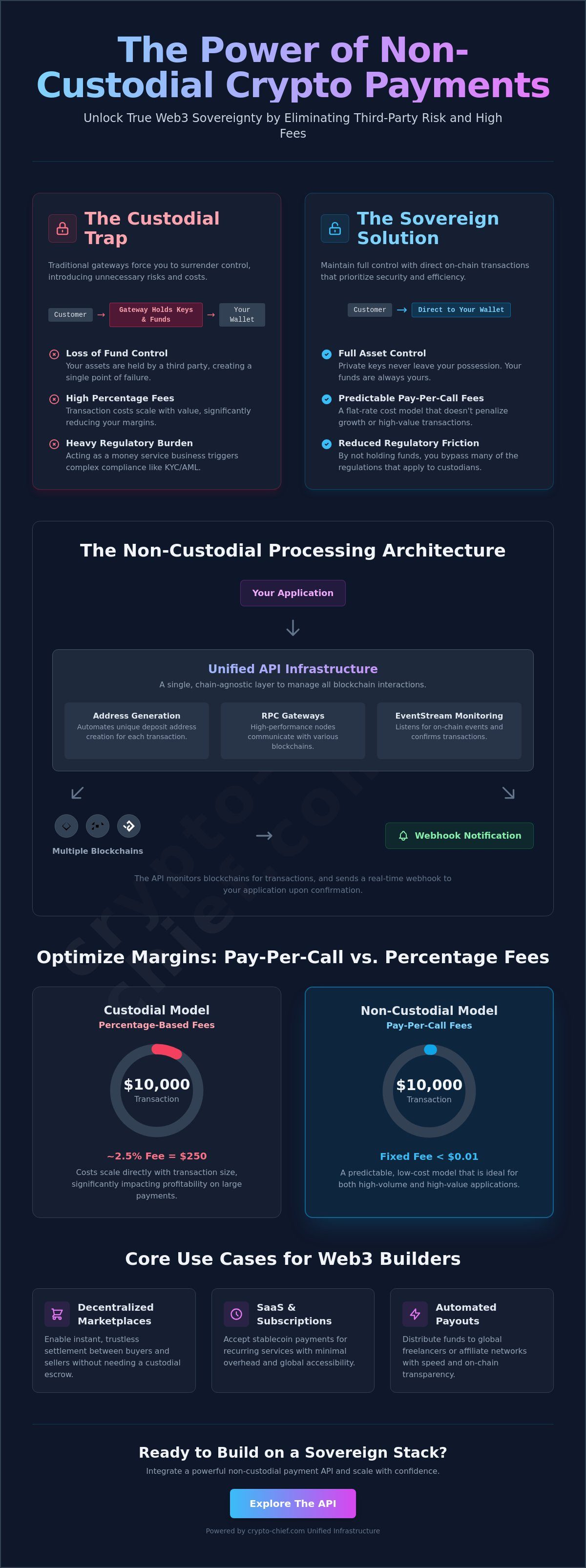
Developers are integrating a non-custodial crypto payment api to solve specific scaling challenges. Decentralized marketplaces use them for instant, trustless settlement between buyers and sellers without needing an escrow middleman. SaaS platforms are moving away from high-fee traditional processors, instead using this infrastructure to accept stablecoins for recurring developer tools. Additionally, automated payout systems utilize these APIs to distribute funds to global freelance or affiliate networks, ensuring speed and transparency that legacy banking systems cannot match.
The Architecture of Non-Custodial Processing
Building a robust non-custodial crypto payment api requires a sophisticated infrastructure stack that extends far beyond a simple checkout interface. At the center of this architecture lies the Unified API layer, which serves to normalize disparate data formats from networks like Ethereum, Solana, and BSC into a single, predictable schema. This abstraction allows developers to build chain-agnostic applications without maintaining unique codebases for every protocol. To ensure the security of these interactions, the system must adhere to rigorous Cryptographic Standards and Guidelines, verifying transaction hashes across multiple independent nodes to confirm absolute finality before updating your application state.
Data integrity is the foundation of trust in Web3 processing. When a transaction is initiated, the infrastructure must verify the ledger across a distributed network to prevent double-spending or false confirmations. This process requires a silent, powerful partner in the background that handles the heavy lifting of node communication, allowing you to focus on the user experience. By utilizing a unified stack, you eliminate the fragmentation that typically plagues multichain development, ensuring that your payment logic remains consistent regardless of the underlying blockchain.
Multichain RPC Nodes: The Backbone of Payments
Low-latency RPC access isn't a luxury; it's a requirement for detecting incoming payments the moment they hit the mempool. To maintain global payment availability, your architecture must manage node failover effectively, ensuring 99.9% uptime even during periods of heavy network congestion. Dedicated RPC endpoints prevent the detection of "dropped" transactions by maintaining a stable, persistent connection to the network state. Leveraging a high-performance RPC Gateway ensures that your application maintains a direct, high-speed link to the blockchain without the overhead of managing individual node clusters.
EventStream and Webhooks: Automating Confirmation
Polling an API for status updates is inefficient and doesn't scale as your transaction volume grows. Modern builders use EventStream technology to move beyond manual requests, utilizing webhooks to listen for on-chain "Transfer" events in real-time. This push-based model allows you to configure webhooks that trigger specific business logic, such as instantly unlocking a digital product or sending a confirmation email, the moment a payment reaches the required block depth. A sophisticated processing engine will also handle re-orgs and chain forks automatically, ensuring that your database only records transactions that have reached immutable finality.
Calculating ROI: Pay-Per-Call vs. Percentage Fees
Revenue shouldn't be a metric for infrastructure costs; it should be a reward for your project's growth. When selecting a non-custodial crypto payment api, the financial model you choose dictates your long-term scalability. Most traditional gateways rely on percentage-based fees, typically ranging from 0.5% to 1.0% in 2026. While this seems accessible for micro-transactions, it becomes a significant "success tax" as your platform moves toward high-ticket enterprise invoices. A $50,000 settlement shouldn't cost you $250 in processing fees when the underlying technical work is identical to a $5 transaction.
The pay-per-call model treats payment processing as pure infrastructure. Instead of losing a slice of every sale, you pay for the specific resources your application consumes. This approach aligns with how developers already manage cloud computing or database storage. By utilizing a prepaid token balance, you can budget for infrastructure with precision, ensuring that your margins remain protected regardless of the transaction volume or the value of the assets being moved. It's a grounded, utility-focused method that prioritizes your bottom line.
Why Developers Prefer Usage-Based Pricing
Usage-based pricing aligns your operational expenses with actual application activity. If your dApp experiences a quiet period, your costs drop automatically. Conversely, when you scale, you aren't penalized for your success with exponentially higher bills. This flexibility allows you to iterate without the pressure of renegotiating complex enterprise contracts every time your traffic spikes. It removes the friction between your financial department and your engineering team, as costs become a predictable variable rather than an unpredictable revenue drain.
Budgeting for High-Volume dApps
Estimating the cost of a high-volume application requires looking at the full lifecycle of a payment. You must account for unique address generation, mempool monitoring through an RPC Gateway, and the final confirmation via webhooks. Utilizing a Unified API consolidates multi-chain data into single requests, which significantly reduces redundant network calls and extends the longevity of your prepaid API balance. To maximize efficiency, developers often optimize their request frequency, using EventStream to receive push-based updates rather than wasting calls on constant polling. This architectural choice ensures that every API call delivers maximum value to the application state.
Implementation Workflow: Integrating a Non-Custodial API
Integrating a non-custodial crypto payment api into a custom application requires a disciplined, step-by-step approach to ensure both security and operational efficiency. The process begins with generating or assigning a unique deposit address for every new user or individual invoice. This ensures that incoming funds are isolated and easily identifiable within your system. Once the address is live, you must configure EventStream webhooks to monitor these specific contract addresses or wallets across the relevant blockchains. This push-based notification system acts as the trigger for your entire backend, eliminating the need for resource-heavy polling while ensuring that no transaction goes unnoticed.
Compliance shouldn't be an afterthought in your development lifecycle. By implementing AML Intelligence, you can filter high-risk funds before they ever reach your wallet, protecting your platform from potential illicit activity. When the API returns a "Confirmed" status, your system executes automated business logic, such as updating a database or provisioning digital access. Finally, the Unified API allows for seamless cross-chain reconciliation, providing a single source of truth for your financial reporting and multi-chain data management. This methodical flow transforms the blockchain from a complex ledger into a reliable, automated payment rail.
Risk Mitigation with AML Intelligence
Non-custodial doesn't mean non-compliant. With regulatory standards tightening, such as the May 2026 FDIC proposal to apply Bank Secrecy Act standards to certain stablecoin interactions, integrating real-time risk scoring is essential. You can automate the detection of sanctioned addresses or mixed funds in real-time, ensuring your wallet history remains clean. This proactive stance preserves your future off-ramp liquidity and keeps your project within safe operational boundaries without sacrificing the benefits of self-custody. It is about building a stable foundation that respects both decentralization and global regulatory expectations.
Best Practices for Transaction Reconciliation
Use unique IDs in your metadata to map on-chain hashes to your internal database records. This prevents confusion during high-traffic periods and simplifies the auditing process. Your code must also handle edge cases like "underpayments" or "overpayments" programmatically. If a user sends slightly less than the required amount, your system should flag the discrepancy rather than failing silently. Additionally, develop robust retry logic for webhook delivery failures to ensure that temporary network issues don't lead to missed confirmations. Build your production-ready stack today by exploring the Crypto Processing API.
Crypto Chief: The Unified Infrastructure for Non-Custodial Payments
Structural integrity is the hallmark of a professional-grade processing stack. Crypto Chief provides a consolidated environment where developers can deploy a non-custodial crypto payment api without the friction of managing fragmented service providers. By housing high-performance RPC access, processing logic, and AML intelligence within a single global engine, the platform acts as an authoritative partner for enterprise-grade applications. This unified approach ensures that your infrastructure remains stable and responsive as you scale. You avoid the "success tax" typical of traditional gateways because the pricing model is built on transparent Pay-Per-Call logic. There are no hidden percentages to erode your margins or tiered lock-ins to complicate your financial planning.
Efficiency is a choice made at the architectural level. While other providers force you to piece together disparate tools, Crypto Chief offers a cohesive narrative for your entire Web3 lifecycle. It's a system designed by builders for builders, prioritizing uptime and logic over marketing fluff. You get the tools you need to move fast, stay secure, and maintain full control over your financial destiny. By removing the technical hurdles of multi-chain integration, the platform allows your team to focus on creating value rather than maintaining background infrastructure.
Beyond Payments: A Complete Web3 Stack
Modern applications require more than just a gateway; they require a comprehensive data layer. You can leverage the Unified API for deep blockchain data normalization, which allows you to interpret complex on-chain activity across multiple networks using a single, predictable schema. The RPC Gateway extends your capabilities further, enabling custom smart contract interactions that go far beyond standard payment detection. With built-in AML tools, tracing funds and detecting risks becomes a seamless part of your daily workflow. This ensures your platform remains secure and compliant with the standards established by the GENIUS Act of 2025 and other emerging frameworks.
Getting Started with Crypto Chief
The path to deployment is direct and methodical. You can purchase prepaid API tokens and begin building your integration in minutes using documentation designed for technical precision and rapid implementation. Accessing the global node network provides the low-latency multichain support necessary for high-performance dApps that demand 99.9% uptime. Whether you're managing a decentralized marketplace or a global affiliate network, the infrastructure is ready to support your vision. Build your non-custodial payment flow with Crypto Chief to establish a secure, scalable foundation for your Web3 application.
Future-Proof Your Web3 Infrastructure
Building for the next billion users requires a foundation that values both sovereign security and operational efficiency. You've seen how a non-custodial crypto payment api removes the regulatory and security liabilities of traditional custodial gateways, allowing you to maintain absolute control over your assets. By shifting to a pay-per-call model, you protect your margins and ensure that your infrastructure costs scale logically with your application's actual usage. The path to a production-ready dApp is no longer blocked by complex multi-chain integration or high percentage-based fees.
Crypto Chief empowers you to deploy with confidence. You get access to a Unified Multichain Infrastructure that simplifies data normalization across various protocols, supported by a transparent Pay-Per-Call Pricing Model and Real-Time AML Risk Detection. It's time to stop managing legacy friction and start building the future of decentralized finance. Start Building with Crypto Chief’s Non-Custodial API and secure your project's place in the evolving global economy. Your vision deserves a silent, powerful partner that works as hard as you do.
Frequently Asked Questions
What is the difference between custodial and non-custodial crypto payment APIs?
A custodial API requires the provider to manage your private keys and hold your funds, whereas a non-custodial crypto payment api allows you to retain full ownership of your assets. In a non-custodial setup, the provider acts as a data router that detects on-chain activity and notifies your backend, but the actual value moves directly into a wallet you control. This eliminates the risk of provider insolvency or security breaches affecting your balance.
How do I handle transaction confirmations in a non-custodial setup?
Transaction confirmations are managed by monitoring the specific block depth of a transaction on the ledger. Instead of manually checking the network, you can use a push-based system to receive notifications once a payment reaches the required level of finality. This ensures your application only triggers business logic, such as provisioning a service, after the transaction is immutable and verified by the network. It's a precise, automated way to ensure data integrity.
Is a non-custodial crypto payment API compliant with AML regulations?
Yes, non-custodial solutions can be fully compliant by integrating AML Intelligence tools to scan and score incoming addresses. This allows you to identify high-risk or sanctioned wallets before they interact with your platform. You maintain a clean wallet history and meet regulatory expectations, such as the standards proposed in the 2025 GENIUS Act, without ever handing over custody of your funds to a third party.
Can I accept multiple cryptocurrencies through one non-custodial API?
You can accept hundreds of different assets across multiple blockchains through a single Unified API. This infrastructure normalizes data from disparate networks like Ethereum, Solana, and BSC into a consistent format for your backend. It simplifies the development process because your application only needs to interact with one interface to manage a diverse multichain payment environment, regardless of the underlying protocol differences.
How does pay-per-call pricing compare to percentage-based fees?
Pay-per-call pricing charges a fixed cost for each infrastructure request, while percentage-based models take a slice of your total transaction volume. For high-ticket items, pay-per-call is significantly more cost-effective because you aren't penalized for your revenue growth. It allows for predictable budgeting where you only pay for the technical resources your application consumes during the processing lifecycle rather than giving away a portion of your success.
What happens if a customer sends the wrong amount to a non-custodial address?
If a customer sends an incorrect amount, your system detects the discrepancy through the metadata provided in the transaction webhook. You can programmatically handle these edge cases by flagging the payment as "underpaid" or "overpaid" in your database. This allows your support team or automated logic to either request the remaining balance or issue a refund directly to the user's wallet without the funds ever being trapped in a middleman's account.
Do I need to run my own node to use a non-custodial payment API?
You don't need to maintain your own node infrastructure to utilize a non-custodial crypto payment api. By leveraging a high-performance RPC Gateway, you gain direct access to the blockchain's state without the operational overhead of running hardware. This provides the speed and reliability of a dedicated node while allowing you to focus entirely on your application's core functionality and user experience.
How do webhooks improve the efficiency of crypto payment processing?
Webhooks significantly improve efficiency by replacing the traditional polling model with a real-time push architecture. Instead of your server constantly asking the network if a payment has arrived, the EventStream notifies you the instant a relevant event occurs on-chain. This reduces server load, saves API credits, and ensures your users receive instant confirmation of their successful transactions, creating a seamless and responsive checkout experience.