
The launch of Operation Economic Outcast on August 24, 2026, has fundamentally shifted the risk profile for every decentralized application processing digital assets. With the Treasury Department now targeting entire sectors of the digital economy, the margin for error in wallet screening has effectively vanished. You likely recognize that manual checks are impossible at scale, yet enterprise compliance suites often introduce unacceptable latency and rigid, high-cost subscription tiers that drain your capital. It's a frustrating trade-off between regulatory safety and the seamless user experience your Web3 application requires.
This guide demonstrates how to integrate a high-performance OFAC sanctions screening api crypto into your existing non-custodial architecture. You'll learn to automate real-time risk detection through a pay-per-call utility that aligns costs with your actual transaction volume. We will cover the technical implementation of AML intelligence, the implications of the missed GENIUS Act deadlines, and the specific steps to maintain a robust compliance posture without overcomplicating your background infrastructure. By the end of this guide, you will have a clear roadmap for building a resilient, automated screening process that protects your platform while respecting your performance requirements.
Key Takeaways
- Navigate the 2026 regulatory shift from individual wallet flagging to broad sectoral determinations following recent Treasury Department mandates.
- Master the technical implementation of an OFAC sanctions screening api crypto to ensure real-time risk detection during the transaction checkout flow.
- Evaluate the trade-offs between one-time RESTful lookups and continuous event streaming to maintain a proactive compliance posture.
- Optimize your operational budget by transitioning to a pay-per-call AML Intelligence model that eliminates fixed-tier subscription barriers.
- Build a resilient, non-custodial compliance framework that prioritizes low-latency performance without sacrificing regulatory integrity.
The Evolution of OFAC Sanctions in the Crypto Ecosystem (2026 Update)
The Office of Foreign Assets Control (OFAC) serves as the primary enforcement body for U.S. economic and trade sanctions, a role that has expanded dramatically into the digital asset space. Its mission involves managing the Specially Designated Nationals (SDN) list, a massive registry that now includes thousands of alphanumeric wallet addresses associated with illicit actors, terrorist financiers, and sanctioned states. In the early days of crypto, compliance often felt like a reactive game of whack-a-mole. Today, the scale of global transactions makes manual cross-referencing against these databases physically impossible for any high-volume dApp. If you aren't automating this process, you're essentially operating in the dark.
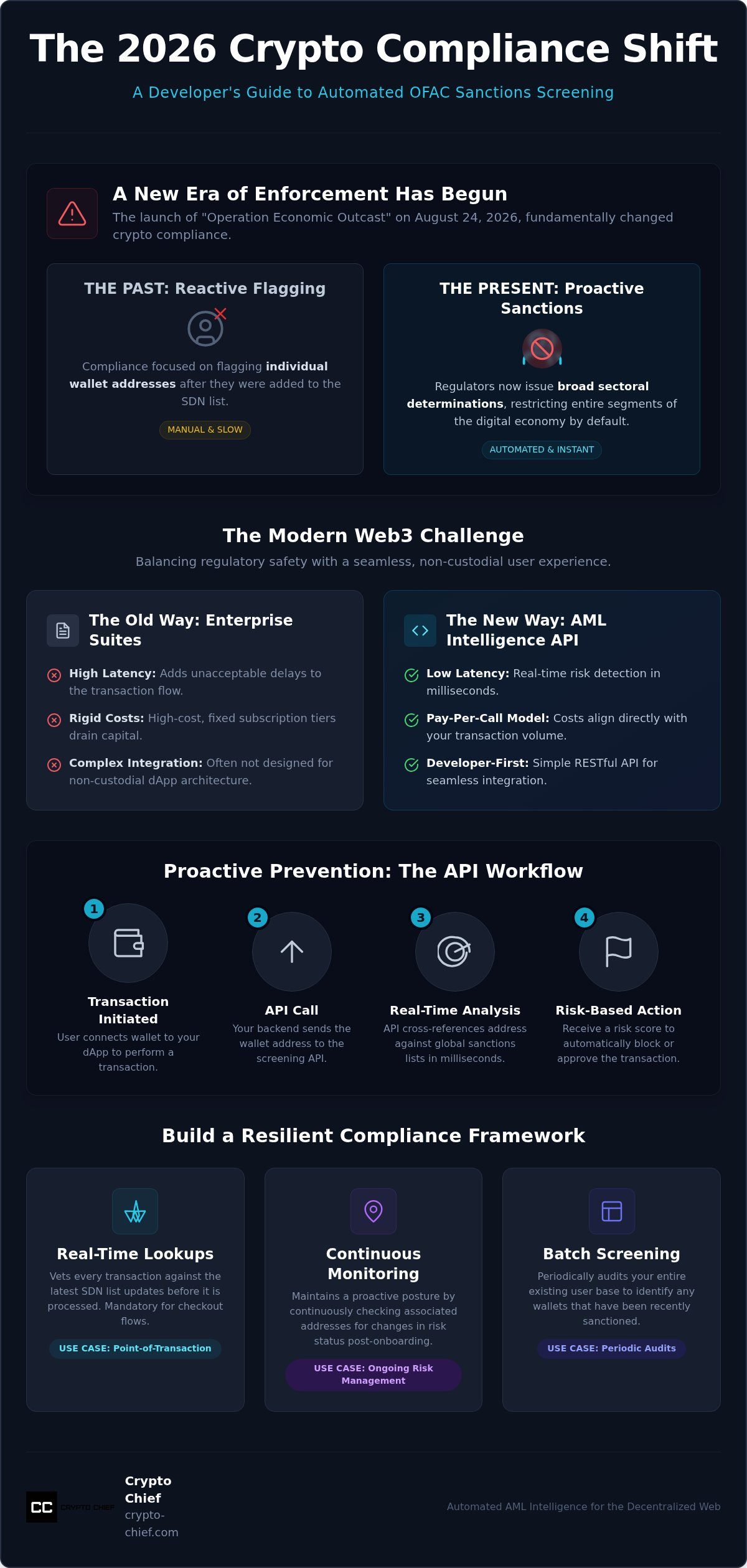
2026 marked a pivotal transition in enforcement strategy. Regulators moved beyond flagging specific individuals to implementing broad sectoral determinations. This shift means entire geographic or industrial segments of the crypto economy are now restricted by default. Implementing a reliable OFAC sanctions screening api crypto is no longer just a best practice; it's a structural requirement for any platform that values its longevity. The speed of on-chain activity demands a screening solution that functions as a silent, powerful partner, identifying risks in milliseconds before they compromise your infrastructure.
New Regulatory Frontiers: Operation Economic Outcast
On August 24, 2026, the U.S. Treasury Department launched Operation Economic Outcast, a targeted campaign against the Iranian regime's digital assets sector. This determination allows OFAC to sanction any entity operating within that specific sector, regardless of whether their individual wallet address appeared on a previous list. Allied authorities are simultaneously closing cross-border evasion gaps, making it difficult for sanctioned actors to use unhosted wallets to move funds. If your application interacts with these wallets without a robust OFAC sanctions screening api crypto, you face strict liability for violations, even if the breach was unintentional.
Why Compliance is Now a Developer Responsibility
Compliance has migrated from the legal department directly into the codebase. Modern Web3 architects are now responsible for integrating automated on-chain risk assessments that trigger before a transaction ever hits the mempool. By incorporating screening logic into smart contracts or front-end checkout flows, you can maintain the spirit of decentralization while fulfilling regulatory mandates. Utilizing a dedicated AML Intelligence API allows for this integration without the need for custodial intermediaries. It ensures that your user's privacy and your platform's performance remain intact while protecting you from the legal fallout of sanctioned peer-to-peer transfers.
How OFAC Sanctions Screening APIs Protect Web3 Platforms
Integrating a robust OFAC sanctions screening api crypto allows your dApp to move from reactive defense to proactive prevention. The mechanics are straightforward: your system sends a RESTful request containing the user's wallet address to the API endpoint. In return, you receive a granular risk score accompanied by attribution data, such as whether the address has interacted with sanctioned entities or high-risk mixing services. This process aligns with OFAC's official compliance guidance, which emphasizes the need for risk-based controls in virtual currency transactions. By automating these lookups, you eliminate the latency of manual reviews while significantly reducing false positives through precise data matching.
Choosing the right frequency for these checks depends on your specific architecture. While periodic batch screening is suitable for auditing existing user bases, real-time screening is mandatory for the checkout flow. This ensures that every individual transaction is vetted against the latest SDN list updates before it is processed. Integrating this logic into your Know Your Transaction (KYT) flow provides a continuous shield that onboarding KYC simply cannot offer on its own. If you're looking for a low-latency solution that scales with your traffic, exploring an AML Intelligence API can help maintain this balance without introducing enterprise-level friction.
Address Screening vs. Entity Mapping
Sophisticated actors rarely use a single wallet for all their activities. Modern APIs go beyond simple lookups by utilizing entity mapping to identify entire clusters of addresses controlled by the same sanctioned group. Address clustering serves as a critical tool for identifying evasive maneuvers by linking seemingly disparate wallets to a single sanctioned entity. This level of intelligence is vital for detecting funds moving through "peeling chains" or other obfuscation techniques meant to bypass basic filters.
Geo-fencing and VPN Detection as Secondary Shields
Relying solely on wallet addresses is a dangerous oversight in a globalized digital economy. Automated screening should include geo-fencing to block traffic from sanctioned jurisdictions like North Korea or Iran. Advanced APIs also detect VPN or proxy usage, flagging users who attempt to mask their physical location to evade regional restrictions. These secondary shields ensure that your compliance program remains resilient against both on-chain and off-chain evasion tactics.
Beyond Simple Lookups: Real-Time Monitoring vs. Batch Screening
A single point-in-time check is a fundamental component of any OFAC sanctions screening api crypto, but it's often insufficient for the dynamic nature of Web3 environments. A wallet that appears clean during onboarding can receive "dirty" funds just minutes later. This creates a regulatory blind spot that static lookups simply cannot address. Continuous monitoring provides a persistent oversight layer, ensuring that your platform remains compliant as on-chain relationships evolve. This proactive approach aligns with OFAC's Sanctions Compliance Guidance for the Virtual Currency Industry, which recommends ongoing monitoring to detect and report suspicious activity throughout the lifecycle of a customer relationship.
Utilizing event streaming through webhooks allows your application to react instantly to incoming risks. Instead of polling an API repeatedly and wasting resources, your system receives an automated alert the moment a monitored address interacts with a sanctioned entity or a high-risk cluster. You can learn about real-time blockchain webhooks to see how this architecture reduces server overhead while maximizing security. This real-time intelligence is vital for non-custodial payment flows where transaction finality occurs rapidly and the window for intervention is small.
The Workflow of Continuous Compliance
Automating your response to risk is the only way to scale without exploding your operational costs. By setting up webhooks, you can monitor for funds entering your ecosystem from sanctioned mixers or newly designated entities. Once an alert is triggered, your backend can automatically execute "freeze" or "reject" logic in your payment gateway. This process reduces manual review time by providing automated risk scoring, ensuring your compliance team only handles complex edge cases that require human judgment.
Batch Screening for Legacy Audits
There are specific scenarios where real-time monitoring isn't the primary requirement. Batch screening serves as an essential tool for historical data sanitization and preparing for scheduled regulatory audits. By using an OFAC sanctions screening api crypto to process thousands of legacy addresses simultaneously, you generate traceable screening logs that document your due diligence. This method also allows you to optimize your API usage by scheduling non-critical background checks in larger, more efficient sets, ensuring you don't overpay for routine maintenance.
Best Practices for Integrating a Compliance API into Your Crypto Workflow
Implementing an OFAC sanctions screening api crypto into a non-custodial workflow requires more than a simple API call; it demands a structured architectural approach that prioritizes security without degrading the user experience. You should begin by securing your API credentials using environment variables or a dedicated secret management service to prevent unauthorized access. Once secured, the most critical step is placing the screening call at the correct point in the transaction lifecycle. For non-custodial dApps, this means screening the destination wallet address immediately before the user signs the transaction. This "pre-flight" check ensures that no funds are broadcast to a sanctioned entity, effectively neutralizing the risk before it hits the blockchain.
Reliability is equally important for maintaining uptime. You must account for potential API downtime by implementing fail-safe compliance logic. If the screening service is unreachable, your system should default to a "safe" state, such as temporarily pausing the transaction or alerting the user, rather than bypassing the check entirely. To maintain a clear audit trail, log every API response with a unique timestamp and transaction ID. This documentation is vital during regulatory reviews, though you should be careful to avoid storing sensitive personally identifiable information (PII) within these logs. Finally, ensure your logic stays current with OFAC’s weekly SDN updates by using an API provider that handles real-time data ingestion on your behalf.
Architecting for Low Latency
Speed is a competitive advantage in Web3. You can significantly reduce latency by caching non-sanctioned addresses for a short duration, such as 24 hours, to bypass redundant checks for frequent users. For non-critical wallet interactions that don't involve direct fund transfers, consider using asynchronous screening to keep the user interface responsive. You can explore our Unified API Documentation to understand how to implement these high-performance patterns in your specific development environment.
Handling "Gray Area" Risk Scores
Not every check returns a binary "pass" or "fail" result. You need to define specific thresholds for High, Medium, and Low risk based on your platform's specific risk tolerance. For example, a wallet with indirect exposure to a sanctioned mixer might return a "Medium" score, requiring secondary verification or manual approval before the transaction is cleared. The Risk Threshold represents the delicate balance between maintaining maximum platform security and ensuring high user conversion rates. If you're ready to automate these complex determinations at scale, you can integrate our AML Intelligence API to protect your platform without adding unnecessary friction.
Scaling Compliance with Crypto Chief’s AML Intelligence API
Scaling compliance shouldn't mean sacrificing your startup's runway or over-provisioning for capacity you don't yet use. Most legacy providers demand significant annual commitments that create a high barrier to entry for emerging dApps. Crypto Chief’s AML Intelligence API disrupts this model by eliminating monthly minimums and fixed-tier overhead. By utilizing a high-performance OFAC sanctions screening api crypto on a pay-per-call basis, you align your regulatory costs directly with your transaction volume. It's a logic-driven approach that empowers architects to build without the shadow of a "compliance tax" looming over their development cycles.
The platform provides a unified gateway across the most critical networks in the ecosystem, including Bitcoin, Ethereum, and TRON. This multichain support means you can manage your entire screening workflow through a single endpoint, which significantly reduces the technical debt associated with maintaining multiple third-party integrations. This intelligence layer works in perfect tandem with our non-custodial crypto processing. It allows you to identify risks and process payments within the same high-velocity environment. It's about building a structural foundation where compliance is a silent, automated feature rather than a manual bottleneck that slows down your deployment speed.
The Pay-Per-Call Advantage for Startups
Startups often face a binary choice: pay for enterprise-grade tools they don't fully utilize or risk non-compliance with manual, error-prone processes. Crypto Chief’s token-based model allows you to scale from 10 to 10 million requests without the friction of renegotiating contracts or upgrading tiers. You can read more about Web3 API cost optimization to see how batching and efficient request management further improve your bottom line. This flexibility ensures that your compliance infrastructure grows at the exact same pace as your user base, providing stability during periods of rapid expansion.
A Unified Infrastructure for Global Builders
Efficiency in Web3 development comes from consolidation without compromise. Crypto Chief acts as a silent, powerful partner by combining RPC nodes, real-time event streaming, and AML intelligence into one cohesive platform. This unified infrastructure ensures global uptime and low-latency response times, which are essential for maintaining a seamless user interface during high-stakes checkout flows. You don't need to juggle separate vendors for node access and wallet screening; everything is accessible via a single, logically organized dashboard. This reduces the risk of integration failures and ensures that your compliance data is always synchronized with your on-chain activity. You can register for your API key and start screening today to secure your platform's future.
Future-Proofing Your Web3 Compliance Architecture
The regulatory environment of 2026 requires more than just reactive measures. With the Treasury's shift toward sectoral determinations, your platform needs a silent, powerful partner to manage risk automatically. Integrating a high-performance OFAC sanctions screening api crypto ensures that you remain compliant with the latest SDN updates without sacrificing the low-latency performance your users expect. You've seen how real-time monitoring and event streaming can transform compliance from a manual bottleneck into a seamless background utility.
By leveraging a unified API with multichain support, you can protect your Bitcoin, Ethereum, and TRON transactions through a single integration. The pay-per-call model effectively eliminates the "compliance tax" of fixed-tier subscriptions, allowing your infrastructure to scale logically with your transaction volume. It's time to move beyond the high costs of legacy enterprise tools and embrace a builder-centric approach to on-chain safety.
Start screening for OFAC compliance with Crypto Chief’s AML API and secure your application against evolving global risks today. Build with confidence, knowing your regulatory foundation is as robust as your code.
Frequently Asked Questions
What is an OFAC sanctions screening API for crypto?
It is a programmatic interface that allows decentralized applications to check wallet addresses against the U.S. Treasury's SDN list in real-time. This OFAC sanctions screening api crypto provides risk scores and attribution data to prevent transactions with sanctioned individuals or entities. It effectively automates the compliance process, ensuring that every interaction is vetted against the most current regulatory data before funds are moved on-chain.
How does pay-per-call pricing work for crypto AML screening?
Pay-per-call pricing operates on a utility model where you only pay for the specific API requests you execute. Instead of committing to expensive monthly subscriptions or fixed enterprise tiers, you use pre-paid tokens to cover individual screenings. This approach is ideal for startups and scaling dApps because it aligns your operational costs directly with your actual transaction volume, eliminating the "compliance tax" of unused capacity.
Can I screen addresses across different blockchains like Bitcoin and Ethereum with one API?
Yes, a unified AML Intelligence API allows you to screen addresses across multiple networks, including Bitcoin, Ethereum, and TRON, using a single endpoint. This consolidated infrastructure simplifies your codebase by removing the need for multiple third-party integrations. You can maintain a consistent compliance posture across all supported chains, ensuring that your risk detection logic is unified regardless of which blockchain your users choose for their transactions.
What happens if a wallet address is flagged as "sanctioned" during a transaction?
If an address is flagged, your application's backend logic should immediately trigger a "reject" or "freeze" action to prevent the transaction from being broadcast. You should log the API response for auditability and potentially notify your compliance team for further review. Handling these flags programmatically ensures that you don't inadvertently facilitate a transfer to a sanctioned entity, which is critical given OFAC’s strict liability enforcement standards.
Is real-time screening necessary for decentralized applications (dApps)?
Real-time screening is essential for dApps to prevent sanctioned funds from entering their ecosystem during high-velocity checkout flows. While batch screening works for audits, only real-time checks can stop a transaction before it reaches finality on the blockchain. Utilizing an OFAC sanctions screening api crypto within your transaction monitoring flow provides a proactive shield, ensuring that your platform remains compliant as on-chain risks evolve in seconds.
How often does the OFAC SDN list update for cryptocurrency addresses?
OFAC typically updates the Specially Designated Nationals (SDN) list on a weekly basis, though emergency designations can occur at any time. A high-performance API provider ingests these updates automatically, ensuring your screening logic always reflects the most recent data. This is particularly vital in 2026, as campaigns like Operation Economic Outcast lead to frequent new designations across the digital assets sector that require immediate enforcement.
Do I need to store user data to use a crypto screening API?
No, you don't need to store sensitive personally identifiable information (PII) to perform effective wallet screening. The API primarily requires the public wallet address to return a risk score and attribution data. This non-custodial approach respects user privacy while fulfilling your regulatory obligations. You simply log the API response and the associated transaction ID to maintain a clear audit trail for future regulatory reviews or internal compliance checks.
What is the difference between address screening and full AML intelligence?
Address screening is a binary check against known blocklists, whereas full AML intelligence involves sophisticated entity mapping and cluster analysis. Intelligence tools identify groups of seemingly unrelated wallets controlled by a single sanctioned actor. This deeper level of insight detects evasive maneuvers like "peeling chains" or the use of mixing services, providing a more resilient defense than simple list-matching alone could ever offer your platform.