
Fixed monthly subscriptions are becoming a legacy tax on Web3 innovation, forcing developers to pay for idle capacity while fearing the inevitable invoice spike during a traffic surge. You've likely felt the frustration of paying for a high-tier plan just to ensure your dApp remains stable during a peak, only to realize that a significant portion of those resources went unused during the quiet hours. In 2026, the transition to pay as you go rpc nodes is no longer just a cost-saving measure; it's a strategic necessity for builders who value structural integrity and capital efficiency.
We understand that managing infrastructure across ten or more chains shouldn't require a degree in accounting or a constant fear of overage charges. You deserve a silent, powerful partner that scales with you, ensuring that every cent spent translates directly into user value. This guide will show you how the pay-per-call model is replacing rigid tiers, allowing you to optimize your bottom line without sacrificing the high-performance access your users expect. We'll break down the shift from complex compute unit multipliers to transparent billing, giving you the clarity needed to maintain a global, high-performance engine for your decentralized applications.
Key Takeaways
- Transition from rigid "use-it-or-lose-it" subscription models to a utility-based framework that aligns infrastructure spend directly with real-time dApp activity.
- Understand how pre-paid token balances provide superior cost visibility and more granular budget control than traditional monthly invoices or unpredictable overage charges.
- Discover why modern pay as you go rpc nodes maintain enterprise-grade performance by effectively decoupling billing logic from the high-speed infrastructure layer.
- Learn to scale and test across multiple chains like Ethereum, Polygon, and BNB without the financial burden of managing several independent subscription tiers.
- Explore the efficiency of a unified stack where a single balance powers your RPC Gateway, AML Intelligence, and Crypto Processing API simultaneously.
The Evolution of Web3 Infrastructure Billing
Web3 development has reached a pivotal juncture where legacy billing models no longer serve the needs of modern builders. For years, the industry relied on fixed SaaS subscriptions, a convenient carryover from the Web2 world that often clashes with the volatile, request-driven nature of decentralized ecosystems. In 2026, this friction has reached a breaking point. Agile development teams are moving away from rigid tiers that prioritize a provider's predictable revenue over a builder's operational efficiency. They require a foundation that is as dynamic as the networks they build upon.
At the core of every decentralized application lies the Remote Procedure Call (RPC). This protocol serves as the essential communication engine, allowing your application to query the blockchain ledger and execute transactions. Because this engine is the primary point of contact between your code and the chain, its cost structure directly dictates your project's margins. Traditional providers have historically locked developers into "use-it-or-lose-it" credit cycles, where any unused capacity at the end of the month simply vanishes, creating a persistent drain on capital. This is why pay as you go rpc nodes have emerged as the standard for teams that value structural integrity and fiscal logic.
What are Pay As You Go RPC Nodes?
Technically, pay as you go rpc nodes provide usage-based access to blockchain data without the constraints of a monthly subscription. Instead of purchasing a pre-defined "bucket" of requests that resets every thirty days, you access a high-performance gateway where each call is accounted for individually. This request-level granularity ensures that your infrastructure spend remains in a 1:1 alignment with your actual user activity. It's a transition from artificial rate-limiting to a transparent, scalable model that treats RPC access as a utility, much like electricity or water. You don't pay for the potential to use the network; you pay for the work performed.
The Problem with Fixed Monthly Tiers
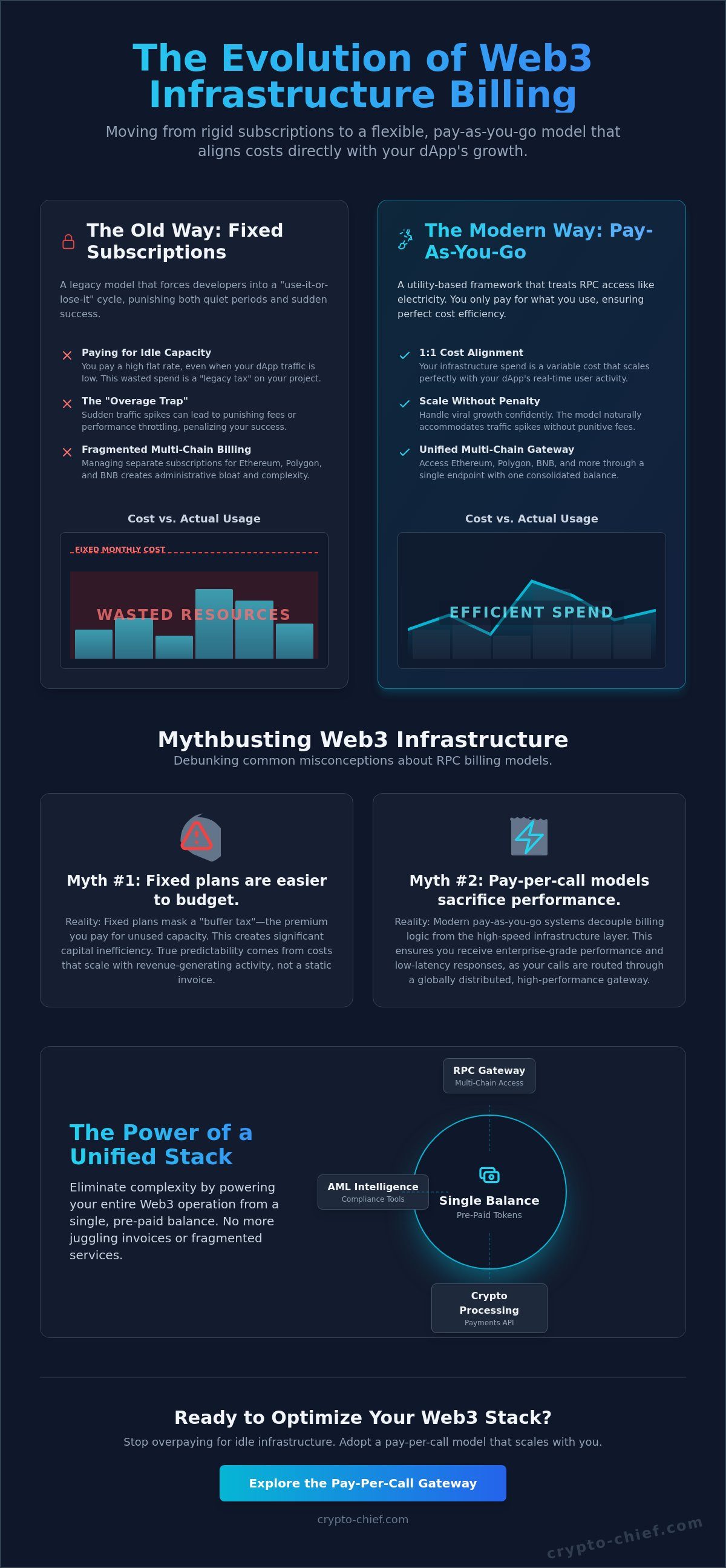
Fixed tiers create a "use-it-or-lose-it" environment that punishes both quiet periods and sudden success. If your dApp experiences a week of low traffic, you're effectively subsidizing the provider's idle hardware. Conversely, the "Overage Trap" remains a constant threat. When a project goes viral, traditional providers often trigger punishing fees or throttle performance the moment you cross an arbitrary threshold. This friction is amplified for multichain projects. Managing separate subscriptions for Ethereum, Polygon, and BNB Smart Chain leads to fragmented billing and administrative bloat. Utilizing a unified RPC Gateway eliminates this complexity, allowing you to scale across multiple chains without managing a dozen different invoices.
Myth #1: Monthly Subscriptions are Easier to Budget
The assumption that a fixed monthly invoice provides the ultimate budgeting safety net is a persistent fallacy in Web3 infrastructure. While a flat fee looks clean on a spreadsheet, it often masks significant capital inefficiency. Developers frequently pay a "buffer tax," purchasing tiers that accommodate their highest anticipated traffic spikes while leaving the majority of those resources idle during standard operations. This mismatch between allocated capacity and actual usage creates a hidden drain on project resources. By shifting to pay as you go rpc nodes, teams replace this rigid overhead with a model that mirrors their real-world growth.
Academic research into the Economics of Distributed Systems suggests that utility-based pricing is the most logical path for scaling decentralized networks. It removes the friction of artificial scarcity. When you choose a usage-based model, you're no longer paying for a provider's potential capacity; you're paying for the specific ledger queries your users trigger. This transition allows the infrastructure to act as a variable cost that scales in perfect symmetry with your revenue-generating activity.
Predictability vs. Efficiency
Predictability shouldn't come at the cost of over-provisioning. In traditional tiered plans, the "cost per 1M requests" is a moving target that changes based on how much of your monthly quota you actually exhaust. If you consistently use only 70% of your plan, you're effectively paying a 30% premium for the privilege of a fixed invoice. Usage analytics now allow developers to forecast their needs with high precision. This makes pre-paid top-ups a more transparent budgeting tool than a recurring subscription that might trigger unexpected overage fees when traffic spikes. You can explore how this unified approach simplifies multichain management by reviewing our RPC Gateway documentation.
The Zero-Waste Advantage
Pre-paid balances offer a structural advantage over monthly credits because they don't expire. In a legacy subscription, your unused credits vanish at the end of every thirty days, forcing a "use-it-or-lose-it" mentality that wastes capital. A tokenized billing system treats your balance as a versatile resource. This allows for cross-service spending where a single balance can power your RPC access, AML Intelligence, and data queries simultaneously. It eliminates the fear of surprise bills and ensures that every dollar deposited remains on your balance sheet until it's actually converted into utility. Some agile teams have reported reducing their monthly infrastructure spend by up to 40% simply by eliminating the idle capacity inherent in their previous fixed-tier plans.
Myth #2: Pay-Per-Call Models Sacrifice Performance
A persistent misconception in the developer community suggests that performance is a premium feature reserved exclusively for high-cost monthly subscriptions. This myth is often reinforced by legacy providers who throttle lower-tier plans or route them through congested, shared node clusters. In reality, the technical architecture of pay as you go rpc nodes in 2026 has completely decoupled billing logic from the data transmission layer. Your payment model no longer dictates your speed. Modern gateways prioritize request execution based on network proximity and load, ensuring that a single developer on a usage-based plan receives the same enterprise-grade performance as a massive conglomerate.
Performance is a product of structural integrity, not the size of your monthly invoice. When you utilize a high-performance RPC Gateway, your requests are handled by a sophisticated routing engine that selects the optimal node for every call. This means that the quality of your data remains consistent, whether you are querying the Ethereum mainnet or a high-throughput network like BNB Smart Chain. By removing artificial performance ceilings, providers allow builders to focus on their application's logic while the background infrastructure handles the heavy lifting of global delivery.
Latency and Throughput in Usage-Based Models
Latency is governed by the laws of physics and network routing, not by your billing cycle. A request from a user in Tokyo will always be faster if it hits a local node, regardless of whether that node is part of a "Pro" plan or a pay-per-call setup. Providers using usage-based models actually have a stronger incentive to maintain high performance. If an endpoint is slow or unreliable, developers will naturally reduce their call volume, directly impacting the provider's revenue. Consequently, these platforms invest heavily in geo-routing and intelligent load balancing to ensure that response times remain competitive with any fixed-tier alternative on the market.
Reliability and SLAs
The idea that reliability is sacrificed in flexible models is debunked by the prevalence of robust Service Level Agreements (SLAs) across the industry. Many pay-as-you-go providers now offer a 99.9% uptime guarantee, which limits annual downtime to just 8.7 hours. This level of stability is achieved through redundant node clusters that automatically failover if a single instance experiences an issue. High-performance gateways manage request spikes by utilizing elastic scaling and distributed node clusters, ensuring consistent throughput without the need for manual tier upgrades. This ensures that your dApp remains responsive even during periods of intense network activity, providing a stable foundation for your users without the overhead of an enterprise-tier contract.
The Strategic Advantage: Aligning RPC Costs with DApp Growth
Scaling a decentralized application in 2026 requires a surgical focus on capital allocation. Builders no longer have the luxury of over-provisioning for hypothetical traffic while their actual user base is still finding its footing. This is where the strategic shift toward pay as you go rpc nodes becomes a distinct competitive advantage. By aligning your infrastructure costs directly with real-time user activity, you ensure that every dollar spent is a dollar that supported a genuine interaction. This "Lean Web3" methodology removes the financial friction that often stifles promising projects before they reach product-market fit.
Infrastructure should grow as you grow, not before you do. In legacy models, reaching a new milestone often triggers a "Success Tax," where you're forced into a significantly more expensive tier just to handle a small increase in volume. A usage-based model eliminates this barrier. It ensures that your margins remain predictable and protected even as you scale from a few hundred users to hundreds of thousands. You aren't paying for the potential to succeed; you're paying for the success you've already achieved. This logic allows for a more aggressive development cycle, as capital is preserved for core product features rather than idle server capacity.
Multichain Flexibility
Modern dApps are rarely confined to a single network. The ability to access Ethereum RPC, Polygon RPC, and BNB Smart Chain from a single, unified balance is a functional requirement for agile teams. Traditional providers often require developers to manage multiple subscriptions, each with its own credit cycle, billing date, and rate limits. This creates an administrative burden and leads to fragmented data analysis. By utilizing a Unified Blockchain API, teams can normalize data across different chains while maintaining a single pool of capital. This reduces integration debt and allows for rapid experimentation on new networks, including Solana or TON, without committing to additional monthly overhead or complex contract negotiations.
Future-Proofing Your Infrastructure
Preparing for the next market cycle requires a foundation that is both stable and elastic. You don't want to be caught over-provisioned during a market lull or under-powered during a sudden spike in network activity. Usage-based billing through pay as you go rpc nodes treats infrastructure as a utility, allowing you to scale instantly without manual upgrades or service interruptions. This flexibility extends beyond just data access. Integrated security features like AML Intelligence can be woven into the same billing flow, ensuring that your compliance and infrastructure costs remain perfectly synchronized with your transaction volume. To see how this unified approach can streamline your operations, you can register for a gateway account and begin testing your multichain stack immediately.
Optimizing Your Web3 Stack with Crypto Chief’s Pay-Per-Call Gateway
Crypto Chief provides a high-performance foundation for teams that refuse to be constrained by legacy infrastructure billing. Our non-custodial RPC Gateway is engineered for production-grade reliability, offering a seamless transition from rigid subscriptions to a model that values absolute capital efficiency. By choosing pay as you go rpc nodes, you gain access to a global network of low-latency nodes that respond to your dApp's needs in real time. We've removed the administrative friction of managing multiple providers, allowing you to focus on your code while we handle the structural integrity of your data access.
The transition to a utility-based model represents more than just a change in billing; it's a commitment to a leaner, more agile development cycle. In the 2026 landscape, the most successful projects are those that can pivot quickly without being weighed down by "use-it-or-lose-it" credit cycles. Our platform acts as a silent, powerful partner, providing the uptime and scalability you need to maintain a global presence across dozens of chains simultaneously. Whether you're a solo creator or an enterprise architect, you receive the same elite service level without the overhead of a traditional contract.
One Balance, Unlimited Potential
The true power of the Crypto Chief ecosystem lies in its unified billing framework. While traditional providers force you to manage separate accounts for infrastructure, payments, and security, we consolidate your entire stack into a single pre-paid token balance. This balance powers your RPC requests, your AML Intelligence queries, and our Crypto Processing API simultaneously. This utility-first approach ensures you only pay for the work performed across every service you utilize, eliminating the need for multiple invoices.
- Monitor your request volume through a transparent, real-time dashboard.
- Top up your balance with a variety of assets to ensure uninterrupted service for your users.
- Scale your transaction processing throughput without negotiating new contract terms.
Developers can integrate these services in minutes by accessing our comprehensive Developer Documentation. Whether you're building a cross-chain bridge or a high-volume decentralized marketplace, the pay-per-call model ensures your overhead remains lean and your focus stays on the user experience.
Built for Builders
We understand that enterprise-grade dApps require more than just flexible billing; they require absolute stability. Crypto Chief maintains a global footprint of redundant node clusters to ensure consistent uptime and minimal latency for users regardless of their geographic location. This commitment to performance is why growing teams choose our gateway to support their multichain ambitions. You don't have to choose between a limited free tier and a bloated pro tier. You can register for Crypto Chief and start building with pay-per-call RPC nodes today, experiencing the freedom of a stack that scales with your logic rather than your invoice.
Future-Proof Your Web3 Operations
The shift toward utility-based infrastructure is a fundamental evolution in how successful decentralized projects manage their resources. By moving away from rigid tiers, you eliminate the legacy tax of idle capacity and ensure your capital stays aligned with your actual user activity. We've shown that usage-based models don't sacrifice speed; they provide a high-performance foundation that is both elastic and reliable. It's time to stop paying for potential and start paying for progress.
Adopting pay as you go rpc nodes allows you to scale across 10+ major blockchains with a single, unified balance. This model provides global, low-latency access with a 99.9% uptime guarantee, ensuring your engine remains stable through any market cycle. You can now manage your RPC Gateway, AML Intelligence, and Crypto Processing through one streamlined billing flow, removing the administrative friction that often stalls innovation. Start building with pay-as-you-go RPC nodes at Crypto Chief and experience a stack designed for builders who value structural integrity and efficiency. Your next breakthrough shouldn't be limited by your infrastructure.
Frequently Asked Questions
What exactly are pay as you go RPC nodes?
Pay as you go RPC nodes provide usage-based access to blockchain ledger data, allowing developers to query networks without a recurring monthly subscription. Instead of purchasing a fixed tier of monthly credits that reset every thirty days, you pay only for the specific requests your application makes. This model treats infrastructure as a utility, ensuring that your costs remain in perfect alignment with your actual user activity and request volume.
Is pay-per-call more expensive than a monthly subscription for high-traffic dApps?
Pay-per-call models are often more cost-effective for high-traffic applications because they eliminate the "buffer tax" associated with fixed tiers. In a traditional subscription, you pay for maximum capacity even during low-traffic periods. With a usage-based approach, you avoid paying for idle resources while maintaining the ability to scale instantly during spikes, preventing the wasted capital common in legacy "use-it-or-lose-it" credit cycles.
How do I track my spending with a usage-based RPC provider?
You can track your spending through a centralized dashboard that provides real-time analytics on request volume and balance depletion. Most providers offer granular visibility into which methods or chains are consuming the most resources. This transparency allows for more accurate budgeting and helps developers identify potential optimizations in their code to reduce unnecessary calls and lower monthly overhead while maintaining structural integrity.
Do pay-as-you-go nodes support all major blockchains like Ethereum and Polygon?
Yes, modern pay as you go rpc nodes typically support a wide array of networks, including Ethereum, Polygon, BNB Smart Chain, and Solana. This multichain compatibility allows builders to manage infrastructure for 10+ different ecosystems from a single account. It removes the complexity of maintaining multiple independent subscriptions, providing a unified access point for all your cross-chain data requirements without administrative friction.
Can I use my pre-paid balance for other services like AML or crypto processing?
Many unified providers allow you to use a single pre-paid balance to power various Web3 services simultaneously. This means your deposit can cover RPC requests, AML Intelligence queries, and Crypto Processing API calls from the same pool of capital. Consolidating these costs into one billing flow reduces administrative bloat and ensures that your entire infrastructure stack scales in symmetry with your transaction volume.
What happens if my pre-paid balance runs out during a traffic spike?
Providers generally implement automated alerts and low-balance notifications to help you maintain service continuity during traffic surges. If a balance is exhausted, requests may be temporarily paused until a top-up is completed. To prevent interruptions, many developers maintain a safety buffer within their pre-paid account to handle unexpected viral growth, ensuring that their dApp remains responsive even during periods of intense network activity.
Are usage-based RPC endpoints as fast as dedicated nodes?
Usage-based RPC endpoints provide the same high-performance access as dedicated nodes because the billing model is decoupled from the infrastructure layer. Your requests are routed through global node clusters and load balancers that prioritize low-latency delivery. Performance is determined by network proximity and node health rather than the type of payment plan you've selected, ensuring production-grade speed for every call you make.
Is there a minimum monthly spend for pay-as-you-go RPC services?
Most pay-as-you-go models don't require a minimum monthly spend, making them ideal for both early-stage startups and fluctuating enterprise workloads. You only pay for the utility you consume, which removes the financial pressure of hitting a specific quota to justify your costs. This flexibility allows developers to test new features or chains without committing to a long-term contract or high entry fee.
Tags: pay as you go rpc nodes