
Why is it that in a world of instant global settlement, your subscription revenue still depends on a user manually signing a transaction every thirty days? Building a scalable recurring crypto payments API requires more than just a basic smart contract. It demands a fundamental shift from the "push" mechanics of Layer 1 blockchains to a seamless, automated "pull" architecture that respects both user sovereignty and business logic.
You likely recognize the friction points that have historically stalled on-chain subscriptions. High gas fees on legacy networks can quickly erode margins on small transactions, while the technical debt of managing chain-specific APIs across Polygon, Base, and Solana often outweighs the benefits of going global. You need a system that offers the stability of traditional direct debits without sacrificing the security of non-custodial control. This guide will help you master the technical architecture of automated crypto billing, showing you how to implement secure, non-custodial recurring payments via a unified API. We will examine how to reduce integration time across multiple chains and automate AML risk scoring for every cycle, providing your business with a reliable, enterprise-grade engine for the 2026 economy.
Key Takeaways
- Understand how to overcome the native "push" limitation of blockchains by utilizing smart contracts to create secure, pre-authorized "pull" mechanics for automated billing.
- Discover how to leverage a recurring crypto payments API to normalize transaction data across multiple Layer 1 and Layer 2 networks through a single, unified interface.
- Learn to build resilient feedback loops using EventStream webhooks that accurately track billing cycles while accounting for blockchain reorganizations.
- Master the integration of automated AML Intelligence to perform real-time risk scoring for every subscription cycle, ensuring your global revenue remains compliant.
- Gain a clear, step-by-step framework for deploying subscription-based smart contracts and connecting them to professional-grade processing infrastructure.
The Architecture of Recurring Crypto Payments: Solving the "Push" Problem
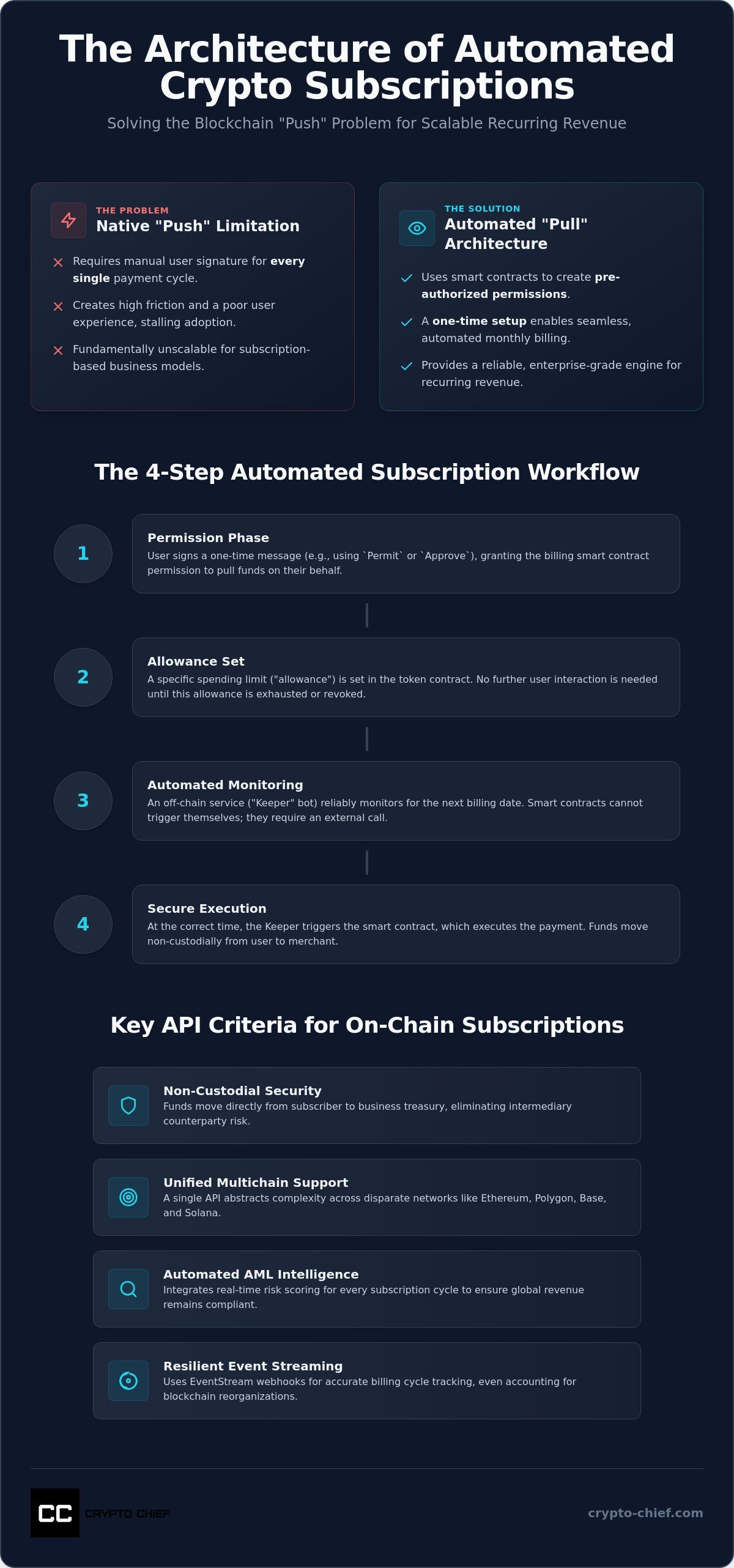
The decentralized nature of blockchain technology creates a unique architectural hurdle for subscription-based businesses. Unlike traditional banking systems that allow merchants to "pull" funds from a customer's account via direct debit, blockchains are natively "push-only" environments. Every transaction requires a cryptographic signature from the user's private key, meaning a subscriber would technically need to manually approve every monthly invoice. This friction is the primary reason why standard wallet interactions fail to support scalable business models. To bypass this, a sophisticated recurring crypto payments API acts as the bridge, utilizing smart contracts to simulate pull mechanics through pre-authorized permissions.
Architects generally choose between two primary standards for these workflows. EIP-1334 provides a framework for time-based recurring payments, while streaming protocols like Superfluid allow for continuous, per-second value transfers. While streaming is innovative, most enterprise billing cycles require the predictability of fixed-interval settlements. A non-custodial API remains the gold standard here because it allows developers to automate these cycles without ever taking possession of the user's private keys or the merchant's revenue. It provides the infrastructure to monitor contract states and execute transactions precisely when the billing logic dictates.
Smart Contracts vs. Off-Chain Schedulers
On-chain escrow contracts facilitate trustless subscriptions by holding funds in a secure environment, releasing them only when specific conditions are met. While highly secure, this can be capital-inefficient for the user. A more flexible hybrid approach involves collecting a one-time off-chain signature and using an on-chain execution layer to process the payment. This method significantly improves gas efficiency, especially for micro-transactions, as it avoids the heavy computational costs of maintaining complex state logic for every individual subscriber on the mainnet. By routing these requests through a high-performance RPC Gateway, you ensure that the execution triggers are broadcast to the network without delay.
The Anatomy of a Subscription Transaction
The technical workflow begins with a permission phase, often utilizing the Permit or Approve functions found in standard token contracts. The allowance mechanism is a pre-authorization for smart contracts to spend a specific token amount. Once this limit is set, the billing system doesn't need to prompt the user again until the allowance is exhausted or revoked. Because smart contracts cannot "wake up" on their own to execute a payment, the architecture relies on Keepers or automated bots to trigger the transaction. Integrating a professional Crypto Processing API removes the burden of managing these bots, providing a reliable execution layer that handles gas price fluctuations and network congestion on your behalf.
Choosing a Recurring Crypto Payments API: Key Evaluation Criteria
Selecting the right infrastructure for on-chain subscriptions isn't just about functionality; it's about structural integrity and long-term scalability. A non-custodial recurring crypto payments API ensures that funds move directly from the subscriber to your business treasury without intermediary risk. This architecture protects your enterprise from the counterparty risks inherent in custodial platforms, where a single point of failure can freeze your entire revenue stream. Beyond security, your chosen API must normalize data across disparate networks. Whether a user settles their invoice on Ethereum, Polygon, or a high-speed Layer 2 like Base, the developer experience should remain consistent through a single, unified interface that abstracts the underlying complexity of each chain.
Compliance and developer experience are equally vital pillars of a professional-grade system. Robust AML Integration within the API workflow allows you to screen every billing cycle automatically, maintaining regulatory standards without manual intervention. High-quality documentation and native SDKs further reduce integration time, allowing your team to focus on core product features rather than debugging raw JSON-RPC calls. When these elements align, your payment stack becomes a silent, powerful partner in your business growth.
The Pay-Per-Call Advantage for Scalable Apps
Traditional SaaS pricing often traps developers in expensive monthly tiers that don't align with their actual usage. Prepaid API token balances offer a more logical alternative, preventing the "tier-lock" that occurs when you outgrow a plan mid-month or pay for capacity you don't use. This model is particularly efficient for high-volume event streaming and webhook notifications, where transaction frequency can fluctuate. You only pay for the specific resources you consume, allowing for precise budgeting as your user base expands. You can see this flexibility in action through the Crypto Chief Processing model, which prioritizes transparent, usage-based billing over rigid, legacy subscription structures.
Uptime and Global RPC Reliability
The hidden cost of RPC latency is often felt in delayed payment confirmations, which can frustrate users and stall service delivery. A unified API backed by a global RPC gateway is essential for any global SaaS aiming for enterprise-grade uptime. Low-latency RPC endpoints prevent "double-spend" race conditions during peak network congestion by ensuring your system sees the most current state of the ledger across all nodes. This reliability turns your payment stack from a potential bottleneck into a high-performance engine. If you're ready to stabilize your infrastructure, you can register for a unified API key to begin testing your subscription logic in minutes.
Non-Custodial Automation: Smart Contracts, Webhooks, and Event Streaming
The automation of a subscription workflow depends entirely on the reliability of the feedback loop between the blockchain and your off-chain database. When you implement a recurring crypto payments API, you aren't just sending transactions; you're building a system that listens and reacts to on-chain state changes in real time. This architecture requires a robust event-streaming engine that can differentiate between a pending transaction, a confirmed block, and a potential chain reorganization (reorg). Reorgs occur when the network temporarily forks, potentially invalidating a transaction that your system previously recorded as successful. To maintain a clean ledger, your infrastructure must wait for a sufficient number of confirmations or utilize a dedicated event stream that handles reorg logic automatically, ensuring that subscription access is only granted when finality is reached.
Maintaining a non-custodial posture remains a priority for security and regulatory clarity. By keeping the merchant out of the flow of funds, the API ensures that revenue moves directly into the merchant's controlled wallet, minimizing the surface area for potential exploits. This architecture also allows for proactive customer management. For instance, your system can monitor the allowance state or the subscriber's balance to trigger insufficient funds alerts before the actual billing cycle fails. This preventative measure reduces churn and improves the overall user experience by allowing customers to top up their wallets in advance, ensuring uninterrupted service.
Real-Time Event Monitoring for Subscriptions
Monitoring Transfer events for ERC-20 stablecoins like USDC, USDT, and DAI is the foundation of modern crypto billing. By using Real-Time Blockchain Webhooks, your application can update user status instantly upon payment detection. It's essential to configure smart retry logic within your webhook listener. If your server is down or returns an error, the event provider should exponentially back off and retry the delivery. This prevents missed billing cycles and maintains data integrity across your entire stack.
Unified Data Normalization
A significant pain point for architects is the technical fragmentation between different networks. Tracking payments on Ethereum shouldn't require a completely different codebase than tracking them on Tron or BNB Smart Chain. A Unified Blockchain API solves this by normalizing raw block data into a consistent JSON format regardless of the source. This standardization is invaluable for multichain reporting, as it allows you to aggregate metadata for accounting and tax compliance without manual translation. Whether you are reconciling thousands of monthly micro-payments or a few high-value enterprise contracts, a unified data layer ensures that your financial records remain accurate and auditable.
Scalability and Compliance: Multichain Support and AML Integration
As your subscription base grows, the focus shifts from technical feasibility to operational risk management. A professional recurring crypto payments API must do more than move tokens; it must protect your business from the regulatory risks inherent in the decentralized economy. The compliance gap is a significant vulnerability that many architects ignore until it's too late. Accepting recurring funds from a sanctioned wallet or an obfuscation service can trigger severe legal repercussions and jeopardize your banking relationships. By integrating AML Intelligence directly into the subscription "Check" phase, you can automate risk scoring at the moment of settlement. This ensures that your revenue stream remains clean and compliant without adding manual friction to the user experience.
Scaling beyond Ethereum is no longer optional for high-volume SaaS providers. While Ethereum remains the primary liquidity hub, networks like Polygon, BNB Chain, and Tron have become the preferred subscription hubs due to their significantly lower transaction costs. Managing "dust" and high gas fees on-chain requires aggressive Layer 2 optimization and a strategy that prioritizes cost-efficiency. By routing micro-transactions through these high-performance environments, you preserve your margins while providing a frictionless service to a global audience. This multichain approach allows you to capture revenue from users regardless of which ecosystem they call home.
Automated Transaction Risk Assessment
Modern compliance demands more than just a one-time check; it requires constant screening of subscriber wallets for links to sanctioned entities or mixers. You can implement automated "Block" thresholds that reject incoming payments if the risk score exceeds your internal tolerance. This proactive posture prevents tainted funds from ever reaching your treasury. For a deeper look at the technical methodology behind these automated checks, refer to the Crypto AML Risk Detection API Guide.
Multichain RPC Strategies
Architectural redundancy is the foundation of 24/7 billing reliability. Load balancing your requests across Ethereum RPC and Polygon RPC ensures that a single network outage doesn't paralyze your payment listeners. Multichain RPC gateways ensure 99.9% uptime for global payment listeners. In this context, "Unified" doesn't just refer to data formats; it means your cross-chain event triggers are synchronized, allowing for a seamless experience even when users migrate between networks. This structural integrity is what separates an elite payment engine from a fragile integration.
Protect your business treasury and ensure global compliance by integrating automated AML Intelligence into your subscription workflow today.
Implementing Recurring Billing with Crypto Chief’s Unified Infrastructure
Transitioning from a conceptual architecture to a production-ready environment requires a platform that prioritizes uptime and developer autonomy. Unlike semi-custodial legacy providers that force you into rigid workflows, the recurring crypto payments API offered by Crypto Chief provides a pure non-custodial path. This ensures you maintain absolute control over your treasury while automating the complex "pull" mechanics discussed earlier. The implementation process is methodical, designed to move your project from a sandbox prototype to a global subscription engine with minimal friction. By following a structured deployment roadmap, you can establish a resilient billing cycle that scales alongside your user base. This growth often necessitates specialized leadership, making private equity executive search firms an invaluable resource for companies looking to hire the talent needed for large-scale transformation.
Your integration journey begins with five critical steps:
- Step 1: Register and obtain your unified API key. Use the registration portal to generate your credentials and access a starting token balance for initial testing.
- Step 2: Deploy or integrate your subscription smart contract. Connect your pre-authorized "pull" logic to our infrastructure to begin facilitating trustless transactions.
- Step 3: Configure EventStream webhooks for billing events. Set up real-time listeners to capture successful settlements, failed attempts, or contract state changes.
- Step 4: Enable AML Intelligence for automated compliance. Activate real-time risk scoring to ensure every incoming payment meets your internal regulatory standards.
- Step 5: Monitor and scale using the pay-per-call dashboard. Track your resource consumption and network performance through a transparent, usage-based interface.
The Developer-First Workflow
Speed of integration is a core metric for any engineering team. You can access comprehensive documentation to jumpstart your prototyping phase, utilizing detailed code samples and native SDKs. It's essential to test your logic in sandbox environments across multiple testnets before moving to mainnet execution. This approach allows you to debug your recurring crypto payments API calls and webhook listeners without risking real capital. Because the platform utilizes a unified data model, the code you write for a testnet environment will transition seamlessly to production across Ethereum, Polygon, or Tron.
Customizing Your Non-Custodial Gateway
Enterprise-grade applications often require a level of aesthetic and functional customization that standard APIs can't provide. You can tailor our whitelabel solutions to match your brand identity, ensuring a cohesive experience for your subscribers from the first approval to the final settlement. Whether you're processing 100 requests or scaling to 1,000,000, the underlying RPC architecture maintains 100% uptime to prevent missed billing cycles. If your project requires a bespoke structural approach, contact our architecture team for custom enterprise integration support tailored to your specific multichain needs.
The Future of Automated On-Chain Revenue
The landscape of digital finance is shifting toward a model where stability and automation are no longer mutually exclusive. By mastering the technical nuances of smart contract pull mechanics and integrating a robust recurring crypto payments API, you've positioned your business at the forefront of the subscription economy. You don't have to choose between user sovereignty and operational efficiency. Instead, you can leverage a unified infrastructure that normalizes multichain data while maintaining a strict non-custodial posture. This structural integrity ensures that your revenue remains within your control while providing the seamless experience your users expect. To understand how these scaling principles apply to your broader software architecture, learn more about API Pilot and their insights on building high-performance web applications.
Building for 2026 requires more than just connectivity; it requires a silent, powerful partner that handles the complexity of global RPC networks and automated AML Intelligence on your behalf. This foundation allows you to focus on product innovation while the background engine ensures every billing cycle is secure, compliant, and verified in real time. Are you ready to modernize your revenue stream? Build your non-custodial recurring billing system with Crypto Chief today and experience the performance of a truly unified multichain API. The tools for global scale are already in your hands.
Frequently Asked Questions
Is it possible to "pull" crypto from a user wallet for subscriptions?
You can simulate a "pull" mechanic by utilizing the ERC-20 allowance standard, which allows a smart contract to spend a predefined amount of tokens from a user's wallet. Once the user provides an initial cryptographic approval, the billing system can execute transactions automatically at set intervals. This architecture respects the "push" nature of blockchains while providing the automation required for modern SaaS models.
Do recurring crypto payments require a smart contract?
Yes, smart contracts are the essential engine for automating the execution logic of a recurring crypto payments API. Without a contract to govern the interval and amount, every monthly payment would require the user to manually sign a new transaction. Contracts act as autonomous agents that verify if the billing conditions are met before moving funds from the subscriber to the merchant.
How much do recurring crypto payment APIs cost?
Pricing for these services typically follows a tiered or pay-per-call model based on transaction volume and network usage. Industry standards for stablecoin processing often range between 0.5% and 2% per transaction, though enterprise-grade APIs may offer flat-fee prepaid credits for high-frequency event streaming. It's important to account for gas fees, which vary significantly depending on the chosen blockchain.
Which blockchains are best for recurring payments?
High-speed, low-fee networks like Polygon, Base, and Tron are the most efficient choices for subscription-based models. While Ethereum provides high security, the gas costs for frequent micro-transactions can quickly become prohibitive for most businesses. Layer 2 solutions and high-throughput chains allow you to handle thousands of concurrent billing cycles without eroding your profit margins.
Are recurring crypto payments compliant with AML regulations?
On-chain subscriptions are fully compliant when you integrate automated risk scoring into your billing workflow. Regulations like the European Union's MiCA and the U.S. GENIUS Act mandate that service providers implement transaction monitoring and due diligence. By utilizing integrated AML Intelligence, you can screen every subscriber wallet against global sanctions lists in real time before settlement occurs.
What happens if a user has insufficient funds for a subscription renewal?
If a wallet lacks the necessary balance at the time of renewal, the smart contract execution will fail, and the system will trigger a failed payment event. Advanced architectures use event-streaming webhooks to monitor wallet balances before the renewal date. This allows you to send automated alerts to the user, encouraging them to top up their funds and preventing service interruptions.
What is the difference between custodial and non-custodial recurring payments?
Non-custodial payments move funds directly from the subscriber to the merchant's wallet, ensuring you maintain absolute control over your revenue at all times. Custodial solutions act as an intermediary, holding the funds on their platform before settling them to your account. Most developers prefer non-custodial architectures because they eliminate counterparty risk and simplify regulatory compliance regarding the flow of funds.
Can I use stablecoins like USDC for recurring billing?
Stablecoins like USDC and USDT are the industry standard for recurring billing because they eliminate the price volatility of assets like Bitcoin. Using stablecoins ensures that your monthly revenue remains consistent and your accounting remains straightforward. As of May 2026, USDC issuance has grown to $78.1 billion, making it one of the most liquid and reliable assets for global subscription revenue.