
In 2026, a 99.9% uptime SLA is no longer a benchmark for excellence; it is a structural liability. You've likely experienced the frustration of a production-ready dApp grinding to a halt because a public node hit a rate limit during a period of high traffic. It's a common struggle for developers who find themselves trapped between the instability of free tiers and the complex "compute unit" pricing models that turn successful scaling into a financial nightmare. Finding reliable web3 rpc endpoints shouldn't feel like a gamble with your project's reputation or your operational budget.
We believe your focus should remain on building innovative features, not managing infrastructure fires. This guide provides a technical roadmap to identifying and implementing high-performance RPC infrastructure that delivers zero-downtime and global low-latency connectivity. You'll learn how to transition from opaque credit systems to predictable pay-per-call models while ensuring your stack meets the rigorous compliance standards of the EU's MiCA and the UK's updated 2026 money laundering regulations. We will analyze the evaluation criteria for enterprise-grade nodes and show you how to architect a system that scales seamlessly with your user base.
Key Takeaways
- Move beyond the "Public Endpoint Trap" by understanding why free nodes are unsuitable for 2026 production traffic and how dedicated infrastructure prevents dApp crashes.
- Implement the five pillars of high-performance infrastructure, including geo-distribution and multichain consistency, to ensure global low-latency connectivity.
- Evaluate reliable web3 rpc endpoints through the lens of a pay-per-call model, which aligns your infrastructure costs directly with actual dApp usage.
- Secure your dApp by integrating AML Intelligence at the RPC layer, creating a proactive first line of defense against illicit on-chain activity.
- Simplify multichain scaling with a unified RPC Gateway that provides consistent access to networks like BNB Smart Chain and Solana through a streamlined prepaid token system.
Anatomy of Reliable Web3 RPC Endpoints: Beyond Public Access
At its core, a Remote Procedure Call (RPC) is the invisible nervous system of any decentralized application. It serves as the primary communication protocol that allows your frontend or backend to request data from, or send transactions to, the blockchain without requiring the user to run a full node locally. By utilizing the JSON-RPC standard, developers can interact with various networks through a uniform set of methods, ensuring that data retrieval and state changes remain predictable across different environments. The structural integrity of this bridge determines whether your dApp feels like a seamless experience or a broken relic of early Web3.
Many creators begin their journey using public endpoints provided by foundations or community groups. These are excellent for local development and initial testing phases. The "Public Endpoint Trap" occurs when these same nodes are carried over into production environments. Public infrastructure is structurally misaligned with the demands of 2026 production traffic. These endpoints are designed for broad access, not high-performance reliability. When you rely on them, you're competing with thousands of other developers for a finite slice of bandwidth.
Why Public Nodes Fail Under Pressure
Public nodes prioritize network safety over individual application performance. This leads to several critical points of failure that can compromise your user experience:
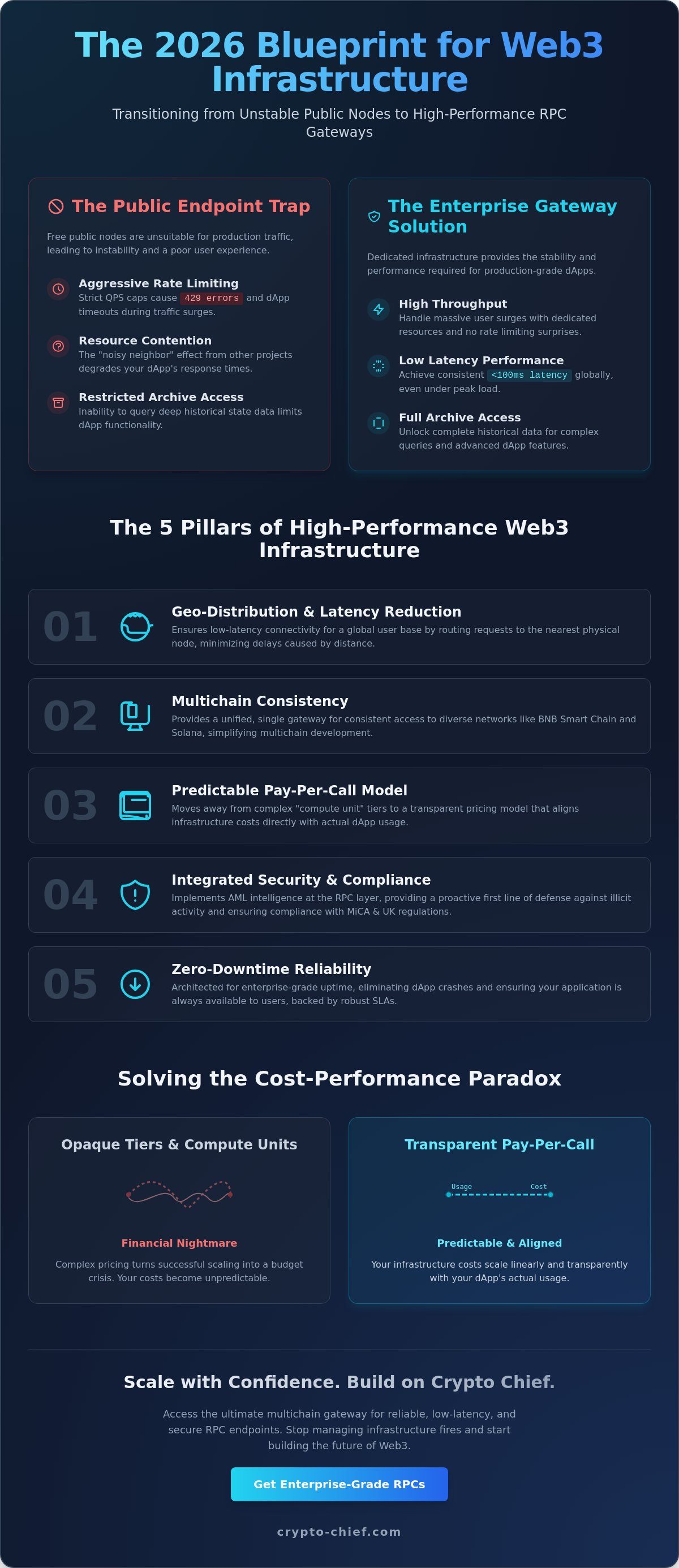
- Aggressive Rate Limiting: Providers enforce strict Queries Per Second (QPS) caps to prevent network abuse, which often trigger 429 errors and application timeouts during user surges.
- Restricted Archive Access: Most free tiers don't provide access to full archive data, limiting your dApp's ability to query deep historical states or complex event logs.
- Resource Contention: Shared infrastructure suffers from the "noisy neighbor" effect, where a traffic spike from an unrelated project can degrade your response times significantly.
It's a common misconception that a "live" node is a functional one. A node can report 100% uptime while failing to deliver the throughput required for a global user base. High latency on a live node is just as damaging as a total outage because it leads to failed transaction broadcasts and a degraded UI experience. For modern developers, reliable web3 rpc endpoints are defined by their ability to maintain consistent performance under stress. A truly reliable RPC endpoint maintains less than 100ms latency even under peak load.
The Shift to Enterprise-Grade RPC Gateways
Transitioning to a dedicated RPC Gateway resolves the unpredictability of shared environments. While shared managed endpoints offer a cost-effective middle ground for growing projects, private gateways provide the dedicated resources necessary for enterprise-grade scalability. These private routes ensure consistent HTTP headers and predictable response times, removing the friction that usually accompanies network congestion. By moving your infrastructure to a professional provider, you gain the structural stability needed to scale your dApp globally. Professional reliable web3 rpc endpoints act as a silent partner, handling the heavy lifting of node maintenance so you can focus on building your core product.
The 5 Pillars of High-Performance Web3 Infrastructure
Building a production-ready dApp requires more than a simple connection to a single server. It demands a sophisticated architecture capable of handling global demand and diverse network protocols. According to a recent Web3 infrastructure analysis, the maturity of the ecosystem now depends on the structural integrity of the underlying node networks. To achieve this, developers must look for reliable web3 rpc endpoints that rest on five specific pillars of performance. These pillars ensure that your application remains responsive, regardless of the user's location or the complexity of the underlying blockchain data.
Geo-Distribution and Latency Reduction
Physical distance remains a primary bottleneck for blockchain interaction. A node located in Virginia provides little utility for a user in Singapore, as the round-trip time for a request can significantly degrade the user experience. High-performance providers solve this by deploying nodes across global Points of Presence (PoPs). By 2026, managing state growth has become more demanding, making the use of high-speed NVMe storage essential for maintaining low-latency responses. If a specific node fails, a resilient provider implements automatic failover mechanisms to switch the session to a healthy node without interrupting the user's journey. This ensures your reliable web3 rpc endpoints stay active during regional outages or maintenance windows.
Unified Multichain Access
Managing separate endpoints for Ethereum and Polygon introduces unnecessary complexity into your environment variables and security keys. A single Web3 RPC gateway simplifies this by providing a unified entry point for all your multichain needs. This architecture utilizes a Unified API to normalize data streaming across different networks. It ensures that your development logic remains consistent whether you're querying a Layer 1 or a Layer 2, which significantly reduces the friction typically found in cross-chain development. You don't have to rebuild your data ingestion logic every time you expand to a new network.
Real-Time Event Streaming and Data Normalization
Beyond simple data retrieval, modern infrastructure must support active, real-time interaction. Moving from traditional polling to push-based webhooks through an EventStream model reduces the load on your application while providing a more responsive UX. This shift allows your dApp to react instantly to on-chain events without the overhead of constant API calls. When combined with data normalization, your application can process events from multiple chains through a single, standardized format. This removes the need to write custom parsers for every new network you integrate. If you're looking to streamline your stack, choosing a unified multichain gateway ensures your infrastructure remains a silent, powerful partner in your growth.
Solving the Cost-Performance Paradox: Pay-Per-Call vs. Tiers
Infrastructure reliability shouldn't come with a "success tax." In the current ecosystem, many developers find themselves caught in a cycle of over-provisioning or under-performance. Traditional tiered pricing models force you to choose between expensive plans that leave capacity unused or restrictive starter tiers that fail when your dApp gains traction. Finding reliable web3 rpc endpoints is only half the battle; the other half is ensuring that your infrastructure costs scale linearly with your actual demand. The paradox of modern Web3 development is that success often leads to unpredictable monthly bills that can stall a project's momentum.
The Inefficiency of Monthly Subscriptions
Standard Web3 API plans are often built on the assumption that traffic is predictable. This is rarely the case for decentralized applications. Monthly subscriptions create an "unused capacity" problem where you pay for millions of requests you never send. Conversely, if your project goes viral unexpectedly, aggressive overage fees can quickly balloon into an unmanageable expense. This structural misalignment is why many builders are moving away from the "Bronze, Silver, Gold" model.
Modern cloud leaders like AWS and GCP have long since adopted Pay-As-You-Go models because they align financial output with technical consumption. Web3 infrastructure is finally catching up to this standard. By adopting more granular billing, developers can avoid the "next tier" price jump that often feels like a penalty for growth. This approach allows a scaling dApp to preserve its runway while maintaining elite performance levels during peak traffic events.
Prepaid Tokens: A New Standard for RPC
The emergence of prepaid API tokens has introduced a level of transparency previously missing from the industry. Instead of navigating complex contract negotiations or being locked into annual commitments, developers can now purchase credits that function as a flexible balance. This model provides real-time tracking of every JSON-RPC call, allowing for granular budgeting that matches your actual server logs. Pay-per-call ensures you only pay for the value you extract from the blockchain.
This shift allows you to deploy reliable web3 rpc endpoints across multiple networks without the overhead of managing multiple recurring subscriptions. It removes the friction of tiered gatekeeping, providing a steady, predictable path for growth that respects your project's logic and financial health. With prepaid tokens, your infrastructure becomes a utility that you consume exactly as needed, ensuring that every dollar spent contributes directly to your application's uptime and user experience.
Security-First RPC: Integrating AML and Risk Detection
Viewing your node infrastructure as a passive data pipe is a structural oversight that modern dApps can't afford. In a regulatory landscape defined by the full implementation of the EU's MiCA and the UK's 2026 AML amendments, the RPC layer must act as your first line of defense. High-performance reliable web3 rpc endpoints are no longer just about uptime; they're about the intelligence they carry. In the first half of 2025, regulators issued 139 fines totaling $1.23 billion for AML and KYC violations, underscoring the massive financial risk of passive infrastructure. Integrating security directly into the gateway level ensures that illicit funds are identified before they ever interact with your smart contracts.
Automating Compliance at the Gateway
Manual tracing is an impossible task for a scaling application. Integrating AML Intelligence directly into your node request workflow allows for real-time risk detection of every incoming and outgoing transaction. This system assigns risk scores to addresses, enabling your dApp to block "tainted" wallets automatically. It prevents your frontend from becoming a vector for money laundering while reducing the administrative burden on your compliance team. This proactive approach turns your reliable web3 rpc endpoints into a sophisticated security shield that protects both your project's reputation and its legal standing.
Non-Custodial Integrity
Security doesn't mean sacrificing the core ethos of decentralization. You can maintain the "not your keys, not your coins" principle while utilizing enterprise-grade managed infrastructure. This is where non-custodial processing pairs perfectly with a secure RPC gateway. While the gateway handles the heavy lifting of data retrieval and risk scoring, the private keys remain entirely under your control. This combination provides a complete fintech stack that meets institutional standards for funds tracing without introducing custodial risks. It's a balanced architecture that values both structural integrity and user sovereignty.
Don't leave your project's compliance to chance. You can start securing your infrastructure with AML Intelligence today to ensure every transaction remains within safe parameters.
Scaling with Crypto Chief: The Ultimate Multichain Gateway
Building a resilient dApp requires a partner that understands the friction of infrastructure management. Crypto Chief provides the foundational tools needed to move from a proof-of-concept to a global production environment without the typical scaling hurdles. By offering unified access to the BNB Smart Chain, Solana, and over 10 other major networks, we remove the need for multiple service providers. Our platform is designed to be the definitive source for reliable web3 rpc endpoints, ensuring your application remains performant across the entire multichain landscape.
The core of our service is a transparent pay-per-call model. We've replaced confusing tiered subscriptions with a prepaid token system that puts you in total control of your budget. This granular approach ensures that you only pay for the specific blockchain interactions your dApp requires. For those needing real-time responsiveness, our EventStream functionality provides high-performance blockchain monitoring, allowing you to replace inefficient polling with instant, push-based webhooks. We back this infrastructure with global uptime guarantees and developer-first documentation tailored for the 2026 market.
Why Developers Choose Crypto Chief
Complexity is the enemy of speed. Our RPC Gateway allows you to manage your entire multichain stack with a single API key. This simplicity doesn't come at the cost of power; we provide enterprise-grade performance that remains accessible to individual builders. If you're in the early stages of development, you can utilize our faucet and developer sandbox to test your logic before moving to a production environment. Why manage ten different endpoints when you can consolidate your infrastructure into one reliable hub?
Implementation and Next Steps
Setting up your first endpoint takes less than 60 seconds. Our documentation is written by developers for developers, focusing on technical precision and functional clarity. Once your connection is live, you can easily integrate AML risk scoring into your existing architecture to meet the compliance standards discussed earlier. The path to high-uptime infrastructure is direct and logical. You can register your account and start building on Crypto Chief today to secure your dApp's future with reliable web3 rpc endpoints that scale as fast as you do.
Future-Proofing Your Web3 Infrastructure
The transition from experimental dApps to enterprise-grade production environments requires a fundamental shift in how we approach node connectivity. You've seen how relying on fragile public infrastructure creates structural bottlenecks that stall growth and compromise user trust. By prioritizing the pillars of geo-distribution and technical consistency, you ensure that your application remains responsive across every global region. True reliability is found in the synergy of performance, security, and cost-efficiency.
Integrating security directly into your reliable web3 rpc endpoints through automated AML risk scoring allows you to meet modern compliance standards without the burden of manual overhead. This structural integrity, combined with a transparent pay-per-call model, removes the friction of unpredictable billing and allows your project to scale with financial precision. You don't have to choose between elite performance and profitability when your infrastructure is built to support both. Using a unified multichain API simplifies your environment, letting you focus on building features rather than managing fires.
Start scaling with reliable, pay-per-call RPC endpoints at Crypto Chief to leverage a unified multichain API built on global high-uptime infrastructure. The tools to build a resilient, compliant, and cost-efficient stack are now at your fingertips; it's time to focus on the innovation that sets your project apart.
Frequently Asked Questions
What are reliable Web3 RPC endpoints?
Reliable Web3 RPC endpoints are high-performance communication bridges that maintain consistent uptime and low latency even during periods of extreme network congestion. Unlike public nodes, these endpoints provide the dedicated throughput necessary for production-grade applications to query blockchain state and broadcast transactions without failing. They serve as the essential infrastructure that ensures your dApp remains responsive for a global user base.
How much do private RPC endpoints cost in 2026?
The cost of private infrastructure depends heavily on the provider's specific billing architecture. Many traditional services still utilize tiered monthly subscriptions that can range from entry-level developer plans to expensive enterprise packages. However, the industry is shifting toward more granular models where you pay only for the requests you actually send, allowing for more efficient budget management as your project scales.
Can I use one RPC gateway for multiple blockchains like Ethereum and Solana?
Yes, modern unified gateways allow you to interact with a wide variety of networks through a single entry point. This architecture simplifies your development stack by consolidating your environment variables and security keys into one management interface. It's an efficient way to support diverse chains like Ethereum, Solana, and various Layer 2 networks without the overhead of managing separate infrastructure providers.
What is the difference between a public and a private RPC endpoint?
The primary difference is found in resource allocation and reliability. Public endpoints are shared, community-funded resources that often employ aggressive rate limiting and lack advanced features like archive data access. Private endpoints provide dedicated bandwidth and higher request limits, making them the only viable choice for reliable web3 rpc endpoints in a production environment where performance is critical.
How does pay-per-call pricing save money compared to monthly tiers?
Pay-per-call pricing eliminates the "unused capacity" problem where you pay for a large bucket of requests that your dApp never actually utilizes. By aligning your financial output directly with your technical consumption, you avoid the steep price jumps associated with moving between subscription tiers. This model ensures that your infrastructure costs remain predictable and proportional to your actual user growth.
Why is AML intelligence important for my RPC infrastructure?
AML intelligence provides a proactive security layer that identifies and blocks illicit on-chain activity at the gateway level. With the full implementation of regulations like MiCA in 2026, developers must ensure their applications aren't facilitating money laundering. Integrating risk scoring directly into your RPC workflow protects your project from legal liabilities and financial penalties before "tainted" funds can interact with your smart contracts.
How do I test the latency of an RPC provider?
You can test latency by measuring the round-trip time of standard JSON-RPC methods, such as eth_blockNumber, from various geographic regions. It's important to use benchmarking tools that simulate real-world traffic patterns to see how the provider handles load. For reliable web3 rpc endpoints, you should look for consistent response times under 100ms across all your primary user markets.
What happens if my RPC provider goes down?
If your provider suffers an outage, your dApp will be unable to fetch blockchain data or process user transactions, leading to a total service disruption. This is why choosing a provider with a 99.99% uptime SLA and automatic failover mechanisms is essential. Redundant infrastructure ensures that if one node fails, your traffic is instantly rerouted to a healthy one, maintaining a seamless experience for your users.