
The most expensive part of your infrastructure isn't the base subscription fee, but the "credit multiplier tax" hidden deep within your provider’s compute unit weights. In 2026, understanding rpc node api call pricing requires more than just looking at a monthly tier; it requires a deep dive into how specific methods are weighted against your budget. You probably already feel the friction of "compute units" that inflate your bills and leave you with unused capacity at the end of the month. It's an inefficient way to build, particularly when complex calls can cost sixty times more than a standard request.
We're here to help you reclaim your budget. This article will show you how to master the complex math of RPC costs and eliminate hidden multipliers through a transparent pay-per-call model. We’ll preview the latest industry benchmarks, compare the true cost of requests across top providers, and provide a roadmap for forecasting expenses with absolute precision. You'll learn how to secure low-latency global performance for your multichain apps without being penalized for the complexity of your code. By the end, you'll have a clear strategy to scale your infrastructure without the enterprise-tier price tags.
Key Takeaways
- Identify the transition from simple monthly tiers to complex "Compute Units" to understand the true drivers of your infrastructure costs.
- Uncover the "credit multiplier tax" that inflates bills by charging up to 50 times more for intensive methods like archive requests.
- Master the technical math of rpc node api call pricing to normalize costs across providers and eliminate wasted budget on unused capacity.
- Apply developer-centric optimization strategies, including JSON-RPC request batching and usage audits, to streamline your application's data consumption.
- Evaluate the benefits of a transparent pay-per-call model that removes hidden multipliers for more predictable, high-performance multichain scaling.
What is RPC Node API Call Pricing? Understanding the 2026 Landscape
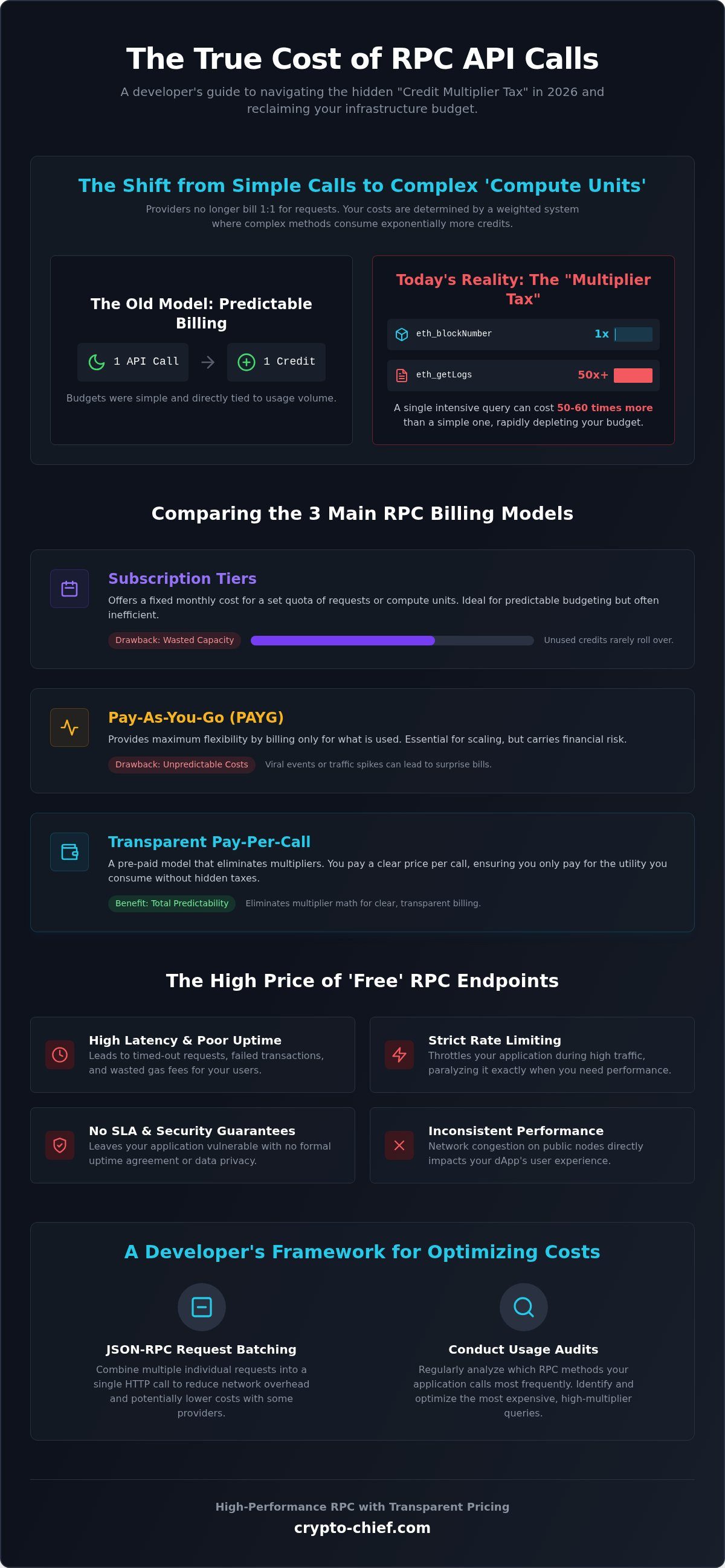
RPC pricing represents the technical cost structure assigned to JSON-RPC methods when an application queries or modifies a blockchain's state. In the early stages of Web3 development, providers typically offered simple, request-based tiers. You paid for a million calls, and you received a million calls. As networks evolved and data loads increased, providers realized that a simple eth_blockNumber query consumed far fewer server resources than an intensive eth_getLogs request. This disparity led to the industry-wide adoption of Compute Units (CU), which allow providers to bill based on the actual computational strain of a call. Consequently, rpc node api call pricing is no longer a simple 1:1 calculation. It's a sophisticated, weighted system where the specific methods your dApp utilizes dictate your total burn rate.
Understanding the nuances of rpc node api call pricing also requires a look at how rate limits intersect with your total volume. Rate limits, measured in Requests Per Second (RPS), define the throughput of your connection. A pricing plan might provide a generous monthly quota but throttle your RPS so tightly that your application fails during high-traffic events. Choosing the right plan means balancing the total volume of calls with the speed at which you can execute them without triggering provider-side bottlenecks.
The Three Main Billing Models in 2026
Developers typically encounter three distinct billing structures when selecting infrastructure partners:
- Subscription Tiers: These offer fixed monthly costs for predictable budgeting, yet they often result in wasted capital on unused capacity that doesn't roll over to the next month.
- Pay-As-You-Go (PAYG): This model provides maximum flexibility for scaling, though it introduces the risk of unpredictable expenses during viral events or unexpected traffic spikes.
- Pre-paid Balances: Employed by the Crypto Chief RPC Gateway, this model ensures you pay only for the utility you consume, providing a clean alternative to complex "multiplier taxes" and expiring credits.
Why 'Free' RPC Endpoints Often Cost You More
Public gateways appear cost-effective initially, yet they frequently introduce significant operational friction that translates into real financial loss. High latency and inconsistent uptime lead to timed-out requests and failed transactions; this creates a poor user experience and wastes gas fees on aborted operations. Without a formal Service Level Agreement (SLA), your application is left vulnerable during periods of high network congestion when reliable data is most critical. Security is also a primary concern, as public endpoints don't offer the same privacy, encryption, or data integrity as dedicated infrastructure. When your project begins to scale, these "free" services often impose strict rate limits that can effectively paralyze your application exactly when you need it to perform for a growing user base.
Decoding the 'Credit Multiplier': How RPC Providers Calculate Costs
The weight table is the most critical document in your infrastructure stack, yet it is often the least scrutinized. Most developers assume that a million requests in a "Pro" tier translates to a million method calls. In reality, rpc node api call pricing is governed by a hidden layer of arithmetic that converts every JSON-RPC request into a proprietary currency. Whether a provider labels these as Compute Units (CU), API Credits, or Request Units, the objective remains the same: to align billing with the intensity of the hardware resources consumed by the node.
The disparity between methods is staggering. A simple eth_blockNumber query is computationally "cheap" because it retrieves a single value from the node's head. Conversely, methods like eth_getLogs or Solana’s getProgramAccounts require the node to scan massive datasets, filter results, and serialize large payloads. This is why a single log query can cost 20 to 50 times more than a basic balance check. Providers use these multipliers to protect their margins, but for the developer, it creates a "Multiplier Tax" where your burn rate accelerates without a corresponding increase in raw request volume.
Method Weighting Examples Across Chains
Cost structures vary significantly across different blockchain architectures. In the Ethereum and EVM ecosystem, a standard eth_call typically consumes 26 CU, while eth_getLogs jumps to 60 CU or higher depending on the provider. For those building on Solana, the introduction of gRPC and LaserStream data has added a new dimension to metering. Some providers charge as little as 10 credits for gRPC calls on premium plans, while others might scale that cost based on the megabytes of data streamed. Accessing archive data adds another layer of complexity; querying historical state often triggers a massive multiplier that can turn a predictable budget into an enterprise-scale expense overnight. For developers seeking a cleaner alternative, the RPC Gateway at Crypto Chief eliminates these multipliers entirely by focusing on a transparent utility model.
The Problem with Tiered Credit Bundles
Subscription models often force a "use it or lose it" scenario that penalizes efficient developers. If your dApp consumes only 60% of your monthly credit allocation, the remaining 40% typically vanishes at the end of the billing cycle, representing wasted capital. This becomes particularly problematic when you factor in overage fees. If a sudden marketing spike or airdrop pushes you 5% over your tier, providers often charge punitive rates for those extra units, sometimes double the base cost. Credit Multipliers are the primary source of Web3 billing unpredictability, transforming a fixed request budget into a variable expense based on the depth of your queries. Before committing to a long-term contract, you must audit your specific method usage against the provider's weight table to find your true rpc node api call pricing.
Subscription Tiers vs. Pay-Per-Call: Finding the ROI Break-even Point
Choosing between subscription tiers and pay-per-call models is a strategic decision that directly impacts your project's runway. For an early-stage dApp, a $499 monthly "Business" plan might seem like a safe bet for future growth, yet it often results in significant capital waste. If your application only consumes 15% of the allocated credits, you're essentially subsidizing the provider's infrastructure without receiving the corresponding utility. A pay-per-call model removes this friction by allowing you to scale during marketing spikes or airdrops without committing to a permanent, high-cost price hike.
The "Infrastructure Pivot" occurs when your monthly API spend consistently matches the cost of maintaining a dedicated node. While dedicated nodes offer unlimited throughput for a fixed price, they lack the global redundancy and automatic failover inherent in a managed Web3 RPC Gateway. For most teams, the operational overhead of managing a self-hosted node, including 24/7 monitoring and security patches, far outweighs the perceived savings. A shared but high-performance gateway provides the best of both worlds: enterprise-grade reliability without the maintenance burden.
Scenario Analysis: The 10 RPS Workload
Sustaining a consistent 10 Requests Per Second (RPS) creates a monthly volume of approximately 25.9 million calls. On a tiered provider, this volume might land your project in a "no-man's land" between standard and enterprise plans, often leading to punitive overage charges that inflate your bill unexpectedly. When you evaluate rpc node api call pricing through this lens, the math favors transparency. Crypto Chief’s model uses pre-paid tokens that don't expire at the end of the month. This approach eliminates the "use it or lose it" risk, ensuring that your balance remains available until every single call is actually executed by your application.
Scalability and Global Uptime Considerations
Building for a global audience requires regional redundancy to maintain low latency across different continents. Enterprise-grade providers often hide these geographical costs behind custom-quoted tiers. However, multichain applications benefit most from a unified billing umbrella. Instead of managing separate subscriptions for Ethereum, Polygon, and Tron, a single balance allows you to pivot resources where they're needed most based on current user demand. You can check Crypto Chief's Ethereum RPC performance benchmarks to see how this unified approach maintains elite speed without the typical enterprise markup. This flexibility is vital when navigating the volatile nature of rpc node api call pricing across different network conditions and chain architectures.
A Developer's Framework for Optimizing RPC API Call Expenses
Efficiency in infrastructure management starts with visibility. You cannot optimize what you don't measure; therefore, the first step in any cost-reduction strategy is a comprehensive audit of your method usage. By examining provider-side analytics, you can identify the specific calls triggering the "multiplier tax" discussed in previous sections. If your dApp relies heavily on expensive state-scanning methods, prioritizing these for refactoring will yield the most significant impact on your rpc node api call pricing. Once you understand your baseline, you can implement a hierarchical optimization framework to streamline data consumption.
Transitioning from aggressive polling to WebSocket (WSS) subscriptions is a primary technical win. Instead of querying the node every few seconds for new blocks or log events, WSS allows the node to push data to your application only when a relevant event occurs. This shift eliminates thousands of redundant requests and significantly reduces your monthly burn rate. For applications with non-linear growth patterns, moving away from rigid subscription tiers toward a pay-per-call model ensures you aren't paying for idle capacity during low-traffic periods.
Technical Optimizations to Reduce Call Volume
Advanced developers utilize Multicall contracts to aggregate multiple state reads into a single eth_call. This technique is particularly effective for dashboards that need to fetch balances, token names, and prices simultaneously; it reduces network overhead and minimizes the number of metered units consumed. Caching static blockchain data, such as token decimals or contract metadata, in a local Redis instance or in-memory cache further prevents unnecessary round-trips to the RPC provider. Implementing RPC request batching can reduce infrastructure costs by up to 40%.
Budgeting for Multichain Complexity
Estimating expenses for applications running across Polygon, BNB Chain, and Tron requires a nuanced understanding of each chain's specific resource requirements. Each network has its own internal logic for method weighting, which can make cross-chain budgeting a logistical hurdle. The advantage of a Unified Blockchain API lies in its ability to normalize these data costs under a single billing structure. Tokenized billing serves as the most flexible option for cross-chain developers, as it allows you to maintain a single balance that scales dynamically across every supported network. To start building with a transparent, high-performance gateway, you can register for the Crypto Chief RPC Gateway today and eliminate hidden infrastructure taxes.
Crypto Chief: The High-Performance Alternative to Opaque RPC Pricing
Transparency is the bedrock of reliable infrastructure. While much of the industry has gravitated toward complex "compute unit" weighting, Crypto Chief operates on a straightforward "Pay-Per-Call" philosophy. We've eliminated the hidden multipliers that make traditional rpc node api call pricing so difficult to forecast. You won't find a 50x tax on log queries here; instead, you get a clean utility model where one call simply equals one call. This approach empowers developers to build with confidence, knowing their burn rate is tied directly to their application's activity rather than a provider's opaque resource math.
By utilizing a unified balance system, we've simplified how developers manage their multichain resources. Unlike providers that require separate subscriptions for every service, we provide a single pre-paid token balance that fuels your entire stack. You can use your API tokens for high-performance RPC requests, switch to AML Intelligence for compliance checks, or integrate Crypto Processing for non-custodial payments. This versatility is essential for modern builders who need to pivot resources quickly across 10+ major blockchains without managing multiple vendor contracts or expiring credit pools.
Beyond RPC: A Unified Web3 Infrastructure
Our Web3 RPC Gateway is designed as a silent, powerful partner for your back-end. Beyond standard data retrieval, you can integrate risk-assessment tools directly into your workflow to screen addresses without adding another monthly subscription. You can also implement real-time event streaming to receive instant transaction alerts via webhooks, which removes the need for the expensive polling architecture discussed in our optimization framework. Because our gateway is non-custodial, you maintain full control over your security parameters while benefiting from our global node network’s structural integrity and low-latency performance.
Transparent Scaling for 2026
Scaling a dApp in 2026 shouldn't feel like a gamble with your project's runway. Whether you are handling high-volume workloads on Solana or Ethereum, our pre-paid model provides absolute cost control. You top up your balance when necessary and scale your throughput as your user base grows. There are no overage fees or "use it or lose it" traps to navigate. Everything you need to integrate our high-performance endpoints is available in the Crypto Chief Docs.
It's time to move past the complexity of legacy rpc node api call pricing and join the elite group of builders who value uptime, scalability, and logic. If you're ready to deploy your next-generation application, register for your API key today and experience the difference of a truly transparent infrastructure partner.
Taking Control of Your Infrastructure Runway
Mastering the nuances of rpc node api call pricing is no longer just a technical requirement; it's a financial necessity for any scaling dApp. We've explored how credit multipliers can quietly erode your budget and why technical optimizations like request batching are essential for maintaining efficiency. The transition from rigid monthly tiers to a transparent utility model represents a significant shift toward a more sustainable Web3 ecosystem. By choosing infrastructure that aligns with your actual usage, you remove the friction of wasted capital and unpredictable overage fees. Efficiency is the new standard.
Crypto Chief provides the stability and performance needed to navigate this landscape with confidence. Our global low-latency gateway and unified API allow you to manage RPC, AML, and processing through a single, pre-paid token balance. This model ensures 100% cost transparency while supporting your growth across multiple blockchains without the typical enterprise-tier hurdles. It's time to build on a foundation that values your project's longevity as much as you do. Start Building for Free with Crypto Chief's Pay-Per-Call API and secure your application's future today.
Frequently Asked Questions
How much does a typical RPC API call cost in 2026?
Industry benchmarks show that a million standard requests typically range from $0.25 to $2.50 depending on the provider. However, the true rpc node api call pricing often depends on the specific method weighting used by your infrastructure partner. While a simple block height check is inexpensive, archive queries or complex logs can significantly increase the effective price per call through compute unit multipliers that vary widely across the 2026 landscape.
What is the difference between an RPC call and a Compute Unit (CU)?
An RPC call is the raw JSON-RPC request sent by your application to interact with the blockchain. A Compute Unit is a metric used by many providers to measure the server resources consumed by that specific request. A single call to eth_getLogs might consume 60 CUs, while eth_blockNumber might only cost 1 CU. This weighting means your total bill is determined by query complexity rather than simple volume.
Is pay-per-call cheaper than a monthly RPC subscription?
Pay-per-call is generally more cost-effective for developers with non-linear growth or fluctuating traffic patterns. Monthly subscriptions often include a fixed number of credits that expire at the end of the billing cycle, which leads to wasted capital. By using a pay-per-call model, you eliminate the cost of unused capacity and ensure that every dollar spent translates directly into successful method execution without the risk of expiring monthly tiers.
How do I calculate the RPS (Requests Per Second) I need for my dApp?
To estimate your required throughput, identify your expected peak concurrent users and multiply that by the number of RPC requests each user action triggers. If 100 users perform an action simultaneously that requires 5 calls, you need a minimum of 500 RPS capacity. Monitoring your provider-side analytics during your initial testing phase provides the most accurate data for these calculations and helps prevent unexpected throttling during high-traffic events.
Can I use one API key for multiple blockchains (Ethereum, Solana, Tron)?
Yes, our Unified API allows you to manage multiple networks under a single billing umbrella. This streamlined approach removes the friction of managing separate subscriptions for Ethereum, Solana, and Tron. You can use your pre-paid token balance across any supported chain, providing the flexibility to pivot resources as your application's multichain requirements evolve. This architectural choice is designed to simplify the workflow for professional developers building complex, cross-chain applications.
What happens if I run out of pre-paid API tokens mid-month?
If your balance reaches zero, the RPC gateway will stop processing requests until you top up your account. This mechanism prevents the punitive overage fees common in subscription-based models where exceeding a limit can result in unexpected charges. Because tokens don't expire at the end of the month, you can maintain a buffer balance to ensure continuous uptime without worrying about losing the value of unused credits over time.
Do complex RPC methods like eth_getLogs cost more on Crypto Chief?
No, Crypto Chief utilizes a transparent pay-per-call philosophy that avoids hidden multipliers. While many providers charge 20 to 50 times more for intensive methods like eth_getLogs, our model focuses on consistent utility. This ensures your rpc node api call pricing remains predictable and fair regardless of whether you are performing a simple balance check or a complex historical log query that would typically trigger a multiplier tax elsewhere.
Is there a limit to how many RPC calls I can make per second?
Yes, every plan has a defined Requests Per Second (RPS) limit to ensure network stability and consistent global performance for all users. These limits vary based on your specific infrastructure needs and are designed to prevent a single application from monopolizing node resources. High-performance gateways are optimized to handle significant bursts, but you should always select a tier or balance that matches your peak traffic and latency requirements.