
Your infrastructure costs shouldn't grow faster than your user base. For many Web3 architects, the reality of scaling a dApp involves a frustrating choice between the high maintenance of self-managed nodes or the unpredictable, tiered pricing of legacy providers. You've likely felt the friction of manual data normalization between EVM and non-EVM chains, or watched latency spikes alienate your global users during peak traffic. It's a common bottleneck that suggests the current model of data access is fundamentally broken. Building a scalable blockchain data api strategy shouldn't require a blank check or a dedicated DevOps team just to keep the lights on.
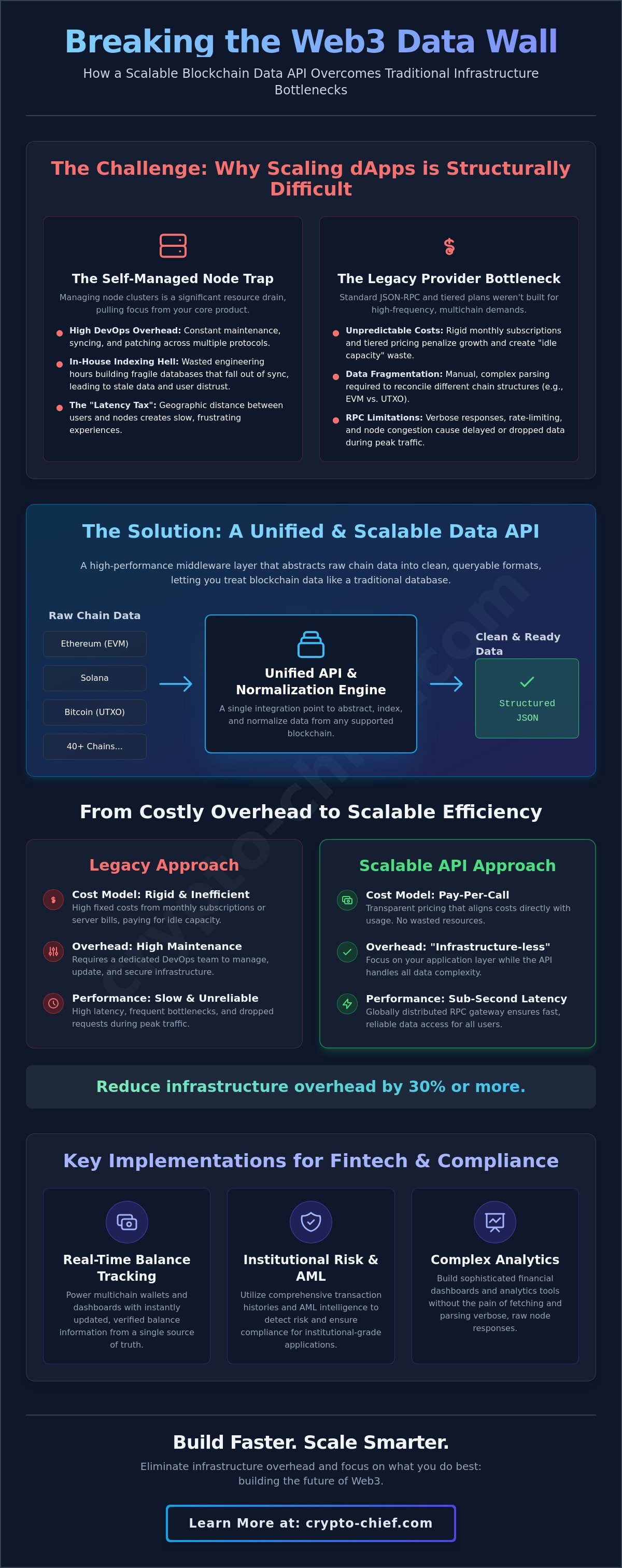
You deserve a data layer that moves as fast as your code. This guide will show you how to reduce your infrastructure overhead by 30% or more while achieving sub-second latency across multiple networks through a single, unified integration. We'll examine the technical architecture required to simplify multichain data flows, eliminate the need for managed node tiers, and replace manual normalization with a streamlined, high-performance engine designed for enterprise stability.
Key Takeaways
- Identify the structural limitations of standard JSON-RPC and learn how to bypass the resource drain of managing internal multichain node clusters.
- Discover how a scalable blockchain data api abstracts raw chain data into queryable formats, enabling you to normalize transactions across 40+ chains with a single Unified API.
- Eliminate the "idle capacity" problem by transitioning from rigid monthly subscriptions to a transparent, pay-per-call model that aligns costs with actual usage.
- Explore practical implementation strategies for fintech applications, ranging from real-time balance tracking to institutional risk detection using AML Intelligence.
- Streamline your global infrastructure by leveraging a high-performance RPC Gateway that provides sub-second latency without the overhead of managed tiers.
The 'Data Wall': Why Scaling Web3 Applications is Structurally Difficult
Developers often hit a metaphorical wall when transitioning from a prototype to a production-grade application. While blockchain technology offers a transparent and immutable ledger, extracting that data at scale is a manual, expensive process. Most projects start by querying nodes directly, only to realize that standard JSON-RPC interfaces weren't built for the high-frequency demands of modern fintech. These interfaces are excellent for simple interactions but fail when asked to power complex dashboards or real-time analytics for thousands of global users.
Managing a multichain node cluster is a significant resource drain that pulls focus away from your core product. You aren't just paying for the cloud instances; you're paying for the specialized DevOps hours required to keep those nodes synced across different protocols. When you factor in the "Latency Tax," where geographic distance between your user and your node cluster adds hundreds of milliseconds to every interaction, the user experience begins to crumble. Then there's the fragmentation. Reconciling the account-based model of Ethereum with the UTXO model of Bitcoin or the unique account structures of Solana creates a data nightmare. Without a scalable blockchain data api, your team spends more time writing parsers than building features.
RPC Limitations and the Bottleneck of Raw Node Access
Raw node responses are notoriously verbose. A single request often returns a mountain of data that your frontend doesn't actually need, wasting bandwidth and slowing down rendering. Rate-limiting by standard providers further complicates this, often throttling your app exactly when it gains traction. Node congestion is a primary hurdle for fintech reliability because the saturation of a node's processing capacity leads to delayed or dropped responses during market volatility. This lack of predictability makes it nearly impossible to maintain the sub-second responsiveness that users expect from financial applications.
The Hidden Costs of In-House Data Indexing
Building a custom indexer is a common trap for growing teams. Startups lose hundreds of engineering hours building and patching internal databases that inevitably fall out of sync with the chain. If your data is even a few blocks behind, your users see stale balances and failed transactions, leading to a total loss of trust. By 2026, the industry standard has shifted toward "infrastructure-less" development. Using a scalable blockchain data api allows your team to focus on the application layer while the complex task of data normalization happens in the background. This approach ensures your data is always fresh, accurate, and ready for institutional-grade audits without the overhead of a dedicated infrastructure team.
What is a Scalable Blockchain Data API and How Does it Work?
A scalable blockchain data api acts as a high-performance middleware layer that sits between raw network nodes and your application's frontend. It functions as an abstraction engine, taking the chaotic, unstructured data from various ledgers and converting it into clean, queryable formats. Instead of your servers struggling to parse hex strings or complex receipt logs, the API delivers structured JSON that's ready for immediate use. This architectural shift allows developers to treat blockchain data like a traditional database, significantly reducing the complexity of building data-heavy applications.
Reliability in this layer depends on two factors: speed and integrity. Whether you are retrieving a transaction from four years ago or a block that was just confirmed, a scalable blockchain data api must maintain consistent sub-second latency. It's not enough to be fast; the data must be verified. High-tier providers ensure that every response matches the on-chain reality, providing a "single source of truth" that fintech apps can rely on for audits and user balances. If you're looking to simplify your stack, exploring a Unified API can help consolidate these disparate data streams into a single, reliable integration.
The Normalization Engine: Bridging the Multichain Gap
The primary challenge in a multichain environment is that no two blockchains share the same data structure. Ethereum uses an account-based model, while Bitcoin relies on UTXO, and Solana introduces a unique account-and-instruction architecture. A Unified API solves this by mapping diverse block headers and transaction types to a single, consistent JSON schema. This normalization extends to decimal handling, which is a frequent source of errors in cross-chain DeFi apps. By providing a standardized format for asset values across 40+ chains, the engine allows developers to use one endpoint rather than managing a dozen different SDKs. This technical foundation is similar to the concepts explored in the BigchainDB whitepaper, which details the necessity of high-throughput data structures for decentralized systems.
EventStream and Webhooks: Moving Beyond Polling
Traditional data retrieval often relies on "polling," where an application constantly asks a node if new data is available. This is incredibly inefficient, as it wastes bandwidth and creates unnecessary server load. Modern dApps utilize a "push" architecture instead. By using EventStream and real-time webhooks, your application receives an immediate notification the moment a specific event occurs on-chain. This transition from pull to push architecture drastically improves app responsiveness and ensures users see their transaction confirmations instantly. It's a more elegant way to handle state changes without the overhead of constant, redundant queries.
Tiered Subscriptions vs. Pay-Per-Call: Optimizing Your API Budget
Traditional infrastructure providers often prioritize their own revenue predictability over your project's bottom line. They achieve this through rigid monthly tiers that force you to pay for "idle capacity," which is the gap between the requests you actually use and the limit of your subscription. If your dApp experiences a quiet weekend with minimal traffic, you're still billed for a high-performance ceiling you didn't touch. A scalable blockchain data api should work like a utility, where costs fluctuate in direct proportion to your actual throughput.
Transparency is the only way to escape the "overage" anxiety that plagues Web3 startups. In a pay-per-call model, every interaction with the chain is an auditable event. This granularity allows architects to identify exactly which features are driving infrastructure costs, making it possible to optimize code for financial efficiency. When the market turns volatile and traffic spikes 10x in an hour, your infrastructure should scale automatically. You shouldn't have to wait for a sales representative to approve a plan upgrade while your users face 403 errors during a critical trading window.
Why Tiered Pricing Often Penalizes Growth
Many developers eventually hit the "Cliff Effect." This occurs when you exceed your current tier by a single request and find yourself forced into an enterprise plan that costs significantly more without offering a proportional increase in value. It's a structural penalty on growth that makes experimental or seasonal projects difficult to budget. Pre-paid models offer a more logical alternative. By maintaining a balance that you can top up as needed, you set a hard cap on spending while retaining the ability to scale instantly during peak network activity. This approach turns infrastructure from a fixed overhead into a flexible, manageable asset.
Measuring ROI on API Performance
Cost per request is a deceptive metric if it doesn't account for the cost of downtime or latency. If a provider offers a low price but fails to deliver sub-second response times, your users will likely migrate to a more responsive competitor. The true ROI of a scalable blockchain data api is found in the balance of stability, speed, and cost-efficiency. Our Web3 API Cost Optimization guide explores how to achieve this balance without sacrificing performance. By leveraging an RPC Gateway that eliminates hidden fees for multichain access, you ensure that your budget is spent on active user engagement rather than maintaining an over-provisioned server cluster that sits empty half the time.
Implementation: Integrating Scalable Data into Fintech and Compliance
The gap between data retrieval and financial execution is where many Web3 applications fail to scale. For a fintech architect, a scalable blockchain data api isn't just a convenience; it's the operational backbone that powers everything from multichain wallet balances to complex tax reporting. By combining high-performance data access with a Crypto Processing API, builders can create seamless flows where transaction monitoring and settlement happen within the same unified environment. This synergy eliminates the friction of jumping between disparate service providers for every step of the user journey, allowing for a more cohesive architecture.
Real-time balance tracking across dozens of networks allows your users to see their total net worth without the lag typically associated with multichain indexing. For institutional users, the focus shifts toward automated accounting and historical reconciliation. By pulling deep historical data through a single endpoint, platforms can generate tax-ready reports that reconcile thousands of transactions in seconds. This level of automation is only possible when you decouple your application logic from the underlying node infrastructure, allowing the API to handle the heavy lifting of data aggregation and normalization across fragmented ledgers.
The relationship between data and non-custodial payment processing is particularly vital for modern fintech. When you integrate a Unified API, you aren't just reading data; you're building the foundation for secure, high-velocity commerce. This setup allows you to verify incoming liquidity, check for contract vulnerabilities, and execute payouts without ever needing to manage the underlying keys or node clusters yourself. It's a "silent partner" approach that prioritizes uptime and structural integrity above all else.
AML Intelligence and Risk Scoring at Scale
Compliance is no longer an optional feature for institutional-grade dApps. Integrating AML Intelligence directly into your onboarding flow allows you to trace funds across mixers and high-risk entities before they ever touch your platform. You can automate these checks to run in the background, ensuring that risk scoring happens without adding unnecessary friction to the user experience. Implementing a robust framework for AML Intelligence is a fundamental necessity for meeting 2026 regulatory standards and maintaining institutional trust in an increasingly scrutinized market.
High-Volume Transaction Monitoring
Efficiency in payment processing requires moving away from manual lookups and resource-heavy polling. By setting up Real-Time Blockchain Webhooks via EventStream, you can receive instant confirmations the moment a payment hits the mempool or achieves finality. This allows you to filter smart contract events for specific DeFi protocol interactions, ensuring your system only reacts to the data that matters. This targeted approach reduces server load and ensures that your application remains responsive even during periods of extreme network congestion. If you're ready to secure your dApp's future, you can start building with our Unified API today.
Scaling with Crypto Chief: The Silent Partner for Global Web3 Builders
Choosing the right scalable blockchain data api is the final step in moving from a fragile prototype to a globally resilient application. Crypto Chief acts as a silent partner, providing a single point of entry to a global network of high-performance RPC nodes through our RPC Gateway. This infrastructure is engineered for 99.99% reliability, ensuring that your dApp remains operational even during intense network congestion or regional outages. By abstracting the complexity of node maintenance, we allow your team to focus exclusively on the logic and user experience of your financial product.
Transparency isn't just a buzzword; it's a financial requirement for growing businesses. The pay-per-call model eliminates the friction of monthly tiers and hidden costs, allowing you to audit your usage down to the individual request. You only pay for the data you consume, which aligns your infrastructure costs perfectly with your user growth. This unified approach extends beyond simple data retrieval, integrating our Crypto Processing API, EventStream, and AML Intelligence into a single, intuitive dashboard that simplifies your entire Web3 stack.
The Builder-Centric Ethos
Crypto Chief is run by developers who understand the scaling pains of the current Web3 ecosystem. We've seen projects stall because of rigid pricing or fragmented data schemas, which is why we've built a single, high-performance service that handles the heavy lifting for you. You can get started in minutes by establishing a pre-paid token balance, giving you full control over your budget without the need for long-term contracts. This flexibility is essential for both experimental startups and established enterprises that need to pivot quickly in a volatile market.
Future-Proofing Your Infrastructure
The multichain explosion is only just beginning. Our roadmap for 2026 includes adding support for emerging chains and deploying advanced risk detection features within our AML Intelligence suite. The unified model is the only sustainable way to manage the increasing complexity of a cross-chain world. By integrating this scalable blockchain data api today, you're future-proofing your infrastructure against the technical debt of tomorrow. You won't need to rebuild your data layer every time a new L1 or L2 gains traction. Start building with Crypto Chief's Scalable API today.
Architecting for a Multichain Future
Building a production-ready dApp requires more than just smart contract logic; it demands a data strategy that remains stable under pressure. You've seen how the "Data Wall" can stall growth and how legacy tiered pricing often penalizes success. By shifting toward a scalable blockchain data api, you remove the operational burden of node synchronization while gaining the precision of normalized, multichain data. This transition allows your engineering team to focus on the application layer while infrastructure costs align perfectly with actual user activity.
Efficiency in 2026 is defined by transparency and performance. Whether you are automating fintech accounting or securing institutional onboarding with AML Intelligence, your foundation must be both robust and cost-effective. Crypto Chief provides the global high-performance RPC gateway and non-custodial infrastructure you need to thrive without the overhead of managed tiers. It's time to stop managing clusters and start building features. Scale your dApp with Crypto Chief's Unified API. The future of Web3 belongs to the architects who prioritize structural integrity and logical scalability. We're ready to help you lead that charge.
Frequently Asked Questions
What makes an API 'scalable' compared to a standard RPC endpoint?
A scalable blockchain data api differs from a standard RPC endpoint by providing a high-performance abstraction layer that handles load balancing and data normalization automatically. While standard endpoints often struggle with rate limits and verbose raw data, a scalable solution optimizes queries to ensure consistent uptime even during massive traffic spikes. It removes the need for developers to manage their own infrastructure, offering a more reliable foundation for production-grade applications.
How does the pay-per-call model work for high-volume enterprise users?
The pay-per-call model operates as a pure utility where you're billed only for the specific requests your application makes. This approach eliminates the "idle capacity" problem found in monthly tiers, ensuring that enterprise users don't pay for unused capacity during low-traffic periods. Every call is tracked with total transparency, allowing architects to audit infrastructure spending down to the individual token and align costs directly with business growth.
Can I use one API key to access multiple blockchains like Ethereum, Solana, and Bitcoin?
Yes, the Unified API allows you to access Ethereum, Solana, Bitcoin, and over 40 other chains using a single integration and API key. This architecture replaces the need to maintain multiple chain-specific SDKs or disparate node connections. By standardizing diverse block headers into a single JSON schema, it simplifies the development of cross-chain applications and reduces the technical debt associated with multichain expansion.
Is there a difference in latency between a unified API and a direct node connection?
Our global RPC Gateway is designed to provide sub-second latency that often rivals or exceeds direct node connections by routing requests through a geographically distributed network. While a single node might be limited by its physical location, a scalable blockchain data api leverages intelligent caching and optimized routing to minimize the "Latency Tax." This ensures that users in any region experience the same high-performance responsiveness regardless of network conditions.
How does the AML Intelligence API integrate with the data retrieval services?
AML Intelligence works alongside our data retrieval services by providing real-time risk scoring for every address or transaction you query. This integration allows you to automate compliance checks directly within your application's workflow. You can identify high-risk entities or funds from mixers without adding friction to the user journey, ensuring your dApp remains compliant with 2026 regulatory standards while maintaining a seamless onboarding experience.
What happens if I run out of my pre-paid API token balance?
If your pre-paid token balance reaches a critical level, the system provides automated notifications to ensure you have ample time to top up your account. Maintaining a sufficient balance is essential for uninterrupted service, as requests are processed against your existing credits. This model allows for total budget control, as you decide exactly when and how much to deposit based on your projected application throughput.
Is the data provided by the API real-time or delayed?
The data provided is real-time, reflecting the current state of the blockchain as new blocks are confirmed. For applications that require instant updates, our EventStream service pushes data the moment it hits the mempool or achieves finality. This ensures that your frontend always displays the most accurate information, which is a critical requirement for fintech applications where even a few seconds of delay can impact user trust.
Does the API support smart contract event tracking via webhooks?
Yes, our EventStream service fully supports smart contract event tracking via real-time webhooks. Instead of repeatedly polling a node to check for state changes, you can configure webhooks to notify your server the moment a specific event, such as a token swap or a large transfer, occurs on-chain. This "push" architecture significantly reduces server load and improves the overall responsiveness of your DeFi or payment processing application.