
If your infrastructure costs grow faster than your transaction volume, you aren't scaling; you're just subsidizing technical debt. Many architects find that while scaling crypto payment processing for a few hundred users is manageable, the leap to millions of transactions often triggers a cascade of high latency, unpredictable API fees, and the nightmare of managing ten or more different blockchain integrations. It's a frustrating bottleneck that forces talented teams to spend more time on maintenance than on innovation.
We understand that you need a foundation that is as stable as it is performant. This guide provides the technical and economic strategies required to transition from fragile setups to high-volume Web3 infrastructure without your budget or your backend exploding. You'll learn how to implement a predictable pay-per-call cost model, leverage a single API for multichain processing, and integrate automated AML risk detection directly into your scaling workflow. We'll explore how to decouple cost from volume, ensuring your platform remains an elite, global engine capable of serving the 741 million crypto owners active in the current market.
Key Takeaways
- Identify the specific failure points of manual transaction monitoring and learn to navigate the hidden costs associated with maintaining nodes for multiple chains.
- Understand the role of Unified APIs in data normalization, enabling your team to write processing logic once for deployment across any blockchain.
- Explore why non-custodial architectures remain the gold standard for secure Web3 scaling and how to manage private keys without introducing system vulnerabilities.
- Learn to master scaling crypto payment processing by replacing manual compliance bottlenecks with automated AML risk scoring and real-time webhook triggers.
- Consolidate your technical stack by integrating RPC gateways, processing engines, and compliance intelligence into a single, high-performance workflow.
The Infrastructure Wall: Challenges in Scaling Crypto Payments
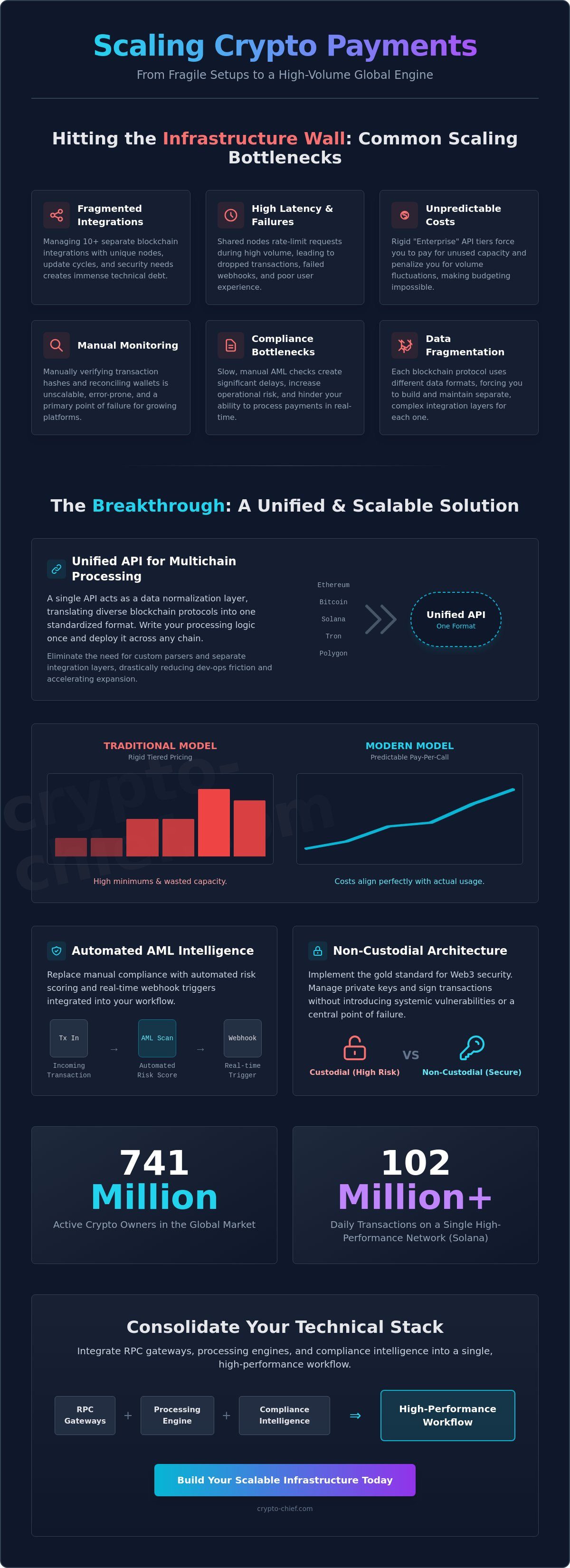
Every successful Web3 project eventually hits the "Infrastructure Wall." This is the critical juncture where the technical architecture that supported your MVP begins to fracture under the weight of enterprise volume. When scaling crypto payment processing, the shift from handling hundreds of transactions to millions isn't linear; it's an exponential increase in complexity. Manual transaction monitoring, which might have been feasible for a small user base, becomes a primary point of failure that leads to missed payments and frustrated customers. If your team is still manually verifying hashes or reconciling wallets, you're not building; you're just treading water.
The technical burden of maintaining dedicated nodes for multiple blockchains is one of the most significant hidden costs in the industry. Operating a high-performance Ethereum RPC alongside nodes for Tron, Bitcoin, and Polygon requires constant attention. Each chain has unique update cycles, security requirements, and resource demands. Beyond the maintenance, latency issues during network congestion can devastate user retention. In a market where networks like Solana process over 102 million transactions daily, users expect immediate confirmation. If slow block times or poorly managed gas price spikes delay a payment, the user doesn't blame the blockchain; they blame your platform.
Bottlenecks in Traditional Node Infrastructure
Shared nodes often fail exactly when you need them most. During high-volume market events, these providers frequently rate-limit requests or experience significant lag, leading to dropped transactions and failed webhooks. This forces your team into a demanding dev-ops cycle to maintain 24/7 uptime. Data fragmentation further complicates the issue. Because different protocols use different data formats, your backend must normalize information from a dozen different sources. Without a Unified RPC Gateway, you're forced to build and maintain separate integration layers for every new chain you add to your stack.
Economic Friction of Tiered API Pricing
Traditional "Enterprise" tiers often introduce unnecessary economic friction through high monthly minimums. These plans force you to pay for capacity you don't always use, which is particularly problematic when transaction volume fluctuates. You're essentially penalized during low-volume months while still facing potential throttling during a surge. This rigid model makes it difficult to predict API costs accurately. Moving toward a granular, pay-per-call model is the only way to ensure your infrastructure costs align with your actual revenue. It removes the financial risk of over-provisioning and allows you to scale your operations based on real-time demand rather than arbitrary monthly quotas.
Leveraging Unified APIs and Pay-Per-Call Models
Efficiency is the silent engine of growth. When scaling crypto payment processing, architects often discover that the greatest friction isn't the network itself, but the fragmented data protocols across different chains. A Unified Web3 API acts as a critical normalization layer, translating the idiosyncratic languages of various blockchains into a single, standardized format. This allows your development team to write code once and process payments on any supported chain, whether it's an EVM-compatible network like Polygon or a non-EVM protocol like Solana, which currently handles over 102 million daily transactions according to recent network data.
To see how this architecture looks in practice, you can explore the technical documentation for a Unified API designed for enterprise volume. By standardizing the data flow, you eliminate the need for custom parsers for every new asset you add to your platform. This approach doesn't just save time; it creates a predictable, stable foundation that removes the dev-ops friction typically associated with multichain expansion. It's about building a system that works as hard as you do, without requiring constant manual intervention.
Data Normalization for Multichain Scalability
Abstracting the structural differences between Ethereum, Solana, and TRON is essential for maintaining a clean codebase. Without this abstraction, your database reconciliation logic becomes a tangled mess of conditional statements and custom parsers. Standardizing transaction responses ensures that every receipt, regardless of its origin, fits perfectly into your existing data structures. This consistency reduces the risk of integration errors when you decide to support new assets, allowing you to expand your reach without increasing your technical debt. It's a methodical way to ensure global reach without sacrificing structural integrity.
Predictable Growth with Pay-Per-Call Token Balances
The traditional SaaS model of tiered subscriptions often fails to meet the needs of high-volume Web3 platforms. Monthly plans frequently lead to overpaying during quiet periods or facing sudden throttling during peak activity. By adopting a pay-per-call model, you align your infrastructure costs directly with your revenue. Prepaid API balances eliminate the "bill shock" that often occurs at the end of a high-traffic month. You pay for the calls you make, and nothing more. This granular approach allows you to allocate costs to specific transactions, ensuring that your margins remain healthy even as you scale your operations across the globe.
Non-Custodial vs. Custodial Architectures at Scale
Architectural decisions made today determine the security perimeter of your platform tomorrow. When scaling crypto payment processing, the choice between custodial and non-custodial models is often the difference between absolute sovereignty and significant counterparty risk. While custodial gateways offer a perceived shortcut to compliance, they create a centralized honey pot that attracts malicious actors. Non-custodial architecture is the gold standard for Web3 because it ensures that funds move directly from the sender to a wallet you control, bypassing the vulnerabilities of a middleman.
Managing private keys for millions of transactions requires a robust, automated approach. Modern architects utilize deterministic wallet generation to provide unique addresses for every customer without the overhead of manual management. This setup also simplifies regulatory considerations. By not taking custody of user funds, your platform significantly reduces its AML liability and operational risk. Settlement is also more efficient; direct on-chain transactions settle as soon as the block is confirmed, whereas custodial systems often require additional reconciliation steps before funds are actually accessible.
Scaling Non-Custodial Workflows
Automation is the only path to high-volume success. By implementing Non-Custodial Crypto Processing APIs, you can automate wallet generation and transaction monitoring for millions of unique users across multiple chains. For enterprise-grade security, these workflows are often enhanced with Multi-Party Computation (MPC) or multi-signature configurations. These technologies allow you to maintain granular control over fund movements while ensuring that no single private key becomes a catastrophic point of failure. It's a sophisticated way to achieve scale without compromising the decentralized ethos of the technology.
Reducing Counterparty Risk
Custodial gateways represent a single point of failure that can paralyze your business during a crisis. If a third-party provider faces a liquidity crunch or an exchange collapse, your funds could be frozen indefinitely. Non-custodial systems ensure 100% fund availability because you are the only entity with the authority to move your assets. This structural integrity has been proven time and again during market volatility. When centralized entities fail, businesses relying on their own non-custodial infrastructure remain operational. This reliability is why elite builders prioritize direct control over their financial rails.
Integrating AML Intelligence and Real-Time Webhooks
Scaling a payment engine to handle enterprise-grade volume requires more than just high-performance RPC nodes. It demands a sophisticated compliance layer that operates at the same speed as your transactions. Manual AML checks are the primary bottleneck for businesses scaling crypto payment processing. If your compliance team is manually reviewing every incoming transfer, your growth is capped by human capacity. Automating this workflow is essential to maintain structural integrity while expanding your global reach.
Structural stability isn't just about uptime; it's about the quality of the data entering your system. By shifting compliance to an automated, real-time model, you remove the friction that typically slows down high-volume settlement. This transition allows your team to focus on building features rather than chasing suspicious hashes. It's about empowering your platform with a silent, powerful partner that handles the complexity of risk management in the background.
Automated Risk Detection and Funds Tracing
Real-time monitoring allows you to identify high-risk flags before funds are even reconciled. By integrating AML Intelligence, you can automate transaction risk scoring based on wallet history and proximity to sanctioned entities. You set the specific thresholds for transaction blocking or review; the system handles the heavy lifting. This proactive approach prevents "tainted" funds from entering your ecosystem, protecting your platform from regulatory scrutiny. It also ensures a clean ledger, which is vital for passing audits under frameworks like the EU's MiCA regulation, which has been in full effect for service providers since late 2024. Maintaining a clean environment is a prerequisite for long-term stability in the Web3 space.
EventStream: Scaling with Asynchronous Architectures
Traditional polling is inefficient and resource-intensive at scale. When you're managing millions of transactions, constantly asking a node for updates creates unnecessary latency and overhead. Asynchronous architectures solve this by using webhooks to trigger instant system actions. Moving to a streaming model ensures that your platform reacts the millisecond a transaction hits the mempool or achieves confirmation.
Handling massive spikes in blockchain events requires a dedicated EventStream capable of maintaining 99.9% uptime. This architecture ensures your payment notifications are reliable, providing a seamless experience for your users regardless of network congestion. It removes the need for constant status checks, allowing your infrastructure to scale horizontally without a corresponding increase in RPC overhead. If you're ready to automate your compliance workflow, you can implement AML Intelligence today to secure your scaling journey and protect your reputation.
Implementing the Crypto Chief Scalable Processing Engine
The journey from a fragmented infrastructure to a unified engine is the final step in scaling crypto payment processing. Instead of juggling separate providers for node access, transaction monitoring, and compliance, you can consolidate your entire stack into a single, cohesive workflow. This unification reduces the surface area for errors and significantly lowers developer overhead. It transforms your infrastructure from a collection of disparate tools into a high-performance engine that acts as a silent partner in your business growth. You're no longer building around limitations; you're building for performance.
Transitioning to this model is designed to be frictionless. The process begins with a simple registration, providing immediate access to the API keys required to initiate your first transaction. From there, you can move away from legacy gateways that often impose rigid limitations or custodial risks. Migrating to a unified model allows you to reclaim control over your data and your funds, ensuring that your platform is ready to handle the next wave of global adoption. It's a methodical transition that prioritizes logic and structural integrity at every step.
Configuring Your Multichain RPC Gateway
Optimizing node performance for high-traffic networks like Ethereum, BNB Smart Chain, and Polygon is critical for maintaining low latency. By balancing the load across global geographic regions, you ensure that your users experience seamless interactions regardless of their location. Utilizing a dedicated Web3 RPC Gateway provides the structural integrity needed for maximum uptime. This global reach is essential when serving a market that has grown to over 430 million crypto owners worldwide. It ensures your engine remains steady even during periods of extreme network volatility.
Developer-First Integration Support
Speed to market is a competitive advantage. You can leverage comprehensive documentation for rapid deployment, allowing your team to integrate complex features in days rather than months. For enterprises requiring a bespoke touch, white-label solutions offer the ability to customize the experience to match your brand's identity perfectly. If you encounter unique challenges or have specific scaling requirements, direct contact with technical support ensures you've an expert guide to help you optimize your architecture. This builder-centric approach values logic and performance, providing the steady foundation your business deserves to scale without compromise.
Mastering the Future of Web3 Infrastructure
Successful architects know that sustainable growth requires a shift from reactive maintenance to proactive orchestration. By decoupling costs from transaction volume and embracing the security of non-custodial workflows, you eliminate the technical debt that often cripples expanding platforms. Scaling crypto payment processing is no longer a matter of simply adding more nodes; it's about refining the logic of your entire financial stack through automation and intelligent data normalization.
You don't have to navigate these complexities alone. With access to a Unified API for 10+ major blockchains, a transparent pay-per-call pricing model, and integrated enterprise-grade AML intelligence, you possess the tools to build a global engine that never sleeps. It's time to move beyond the limitations of legacy gateways and claim your place as a leader in the digital economy. Register now and start scaling your crypto processing with Crypto Chief. Your journey toward high-performance, compliant, and cost-effective Web3 payments starts today.
Frequently Asked Questions
What is the most cost-effective way to scale crypto payments?
The most cost-effective approach involves utilizing a pay-per-call model that aligns your infrastructure expenses directly with your actual transaction volume. By using a Unified API, you also eliminate the hidden costs of managing separate integrations and dedicated nodes for every blockchain you support. This strategy removes the burden of expensive enterprise tiers that often require high monthly minimums regardless of your usage.
How does a non-custodial crypto API differ from a traditional gateway?
A non-custodial API allows you to maintain absolute control over your private keys and funds, whereas a traditional gateway acts as a third-party intermediary. This architectural choice reduces your platform's counterparty risk and lowers your AML liability because you never take custody of user assets. It's a more secure, sovereign approach that aligns with the decentralized ethos of Web3.
Do I need my own nodes to scale crypto processing?
You don't need to maintain your own nodes to achieve enterprise-level scale. Utilizing a high-performance RPC Gateway provides you with the same low-latency access to global blockchain networks without the massive dev-ops burden of 24/7 node maintenance. This setup ensures your infrastructure remains stable and performant while allowing your team to focus on building core product features.
How can I automate AML compliance for high-volume transactions?
You can automate compliance by integrating AML Intelligence that performs real-time risk scoring on every incoming transaction. By setting automated thresholds for blocking or reviewing transfers based on wallet history, you eliminate the manual review process that often bottlenecks growth. This ensures your ledger remains clean and ready for regulatory audits without slowing down your settlement speed.
What are the benefits of a pay-per-call API model for Web3?
A pay-per-call model ensures that you only pay for the specific API resources you consume, eliminating the financial waste of underutilized monthly plans. It provides a granular cost structure that makes it easier to predict expenses as you focus on scaling crypto payment processing across new markets. This model allows your infrastructure costs to scale elastically with your revenue.
How do real-time webhooks improve the scaling of payment notifications?
Real-time webhooks replace the inefficient practice of polling for transaction updates with an asynchronous EventStream that pushes data to your system instantly. This architecture is essential for handling massive spikes in volume, as it ensures 99.9% uptime for payment notifications without overwhelming your backend. It's a methodical way to ensure a seamless user experience during high-traffic events.
Can I use one API to process payments on multiple blockchains?
Yes, a Unified API allows you to manage payments across 10+ major blockchains through a single integration. This normalization layer abstracts the technical differences between networks like Ethereum, Solana, and TRON, allowing your developers to write logic once and deploy it everywhere. It's the most efficient way to achieve global reach when scaling crypto payment processing for a multichain audience.
What happens if the blockchain network is congested during a high-volume event?
During periods of extreme congestion, high-performance infrastructure utilizes optimized RPC nodes to manage gas price fluctuations and ensure transaction priority. By leveraging a global network of nodes, the system maintains structural integrity and minimizes the latency issues that often lead to dropped transactions on shared infrastructure. This ensures your payments settle as quickly as the underlying network allows.