
Imagine deploying a sophisticated Clarity 4 smart contract only to watch it fail during execution because your infrastructure couldn't keep pace with the underlying Bitcoin L1 state. You understand that building on the Stacks layer requires more than just a basic connection; it demands a stable, high-performance bridge that respects the security of Bitcoin while delivering the speed your users expect. Finding the right stacks rpc provider is often the singular difference between a seamless decentralized application and a series of frustrating, high-latency timeouts that drain your development budget. Reliability is no longer optional.
We recognize that unpredictable subscription costs and synchronization hurdles are the primary barriers to scaling Bitcoin smart contracts in 2026. This guide will help you navigate these challenges by identifying the infrastructure required to maintain 99.9% uptime and implement predictable, pay-per-call billing models. You'll learn how to integrate unified API solutions that combine RPC data with AML intelligence, ensuring your Bitcoin-backed dApps are both performant and compliant. We will cover the essential technical updates for Stacks Core 3.3, the nuances of Proof of Transfer, and the integration strategies needed to achieve true Bitcoin finality.
Key Takeaways
- Understand how RPC nodes facilitate Proof of Transfer and sBTC transactions to bridge Bitcoin security with Clarity smart contract logic.
- Learn to distinguish between the raw Stacks Node RPC for broadcasting transactions and the indexed Blockchain API for retrieving deep account history.
- Discover how to select a high-performance stacks rpc provider that offers global node distribution and a transparent pay-per-call pricing model.
- Master the integration process by provisioning secure endpoints and configuring authentication headers for both mainnet and testnet deployments.
- Optimize your dApp's scalability by unifying RPC data with integrated AML intelligence and non-custodial payment processing in a single API.
The Role of Stacks RPC in the Bitcoin DeFi Ecosystem
Stacks RPC serves as the primary gateway for developers seeking to deploy Ethereum-style logic while anchored to the security of the Bitcoin network. It acts as the communication layer that translates decentralized application requests into actionable on-chain data. By utilizing a high-performance stacks rpc provider, engineers can broadcast transactions, query the state of Clarity smart contracts, and interact with the Bitcoin L1 without managing the immense overhead of a local full node. This infrastructure is the invisible engine that powers the modern Bitcoin economy.
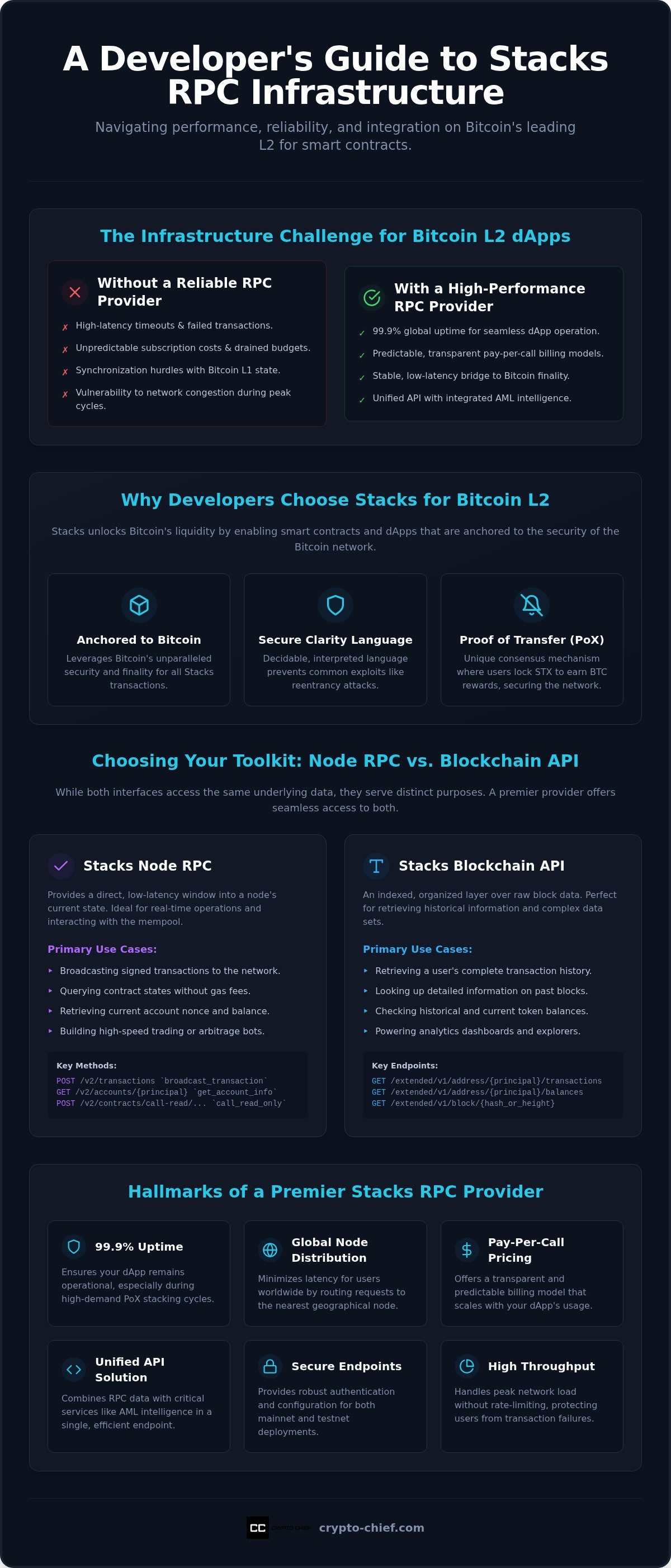
The strategic importance of Stacks has surged in 2026, especially as the ecosystem matures following the Nakamoto upgrade. As the leading Bitcoin Layer 2 for programmable yield, Stacks enables complex financial instruments that were previously impossible on the base layer. RPC nodes are the structural pillars behind this evolution, facilitating the Proof of Transfer (PoX) consensus mechanism and managing the movement of sBTC. While public endpoints are available for testing, they often suffer from rate-limiting and high latency. A dedicated stacks rpc provider is essential for production-grade environments that require consistent throughput and 99.9% global uptime.
Why Developers Choose Stacks for Bitcoin L2
Building on Stacks allows developers to leverage the Clarity smart contract language, which is decidable and interpreted rather than compiled. This architecture prevents common vulnerabilities like reentrancy attacks, providing a level of security that aligns with Bitcoin’s conservative ethos. Stacks RPC nodes facilitate this by constantly monitoring the Bitcoin L1 state, allowing L2 actions to be triggered by specific Bitcoin transactions. Stacks RPC is the bridge between Bitcoin's capital and programmable smart contracts. This direct link ensures that decentralized applications can tap into over $1 trillion in latent liquidity while maintaining sovereign control over their execution environments.
The Critical Need for Reliability in PoX Cycles
Reliability becomes a non-negotiable requirement during peak network activity, specifically during stacking cycles. As thousands of users lock STX to earn Bitcoin rewards, network congestion can lead to delayed block validation or failed contract executions. For DeFi protocols performing liquid stacking or high-frequency arbitrage, even a few milliseconds of latency can result in significant slippage. Professional infrastructure ensures that your endpoints remain responsive when the network is at its busiest, protecting your users from the volatility of public infrastructure. Stable connectivity isn't just a luxury; it's the foundation of a secure, Bitcoin-backed economy.
Technical Standards: Stacks Node RPC vs. Stacks Blockchain API
Developers interacting with this Bitcoin Layer 2 often encounter two distinct interfaces: the raw Stacks Node RPC and the indexed Stacks Blockchain API. While they share the same underlying data, their utility varies significantly depending on your application's requirements. The raw Node RPC, accessible via endpoints like v2/info, provides a direct window into the current state of a single node. In contrast, the Blockchain API acts as an indexing layer, organizing raw block data into searchable formats like transaction histories and token balances. Choosing the right stacks rpc provider ensures you have access to both without the friction of maintaining separate infrastructure stacks.
Adherence to JSON-RPC 2.0 standards is a critical requirement for modern development. This protocol ensures multichain compatibility, allowing engineers to use familiar tooling when shifting between Stacks and other networks. Key methods you'll frequently employ include broadcast_transaction for sending signed payloads to the mempool, get_account_info for retrieving current nonce and balance data, and call_read_only_function for querying Clarity contract states without incurring gas fees. These tools form the core of any functional dApp integration.
When to Use the Stacks Node RPC
The raw Node RPC is your best choice for low-level operations that require the highest possible speed and the least amount of processing overhead. If you're building a high-speed trading bot or a mempool monitor, you need to see transactions before they're indexed. Direct broadcasting through a stacks rpc provider ensures your transaction propagates to the network immediately, bypassing any potential delays in the indexing layer. It's the purest way to interact with Clarity contracts, providing the rawest form of truth available on the chain.
When to Use the Indexed Blockchain API
Most user-facing applications, such as wallets and portfolio trackers, rely on the indexed Stacks Blockchain API. This layer is necessary for fetching historical data that the raw node doesn't store in an easily searchable format. If your application needs to display a list of every NFT a user owns or resolve a Stacks Name Service (BNS) handle, the indexed API is indispensable. Many developers prefer using a Unified Blockchain API because it normalizes these complex data sets, making them easier to consume across different environments. You can explore our technical documentation to see how these methods integrate into your existing workflow.
Performance Benchmarks: Choosing a Reliable Stacks RPC Provider
Selecting a stacks rpc provider requires a rigorous evaluation of technical performance metrics and cost structures. While public endpoints serve as a useful entry point for hobbyist projects, they lack the security and rate-limiting resilience needed for production-grade dApps. Private RPC infrastructure offers dedicated bandwidth, ensuring that your application remains responsive even when the Stacks network experiences high transaction volume. High latency during round-trip requests often stems from a lack of global node distribution, forcing data to travel across oceans before reaching your user and potentially causing failed Clarity contract executions.
Real-time mempool monitoring is another critical benchmark for developers. Without robust WebSocket support, your application must rely on inefficient polling, which increases latency and consumes unnecessary API credits. By choosing a high-performance stacks rpc provider that offers full WebSocket integration, your UI can react instantly to pending transactions. This capability is essential for DeFi platforms where price accuracy and execution speed are the primary drivers of user retention.
Pay-Per-Call vs. Monthly Subscriptions
Traditional tiered models often force developers into over-provisioning, where they pay for millions of unused requests simply to avoid the limitations of a lower tier. This creates hidden costs that drain capital from growing startups. A pay-per-call model is superior because it aligns your infrastructure expenses directly with your actual user traffic. You can find a detailed cost analysis in our guide on Web3 RPC Gateway: The Architect’s Guide to Multichain Infrastructure in 2026. This approach utilizes a prepaid token system that prevents unexpected budget overruns and ensures you only pay for the data you consume.
Uptime and Redundancy for Enterprise dApps
Financial applications built on Stacks demand a minimum of 99.9% uptime to maintain user trust and operational integrity. An NYU Stern study on Stacks protocol performance underscores the importance of node stability in maintaining network health. To achieve this, elite providers deploy geo-balanced node clusters across multiple regions. This redundancy ensures that if a single data center faces an outage, your traffic is instantly rerouted to the nearest active node. For those building compliant financial tools, integrating AML Intelligence alongside these redundant endpoints provides an additional layer of security for your Bitcoin-backed assets.
Integration Guide: Connecting to Stacks Mainnet and Testnet
Transitioning from a local development environment to a production-grade deployment requires a secure, high-performance connection to the network. While mocknets are suitable for initial testing, scaling a dApp necessitates a stacks rpc provider that supports authenticated access and delivers consistent throughput. Following a structured integration process ensures that your application remains resilient against network fluctuations while protecting your infrastructure from unauthorized usage.
- Step 1: Provisioning. Access the Crypto Chief dashboard to generate your unique RPC endpoints for both mainnet and testnet.
- Step 2: Authentication. Configure your environment variables to include the necessary API headers, ensuring every request to your stacks rpc provider is securely signed.
- Step 3: SDK Configuration. Initialize the Stacks.js or Hiro SDK by passing your custom RPC URL into the network object, replacing default public endpoints.
- Step 4: Connection Validation. Execute a
GETrequest to the/v2/infoendpoint to verify that your application can successfully retrieve current block heights and network constants. - Step 5: Resilience Planning. Implement automated error handling that detects timeouts and triggers a fallback to a secondary cluster, maintaining 99.9% uptime for your users.
JavaScript and Python Integration Examples
Most Stacks developers prefer using the Stacks.js library due to its native support for Clarity contract interactions. To connect, you simply define a StacksMainnet or StacksTestnet object and override the url property with your private endpoint. For example, when calling a read-only function, you would pass this network object into the callReadOnlyFunction method to fetch data without gas costs. You can find language-specific SDK implementations and boilerplate code in the Crypto Chief Documentation to accelerate your setup process.
Monitoring and Webhooks
Relying on constant polling to detect transaction confirmations is an inefficient use of resources that can lead to unnecessary latency. Instead, modern architects are moving to Real-Time Blockchain Webhooks to stream events directly to their backend. This is particularly vital for monitoring large STX or sBTC transfers that require immediate AML risk scoring. To monitor specific contract interactions, you can configure a webhook to trigger an HTTP POST request whenever a targeted Stacks smart contract event is emitted on-chain. You can begin provisioning your production environment by visiting our developer portal.
Scaling Stacks dApps with Unified Infrastructure
Scaling a decentralized application on the Stacks layer involves more than just maintaining a stable connection to the blockchain. As the ecosystem moves toward mass adoption in 2026, the complexity of managing disparate services for data, compliance, and payments can become a significant bottleneck for growing teams. Utilizing a comprehensive stacks rpc provider that offers a unified infrastructure allows developers to consolidate their technical stack, reducing latency and minimizing operational overhead. This approach is particularly critical for cross-chain applications that need to compare the Stacks state with the Bitcoin L1 state in real-time to ensure the integrity of sBTC transactions.
Future-proofing your application requires an infrastructure partner that supports more than just a single network. By leveraging a provider with multichain support across 50+ protocols, you ensure that your application can scale as your project expands into new ecosystems without requiring a complete rewrite of your backend logic. This structural integrity is what separates an elite service provider from a basic endpoint. It positions your dApp as a reliable foundation in the evolving Bitcoin DeFi landscape, where speed and consistency are the primary metrics of success.
Compliance for Stacks DeFi
Institutional-grade applications cannot ignore the regulatory requirements surrounding digital assets. As Bitcoin-backed DeFi matures, AML Intelligence becomes a mandatory component for any platform handling significant transaction volume. Integrating real-time risk scoring allows you to trace funds and assess the risk profile of Stacks addresses before they interact with your Clarity contracts. This automated approach to fund tracing is detailed in our Crypto AML Risk Detection API guide, which explains how to maintain rigorous compliance standards without sacrificing the decentralized user experience.
Unified Payments and Payouts
Managing the flow of capital is the final piece of the scaling puzzle. By implementing Non-Custodial Crypto Processing, you can accept STX and sBTC payments directly while avoiding the security vulnerabilities inherent in custodial hosting. This level of control is essential for automating developer payouts and user rewards through a single API surface. The efficiency of managing your stacks rpc provider alongside AML and payment processing tools creates a seamless environment where you can focus on building features rather than managing fragmented background infrastructure. This unified logic ensures that your dApp remains scalable and secure as the Bitcoin economy continues its global expansion.
Scale Your Stacks Infrastructure with Precision
Transitioning your Stacks dApp from a prototype to an enterprise-grade solution demands a technical foundation that values stability, performance, and predictable scaling. We've examined the critical differences between raw Node RPC and indexed APIs, emphasizing that your choice of a stacks rpc provider directly impacts your application's latency and cost-efficiency. By unifying your RPC access with real-time AML intelligence and non-custodial payment processing, you eliminate the friction of managing fragmented services. This integrated approach ensures your Clarity contracts execute with 99.9% uptime while maintaining rigorous compliance standards.
The infrastructure challenges of the past shouldn't hinder your creative vision today. You have the tools and the knowledge to build secure, scalable, and compliant applications on the world's most secure settlement layer. Build Faster on Stacks with Crypto Chief’s High-Performance RPC Gateway to leverage pay-per-call pricing and our unified multichain API. You're ready to lead the next generation of Bitcoin DeFi.
Frequently Asked Questions
What is a Stacks RPC provider?
A Stacks RPC provider is a specialized infrastructure service that hosts and maintains Stacks nodes to offer a stable interface for developers. It's the tool that allows your application to communicate with the blockchain by broadcasting transactions, querying the state of Clarity smart contracts, and retrieving block data. By using a professional provider, you avoid the operational burden of self-hosting, which requires significant hardware resources and constant maintenance to stay synchronized with the Bitcoin L1 state.
How do I get a Stacks RPC endpoint for free?
You can access public RPC endpoints provided by the Stacks Foundation, such as the mainnet API URL, at no initial cost. These public gateways are excellent for early-stage development and testing. However, they typically enforce strict rate limits and may experience higher latency during peak network activity. For production environments that require 99.9% uptime and dedicated bandwidth, transitioning to a private stacks rpc provider is the standard industry practice to ensure reliability.
What is the difference between Stacks Mainnet and Testnet RPC?
Stacks Mainnet RPC connects to the live production environment where actual STX and sBTC transactions occur on the Bitcoin blockchain. Stacks Testnet RPC is a separate network used for debugging and experimentation with Clarity smart contracts without risking real capital. Developers use the testnet to validate contract logic and integration flows, as it provides a safe sandbox that mirrors the technical behavior of the mainnet while using worthless test tokens.
Does Stacks support JSON-RPC 2.0?
Yes, the Stacks protocol supports the JSON-RPC 2.0 standard for its core node interactions. This ensures that developers can use familiar request and response structures when querying node information or broadcasting transactions. Utilizing this standard protocol makes it easier to integrate Stacks into existing multichain workflows. Most professional providers normalize these requests to maintain compatibility with standard Web3 tooling, allowing for seamless communication between your application's backend and the blockchain.
How much does a Stacks RPC provider cost in 2026?
In 2026, the cost of a stacks rpc provider varies based on the pricing model you choose. Some services use tiered monthly subscriptions that charge a flat fee for a set number of requests. Others, like Crypto Chief, utilize a pay-per-call model where you purchase prepaid token balances and only pay for the actual requests your application makes. It's often more cost-effective for dApps with fluctuating traffic, as it eliminates wasted overhead from unused capacity.
Can I use Stacks RPC to monitor Bitcoin transactions?
While a Stacks RPC primarily monitors the Stacks layer, it's deeply integrated with the Bitcoin network due to the Proof of Transfer consensus. You can use specific endpoints to check the status of Bitcoin blocks that impact Stacks or to monitor the progress of sBTC minting. However, for comprehensive Bitcoin L1 monitoring, developers often use a unified API that bridges data from both networks. This allows for more complex cross-chain logic in decentralized financial applications.
Is the Hiro API the same as a Stacks Node RPC?
No, the Hiro API and the Stacks Node RPC serve different technical purposes. The Stacks Node RPC is the raw interface provided by every running node, used for low-level operations like transaction broadcasting. The Hiro API, often called the Stacks Blockchain API, is an indexing layer that organizes raw data into a more searchable format for wallets and explorers. Most developers use both, relying on the raw RPC for speed because the indexed API doesn't store raw state as efficiently.
How do I secure my Stacks RPC connection?
Securing your connection involves using authenticated API headers and encrypted HTTPS protocols. Most professional providers require unique API keys to prevent unauthorized access to your endpoints. You should also implement client-side error handling to manage potential timeouts gracefully. Additionally, some enterprise services allow you to whitelist specific IP addresses, ensuring that only your authorized servers can communicate with the RPC gateway, which significantly reduces the risk of malicious request flooding or credential theft.
Tags: stacks rpc provider