
Building a multi-chain application shouldn't feel like managing a dozen separate infrastructure companies. With over 4,000 distinct blockchains now in existence, the manual labor of maintaining individual RPC providers and reconciling fragmented schemas has become the primary bottleneck for technical growth. You've likely felt the strain of unpredictable monthly costs and the constant friction of adapting to unique data formats for every new L2 or protocol upgrade. It is an unsustainable model for any architect aiming for global scale.
This guide demonstrates how a unified cross-chain data api architecture solves these challenges by consolidating disparate networks into a single, predictable schema. You'll learn how to replace bloated subscription tiers with efficient pay-per-call pricing while optimizing your data retrieval for sub-second finality. We will explore the technical shift toward high-performance data streaming and show you how to build a foundation that is both cost-effective and ready for the regulatory demands of the 2026 landscape.
Key Takeaways
- Learn how to abstract the technical debt of over 4,000 blockchains by implementing a unified schema that normalizes data across both EVM and non-EVM environments.
- Discover how the pay-per-call model eliminates wasted subscription credits. This ensures your infrastructure spend aligns precisely with real-time application usage.
- Master a streamlined five-step implementation process to generate a single API key for major networks like Ethereum, BNB, and Polygon.
- Understand why a robust cross-chain data api is the critical architectural choice for maintaining performance and ensuring compliance in the 2026 market.
- Explore the strategic advantage of a unified infrastructure that pairs high-performance data retrieval with a secure, non-custodial Crypto Processing API.
What is a Cross-Chain Data API and Why Does Your dApp Need One?
A cross-chain data api serves as a unified interface that abstracts the dense complexities of multiple blockchain protocols into a single, normalized schema. Historically, dApp development required building a unique data pipeline for every individual chain, a process that inevitably led to massive technical debt and heavy maintenance overhead. By 2026, the industry standard has shifted toward chain-agnostic development. Architects now prioritize business logic over node management, relying on infrastructure that ensures a "transfer" event on Ethereum behaves identically to one on Solana or Polygon. This structural integrity allows developers to scale without rewriting their core codebase for every new Layer 2.
The primary value of this architecture lies in data normalization. Without it, your application must interpret the nuances of different gas models, block times, and event logs for every network you support. A unified API eliminates this friction by delivering a consistent JSON or GraphQL output regardless of the source. It’s no longer about whether you can connect to a chain, but how efficiently you can utilize its data to drive user value.
The Evolution from Single-Chain RPCs to Unified Gateways
Standard JSON-RPC methods were never designed for the fragmented ecosystem of 2026. While single-chain nodes provide raw data, they lack the translation layer needed to communicate across disparate protocols. Unified gateways solve this by acting as a high-performance engine that routes requests with low latency and global uptime. These gateways don't just fetch data; they translate it into a usable format. This evolution mirrors the development of Chainlink's Cross-Chain Interoperability Protocol, which emphasizes the need for secure, standardized communication between distinct networks. By utilizing a Unified API, architects can bypass the limitations of individual RPC providers and achieve a more resilient infrastructure.
Core Use Cases: From DEX Aggregators to Portfolio Trackers
Multi-chain portfolio trackers are currently the most demanding consumers of cross-chain data api services. These platforms must aggregate balances and transaction histories across dozens of networks simultaneously to provide a coherent user experience. Without a normalized feed, the overhead of calculating a user’s total net worth across EVM and non-EVM chains would be computationally expensive and prone to error. The API handles the heavy lifting, allowing the frontend to focus on visualization.
Similarly, DEX aggregators rely on real-time price feeds and deep liquidity data to optimize trade execution across fragmented pools. Speed is the only metric that matters here. Beyond real-time needs, tax and auditing tools require consistent access to historical data. Normalizing this history ensures that compliance reports remain accurate without requiring the developer to manually parse unique block structures for every legacy chain. Whether you're building a simple wallet or a complex institutional audit tool, the foundation remains the same: reliable, unified data access.
The Architecture of Data Normalization: EVM vs. Non-EVM
Normalization acts as the structural foundation for modern multi-chain architecture. It is the sophisticated process of mapping diverse blockchain data structures into a consistent JSON or GraphQL output, ensuring that your application doesn't need to speak a dozen different "languages" simultaneously. While EVM-compatible networks like Ethereum, BNB Smart Chain, and Polygon share a common underlying logic, they remain distinct in their execution. Variations in block times, gas price structures, and finality speeds create friction for developers who lack a unified abstraction layer.
The challenge intensifies when integrating non-EVM environments. Chains like Solana and TON utilize entirely different account models and transaction formats, necessitating specialized indexing to fit into a standardized data model. A high-performance cross-chain data api must handle these architectural discrepancies silently. It functions as a silent, powerful partner that translates raw, heterogeneous data into a clean, actionable stream, allowing you to focus on building features rather than debugging node responses. This technical complexity is explored in depth within this comprehensive survey on cross-chain interoperability, which highlights the necessity of standardized communication in a fragmented ecosystem.
Handling Smart Contract Events and Logs
Decoding raw logs into human-readable data points is where the real value of a cross-chain data api becomes apparent. Instead of manually parsing hex strings, the API provides structured fields for event parameters. Real-time event streaming is critical for maintaining an accurate application state, especially for high-frequency environments. For architects looking to implement deep-dive event monitoring, our guide on Real-Time Blockchain Webhooks provides a detailed look at optimizing your event-driven architecture.
Bridging the Gap with Unified Web3 Infrastructure
Maintaining multiple provider subscriptions is a legacy approach that introduces unnecessary operational risk. A single API key can replace a dozen fragmented services, streamlining your billing and reducing integration complexity. By pairing your data retrieval with integrated RPC Gateways, you ensure that your write operations and read queries share the same high-performance foundation. This unified approach guarantees data integrity through redundant node clusters and global load balancing. If you're ready to eliminate infrastructure friction, you can generate your unified API key to start building immediately.
Cost Optimization: Pay-Per-Call vs. Tiered Subscriptions
Infrastructure costs in Web3 have historically been a source of significant friction for growing dApps. Most legacy providers force users into rigid monthly tiers, which often leads to the accumulation of "zombie" credits. These are units of data you've paid for but never actually consume, yet they expire at the end of the billing cycle regardless of your actual usage. For an architect, this represents a direct hit to the project's ROI. A high-performance cross-chain data api should not only solve technical fragmentation but also address these economic inefficiencies through a more logical billing structure.
The Pay-Per-Call model offers a decisive alternative. By allowing businesses to purchase prepaid balances, this system ensures you only pay for the data your application actually requests. This model provides the structural stability required for long-term budgeting, particularly for projects that experience highly variable traffic patterns across different networks. Transparency in pricing becomes a competitive advantage. When every call is accounted for, you can justify infrastructure spend with granular precision, aligning your operational costs directly with user growth.
Eliminating the "Credit Waste" in Web3 Development
The "use it or lose it" model is a relic of traditional SaaS that doesn't fit the dynamic nature of blockchain data retrieval. In contrast, the prepaid utility model treats infrastructure like a resource you tap into as needed. You shouldn't be penalized for a slow month, nor should you be forced into an expensive overage tier because of a sudden spike in Polygon or BNB Smart Chain activity. To further refine your spend, implementing RPC Request Batching is an excellent complementary strategy. This allows you to group multiple queries into a single request, maximizing the value of every credit spent on your cross-chain data api.
Scaling from MVP to Enterprise Without Hidden Fees
Predictable costs are critical for startups moving through Series A and B funding rounds. Hidden fees or sudden "bill shock" from tiered plans can disrupt a roadmap and drain resources. Using a unified infrastructure that scales with you reduces the total cost of ownership (TCO) by eliminating the need for custom indexing pipelines for each new chain. Advanced management tools now allow teams to distribute prepaid balances across multiple projects or departments. This granular control ensures that your engineering team has the resources they need to ship features without the administrative burden of managing a dozen different provider subscriptions. It’s about building a foundation that is both elite in performance and humble in its cost-to-value ratio.
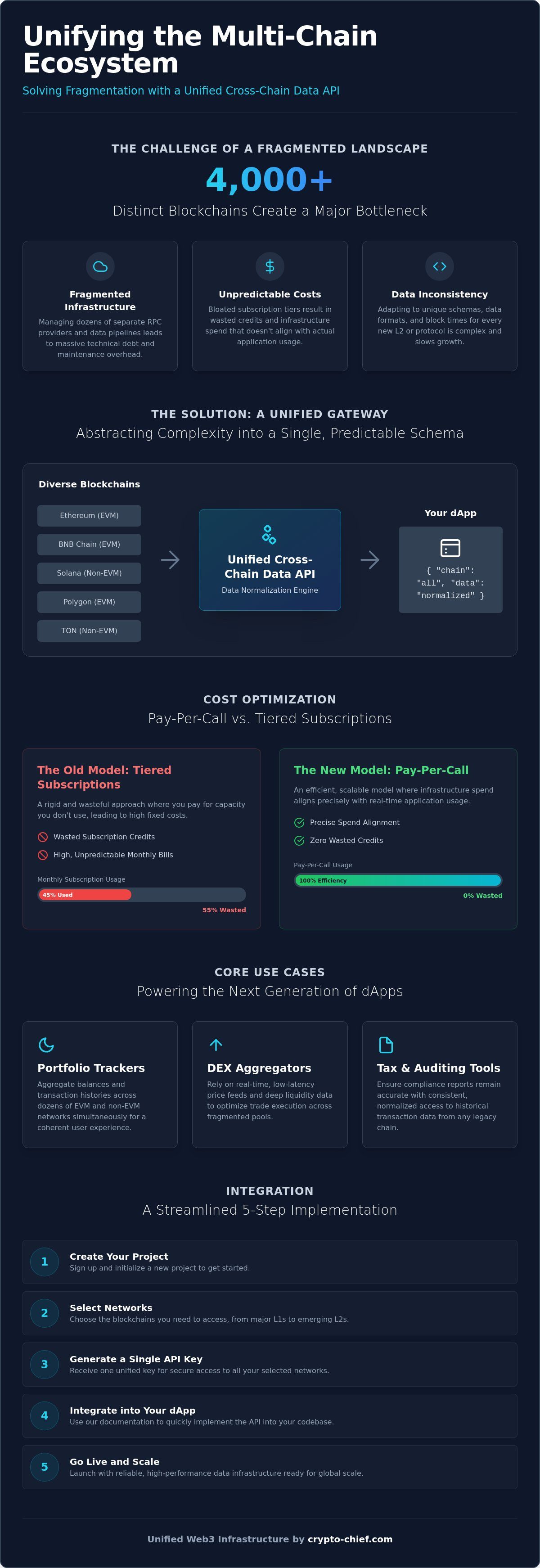
How to Integrate a Cross-Chain API: A 5-Step Implementation
Implementation is where architectural theory meets operational reality. Integrating a high-performance cross-chain data api requires a structured approach that prioritizes security and scalability from the first line of code. By following a standardized integration path, you ensure that your dApp remains resilient even as the underlying network landscape evolves. This process allows you to maintain a lean infrastructure while delivering the real-time data your users demand.
- Step 1: Generate Your Unified Credentials. Begin by registering for an account to generate your unique API key. This single token serves as your gateway to every supported network, replacing the need for fragmented authentication across multiple providers.
- Step 2: Configure Network Targets. Select the specific chains your application requires. Whether your project lives on Ethereum, BNB Smart Chain, or Polygon, the underlying schema remains identical, allowing for rapid cross-chain expansion without code refactoring.
- Step 3: Define Query Parameters. Specify the data points your application needs to retrieve. You can query granular wallet balances, historical DEX trade data, or decoded smart contract logs through a single, high-performance endpoint.
- Step 4: Enable Real-Time Streaming. Implement EventStream webhooks to receive push notifications for on-chain events. This eliminates the need for constant polling and ensures your application state is always synchronized with the latest block data.
- Step 5: Operational Oversight. Use the centralized dashboard to monitor your usage metrics in real-time. The pay-per-call model allows you to replenish your prepaid balance instantly, ensuring zero downtime for your users as your traffic scales.
Best Practices for High-Performance Queries
Efficiency is the hallmark of a well-designed system. To maintain low latency, use precise filters to limit the scope of your queries, which reduces the overall payload size and speeds up processing time. While REST endpoints are suitable for on-demand historical data, WebSockets are the superior choice for real-time applications that demand sub-second updates. You can find detailed endpoint schemas and implementation examples in our technical documentation. Strategic query design doesn't just save time; it optimizes your credit usage and improves the end-user experience. To start building with a unified key, register your developer account today.
Integrating AML Intelligence into the Data Flow
With the 2026 regulatory environment demanding higher standards of transparency, security is a core architectural requirement. Checking address risk scores should be an automated component of every data retrieval process. By utilizing our AML Intelligence API, you can flag suspicious transactions and high-risk wallets the moment they interact with your dApp. This integration allows you to automate compliance workflows without introducing latency. It transforms security from a manual hurdle into a silent, background process that protects your platform's integrity while maintaining a seamless experience for legitimate users.
The Crypto Chief Advantage: Unified Web3 Infrastructure
Crypto Chief functions as a silent, powerful partner by providing a unified foundation for nodes, APIs, and compliance. In an ecosystem where raw data and risk intelligence are often siloed, our infrastructure bridges the gap. By integrating a high-performance cross-chain data api with our non-custodial Crypto Processing API, architects can manage payments and data retrieval through a single, cohesive engine. This approach eliminates the friction of managing multiple third-party providers while ensuring your dApp remains compliant and scalable. We prioritize technical precision and utility-focused delivery, ensuring that your application stays online even during periods of extreme network congestion.
A Single High-Performance Engine for Global Uptime
Reliability is not a luxury; it's a structural requirement. Our Ethereum RPC and Polygon RPC endpoints are backed by a redundant node architecture that guarantees enterprise-grade uptime. This unified infrastructure removes the fragile "glue code" from your backend, allowing your engineering team to focus on innovation rather than maintenance. By consolidating your RPC Gateway and data needs, you reduce the surface area for potential failures. It's a builder-centric ethos that values logic and stability over speculative marketing hype, providing a global engine that is both elite in its capabilities and humble in its service-oriented delivery.
Future-Proofing Your dApp for 2026 and Beyond
The blockchain landscape of 2026 is defined by rapid evolution. Our integration pipeline is designed to support new chain launches with minimal lead time, ensuring your application remains competitive as the market expands. For organizations requiring specialized configurations, our whitelabel options and custom enterprise solutions provide the flexibility needed to meet unique business goals. Whether you're scaling a startup or managing institutional-grade traffic, our platform adapts to your requirements without the burden of tiered subscription locks.
If you have specific architectural requirements or need a tailored solution for your project, you can contact our team for a technical consultation. The transition to a unified cross-chain data api is the final step in optimizing your Web3 stack. Stop managing fragmented providers and start building on a high-performance engine designed for the next generation of decentralized applications. Register now to access your unified API key and begin your implementation today.
Scaling Your Infrastructure for the Multi-Chain Era
The transition toward a chain-agnostic architecture is no longer a luxury for dApp developers; it’s a critical requirement for survival in a fragmented market. You've seen how a unified cross-chain data api removes the technical debt of maintaining disparate pipelines while ensuring your data remains normalized across EVM and non-EVM networks. By moving away from rigid subscription tiers and embracing a transparent pay-per-call model, you align your infrastructure costs directly with actual user demand. This economic efficiency, paired with integrated AML intelligence, creates a foundation that is both secure and sustainable.
With 99.9% production uptime and a unified schema supporting over 10 blockchains, our platform provides the stability your project needs to scale with confidence. Integrating high-performance data retrieval into a single engine allows you to focus on the logic that defines your application. It’s time to stop managing nodes and start building the next generation of Web3 tools.
Start Building with Crypto Chief’s Unified API and experience a foundation designed for global reach. We're here to support your growth every step of the way.
Frequently Asked Questions
Is a cross-chain data API different from a standard RPC node?
Yes, a cross-chain data api provides a layer of abstraction that standard RPC nodes lack. While a standard node delivers raw, network-specific data that requires manual parsing, a unified API normalizes this information into a consistent schema. This means a transaction on Ethereum and a transfer on Solana are delivered in the same format, significantly reducing the amount of custom backend code your team needs to maintain.
How much does it cost to use a pay-per-call API model?
The pay-per-call model is designed to eliminate the waste associated with rigid monthly subscriptions. Instead of paying for a tier of "zombie" credits that might expire unused, you purchase a prepaid balance and only pay for the specific queries your application makes. This utility-focused approach provides structural stability for your budget, as costs scale directly with your actual user traffic and data consumption.
Can I monitor real-time smart contract events across multiple chains?
You can monitor events in real-time by utilizing EventStream webhooks or WebSocket connections. These tools allow your application to receive push notifications the moment a specific smart contract event occurs on any supported network. This is far more efficient than constant polling, as it ensures your application state remains synchronized with the blockchain while minimizing unnecessary latency and infrastructure overhead.
Does the cross-chain API support non-EVM chains like Solana and Bitcoin?
Our cross-chain data api is built to bridge the gap between EVM and non-EVM environments. It abstracts the unique account models and transaction structures of networks like Solana, Bitcoin, and TON into a unified data model. This architectural choice allows you to build multi-chain portfolio trackers or cross-chain analytics tools without needing to become an expert in the low-level protocols of every individual network.
What happens if a specific blockchain goes down?
If a specific network experiences a halt or significant congestion, the API gateway utilizes redundant node clusters to maintain service stability. While the API cannot retrieve new data from a halted chain, it provides clear status codes and error handling to ensure your application can respond gracefully. Global load balancing ensures that requests are routed to the healthiest available nodes to minimize downtime for your users.
How do I ensure my dApp remains compliant with AML regulations?
Compliance is managed by integrating AML Intelligence directly into your data retrieval flow. By scanning wallet addresses and transaction hashes against global risk databases in real-time, you can automatically flag or block suspicious activity. This process happens silently in the background, allowing you to meet regulatory requirements like MiCA without adding friction to the user experience or requiring manual oversight of every transaction.
Can I use the API for historical data analysis and auditing?
The API provides comprehensive access to historical block data, transaction logs, and internal traces across all supported chains. This makes it an ideal foundation for building tax calculators, auditing tools, or deep-dive analytics platforms. Because the data is already normalized, you can perform cross-chain comparisons and aggregate historical trends without the need for a complex, multi-chain indexing pipeline.
Is there a limit to how many API calls I can make per second?
Rate limits are implemented to ensure global stability and high performance for all users. While standard configurations support the needs of most growing dApps, enterprise-grade solutions offer customizable throughput limits for high-frequency applications. You can monitor your real-time usage and requests-per-second metrics through your centralized dashboard, allowing you to scale your infrastructure as your application's demand increases.
Tags: cross-chain data api