
What if the primary bottleneck for your multichain dApp isn't network throughput, but the fragmented way you're forced to query it? In 2026, the debate over the graph vs unified api has moved beyond theoretical decentralization toward practical, high-performance utility. Developers still struggle with the friction of managing disparate schemas across Ethereum, Solana, and a growing sea of L2s. You've likely felt the frustration of high latency impacting user retention or the headache of unpredictable billing models that make enterprise budgeting nearly impossible.
We understand that building a resilient product requires a data foundation that stays out of your way. This guide compares the decentralized indexing of The Graph with the streamlined efficiency of Unified APIs to help you build a scalable, high-performance multichain dApp. We'll examine how to achieve faster time-to-market through data normalization that requires zero manual parsing. Finally, we'll preview the architectural trade-offs between custom indexing and predictable, pay-per-call pricing models to ensure your infrastructure choice supports your 2026 growth targets.
Key Takeaways
- Contrast decentralized indexing protocols with normalized middleware to determine which architecture best supports your project’s specific data retrieval requirements.
- Evaluate the flexibility of custom subgraphs against the speed of pre-indexed schemas to optimize your development lifecycle for 2026.
- Examine the critical performance and cost benchmarks of the graph vs unified api to maintain high-performance user experiences and predictable enterprise budgets.
- Learn to implement a "write once, run anywhere" strategy that standardizes data across Ethereum, Solana, and L2s without manual parsing.
- Discover how to layer unified data with non-custodial processing and AML intelligence for a secure, enterprise-ready Web3 infrastructure.
Understanding the Landscape: The Graph vs. Unified Blockchain APIs
The technical velocity of your dApp depends heavily on your choice between the graph vs unified api. In 2026, developers no longer build for a single chain; they architect for a global ecosystem of interconnected L2s, sidechains, and modular networks. This shift has transformed data retrieval from a minor utility into a primary architectural hurdle. As user expectations for real-time performance grow, the method you use to ingest and parse on-chain events will dictate your project's scalability.
The Graph represents a decentralized solution to this challenge. It functions as an indexing layer where a network of indexers process blockchain data into subgraphs, enabling highly specific, custom query logic using GraphQL. As a foundational piece of Web3 infrastructure, The Graph protocol has evolved through its "Horizon" upgrade into a multi-service data ecosystem. By early 2026, it has served over 1.27 trillion queries, proving its utility for projects that require deep, custom indexing logic for unique smart contracts.
Conversely, a Unified API acts as a high-performance middleware. It normalizes data from over 100 different blockchains into a single, consistent schema. Instead of writing unique indexing logic for every contract, you consume pre-parsed data through a standardized interface. This approach prioritizes developer experience and speed, offering a "write once, run anywhere" methodology. It is particularly effective for teams that need to scale across multiple chains without the overhead of maintaining complex subgraph configurations.
The Evolution of Data Indexing
Early Web3 development relied on primitive block-polling. Engineers wrote custom microservices to scrape logs and store them in local SQL databases. This process was fragile and difficult to maintain. In 2026, the sheer volume of data across fragmented L2s makes these custom stacks a liability. Modern developers are shifting toward sophisticated indexing layers that provide structural integrity. This transition allows teams to focus on core product features rather than the background noise of data ingestion and storage.
When to Move Beyond Raw RPC Nodes
Standard JSON-RPC nodes are excellent for broadcasting transactions, but they're notoriously inefficient for complex historical queries. If your dApp needs to display a user's entire transaction history across five chains or aggregate total value locked (TVL), raw RPC calls will likely cause significant latency. They require multiple round-trips to the node and return unparsed data that demands heavy client-side processing. Data layers solve this by providing pre-indexed, aggregate data. This reduction in backend complexity is vital for fintech applications where speed and data accuracy are non-negotiable. For detailed technical documentation on high-performance alternatives, developers often consult the Crypto Chief documentation to understand how normalized schemas streamline multichain scaling.
The Graph Approach: Decentralized Indexing and Subgraph Querying
Choosing between the graph vs unified api often comes down to how much control you need over your data schema. The Graph excels in scenarios where you require bespoke indexing logic for specific smart contracts. By deploying a subgraph, you define exactly how blockchain events are mapped and stored. This level of granularity is indispensable for complex DEX aggregators or decentralized lending protocols that need to track unique state changes across thousands of transactions. It offers a degree of customizability that generic APIs can't always match.
The system relies on a decentralized network of indexers, curators, and delegators. These participants are incentivized by the GRT token to ensure data remains available and accurate. As discussed by The New Stack on Web3 APIs, this architecture represents a significant departure from traditional Web 2.0 data silos. It prioritizes censorship resistance and permissionless access, making it a favorite for teams committed to the "unstoppable" nature of decentralized applications. While this adds a layer of security, it also introduces a unique set of operational considerations that every architect must weigh.
The Benefits of GraphQL for Web3
GraphQL is the engine that drives The Graph's query efficiency. Unlike REST APIs that return massive, rigid JSON objects, GraphQL lets you request only the specific nested fields your frontend needs. This significantly reduces payload sizes, which is critical for mobile dApp performance. You can filter and sort data directly at the query level, removing the need for heavy client-side processing. For real-time updates, GraphQL subscriptions provide a steady stream of data as new blocks are indexed, ensuring your UI stays in sync with the chain.
The Operational Tax of The Graph
Performance and flexibility come with a steep learning curve. Developers must master AssemblyScript to write subgraph mappings, which can slow down initial deployment. You also face the complexity of managing GRT token volatility and selecting reliable indexers to avoid query failures. In a decentralized environment, query propagation can sometimes lead to higher latency compared to centralized counterparts. If your project requires instant data retrieval without the overhead of token management, you might find that a high-performance non-custodial processing layer or a unified data model better fits your enterprise budget. For those looking to dive deeper into technical implementation, the Crypto Chief documentation offers a roadmap for integrating these streamlined alternatives.
The Unified API Advantage: Structural Normalization for Multichain Scaling
The primary friction in multichain development isn't just accessing data; it's the exhausting process of reconciling different chain architectures. When evaluating the graph vs unified api, the most immediate benefit of a unified approach is structural normalization. Instead of managing a separate indexing microservice for every network, you interact with a standardized middleware layer. This architecture allows you to scale your dApp across Ethereum, Solana, and BSC simultaneously without rewriting your core data ingestion logic. It's the difference between building a custom engine for every vehicle and having a universal fuel that works across the entire fleet.
Data normalization solves the "hidden" engineering costs that plague Web3 teams. Every blockchain handles decimals, address formats, and block confirmation depths differently. For instance, an Ethereum address doesn't look like a Solana public key; a transaction on Polygon might require more confirmations for safety than one on an L2. A Unified API abstracts these nuances. It presents all data in a consistent format, ensuring your frontend receives pre-parsed, uniform objects. This "write once, run anywhere" philosophy is why wallet and exchange developers often prefer unified endpoints to accelerate their time-to-market.
Simplifying the Developer Experience (DX)
Modern developers value predictable workflows. A Unified API provides standardized RESTful or GraphQL responses that remain consistent regardless of the underlying chain. If you decide to support a new L2 or sidechain, the integration is often as simple as changing a single parameter in your query. This flexibility is a core component of a Unified Web3 Developer Platform, where the infrastructure adapts to your growth rather than forcing a code refactor for every new deployment.
Reducing Infrastructure Overhead
Maintaining custom subgraphs involves a significant "operational tax" that many teams underestimate. You don't just write the code; you have to monitor indexer health, manage token stakes, and troubleshoot sync lags. By offloading these responsibilities to a specialized provider, you eliminate the need for dedicated DevOps resources focused solely on data parsing. You get reliable event streaming and high-performance data retrieval without the headache of managing WebSocket stability or database migrations. This shift allows your engineering team to focus 100% of their energy on core business logic and user experience, which are the true drivers of dApp success in 2026.
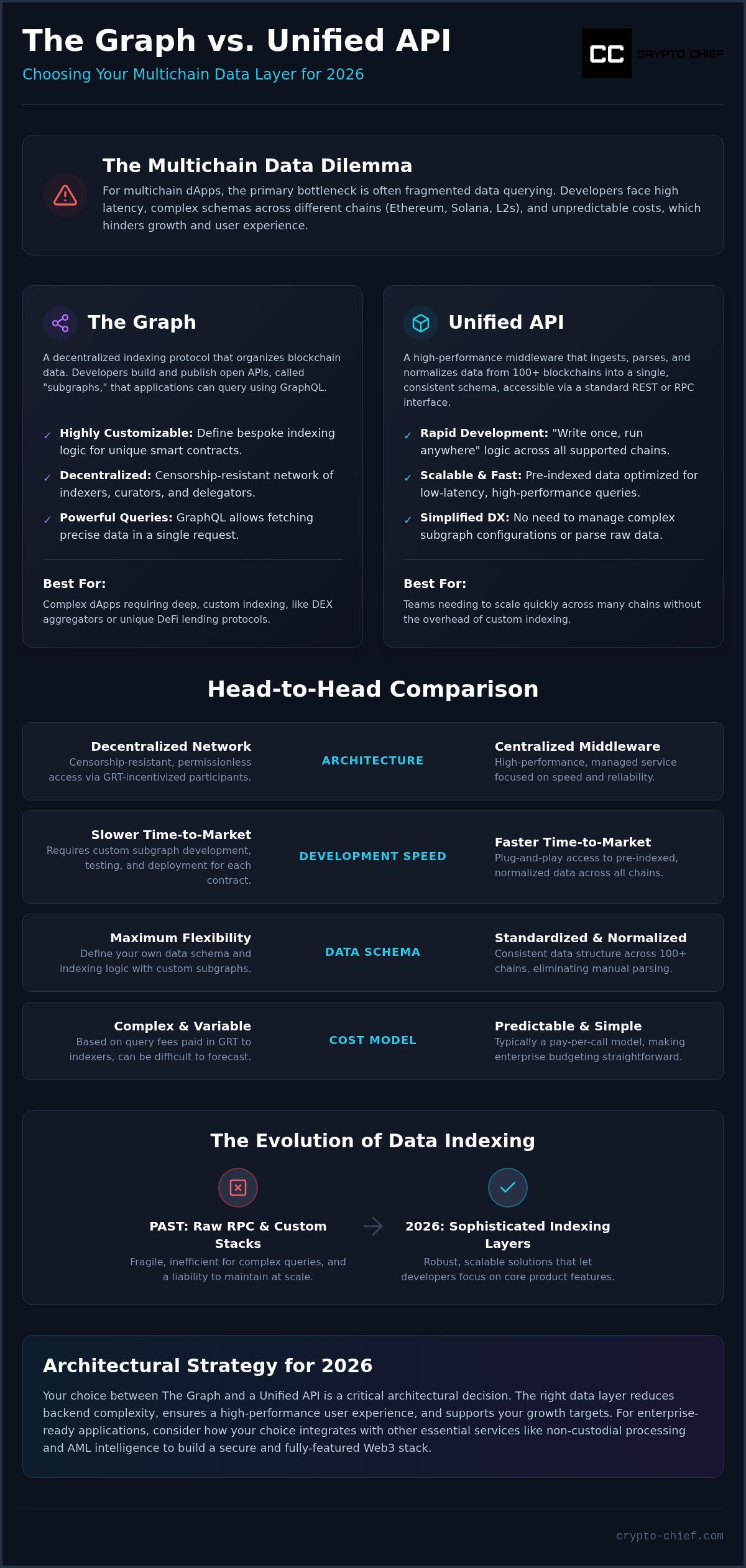
Comparative Analysis: Performance, Latency, and Cost Predictability
Performance metrics often reveal the starkest differences between the graph vs unified api. While decentralized indexing provides a resilient backbone for community-led projects, it frequently struggles with query propagation latency. In a decentralized network, your query must find an indexer that has already processed the latest block. If that indexer lags, your dApp displays stale data. Benchmarks from mid-2026 indicate that while GraphQL can reduce bandwidth consumption by up to 30%, it often comes at the cost of increased server CPU usage compared to optimized RESTful endpoints. High-performance Unified APIs utilize centralized, geographically distributed nodes to ensure sub-second response times, which is critical for real-time portfolio trackers where indexer lag can compromise user trust.
Integration complexity also varies significantly. Deploying a subgraph requires writing custom mapping logic in AssemblyScript and waiting for the initial sync, which can take days for high-volume contracts. A Unified API allows for immediate data retrieval via simple API key authentication. This streamlined approach removes the friction of managing infrastructure, letting you focus on scaling your application rather than troubleshooting indexer synchronization.
The Pay-Per-Call Pricing Advantage
Predictable budgeting is the cornerstone of enterprise stability. Many decentralized protocols rely on token-based systems like GRT, where query costs fluctuate based on market volatility. Other providers use point-based systems that obscure the true cost of a request through complex multipliers. A pay-per-call model provides a transparent alternative. You pay a fixed rate per request, making it easy to calculate your total cost of ownership as you scale toward 10 million requests per month. This clarity eliminates the "bill shock" often associated with complex query logic or sudden traffic spikes in a volatile market.
Reliability and Global Uptime
Enterprise applications require more than a "best effort" promise. They demand strict Service Level Agreements (SLAs) that decentralized networks simply cannot guarantee. High-performance data providers maintain global RPC redundancy to ensure that if one node fails, your traffic automatically reroutes to the next available gateway. This level of structural integrity is vital for maintaining uptime in the 2026 Web3 landscape. To further optimize your overhead, you can implement strategies like RPC request batching for cost reduction, which maximizes the efficiency of every call. For teams ready to build on a foundation of speed and reliability, you can start scaling with Crypto Chief today.
Architectural Strategy: Building a High-Performance Web3 Stack with Crypto Chief
Deciding between the graph vs unified api is a foundational step, yet data retrieval is only one component of a production-ready Web3 stack. In 2026, a truly high-performance architecture requires a cohesive strategy that links data ingestion with transaction processing and regulatory compliance. Relying on a fragmented set of tools often introduces unnecessary integration latency and security vulnerabilities. By consolidating your infrastructure, you ensure that every part of your dApp, from the frontend query to the backend settlement, operates on the same high-performance engine.
Crypto Chief simplifies this by combining its Unified API with Non-Custodial Crypto Processing, allowing you to build seamless financial workflows. This integration means you can query normalized multichain data and trigger secure, non-custodial payments through a single interface. Security and speed are further enhanced when you reduce external dependencies. By integrating AML Intelligence directly into your data layer, you automate risk scoring and compliance checks without the overhead of multiple third-party round-trips. For real-time monitoring, EventStream Webhooks provide instant notifications for on-chain events, ensuring your dApp remains responsive to every state change across 100+ supported blockchains.
The Power of Integrated Web3 Infrastructure
Managing multiple fragmented providers often results in a "Web3 tax" of wasted engineering hours and unpredictable costs. Consolidation offers a unified billing and management experience for RPC, data, and AML services, which is essential for enterprise-level budgeting. This structural integrity allows you to scale from a proof-of-concept to a global enterprise application using the same reliable foundation. When the debate of the graph vs unified api is viewed through this lens, the choice becomes clear for teams that prioritize stability, global uptime, and a logical progression from development to production.
Next Steps for Technical Architects
Building a multichain dApp shouldn't require weeks of custom indexing logic or complex subgraph deployments. You can start by reviewing the Crypto Chief Documentation to understand the full range of API specifications and normalized schemas available. For most technical architects, the fastest path to market involves building a proof-of-concept in hours using pre-indexed data. Leveraging a pay-per-call model ensures risk-free scaling in 2026, allowing you to focus on your core business logic while your infrastructure partner handles the complexities of the multichain landscape.
Scaling with Structural Integrity in the Multichain Era
The choice between the graph vs unified api ultimately defines your dApp's operational velocity and cost efficiency in 2026. While decentralized indexing offers flexibility for niche schemas, the structural normalization of a Unified API provides the "write once, run anywhere" foundation essential for rapid multichain scaling. By abstracting the complexities of different chain architectures, you eliminate the overhead of manual data parsing and the unpredictability of token-based billing models. This shift allows your engineering team to focus on core product innovation rather than background infrastructure maintenance.
Successful architects prioritize a unified stack that integrates high-performance data with essential financial layers. Combining normalized multichain endpoints with automated AML intelligence and non-custodial processing creates a resilient, enterprise-grade foundation. This approach ensures you spend less time managing fragmented providers and more time delivering a seamless experience to your users. If you're ready to remove technical friction and stabilize your infrastructure budget with predictable pay-per-call pricing and 99.9% global uptime, it's time to elevate your build. Scale your dApp with Crypto Chief’s Unified API and launch your multichain features with confidence.
Frequently Asked Questions
Is The Graph better than a Unified API for decentralized applications?
The choice between the graph vs unified api depends on whether your project requires custom on-chain indexing logic or high-performance multichain data. The Graph is ideal for decentralized apps that need highly specific, custom-built schemas via subgraphs. However, for most enterprise applications, a Unified API provides superior performance and lower latency by offering pre-indexed, normalized data across 100+ chains. This eliminates the need to manage complex infrastructure or decentralized indexer selection.
How does Crypto Chief’s pay-per-call pricing compare to The Graph’s GRT system?
Crypto Chief utilizes a transparent pay-per-call pricing model, whereas The Graph relies on the GRT token system. With pay-per-call, you purchase prepaid credits and pay a fixed rate per request, which ensures predictable budgeting for enterprise projects. In contrast, the GRT system involves market volatility and complex staking requirements that can lead to fluctuating query costs. This makes pay-per-call the more stable choice for businesses that require strict financial forecasting and cost control.
Can a Unified API support niche smart contract events like The Graph?
Modern Unified APIs support niche events through real-time event streaming and specialized endpoints. You can track specific smart contract logs and state changes without writing custom indexing code. This approach covers the majority of DeFi and NFT use cases. If your project demands highly unique, non-standard data transformations, a subgraph might be necessary, but unified middleware satisfies the requirements for most scalable multichain dApps in 2026 by delivering pre-parsed, reliable data.
What is the latency difference between a subgraph and a Unified API?
Unified APIs generally offer lower latency because they rely on geographically distributed, high-performance nodes rather than decentralized query propagation. In a decentralized network, requests must be routed through specific indexers, which can introduce delays if those indexers lag or are over-leveraged. High-performance APIs prioritize sub-second response times and global redundancy. This ensures your application remains responsive even during periods of heavy network congestion or across disparate blockchain architectures where speed is critical for user retention.
Which solution is easier for developers new to Web3 development?
A Unified API is significantly easier for developers who are new to the Web3 ecosystem. It uses familiar RESTful or GraphQL interfaces that don't require learning specialized languages like AssemblyScript. You can authenticate with a simple API key and begin querying data immediately. This removes the operational tax of managing token balances, selecting indexers, or waiting days for a subgraph to sync, allowing teams to move from MVP to production in hours rather than weeks.
Does a Unified API handle data normalization across EVM and Non-EVM chains?
Yes, a primary benefit of the the graph vs unified api comparison is that unified providers specialize in cross-chain normalization. They standardize data from both EVM networks like Ethereum and non-EVM chains like Solana into a single, consistent schema. This means your backend receives the same data format regardless of the underlying chain's architecture. It eliminates the need to write custom parsing logic for different address formats, decimal handling, or transaction structures across diverse networks.
How do I monitor real-time transactions using a Unified API?
You monitor real-time transactions by utilizing EventStream webhooks or real-time streaming endpoints. Instead of constantly polling the blockchain for updates, you receive push notifications the moment an event occurs on-chain. This is much more efficient than traditional RPC polling and reduces your total query volume. These webhooks can be configured to monitor specific wallet addresses, smart contract events, or global network activity, providing instant, actionable data for your application's frontend without manual intervention.
What happens to my data access if a blockchain undergoes a major hard fork?
If a blockchain undergoes a hard fork, a Unified API provider handles the complex infrastructure updates on your behalf. They manage the node migrations and re-indexing processes to ensure your data access remains uninterrupted. This offloads the technical burden from your engineering team, who would otherwise need to manually update custom subgraphs or local indexing services. It provides a layer of structural integrity that keeps your dApp operational during volatile network transitions and protocol upgrades.
Tags: the graph vs unified api