
Why are modern enterprises still paying for the privilege of assuming someone else's financial risk? For years, the standard approach relied on custodial "walled gardens" that forced businesses to trade control for convenience, resulting in high insurance premiums and sluggish settlement cycles. You've likely felt the mounting pressure of complex regulatory compliance and the inherent liability of holding user funds. It's a heavy burden that often stifles the very innovation it was meant to support.
By understanding the strategic benefits of non-custodial crypto processing, you can reclaim your transaction sovereignty and eliminate custodial liability entirely. This guide details how a decentralized infrastructure allows for direct on-chain settlement and seamless multichain scalability without the friction of traditional intermediaries. We'll explore the shift toward developer-centric APIs and show you how to build a resilient, high-performance stack that prioritizes structural integrity. From reducing counterparty risk to leveraging real-time blockchain event streaming, you'll discover how to transition from a custodian of risk to a powerful facilitator of global value. It's time to build on a foundation that values uptime, logic, and your absolute control over private keys.
Key Takeaways
- Learn how non-custodial architectures shift your operational role from a risk-bearing custodian to a validator of on-chain events, ensuring absolute sovereignty over private keys.
- Discover the strategic benefits of non-custodial crypto processing in eliminating counterparty risk and protecting your enterprise from the centralized "honeypot" vulnerabilities that attract malicious actors.
- Understand how removing your business from the direct flow of funds reduces the scope of money transmitter licensing and lowers operational overhead by decreasing insurance premiums.
- Explore how a unified API and multichain RPC nodes provide the structural integrity needed to scale across Ethereum, Solana, and BSC with high-performance uptime and low latency.
- Gain a practical roadmap for technical integration, covering everything from secure API credentialing to the configuration of real-time webhooks for seamless transaction monitoring.
Understanding Non-Custodial Crypto Processing: A 2026 Perspective
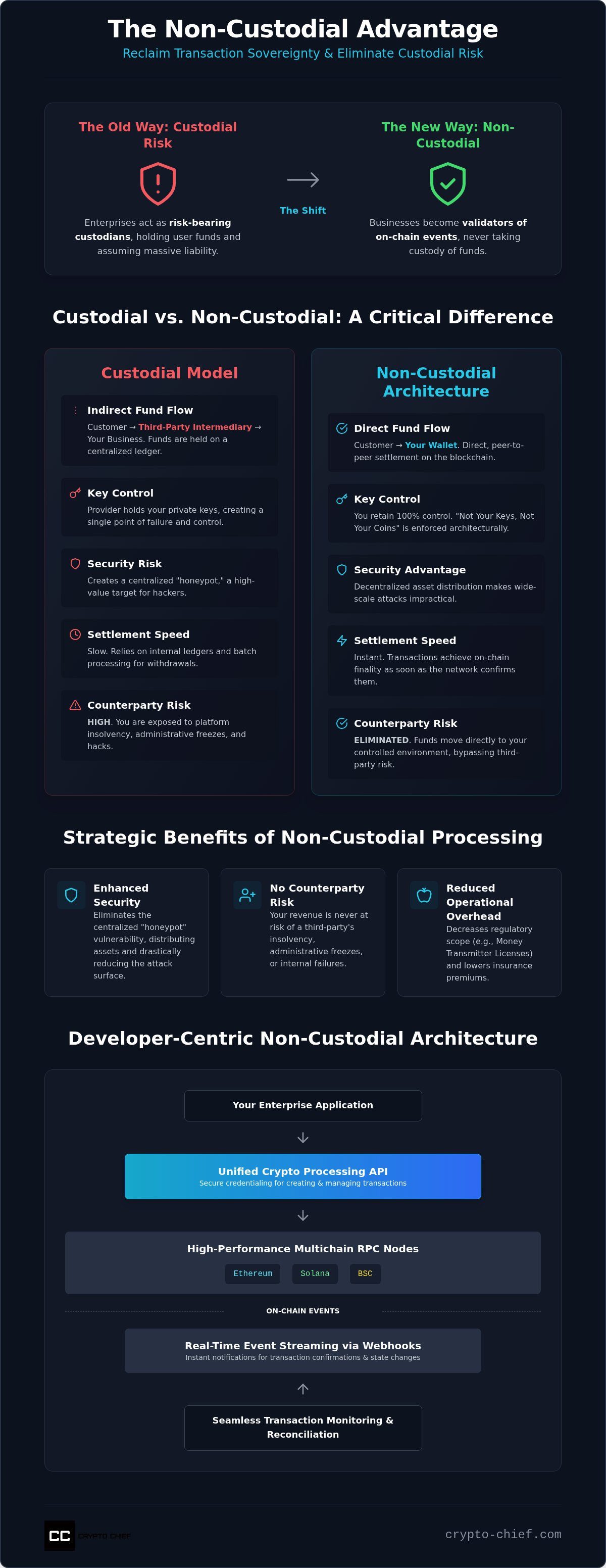
The digital asset ecosystem has matured beyond the era of centralized intermediaries acting as gatekeepers for every transaction. In 2026, the shift toward decentralization isn't just a philosophical choice; it's a technical necessity for enterprises seeking to eliminate unnecessary friction. Traditional payment gateways often function as "walled gardens," holding funds in internal ledgers before eventually settling to a merchant's account. Non-custodial infrastructure changes this dynamic entirely by facilitating direct, wallet-to-wallet interactions. This evolution represents one of the primary benefits of non-custodial crypto processing, as it transforms the merchant's role from a risk-bearing holder of assets to a strategic validator of blockchain events. By focusing on event validation rather than fund management, businesses can scale their operations without the regulatory and security overhead associated with traditional custody.
The Core Architecture of Non-Custodial Payments
At the heart of this system lies the fundamental concept of the Cryptocurrency wallet, where the merchant or user retains exclusive control over their private keys. Unlike custodial services that manage these keys on your behalf, non-custodial solutions use decentralized protocols to route payments. Smart contracts automate the entire flow, ensuring that funds move directly from the customer to the merchant without passing through a third-party's balance sheet. Non-custodial processing is the programmatic validation of on-chain value transfer without third-party escrow. This architecture ensures that your business doesn't become a target for hackers seeking centralized pools of capital. It prioritizes structural integrity by keeping assets distributed rather than concentrated in a single, vulnerable point of failure.
Custodial vs. Non-Custodial: The Critical Differences
The distinction between these models is defined by control, settlement speed, and transparency. In a custodial setup, a provider holds the keys during the transaction window, creating a critical period of counterparty risk. Non-custodial systems maintain instant on-chain finality, where the transaction is recorded on the public ledger the moment the network confirms it. There's no waiting for internal ledger updates or "batching" of withdrawals. Verification is immediate and public. By utilizing a high-performance Crypto Processing API, businesses can monitor these events in real-time through unified infrastructure. This transparency allows for automated accounting and reconciliation that traditional "middleman" gateways simply cannot match. You're not just processing payments; you're orchestrating a transparent, global value stream with full sovereignty. This move away from centralized gateways ensures that your enterprise remains resilient, global, and entirely self-sufficient.
Eliminating Counterparty Risk and Enhancing Security
Counterparty risk is the silent killer of enterprise crypto adoption. In a traditional custodial model, you're effectively lending your revenue to a third party the moment a customer pays. One of the core benefits of non-custodial crypto processing is the immediate removal of this vulnerability. By ensuring that funds move directly to your controlled environment, you bypass the risk of platform insolvency or administrative freezes. The "Not Your Keys, Not Your Coins" principle isn't just for individual enthusiasts; it's a fundamental requirement for building a resilient, enterprise-ready financial stack.
Hackers prioritize efficiency. They target centralized custodial pools because these "honeypots" offer a massive payout for a single breach. In contrast, a non-custodial architecture distributes assets across individual merchant wallets. This decentralized approach makes a wide-scale attack economically and technically impractical. Every transaction remains transparent and auditable on the blockchain, providing a level of security through visibility that traditional financial silos cannot replicate. You don't have to trust a provider's internal ledger when you can verify every movement on a public explorer in real-time.
Reducing the Attack Surface
Centralized hot wallets are liabilities, not assets. By utilizing a non-custodial Crypto Processing API, you eliminate the need to store large sums in a provider's infrastructure. Even if a service provider experiences a technical disruption, your funds remain secure within your own wallet. This resilience is bolstered by using reliable web3 rpc endpoints for secure transaction broadcasting, ensuring that your connection to the blockchain remains direct and uncompromised. This architecture ensures that a breach at the service level doesn't translate into a total loss of your operational capital.
Sovereignty and Fund Access
Business continuity requires uninterrupted access to capital. Custodial platforms often impose withdrawal limits, settlement delays, or "compliance freezes" that can disrupt your cash flow during critical periods. Non-custodial systems grant you 24/7 access to your funds, regardless of market volatility or the operational status of your infrastructure partners. You're protected against third-party failures because your liquidity isn't tied to their survival. This level of sovereignty ensures that your business remains operational and agile, even when the broader market faces turbulence. It's about building a system where you are the ultimate authority over your financial resources, removing the friction of waiting for a middleman to approve your own transactions.
Regulatory Efficiency and Operational Cost Reduction
Custody is a regulatory magnet. When an enterprise chooses to hold user funds, it immediately enters a complex web of money transmitter licensing and stringent capital requirements. One of the most overlooked benefits of non-custodial crypto processing is the dramatic reduction in regulatory scope. By utilizing infrastructure that facilitates direct wallet-to-wallet transfers, your business avoids becoming a financial intermediary in the eyes of many global regulators. You aren't "moving" money; you're providing the technical rails for value to move itself. This architectural choice allows you to focus on product innovation rather than navigating the expensive, multi-year process of securing and maintaining traditional custodial licenses.
Operational overhead extends beyond legal fees to the realm of risk management. Custodial liability requires massive insurance premiums to protect against internal fraud, hacking, or platform failure. When you remove the "honeypot" of centralized funds, these insurance costs drop significantly. Auditing also becomes a streamlined, programmatic process. Instead of reconciling internal ledgers against bank statements and third-party reports, your compliance team can pull data directly from the blockchain. This single source of truth provides an immutable trail of every transaction, making quarterly reviews faster and far more accurate. It's a shift from manual verification to automated, on-chain certainty.
Compliance Without Custody
Maintaining a non-custodial flow doesn't mean bypassing security or compliance standards. Modern enterprises use AML Intelligence to screen incoming transactions in real-time without ever touching the underlying assets. This allows you to block high-risk wallets or flagged addresses before they interact with your platform. By integrating a crypto aml risk detection api into your existing workflow, you automate risk scoring for every event on the chain. You get the protection of a full compliance stack while maintaining the lean operational profile of a non-custodial builder. It's a silent, powerful partner that ensures your sovereign infrastructure remains clean and compliant.
Lowering the Total Cost of Ownership (TCO)
Traditional payment processors often hide a "custody tax" within their percentage-based fee structures. For high-volume applications, these fees scale aggressively, eating into margins as your business grows. Non-custodial solutions typically favor a pay-per-call model, where you pay for infrastructure usage rather than a percentage of your total volume. This creates predictable pricing that rewards efficiency. You don't need a massive internal department to manage custodial security because the blockchain handles the heavy lifting of asset protection. By reducing the need for internal compliance and security teams, you lower your total cost of ownership while maximizing the performance of your global value stream. For enterprises in specialized sectors like cannabis, combining these financial efficiencies with an all-in-one ERP like PROTEUS420 allows for a fully synchronized and compliant business ecosystem.
Modern enterprises cannot afford to be locked into a single blockchain. The 2026 landscape is inherently multichain, requiring a technical stack that gracefully handles the nuances of Ethereum, Solana, and BSC simultaneously. One of the defining benefits of non-custodial crypto processing is the ability to maintain a unified interface while interacting with diverse network architectures. Instead of building separate, siloed integrations for every new Layer 2 or Layer 3 solution, developers can utilize a standardized abstraction layer. This flexibility ensures that your infrastructure remains agile, allowing you to pivot as network dominance shifts or gas costs fluctuate across different ecosystems without rewriting your core logic.
Unified Infrastructure for Multichain Apps
Normalizing data across disparate blockchain architectures is a significant hurdle for growing platforms. Ethereum's account-based model differs fundamentally from Solana's account structure, often creating friction for developers trying to maintain a consistent user experience. By utilizing real-time blockchain webhooks, you can ensure your non-custodial application reacts to payments the moment they are confirmed on-chain. This event-driven architecture removes the need for constant polling, which often leads to rate-limiting issues and wasted server resources. A single integration point reduces technical debt, enabling your team to ship features faster while the background infrastructure handles the complexities of multichain synchronization.
High Performance and Global Uptime
Reliability is the bedrock of any payment system. If your RPC gateway fails, your ability to broadcast transactions or monitor incoming value disappears instantly. High-concurrency volumes require an infrastructure that can handle thousands of simultaneous requests without creating bottlenecks or increasing latency. Multichain RPC nodes ensure that non-custodial transactions are broadcast to the network with minimal latency, providing the near-instant feedback that modern users expect. This structural integrity is essential for maintaining global uptime and ensuring that your application remains responsive during periods of peak network congestion. By leveraging a high-performance Crypto Processing API, you can scale your Web3 operations with confidence, knowing the underlying engine is built for enterprise-grade throughput.
Ready to build a scalable, multichain future? Explore our Crypto PSP Whitelabel solutions to launch your own sovereign processing platform today.
Integrating the Crypto Chief Non-Custodial API
Transitioning from the theoretical benefits of non-custodial crypto processing to active deployment requires a methodical, developer-centric approach. The integration process is designed to be direct, removing the technical friction that often stalls enterprise Web3 initiatives. By following a structured workflow, you can move from a sandbox environment to a production-ready stack that maintains your financial sovereignty while automating the heavy lifting of blockchain communication. This shift ensures that your team remains focused on building core product features rather than managing complex node infrastructure.
Step 1 involves establishing your foundational security. You'll generate your unique API credentials and link them to your non-custodial environment, ensuring that you remain the sole holder of your private keys from the very first call. Step 2 focuses on real-time awareness. By configuring webhooks through our EventStream service, your application receives instant notifications the moment a transaction is detected in the mempool. Step 3 introduces the essential compliance layer. You can implement real-time AML screening to ensure every incoming payment meets your risk thresholds before it's finalized. Finally, Step 4 allows for rigorous testing and scaling. Because we utilize a pay-per-call model, you can scale your integration precisely alongside your transaction volume without worrying about the unpredictable overhead of percentage-based fees.
The Developer-First Integration Workflow
Speed to market is a critical competitive advantage for modern builders. Developers can access our official documentation to find comprehensive quick-start guides, code snippets, and endpoint specifications. Our EventStream functionality provides immediate payment confirmation, allowing your user interface to feel as responsive as traditional fiat systems. You can customize the Crypto Processing API to fit your specific business logic, whether you're building a simple checkout or a complex, multichain marketplace. This flexibility ensures that the infrastructure adapts to your needs, rather than forcing your engineers to work within the constraints of a rigid, custodial platform.
Scaling from MVP to Enterprise
Growth requires deep visibility into your infrastructure's performance. As your application gains traction, monitoring your API usage and optimizing call frequency becomes essential for maintaining high-performance margins. For businesses looking to provide a more cohesive brand experience, our whitelabel solutions allow you to offer branded payment experiences that sit directly on top of our high-performance engine. This path from prototype to enterprise-grade solution is seamless, supported by a system that values uptime, logic, and structural integrity. You've already solved the hardest parts of Web3 infrastructure by choosing a non-custodial partner. Start building with Crypto Chief’s non-custodial API today to secure your transaction sovereignty.
Securing Your Sovereign Financial Future
The shift toward non-custodial infrastructure isn't just a technical trend; it's a strategic evolution for enterprises that value stability and performance. You've seen how removing the "middleman" gateway effectively eliminates counterparty risk while dramatically reducing the regulatory burden of holding user funds. By prioritizing structural integrity, your business can scale across Ethereum, Solana, and BSC without the friction of traditional custodial silos. The benefits of non-custodial crypto processing lie in this unique combination of absolute sovereignty and operational efficiency.
Building on a unified Web3 infrastructure allows you to focus on your core product, leaving the complexities of node management and real-time AML intelligence to a silent, powerful partner. With transparent pay-per-call pricing, you can scale your high-volume applications with predictable margins and zero "custody tax." You're now equipped to transition from a custodian of liability to a facilitator of global value. It's time to build a resilient, future-proof stack that puts you in full control of your private keys and your growth. We're here to provide the steady, knowledgeable foundation your enterprise needs to thrive.
Explore the Crypto Processing API and start your integration today.
Frequently Asked Questions
Is non-custodial crypto processing more secure than custodial?
Non-custodial processing is fundamentally more secure because it eliminates the centralized "honeypot" effect. By ensuring that private keys stay with the merchant, assets remain distributed across the network rather than concentrated in a single provider's hot wallet. This decentralized architecture drastically reduces the impact of platform-level breaches. You maintain absolute sovereignty over your digital assets, ensuring that a security failure at the infrastructure level doesn't translate into a total loss of your business capital.
How do I handle AML compliance if I don’t hold the user’s funds?
Compliance is managed through real-time wallet screening before transactions are finalized. By utilizing AML Intelligence, you can automatically scan incoming addresses for risk flags or illicit associations without ever taking possession of the underlying funds. This proactive approach ensures that your non-custodial flow remains clean and compliant with global regulatory standards. You gain the security of a full compliance stack while maintaining the lean, efficient operational profile of a sovereign Web3 builder.
What are the main costs associated with non-custodial processing?
A key strategic advantage is the transition from percentage-based fees to a transparent pay-per-call model. Instead of paying a hidden "custody tax" on every dollar processed, you only pay for the specific infrastructure usage, such as API requests and blockchain event monitoring. This creates predictable pricing that scales with your actual technical needs. You also realize significant savings by reducing insurance premiums and the high overhead associated with maintaining complex custodial licenses and internal security teams.
Can I use a non-custodial API for automated payouts?
A non-custodial API can facilitate automated payouts by programmatically signing transactions with your own keys within your secure environment. This allows for high-performance distribution of funds, such as rewards or vendor payments, without needing third-party approval. You maintain 24/7 access to your liquidity, ensuring your business processes are agile and uninterrupted. This sovereignty is one of the primary benefits of non-custodial crypto processing, as it removes the settlement delays inherent in custodial "walled gardens."
Do I need my own RPC nodes for non-custodial processing?
You don't need to maintain your own physical nodes if you use a provider that offers high-performance RPC gateway access. These unified infrastructure platforms manage node synchronization and global uptime for you. By leveraging multichain RPC nodes through an API, you ensure your transactions are broadcast with minimal latency across different networks. This approach provides the reliability of a professional node cluster without the technical debt and maintenance costs associated with running and scaling your own hardware.
How does non-custodial processing affect transaction speed?
Non-custodial processing typically improves settlement speed by enabling direct on-chain finality. Transactions don't wait for internal ledger updates or the "batching" processes that custodial gateways use to manage their own liquidity. The moment a transaction is confirmed on the public blockchain, it is settled in your wallet. By using real-time event streaming, your application can react to these confirmations instantly, providing a responsive user experience that rivals the speed of traditional, centralized payment systems. This efficiency is what allows services like Recarga Rapido to provide instant mobile credit and data top-ups across 150 countries, ensuring users stay connected without delay.
Your funds remain entirely safe and accessible because you retain exclusive control of your private keys. While an API provider outage might temporarily disrupt your transaction monitoring through their specific rails, you can use any other RPC provider or blockchain explorer to access your assets on-chain. This resilience is a critical advantage over custodial systems. In those setups, a platform failure or insolvency could lead to your funds being locked or lost entirely due to counterparty risk.
Is non-custodial processing compliant with global regulations?
Non-custodial processing is compliant and often significantly reduces your regulatory burden. By not taking possession of user funds, your business frequently avoids being classified as a financial intermediary, which can exempt you from certain money transmitter licensing requirements. However, you must still integrate robust AML and risk detection protocols to align with global standards. This allows you to build a compliant financial stack while focusing on product innovation rather than navigating the expensive legal complexities of custody.