
Your Web3 infrastructure shouldn't feel like a bloated legacy subscription where you're forced to pay for the full capacity of a high-tier plan while your dApp only utilizes a fraction of it. It's a common frustration for developers who find themselves subsidizing unused bandwidth, trapped by opaque credit systems that make financial forecasting nearly impossible. When latency spikes during peak traffic on shared nodes, the cost of these rigid monthly commitments feels even more burdensome. Searching for quicknode alternatives pay per call models has become the strategic move for teams that value technical precision and fiscal logic.
You'll discover how to eliminate monthly subscription waste by switching to high-performance, utility-based Web3 API providers that offer a more transparent path to scaling. We'll examine the top RPC gateways and unified APIs for 2026, focusing on those that provide global low-latency access without the weight of monthly minimums. By moving to a prepaid, utility-driven framework, you can ensure your infrastructure costs remain perfectly aligned with your actual traffic, allowing you to focus on building rather than budgeting.
Key Takeaways
- Identify how rigid monthly tiers create an "unused credit tax" that drains startup capital, and learn to recognize the inefficiencies in standard subscription models.
- Evaluate high-performance quicknode alternatives pay per call structures to find providers that offer global RPC access without requiring high-tier monthly commitments.
- Learn to calculate true infrastructure expenses by normalizing costs per million calls and accounting for complex method weightings that often hide the real price of data.
- Discover a risk-free migration strategy that uses usage auditing and failover endpoints to switch providers without compromising your application's uptime or stability.
- Transition to a unified prepaid token system across 70+ chains to ensure your infrastructure costs scale precisely with your actual request volume.
Why Developers are Moving Away from Tiered Web3 Pricing
Developers are recalculating their infrastructure spend with a focus on efficiency. In 2026, the inefficiency of legacy subscription models has become a primary bottleneck for scaling decentralized applications. The industry is witnessing a significant migration toward quicknode alternatives pay per call structures as teams realize that rigid monthly tiers are designed for provider predictability, not developer growth. Transitioning to quicknode alternatives pay per call models allows architects to reclaim their budgets and invest those savings into core product development rather than over-provisioned capacity.
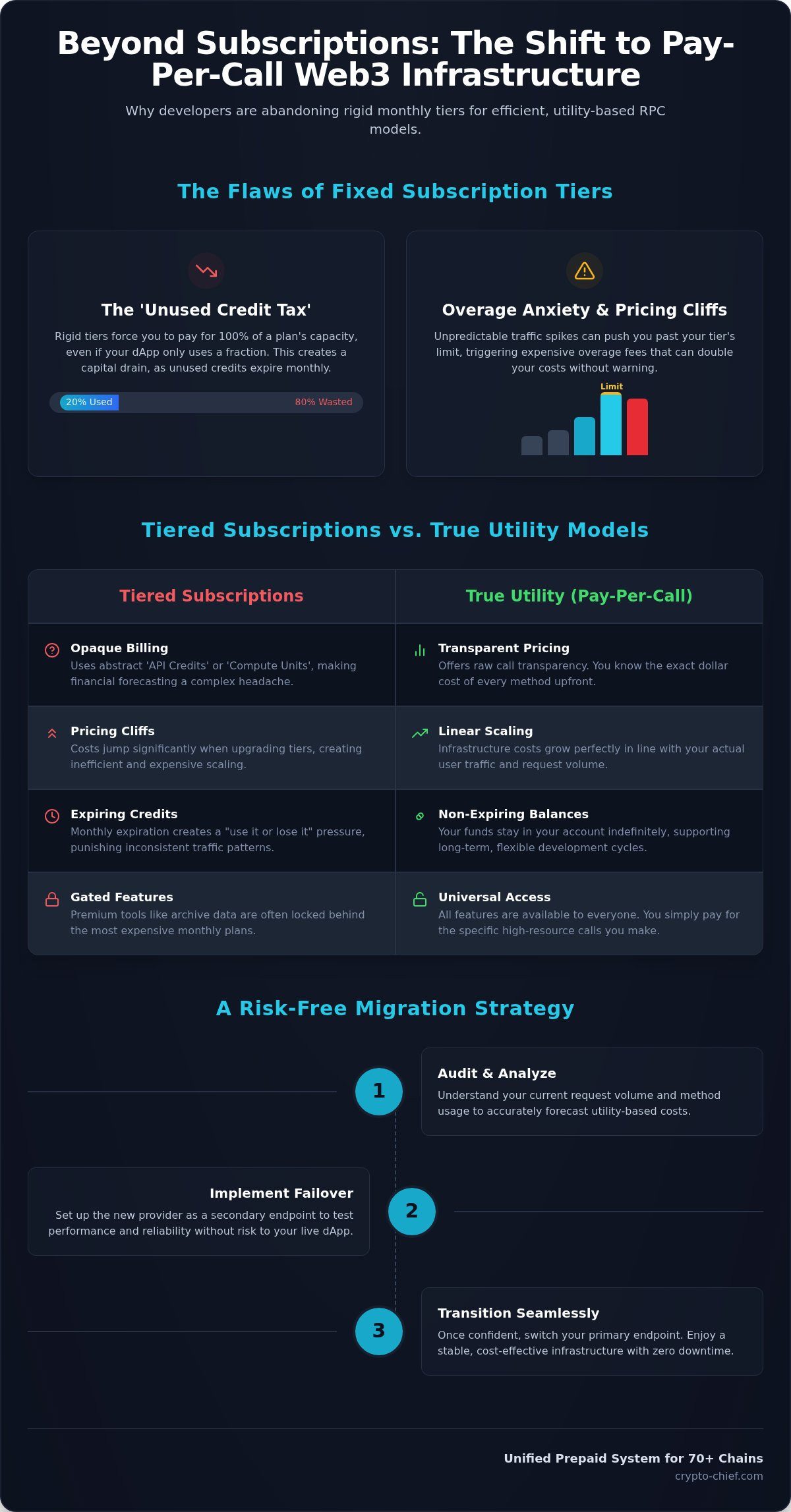
The most pervasive issue is the 'Unused Credit Tax'. Most high-tier plans provide millions of credits that expire at the end of the billing cycle. If your dApp only utilizes 20% of its allocated capacity, you're still paying for the full 100%. This capital drain is particularly damaging for startups that need to maintain lean operations. Conversely, fixed plans create overage anxiety. A sudden spike in traffic can push a project into expensive overage territory, where per-call costs often double without warning.
The Problem with Monthly Subscriptions in Web3
Blockchain traffic is inherently volatile. Unlike traditional web services, Web3 interactions often fluctuate based on market conditions, network congestion, and protocol launches. Tiered models ignore this reality. They force developers into a psychological friction point: you shouldn't have to upgrade your entire tier just to access a single premium feature like archive data or higher rate limits. This model prioritizes recurring revenue over actual utility, forcing builders to pay for overhead they don't need just to unlock the performance they do.
Defining True Pay-Per-Call Utility
True utility billing removes the abstraction of 'API Credits' or 'Compute Units'. These proprietary metrics often obscure the real cost of a request. For example, a simple call might cost 10 units while a complex trace method costs 1,000. Mapping these back to a dollar amount in a tiered plan is a mathematical headache that makes budgeting impossible. A genuine utility-based RPC Gateway offers raw call transparency where you know the exact cost of every method upfront without calculating unit conversions.
A high-performance utility model should provide several key advantages:
- Non-Expiring Balances: Your funds stay in your account until you actually use them, supporting long-term development cycles without the pressure of monthly expiration.
- Zero Monthly Minimums: You pay only for the traffic your users generate, which eliminates the baseline financial burden for early-stage projects.
- Predictable Scaling: As your user base grows, your costs scale linearly with your usage, preventing the "pricing cliffs" found in tiered structures.
As infrastructure matures, the demand for this level of precision has made it clear that the future of the industry lies in utility, not subscriptions. Projects that adopt these models gain a competitive edge by aligning their operational expenses directly with their active user engagement.
Comparing the Best QuickNode Alternatives in 2026
Selecting the right infrastructure provider requires looking past headline prices to the underlying billing logic. While many quicknode alternatives pay per call options exist, their definitions of a "call" vary wildly. In 2026, the market has split between legacy providers using complex credit abstractions and modern utility platforms that prioritize raw transparency. For developers, the goal is to find a partner that offers elite performance without forcing a choice between under-provisioning and over-paying for capacity that never gets used.
Tiered Providers vs. Pure Utility Models
Many prominent players in the space utilize a "Compute Unit" (CU) or "Request Unit" system to weight different RPC methods based on resource intensity. While these platforms often provide generous entry-level tiers for initial prototyping, the transition to production-level scaling often reveals a significant pricing cliff. Feature gating is a major operational hurdle here; advanced debugging tools and high-frequency archive access are frequently locked behind premium plans that require substantial monthly commitments. This creates a situation where you might pay for an entire plan upgrade just to access one specific method, even if your total volume doesn't justify the cost. When you calculate the effective cost per request, pure utility providers often prove more economical as your application traffic matures.
Chainstack and the Shift to Transparent Pricing
Chainstack has positioned itself as a performance leader, offering elastic volume that handles traffic surges better than traditional fixed-tier models. They provide a choice between shared and dedicated nodes, which is vital for cost optimization. Shared nodes work for general queries, while dedicated infrastructure provides the stability needed for high-frequency trading bots. However, despite their entry-level plans starting lower than some competitors, they still require a base monthly commitment to unlock their most competitive rates. For teams seeking quicknode alternatives pay per call, the necessity of a monthly subscription fee, even a small one, remains a point of friction compared to pure prepaid models that operate without recurring overhead.
For Solana-centric stacks, Helius offers specialized indexing and RPC services tailored to that ecosystem's unique architecture. But for developers managing multichain portfolios, the overhead of managing multiple subscriptions across different specialized providers is a major operational burden. This is where a unified RPC Gateway like Crypto Chief excels. By using a single prepaid token balance across 70+ chains, you avoid the complexity of weighted units and monthly minimums entirely. It's a pure utility model that scales with your actual demand, ensuring you never pay for idle capacity or credits that expire before you can use them. This approach allows you to maintain a lean budget while accessing enterprise-grade infrastructure across every major network.
Ready to streamline your infrastructure spend? Explore how a utility-based RPC gateway can align your costs with your actual growth.
How to Calculate Real RPC Costs: Beyond the Sticker Price
Determining the actual expense of your infrastructure requires more than just looking at a base subscription fee. Many teams evaluating quicknode alternatives pay per call find that the true cost is often obscured by proprietary credit systems that lack direct transparency. To gain clarity, you must look at the underlying math. RPC Cost Normalization is the process of equalizing different method weights into a single dollar value. Without this normalization, comparing two providers is nearly impossible because a "call" on one platform might represent a fraction of the compute power of a "call" on another.
The 'Cost Per Million Calls' metric serves as the industry's most reliable universal standard for comparison. While a provider might advertise a low entry price, their weighting for specific methods can drastically alter the final bill. For instance, a basic `eth_blockNumber` request is computationally light, whereas a `debug_traceTransaction` requires the node to re-execute the transaction and capture state changes, which is significantly more resource-intensive. Industry data from early 2026 suggests that the same `eth_call` request can have a 200x pricing variance between providers due to these differing credit weightings. You must also account for hidden fees such as data egress charges, regional surcharges for nodes in specific territories, and forced upgrades to premium support tiers.
Method-Specific Pricing vs. Flat Rate
Heavy compute methods should be priced differently to reflect the actual load they place on the RPC Gateway. However, some providers offer "unlimited" plans that hide restrictive fair-use policies in their fine print. These policies often throttle your throughput once you reach a certain threshold, which is effectively a hidden cap. When budgeting for peak events like NFT mints or major airdrops, a transparent pay-per-call model is superior. It ensures you have the burst capacity you need without the risk of sudden throttling or unexpected overage penalties that can derail a project's finances during high-volatility periods.
The Impact of Latency on Indirect Costs
Latency isn't just a performance metric; it's a financial one. Slow RPC response times directly increase your cloud compute bills because your application servers must wait longer for data, keeping processes open and consuming resources. If your provider lacks a truly global node distribution, your throughput will suffer regardless of your RPS limit. Calculating the ROI of sub-10ms response times reveals that the efficiency gained in server utilization often offsets the cost of the RPC calls themselves. High-performance infrastructure acts as a force multiplier for your entire technical stack, reducing waste at every layer of your application.
Strategic Migration: Switching Providers Without Downtime
Transitioning away from rigid subscriptions shouldn't jeopardize your application's uptime. A methodical approach ensures that moving to quicknode alternatives pay per call is a seamless technical upgrade rather than a high-risk gamble. The process begins with a comprehensive audit of your current usage patterns. You must identify which RPC methods are called most frequently and map their current performance baselines. This data serves as your benchmark, allowing you to verify that your new provider meets or exceeds the stability of your legacy infrastructure.
Once you have your baseline, the second step involves setting up failover endpoints. Instead of a hard cutover, integrate the new provider as a secondary source within your application logic. Use environment-variable-based endpoint switching to manage this transition. This allows you to toggle traffic between providers instantly without requiring a full code redeploy. It's a strategy that prioritizes resilience, ensuring that if any latency spikes occur during the test phase, your system can automatically revert to the previous endpoint.
The final stages focus on live monitoring and deprecation. Track latency and error rates across both providers in real-time. Only when the data confirms that the new utility-based model is performing consistently should you finalize the move. After the transition is complete, you can safely deprecate your legacy tiered accounts, effectively ending the cycle of paying for unused capacity. This structured migration allows you to scale your quicknode alternatives pay per call strategy with complete confidence in your system's integrity.
Ensuring Multichain Compatibility
Modern dApps require more than just a basic connection; they need deep protocol support. When migrating, verify that your new provider fully supports EIP-1559 and the latest network hardforks to ensure transaction efficiency. Stability for WebSocket (WSS) connections is equally critical for real-time event streaming and mempool monitoring. See our Web3 RPC Gateway guide for technical specs on optimizing these multichain connections.
Managing API Keys and Security
Security remains a paramount concern during any infrastructure shift. Implement strict whitelist restrictions, including IP and Domain limitations, to prevent unauthorized access to your prepaid balance. Modern security architectures also utilize JSON Web Tokens (JWTs) to provide a more robust authentication layer than static keys alone. When rotating keys, do it in stages to avoid interrupting production traffic. This ensures that your transition to a more efficient billing model doesn't create new vulnerabilities in your stack.
Ready to optimize your infrastructure? Register your prepaid account today to start building with a pure utility-based model.
Crypto Chief: The Ultimate Pay-Per-Call Developer Platform
Crypto Chief redefines the developer experience by replacing fragmented subscriptions with a single, high-performance engine. While other quicknode alternatives pay per call models focus strictly on node access, this platform provides a comprehensive utility suite that scales with your logic. The "One Balance, All Chains" philosophy ensures that a single prepaid token balance covers your needs across Ethereum, Solana, and over 70 other networks. This removes the administrative burden of managing multiple billing cycles and allows you to focus on the structural integrity of your dApp.
The platform's RPC Gateway is just the foundation. By consolidating your stack, you gain access to AML Intelligence and non-custodial Crypto Processing through the same unified interface. This synergy eliminates the friction of integrating disparate third-party services, providing a stable environment where security and performance are built-in. It's an enterprise-ready solution that remains welcoming to individual builders, offering a silent, powerful partnership that values uptime and logical scalability. You don't have to worry about credit expiration or tiered gating; you simply pay for the utility you consume.
Beyond RPC: A Unified Web3 API
Writing custom parsers for every chain is a legacy inefficiency that drains engineering resources. Crypto Chief provides a Unified API for multichain data normalization, allowing you to interact with diverse blockchains using a consistent data format. This approach removes the "integration tax" that often slows down new developers or expansion into new ecosystems. For those requiring real-time updates, EventStream delivers blockchain webhooks with elite precision. You can subscribe to on-chain events and receive filtered, normalized data streams without the overhead of maintaining persistent WebSocket connections yourself.
Getting Started with No Commitments
Transparency is a core pillar of the platform's ethos. The Crypto Chief Documentation provides a clear, granular look at technical specifications without marketing fluff. You won't find hidden fees or complex credit-to-method mapping here. Setting up your first prepaid balance takes minutes, giving you immediate access to a global, high-performance infrastructure. It is a steady, knowledgeable guide for professional architects who demand predictable costs and structural integrity. Stop paying for idle capacity and start building with a model that respects your budget. Register your account and start building with pay-per-call pricing to experience the efficiency of a truly utility-based Web3 stack.
Optimizing Your Web3 Infrastructure for 2026
Transitioning to utility-based billing isn't just a cost-saving measure; it's a requirement for agile development. By moving away from rigid monthly subscriptions, you eliminate the financial waste of unused credits and the operational friction of tiered feature gating. You've seen how normalizing RPC costs and executing a strategic migration can stabilize your budget without compromising performance. Evaluating quicknode alternatives pay per call models reveals that the most resilient teams are those that align infrastructure expenses directly with user demand.
Crypto Chief provides the foundation for this transition. With a high-performance global RPC gateway and a Unified API supporting 70+ chains, you can consolidate your stack under a single prepaid token model. There are no monthly tiers or hidden commitments to manage. It's a builder-centric approach designed to remove friction and empower your next innovation. Start building with Crypto Chief's pay-per-call API and regain control over your technical overhead. Your project deserves an infrastructure partner that scales as precisely as your code.
Frequently Asked Questions
What is a true pay-per-call model in Web3?
A true pay-per-call model charges you only for the specific API requests your application makes, without a base monthly subscription fee or minimum commitment. Unlike tiered plans that bundle capacity you might not use, this utility-based approach ensures your costs align perfectly with your traffic. It removes the baseline financial overhead for startups while providing a transparent path for scaling production dApps without the risk of unused credit waste.
How do QuickNode credits differ from Crypto Chief's prepaid tokens?
QuickNode credits are typically tied to monthly subscription tiers and expire at the end of each billing cycle, which can lead to capital waste. In contrast, Crypto Chief uses a prepaid token balance system that remains active until consumed. This makes it one of the most efficient quicknode alternatives pay per call options because it eliminates the "unused credit tax." Your balance stays in your account, supporting long-term development cycles without the pressure of monthly expiration.
Can I use pay-per-call APIs for high-volume production dApps?
Yes, utility-based APIs are engineered for high-volume production environments that require consistent performance and predictable scaling. These systems handle elastic traffic surges effectively because they don't rely on the artificial constraints of a fixed-tier plan. High-performance gateways ensure global low-latency access even during peak network volatility. This makes them ideal for trading bots, NFT platforms, and other data-intensive applications that demand enterprise-grade stability without the burden of rigid monthly overhead.
Do prepaid balances in Crypto Chief expire?
No, prepaid API token balances do not expire, ensuring your funds are always available for future usage. This non-expiring model respects your development timeline, whether you are in a quiet building phase or experiencing rapid growth. It removes the psychological friction of monthly billing cycles and allows you to manage your infrastructure budget with total precision. You only pay for the utility you actually consume, making it a reliable foundation for sustainable Web3 development.
Which blockchains are supported by Crypto Chief's RPC Gateway?
The RPC Gateway provides high-performance access to over 70 different blockchain networks, including major ecosystems like Ethereum, Solana, BNB Smart Chain, and Polygon. It also supports emerging and specialized chains to ensure comprehensive multichain coverage. This breadth allows developers to manage their entire infrastructure through a single provider. By using a unified prepaid balance across all these chains, you simplify your billing operations while maintaining elite access to the global decentralized landscape.
How does the Unified API help reduce development costs?
The Unified API reduces costs by providing multichain data normalization, which means you don't have to write and maintain custom parsers for every individual chain. This significantly lowers engineering overhead and accelerates your time-to-market when expanding into new ecosystems. By standardizing how your application interacts with diverse data structures, you minimize technical debt. This efficiency is a core reason why teams look for quicknode alternatives pay per call that offer more than just raw node access.
Is there a limit to how many calls I can make per second on a pay-per-call plan?
Rate limits are typically determined by the specific requirements of your application rather than the billing model itself. High-performance gateways are designed to handle significant throughput and can be adjusted to meet the needs of enterprise-scale projects. Unlike legacy plans that might throttle your traffic once you reach a certain threshold, a utility-based system scales with your actual demand. This ensures your dApp remains responsive even during periods of extreme network activity or user growth.
How does Crypto Chief handle AML compliance within its API?
AML Intelligence is integrated directly into the platform's suite of services, allowing you to perform risk assessments and compliance checks through the same unified interface. This tool provides real-time analysis of wallet addresses and transactions to help you maintain regulatory standards without integrating a separate third-party provider. By consolidating AML checks with your RPC and processing needs, you reduce the complexity of your stack while ensuring your application remains secure and compliant.