
In 2026, the era of the six-figure, rigid blockchain intelligence contract is officially over. While enterprise giants once held a monopoly on security, the market now demands more than just deep forensics; it requires speed, modularity, and fiscal logic. You have likely experienced the frustration of opaque pricing models and high-latency risk scoring that stalls your user experience. With the full implementation of MiCA and the zero-euro threshold for the Travel Rule now in effect, the stakes for real-time compliance have never been higher. If your growth is currently throttled by a rigid SaaS contract that doesn't scale with your usage, it's time to evaluate the next generation of trm labs alternatives.
You deserve a security layer that acts as a silent, powerful partner rather than a technical bottleneck. We understand that modern builders need seamless, API-first integration and real-time AML intelligence that works across multiple chains out of the box. This article compares the top blockchain intelligence tools for 2026, contrasting traditional enterprise heavyweights with agile, developer-first infrastructure. We will show you how to achieve lower infrastructure costs and instant risk detection without sacrificing the structural integrity of your platform.
Key Takeaways
- The 2026 compliance landscape requires a shift from reactive forensics to proactive, real-time risk mitigation to meet stringent global standards like MiCA.
- Exploring trm labs alternatives allows businesses to access elite-level blockchain intelligence while avoiding the opaque pricing and high entry costs of traditional enterprise giants.
- Transitioning to a pay-per-call infrastructure model helps you eliminate six-figure annual contracts by aligning security costs directly with your actual usage.
- Prioritizing API-first integration and low-latency scoring ensures your AML stack can intercept high-risk transfers across multiple chains without compromising user experience.
- Discover how integrating AML intelligence with your RPC nodes creates a unified, high-performance engine that simplifies compliance for modern Web3 developers.
Beyond TRM Labs: The Evolution of Blockchain Intelligence in 2026
The landscape of Blockchain analysis has undergone a fundamental transformation. For years, the industry focused on investigative forensics to trace funds after a security breach occurred. By 2026, this reactive approach is no longer sufficient for businesses operating under the Markets in Crypto-Assets (MiCA) framework or the European Transfer of Funds Regulation (TFR). Modern compliance demands proactive, real-time risk prevention. Developers are increasingly searching for trm labs alternatives that offer more than just historical data. They need infrastructure that intercepts high-risk transactions at the point of entry before they interact with their protocol.
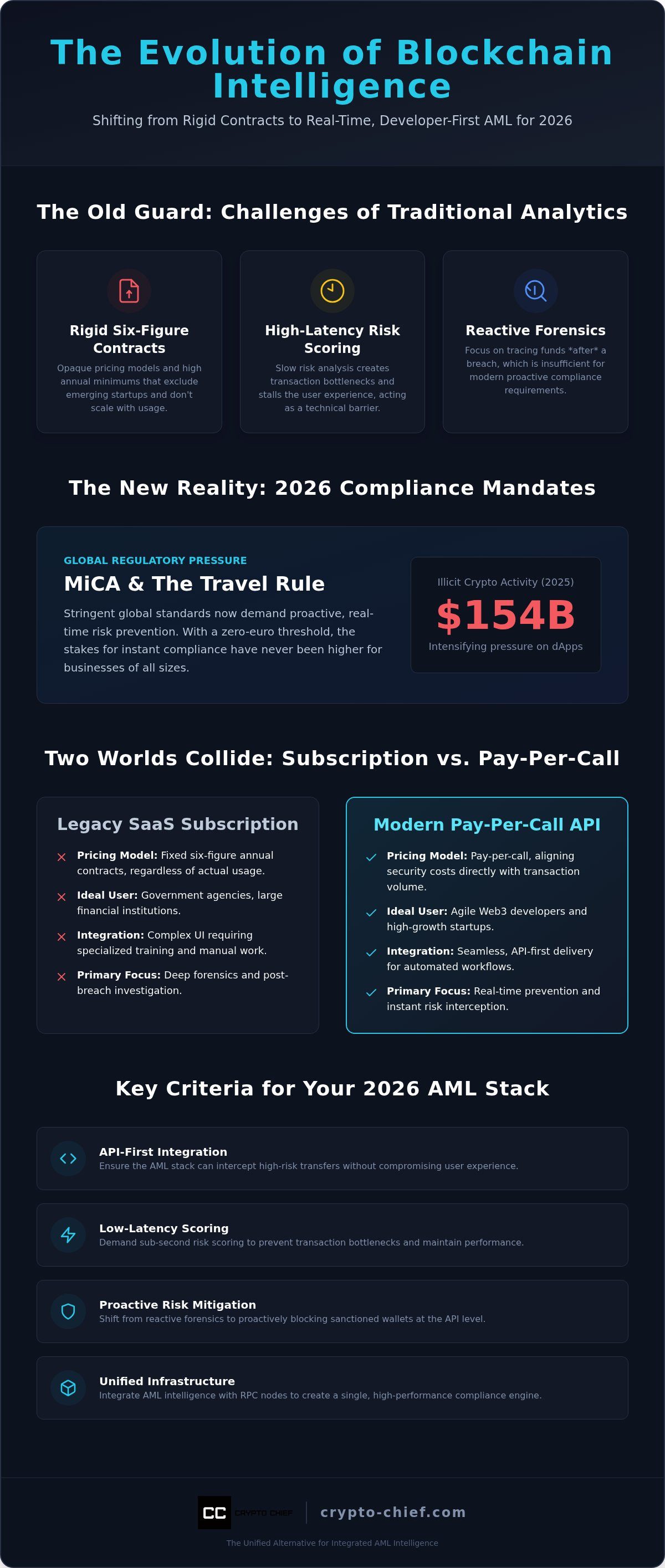
This shift is driven by the need for speed and global reach. As illicit crypto activity reached $154 billion in 2025, the pressure on decentralized applications (dApps) to filter sanctioned entities has intensified. It's no longer just about checking a box for a regulator; it's about protecting the structural integrity of your entire ecosystem. AML intelligence is now a core component of the modern Web3 stack, functioning as a silent partner that allows you to scale without the fear of sudden regulatory enforcement actions.
The Problem with Legacy Blockchain Analytics
Many enterprise platforms were built for government agencies and large-scale financial institutions, not for agile Web3 developers. These legacy systems often come with high annual minimums that exclude emerging startups from accessing quality data. Beyond the cost, these tools frequently rely on siloed data environments that require manual cross-referencing. This creates significant operational overhead. The "black box" nature of some proprietary risk scores also remains a major pain point, as it leaves compliance officers unable to explain automated flagging to their users.
Defining Your 2026 Compliance Requirements
Your 2026 AML stack must be as fast as your core infrastructure. It's no longer enough to support just a handful of major assets. You need native multichain coverage for L2s, sidechains, and new L1s right out of the box. High-frequency processing requires sub-second risk scoring to prevent transaction bottlenecks. If you are building with non-custodial crypto payment APIs, your intelligence tool must integrate seamlessly to maintain a smooth user experience. This is why many teams are pivoting toward trm labs alternatives that prioritize API-first delivery and transparent, pay-per-call pricing models that align with their actual transaction volume.
Top Enterprise Alternatives: Chainalysis and Elliptic
When evaluating the "Big Three" of blockchain intelligence, Chainalysis and Elliptic stand as the most prominent trm labs alternatives for organizations requiring deep forensics. These platforms aren't just software; they are massive data engines designed to map the global crypto economy. While TRM Labs focuses on behavioral monitoring, its peers excel in specific niches that cater to the highest levels of government and finance. As noted in the GAO report on blockchain challenges, the complexity of digital assets requires sophisticated oversight to manage risks effectively. For large-scale entities, these enterprise giants provide the necessary firepower to satisfy global regulators.
Chainalysis: Forensics vs. Real-Time Monitoring
Chainalysis remains the investigative powerhouse of the industry. In March 2026, it introduced its "blockchain intelligence agents," an AI-powered evolution designed to assist human investigators with automated data synthesis. Following the appointment of Eric Trexler as COO in August 2026, the firm has doubled down on scaling its investigative capabilities for law enforcement. Its strength lies in unmatched data depth and attribution, making it the primary choice for government agencies and the world's largest exchanges. However, this depth comes with a cost. Negotiated contracts frequently reach six figures, and the platform’s complex UI requires specialized training. It's a high-touch solution that may feel like overkill for developers who simply need to block a sanctioned wallet at the API level.
Elliptic: Compliance for Regulated Fintech
Elliptic has carved out a distinct position by focusing on deep regulatory alignment for financial institutions. Their July 16, 2026, launch of a "Continuous Monitoring" solution significantly reduced alert fatigue by up to 75%, a critical metric for compliance teams managing high transaction volumes. Elliptic is often the preferred choice for neobanks and institutional crypto desks due to its strong reputation with traditional banking partners. While powerful, its infrastructure can feel rigid for non-custodial or DeFi use cases that require more agile integration. If you find these enterprise models too cumbersome for your stack, exploring modular AML Intelligence can provide the necessary security without the institutional friction.
Choosing between an enterprise giant and a specialized provider depends on your operational scale. If your primary goal is real-time transaction screening rather than deep-dive forensic investigation, some trm labs alternatives in the infrastructure space may offer better ROI. The giants provide historical depth, but the agile providers offer the speed and integration ease that modern dApp development requires. You don't always need a forensic lab when a high-performance gatekeeper will suffice.
Comparing Pricing Models: SaaS Subscriptions vs. Pay-Per-Call APIs
The decision to switch to trm labs alternatives often stems from a need for fiscal transparency and operational logic. Enterprise SaaS models typically require high upfront commitments that don't reflect the actual usage of a growing dApp. These rigid tiers force developers to choose between paying for unused capacity or risking service interruptions during traffic surges. By contrast, an API-first approach provides the granular control necessary to align security spending with business growth. Pay-per-call is a model where users only pay for successful API responses, eliminating idle capacity costs.
This shift removes the barrier to entry for smaller teams while providing enterprise-grade security. Instead of signing a multi-year contract, you can utilize a prepaid token balance that draws down only when your platform actually processes a transaction. This prevents the "fixed-tier trap" where you're penalized for being either too small or growing too fast for your current license. It allows you to maintain a lean infrastructure while ensuring your compliance stack is always ready to scale.
Analyzing the Total Cost of Ownership (TCO)
True efficiency is measured by the total cost of ownership, which includes developer maintenance and the operational weight of false positives. If an AML tool flags legitimate users too frequently, your support team's workload increases, damaging your brand's reputation. To manage your Web3 API expenses, infrastructure-first providers allow for request batching and precise filtering. Grouping multiple screening requests into a single API call minimizes latency and reduces the number of billable events, ensuring your security layer remains a silent, high-performance engine.
Flexibility for Scaling dApps
Scaling a decentralized application requires infrastructure that breathes with your user base. Traffic spikes are a reality of the crypto market, yet over-provisioning licenses is an expensive way to handle them. A unified balance offers a significant advantage by allowing one pool of resources to power your RPC nodes, EventStream alerts, and AML Intelligence simultaneously. This integrated logic means you don't have to manage separate contracts for different parts of your stack. It provides a steady, knowledgeable foundation that values uptime and logic over marketing fluff, ensuring your trm labs alternatives work for you rather than against your budget.
Key Selection Criteria for Your 2026 AML Stack
Selecting trm labs alternatives in the current regulatory environment requires a shift in priorities. While forensics remain useful for post-mortem analysis, your 2026 stack must prioritize technical performance and integration depth. Data coverage is the first pillar. You need a solution that natively supports the full spectrum of L1 and L2 networks, including Bitcoin, Ethereum, BNB Chain, and Solana. Accuracy is equally critical. High false-positive rates create friction for legitimate users, which can be as damaging to your business as a security breach. A sophisticated partner provides the logic to distinguish between a mixer and a legitimate decentralized protocol.
Speed is the ultimate differentiator. In a high-frequency environment, API latency can determine whether a sanctioned transaction is blocked or successfully executed. Your AML intelligence should integrate seamlessly with multichain RPC gateways. This allows you to screen requests at the edge, ensuring that risk assessment happens before the transaction even reaches your smart contracts. By processing these checks at the gateway level, you maintain a high-performance engine that doesn't compromise on security or user experience.
Real-Time Event Monitoring and Webhooks
Manual address checking has become an obsolete practice for modern dApps. To maintain compliance without sacrificing performance, you must implement real-time blockchain webhooks. These tools allow your system to receive instant push notifications for specific on-chain events. By automating "freeze" actions based on real-time risk scores, you can mitigate threats as they emerge. This proactive approach ensures you're always ahead of the curve, removing the need for constant manual oversight. It's about building a resilient foundation that removes friction for the end user while satisfying the most stringent regulatory bodies.
Developer Experience (DX) and Documentation
A powerful API is only as good as its implementation. For technical architects, evaluating trm labs alternatives often comes down to the quality of a developer documentation portal. You need clear error handling, robust SDKs, and comprehensive sandboxes for testing compliance workflows. A builder-centric ethos ensures that your team spends less time debugging and more time shipping features. When documentation is structured logically, it empowers your developers to solve complex problems independently. If you're ready to upgrade your security, you can integrate AML Intelligence today to secure your multichain operations.
Crypto Chief: The Unified Alternative for Integrated AML Intelligence
While the market offers several trm labs alternatives, most remain siloed forensic tools that require separate integration and billing. Crypto Chief breaks this cycle by embedding security directly into the infrastructure layer. By combining AML Intelligence with high-performance RPC nodes, you eliminate the friction of managing multiple service providers. This builder-centric approach allows you to focus on developing your core product while we handle the background complexity of risk detection and global scalability.
A key advantage of this platform is the non-custodial Crypto Processing API. It doesn't just facilitate payments; it acts as an intelligent gatekeeper with built-in risk detection. This means every transaction is screened against global sanctions lists before it interacts with your smart contracts. Crypto Chief provides a high-performance AML API that enables sub-second risk scoring across 10+ major blockchains. This high-uptime, multichain environment ensures your dApp remains compliant without sacrificing the speed your users expect.
Unified API: One Integration, Every Chain
Managing disparate data formats across Ethereum, BNB Chain, and Polygon is a common pain point for Web3 architects. Our Unified API normalizes this data, providing a consistent experience regardless of the underlying network. You can access RPC endpoints for Polygon and other major chains through the same dashboard, significantly reducing vendor sprawl. This integrated logic ensures that your AML intelligence and node infrastructure work in perfect harmony, creating a streamlined development workflow that values logic over marketing fluff.
Getting Started with Crypto Chief AML
Transitioning to a more agile compliance stack shouldn't take weeks of negotiation. The registration process is direct, providing immediate API access so you can start testing your workflows in a sandbox environment. Once integrated, you have full control to configure risk thresholds that align with your specific business logic. Whether you're a startup or an established enterprise, this flexibility ensures you don't get trapped in a rigid contract. It's a professional foundation designed for those who value performance, stability, and structural integrity in their trm labs alternatives search for 2026.
Securing Your Multichain Future with Integrated Intelligence
The 2026 compliance landscape demands a shift from reactive investigation to proactive, real-time risk mitigation. While enterprise giants offer deep forensics, the high barrier to entry and rigid contracts are driving technical architects toward more flexible trm labs alternatives. By moving your AML checks to the gateway level, you ensure security remains a silent partner that supports growth rather than a bottleneck that stalls innovation. Choosing a unified platform allows you to eliminate vendor sprawl and align your infrastructure costs directly with your actual transaction volume.
Modern Web3 development requires a foundation built on stability, speed, and logical scalability. You don't have to sacrifice performance to meet global regulatory standards like MiCA. You can now access sub-second AML risk scoring and multichain data through a single, high-performance engine designed for the next generation of digital finance. It's time to build with infrastructure that respects your budget and your timeline. Register for Crypto Chief and start with a pay-per-call AML API today to leverage our high-performance Unified API and scalable Web3 infrastructure. Your journey toward a more resilient and efficient protocol starts here.
Frequently Asked Questions
What makes TRM Labs different from Chainalysis or Elliptic?
TRM Labs focuses on behavioral monitoring and advanced risk management, whereas Chainalysis is known for investigative forensics and Elliptic for regulatory alignment with traditional banks. TRM is often seen as more modern in its data visualization, but all three share high-cost enterprise models. They primarily target law enforcement and large financial institutions with comprehensive, investigative dashboards that can be overkill for developers needing simple API checks for transaction screening.
Are there any free TRM Labs alternatives for small developers?
Yes, tools like OnChainRisk offer free tiers for limited checks, such as 10 analyses per 24 hours. While these are useful for testing, they often lack the depth of data needed for 2026 compliance. Most trm labs alternatives for professional use operate on a paid model to ensure data accuracy and real-time updates. Developers often prefer pay-per-call models to keep their security costs proportional to their actual transaction usage.
How does pay-per-call pricing compare to monthly SaaS subscriptions for AML?
Pay-per-call pricing eliminates the idle capacity costs of traditional SaaS subscriptions by charging only for successful API responses. Monthly subscriptions often require high minimum commitments that don't scale efficiently with transaction volume. A pay-per-call model allows you to use a prepaid token balance, providing the predictability of a budget without the burden of a six-figure annual contract. This approach is ideal for decentralized applications experiencing variable or seasonal traffic spikes.
Can I integrate AML risk detection into my crypto payment gateway?
You can integrate AML risk detection directly into your gateway by using a non-custodial Crypto Processing API with built-in screening. This setup allows your system to block sanctioned wallets or high-risk transfers before they are processed. By combining payment processing with real-time intelligence, you create a seamless security layer that protects your protocol while maintaining a smooth checkout experience for legitimate users across Bitcoin, Ethereum, and other major chains.
Which TRM Labs alternative has the best support for Solana and L2s?
Infrastructure-first providers generally offer superior support for Solana and Layer 2 networks by integrating intelligence directly with their RPC nodes. While enterprise giants are expanding their coverage, agile trm labs alternatives often prioritize multichain data via a Unified API. This ensures that L2 assets and high-speed chains like Solana are covered with the same sub-second latency as legacy networks, providing a consistent experience for developers across the entire Web3 stack.
Do I need a separate provider for RPC nodes and AML intelligence?
You don't need separate providers if you choose a unified Web3 platform that offers both services. Using a single provider for your RPC Gateway and AML Intelligence reduces vendor sprawl and simplifies your integration logic. This unified approach allows your system to perform risk checks at the node level, ensuring that every request is screened for compliance without the latency overhead of calling multiple external services from different infrastructure partners.
What is the "enterprise tax" in blockchain intelligence tools?
The "enterprise tax" refers to the high markups and rigid minimums imposed by legacy providers on top of their core data services. These costs often cover high-touch sales processes and complex forensic UIs that many developers don't actually need for their daily operations. By choosing a developer-first alternative, you avoid paying for these unnecessary enterprise features and instead focus your budget on the actual API performance and data accuracy required for your protocol.
How do I migrate my compliance workflow from TRM Labs to a new API?
Migrating starts with mapping your existing risk thresholds to the new provider's scoring logic. You should then replace your current investigative hooks with standardized API calls from a Unified API. Most modern providers offer a sandbox environment to test your new compliance logic before going live. Documentation portals typically provide SDKs and clear error-handling guides to ensure your transition is smooth and doesn't interrupt your production transaction flow or the user experience.
Tags: trm labs alternatives