
Your Web3 API keys are no longer just strings of characters; they are direct, unshielded lines to your infrastructure budget. With 95% of organizations reporting API security issues in the past year, implementing the best practices for web3 api key management is no longer optional for serious developers. You're likely balancing the fear of massive, pay-per-call bills against the growing complexity of managing credentials across dozens of chains. It’s exhausting to maintain security when native Web3 secrets management tools often feel like an afterthought in the development cycle.
We understand that your primary focus should be on building innovative features, not playing cat-and-mouse with credential leakers. This guide empowers you to establish a "zero-leak" architecture for your Web3 credentials. You'll master the architectural strategies required to secure your infrastructure, prevent budget-draining leaks, and manage multichain credentials at scale. We will detail how to automate rotation workflows and use unified API structures to reduce your overhead, ensuring your team remains an elite force of builders rather than a cleanup crew for security breaches.
Key Takeaways
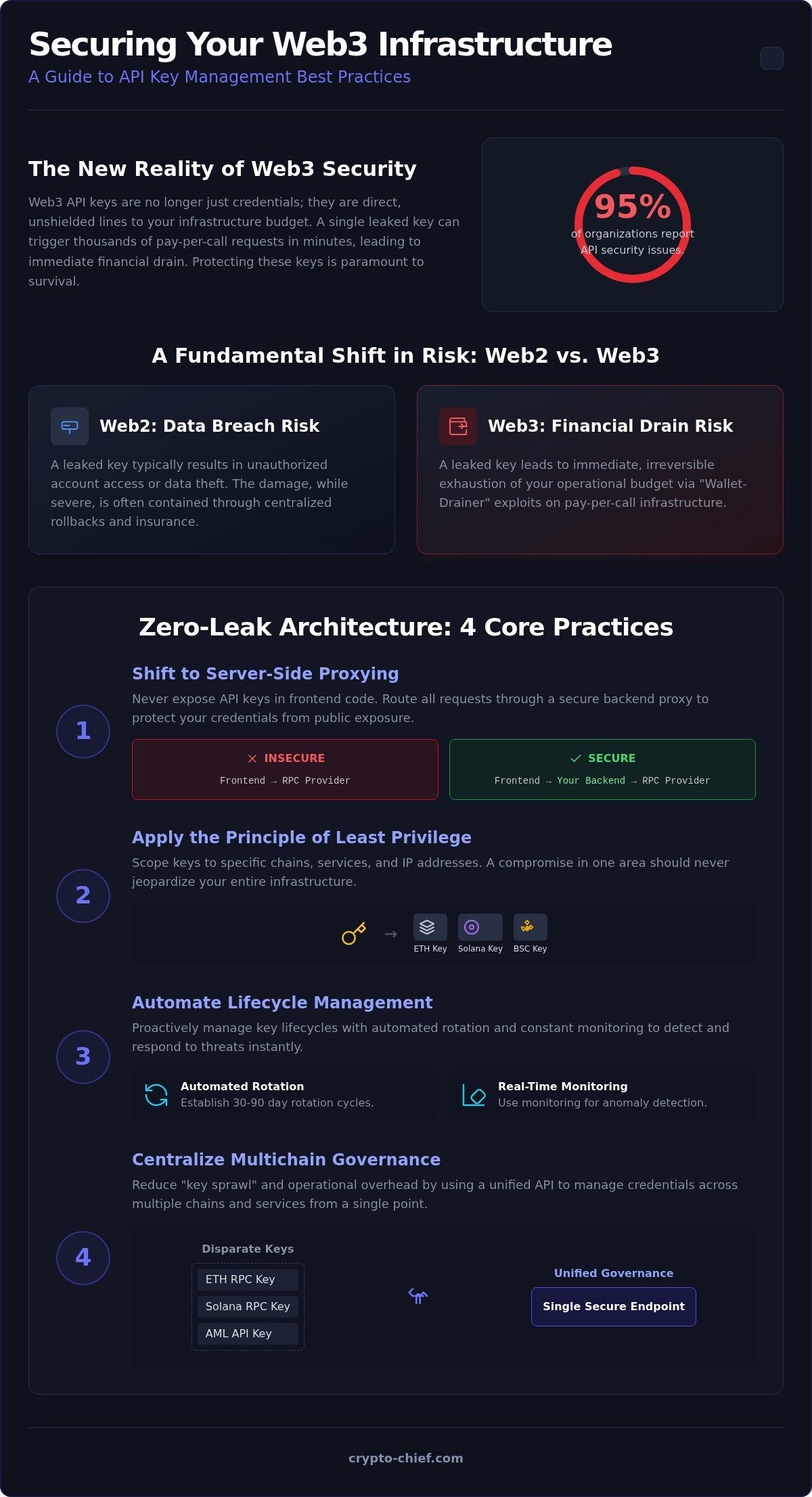
- Shift your security model from client-side exposure to server-side proxying to eliminate the risk of frontend credential theft.
- Implement the Principle of Least Privilege by scoping keys to specific chains and services, ensuring a compromise in one area doesn't jeopardize your entire infrastructure.
- Learn the best practices for web3 api key management to establish automated 30-90 day rotation cycles and real-time usage monitoring for instant anomaly detection.
- Reduce operational overhead by centralizing multichain RPC governance and AML Intelligence through a single, secure architectural point.
Why Web3 API Key Management is Different from Web2
Web3 API key management represents the technical governance of credentials used to access RPC nodes, data indexers, and non-custodial processing services. In the traditional Web2 model, a leaked API key typically results in a data breach or unauthorized account access. While severe, these risks are often mitigated by centralized rollbacks or data insurance. Web3 infrastructure operates on a different logic. Here, a leaked credential is less about data theft and more about the immediate, irreversible exhaustion of your operational capital.
The architectural shift toward decentralized networks means your keys are the primary gatekeepers to expensive, compute-heavy resources. If your security posture fails, you aren't just losing data; you're losing the liquid balance required to keep your application alive. This reality demands a transition from simple protection to a comprehensive strategy of financial and technical governance.
The Financial Risk of Pay-Per-Call Infrastructure
In 2026, the pay-per-call model dominates the landscape for high-performance RPC and indexing services. This pricing structure has given rise to a new breed of "Wallet-Drainer" exploits targeting infrastructure rather than user wallets. Automated botnets constantly scan for exposed endpoints to perform high-frequency data scraping or arbitrage execution at your expense. Within minutes, a single leaked key can trigger thousands of calls, draining your prepaid balance before your team even receives an alert.
Adhering to best practices for web3 api key management requires treating every API token as a financial asset. Developers must implement a dual-layer defense: hard limits that terminate access when a budget is reached, and soft limits that trigger immediate notifications. Without these controls, your infrastructure budget remains an open target for opportunistic exploitation.
Multichain Complexity and Credential Proliferation
Modern decentralized applications rarely exist in isolation on a single network. The complexity of managing unique credentials for Ethereum, Solana, BSC, and Layer 2s creates a massive attack surface known as "key sprawl." Using identical keys across different environments is a dangerous shortcut that compromises your entire stack if a single chain's environment is breached. This proliferation of secrets increases the likelihood of human error during deployment.
A unified blockchain API serves as a strategic solution to this sprawl. By normalizing data across multiple networks, platforms like Crypto Chief allow developers to consolidate their governance. Instead of managing dozens of disparate provider keys, you utilize a centralized dashboard to oversee your multichain RPC and AML Intelligence needs. This approach reduces infrastructure overhead while ensuring that your security protocols remain consistent across every chain you support.
Architecting for Zero Leakage: Secure Storage and Deployment
The cardinal rule of Web3 development is absolute: never expose your API keys in frontend code, client-side JavaScript, or mobile applications. While it's tempting to call an RPC provider directly from the browser for simplicity, doing so hands your infrastructure budget to anyone with a "View Source" tab. This exposure is the most frequent cause of balance exhaustion in decentralized projects. To maintain best practices for web3 api key management, you must treat your client-side environment as a hostile space where no secret is safe.
Most teams start by utilizing environment variables via .env files. While effective for local development, these files are a high-risk vector for accidental Git commits. A single push to a public repository can compromise your credentials in seconds. For production environments, you should transition to advanced secrets management tools like HashiCorp Vault, AWS Secrets Manager, or Google Secret Manager. These platforms provide encrypted storage and programmatic access, ensuring your keys remain decoupled from your source code.
The "Backend Proxy" Pattern for dApps
Traditional dApp architectures often lack a robust backend, leading developers to hardcode keys into their frontend frameworks. This approach is inherently insecure. Implementing a lightweight middleware or proxy layer is the standard solution. By routing requests through a secure server, you can hide the provider key and perform additional validation before forwarding the call to the blockchain. While this introduces a minor latency trade-off, the security benefits of keeping your credentials private far outweigh the millisecond-scale delay.
Automated Prevention of Key Leaks
Human error is the primary driver of security breaches. Automated tooling acts as your last line of defense. Integrating pre-commit hooks like Gitleaks or TruffleHog into your development workflow allows you to scan for Web3 API keys before they ever reach your repository. These tools identify patterns matching known provider formats and block the commit if a secret is detected. Your CI/CD pipeline should then handle the injection of keys at the production runtime level, ensuring that no human ever sees the raw credential during the deployment process.
The "secret-zero" problem in Web3 infrastructure deployment refers to the initial, master credential required to access all other stored secrets in your management system. Solving this requires strict identity-based access controls and machine-to-machine authentication. By combining automated scanning with a robust proxy layer, you build a resilient foundation that protects your resources. For developers scaling multichain applications, Crypto Chief's secure processing API provides the granular governance needed to manage these credentials without compromising on speed or reliability.
Granular Access Control: Scoping and IP Restrictions
Securing the physical or virtual location of your keys is only half the battle. You must also define the precise boundaries of what those keys are authorized to do. Following the Principle of Least Privilege ensures that even if a credential is compromised, the "blast radius" is strictly contained. For instance, a key dedicated to a specific chain, such as Polygon, should never have permissions for Ethereum or BSC. This multichain scoping is a cornerstone of best practices for web3 api key management, preventing a single point of failure from cascading across your entire multichain infrastructure.
Your AML Intelligence key serves a fundamentally different purpose than your RPC key. Combining these functionalities into a single credential creates unnecessary risk and complicates your audit trails. By separating these concerns, you ensure that high-velocity RPC calls don't share the same security profile as sensitive compliance checks. For fixed server environments, such as backend nodes or indexers, IP allowlisting remains your most effective perimeter defense. If you must develop in browser-based environments where a proxy is temporarily unavailable, implementing HTTP Referrer restrictions provides a secondary, albeit less robust, layer of protection.
Defining Scopes for Web3 Services
Effective scoping differentiates between "Read" and "Write" permissions. A key used only for balance checks or event monitoring shouldn't have the authority to broadcast transactions. Advanced developers further restrict keys to specific smart contract addresses or event streams, minimizing the potential for unauthorized interactions. Consult the Crypto Chief Documentation for technical implementation details and examples of how to structure these scoped API requests to ensure maximum operational integrity.
Dynamic IP and Serverless Challenges
Serverless environments like AWS Lambda or Vercel Functions present unique challenges for traditional IP allowlisting due to their ephemeral nature. To maintain a secure perimeter without sacrificing the scalability of serverless architecture, teams often utilize NAT Gateways or dedicated static IP providers to route traffic through a consistent address. When these technical solutions are unfeasible, granular scoping becomes your primary defense. By limiting a key's functional range to the bare minimum required for the task, you mitigate the risk associated with its broad network accessibility.
Lifecycle Management: Monitoring and Rotation
Security isn't a static state; it's a continuous process of renewal. Even with the most robust storage, the integrity of a credential naturally degrades the longer it remains active. In 2026, the industry standard for best practices for web3 api key management has shifted from reactive replacement to proactive, automated rotation every 30 to 90 days. This lifecycle approach ensures that even if a secret is silently harvested, its utility for an attacker is strictly time-limited.
Effective auditing starts with clear identification. Using descriptive prefixes, such as cc_live_ for production and cc_test_ for development, allows your security team to filter logs and identify anomalies instantly. If a breach is confirmed, you need established revocation protocols that allow you to kill a key without crashing your dApp. This requires your application to be built with "hot-swappable" credential logic, ensuring your infrastructure remains resilient during emergency security updates. You don't want to choose between a drained balance and a broken service.
How to Rotate Keys with Zero Downtime
Maintaining uptime during a rotation is a critical requirement for high-traffic Web3 applications. Following a disciplined four-step process prevents service interruptions:
- Step 1: Generate the new key and deploy it alongside the existing one in a "dual-key" configuration within your secrets manager.
- Step 2: Monitor your traffic logs to verify that the new key is successfully authenticating and making requests.
- Step 3: Deprecate the old key by removing it from the active environment after a 24-hour overlap period, allowing all cached sessions to expire.
- Step 4: Perform a final audit of usage logs to ensure no legacy systems are still attempting to use the decommissioned credential.
Real-Time Usage Alerts and Anomaly Detection
Static security is insufficient for the volatile nature of blockchain infrastructure. You must integrate your Web3 API logs with professional observability tools like Datadog or Prometheus to create a baseline of normal activity. Setting up automated alerts for Slack or Discord when usage exceeds 120% of your rolling daily average is a vital early-warning system. These thresholds allow you to catch compromised keys before they exhaust your entire budget.
Leveraging real-time blockchain webhooks provides an additional layer of visibility into your infrastructure health, allowing you to stream event data directly into your monitoring stack. For enterprises requiring a fully managed, secure environment, Crypto Chief's PSP Whitelabel solutions offer the integrated governance tools needed to automate these complex lifecycle workflows. By treating your keys as ephemeral assets, you significantly reduce your long-term risk profile.
Securing Your Web3 Stack with Crypto Chief
High-performance infrastructure requires more than just a provider; it needs a partner that understands the financial stakes of multichain governance. Crypto Chief centralizes your infrastructure management, providing a single, hardened point of entry for your entire operational stack. Managing multiple providers often results in a fragmented security posture, but our unified dashboard brings RPC and AML Intelligence under a cohesive framework. This consolidation is central to the best practices for web3 api key management, as it allows you to apply consistent security policies across every chain you support without the overhead of juggling dozens of disparate credentials.
Our non-custodial crypto processing architecture ensures that you maintain absolute control over your private keys while our API handles the underlying network complexity. This model effectively removes the risk of custodial theft, positioning the API key as a functional tool for processing rather than a master key to your liquid assets. By leveraging our granular usage controls and hard limits, you can operate the pay-per-call model with total confidence. We treat infrastructure security as a first-class citizen, ensuring that your prepaid balances remain protected against unauthorized spikes or botnet activity through native, platform-level safeguards.
Unified Infrastructure, Simplified Security
Consolidation is your most effective strategy for reducing a project’s attack surface. When you move away from a patchwork of providers, you minimize the potential points of failure where credentials can be intercepted or mismanaged. Crypto Chief also facilitates RPC request batching, which improves both your security profile and your cost-efficiency by reducing the total number of calls required to synchronize state. For enterprises requiring a more bespoke environment, our Whitelabel solution provides the custom infrastructure security and branding necessary to scale with stability and professional confidence.
Getting Started with Secure Web3 APIs
Your first API call on Crypto Chief should be a reflection of your commitment to stability. We recommend starting with a scoped test key to verify your integration before moving to production environments. It is vital to consult our documentation to implement the latest security headers and authentication patterns, ensuring your requests are signed and validated correctly from day one. Do you have the right architecture to prevent budget-draining leaks? Secure your infrastructure today and focus on the creative logic that sets your dApp apart, knowing your foundation is logically sound and expertly protected.
Future-Proofing Your Web3 Infrastructure Governance
The landscape of 2026 demands a shift from passive protection to active financial governance. By migrating secrets to a secure backend proxy and enforcing strict lifecycle rotations, you eliminate the primary vectors for balance exhaustion. Adopting these best practices for web3 api key management ensures your project remains resilient against the evolving threats of automated botnets and credential leakage. You've already mastered the strategies for scoping permissions and monitoring usage to maintain a zero-leak environment.
Now is the time to consolidate your multichain operations into a single, high-performance point of control. Crypto Chief provides a robust foundation through our unified multichain infrastructure, allowing you to manage RPC and real-time AML intelligence integration from one dashboard. Our no-custody processing API ensures you retain absolute control while we handle the underlying network complexity. Start Building Securely with Crypto Chief’s Unified Web3 API and return your focus to the innovative logic of your dApp. Your infrastructure is the engine of your vision; keep it secure, keep it scalable, and continue building with professional confidence.
Frequently Asked Questions
Is it safe to store Web3 API keys in a .env file?
Storing keys in a .env file is acceptable for local development but poses a high risk for production environments. A single accidental commit to a public repository can expose your infrastructure budget to botnets. To maintain best practices for web3 api key management, you should utilize dedicated secrets management services like AWS Secrets Manager or HashiCorp Vault. These tools decouple your credentials from the source code and provide encrypted, programmatic access.
How often should I rotate my blockchain RPC API keys?
The 2026 industry standard for blockchain RPC API keys is rotation every 30 to 90 days. Regular rotation limits the window of opportunity for an attacker if a key is silently compromised. You should implement a "dual-key" configuration during the handover period to ensure zero downtime. This proactive lifecycle management is essential for maintaining the long-term integrity of your multichain infrastructure and preventing unauthorized resource exhaustion.
What should I do if my Web3 API key is leaked on GitHub?
You must revoke the compromised key immediately through your provider’s dashboard to stop further unauthorized calls. After revocation, audit your usage logs to identify the scale of the leak and check for any suspicious activity. You should also rotate any other secrets that may have been stored in the same environment. Finally, implement pre-commit scanning tools like Gitleaks to prevent similar exposures in your future deployment pipelines.
Can I restrict an API key to a specific blockchain network?
Yes, granular scoping allows you to restrict an API key to a specific blockchain network, such as Polygon or Ethereum. This practice follows the Principle of Least Privilege, ensuring that a compromised key cannot be used to access your resources on other chains. Consolidation through a unified platform like Crypto Chief simplifies this process, allowing you to manage these network-specific restrictions from a single point of technical governance.
How do I prevent my API key from being used for unauthorized crypto processing?
Preventing unauthorized usage requires a combination of hard budget limits and functional scoping. You should restrict your processing keys so they can only interact with specific smart contract addresses or event streams. Implementing IP allowlisting for your backend nodes further secures the perimeter. By using a non-custodial processing architecture, you ensure the API key only facilitates transaction requests without ever gaining direct control over your underlying private keys.
What is the difference between an API key and a private key in Web3?
An API key grants access to infrastructure services like RPC nodes and data indexers, while a private key provides direct control over a blockchain wallet and its assets. Losing an API key results in a drained infrastructure budget; losing a private key results in the permanent loss of funds. Understanding this distinction is vital for best practices for web3 api key management, as it dictates where you should apply different levels of cryptographic security.
Does IP allowlisting work with serverless dApp architectures?
IP allowlisting is challenging in serverless environments due to ephemeral IP addresses, but it is achievable through NAT Gateways. By routing your serverless traffic through a fixed gateway, you maintain a consistent IP for your provider's allowlist. If this infrastructure is too complex, your best defense is strict functional scoping. This ensures the key is only authorized for specific actions, regardless of the network location from which the request originates.
How can I monitor my Web3 API usage in real-time to prevent overspending?
Real-time monitoring is best achieved by integrating your API logs with observability platforms like Datadog or Prometheus. You can set up automated alerts that trigger when usage exceeds a specific percentage of your daily average. Using real-time blockchain webhooks also helps track infrastructure health and event streaming. These tools provide the visibility needed to detect anomalies early, allowing you to revoke keys before a leak causes significant financial damage.