
Why are you still paying for idle server capacity when your dApp's traffic only peaks for a few hours a day? Most engineering teams accept unpredictable monthly invoices as an unavoidable friction point in scaling. You've likely experienced the frustration of tiered subscription plans that charge for capacity you never use, or the technical debt of maintaining separate integrations for every new chain you support. Managing your web3 infrastructure total cost of ownership shouldn't feel like a speculative exercise where performance and budget are constantly at odds.
It's time to move beyond the constraints of legacy pricing models and fragmented tech stacks. In this article, you'll learn how to master the technical and architectural strategies required to slash your blockchain infrastructure expenses while maintaining elite, high-performance multichain connectivity. We'll examine how transitioning to granular pay-per-call systems, utilizing a Unified API, and implementing real-time EventStream webhooks can stabilize your bottom line. By the end, you'll have a clear roadmap to predictable spending, reduced latency, and a simplified infrastructure that scales effortlessly into 2026.
Key Takeaways
- Analyze the shift from legacy tiered subscriptions to high-performance models that prioritize operational efficiency and eliminate the cost of idle capacity.
- Learn how a granular pay-per-call model stabilizes your web3 infrastructure total cost of ownership by aligning expenses directly with real-time user activity.
- Reduce the "maintenance tax" of multichain scaling by using a Unified API to normalize data across diverse blockchain networks through a single, streamlined integration.
- Master technical optimizations like request batching and switching from polling to EventStream webhooks to eliminate redundant API calls and unnecessary latency.
- Build a leaner, enterprise-ready tech stack by consolidating fragmented services into a single, high-performance infrastructure foundation.
The State of Web3 Infrastructure Total Cost of Ownership in 2026
In 2026, the complexity of decentralized ecosystems has redefined how architects calculate their bottom line. Calculating your web3 infrastructure total cost of ownership is no longer a simple matter of comparing the price per million requests. It requires a holistic view of request volume, global latency, and the structural stability of your connections. Many teams fall into the trap of looking only at the sticker price, ignoring the massive overhead created by API sprawl as they scale across multiple chains. Supporting ten different networks often results in ten times the integration effort, as developers struggle with inconsistent data formats and fragmented provider dashboards. Hidden costs, such as the developer hours spent on manual data normalization and the compute power wasted on constant polling, often outweigh the direct cost of the API calls themselves.
The Shift from Subscriptions to Granular Billing
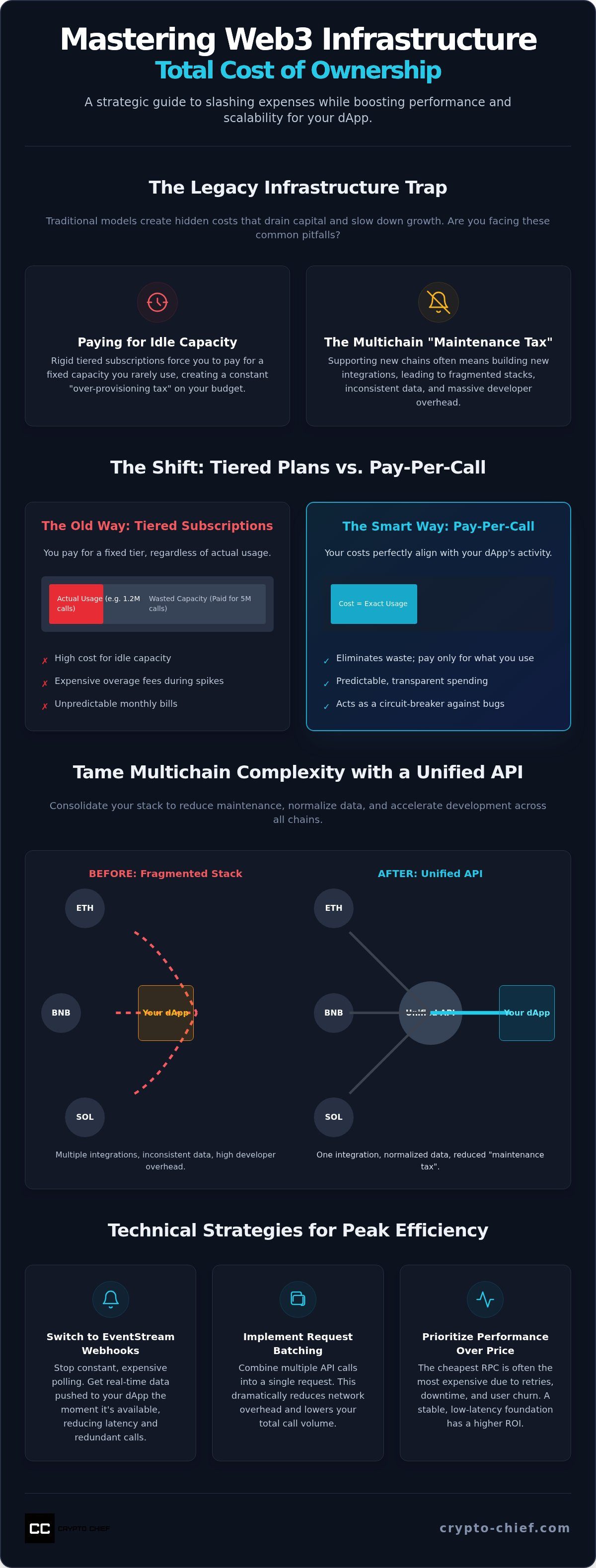
Paying for unused capacity in monthly tiers is a legacy anti-pattern that drains capital from high-growth dApps. Fixed plans assume a predictable traffic pattern that rarely exists in the volatile world of blockchain. When your user activity spikes, you're forced into expensive overages; when it dips, you're paying for idle resources you don't need. A more efficient approach utilizes prepaid token balances, where every cent spent corresponds to a specific action. This model provides the budget transparency needed to forecast expenses accurately without the over-provisioning tax associated with traditional providers. It transforms infrastructure from a rigid monthly liability into a flexible, utility-based asset.
Performance vs. Price: The False Trade-off
The cheapest RPC Gateway often becomes the most expensive line item when you factor in retry logic and user churn. Low-cost providers frequently suffer from high latency, forcing your application to send the same request multiple times to ensure success. This redundancy bloats your total call volume and degrades the user experience. You must also account for the real cost of downtime, especially for transaction-heavy applications where a few minutes of instability can lead to thousands in lost revenue. Infrastructure ROI is the ratio of successful, low-latency throughput to the total operational expenditure required to maintain that connectivity. By prioritizing structural integrity over bottom-barrel pricing, you build a foundation that actually reduces your web3 infrastructure total cost of ownership as you scale.
The Pay-Per-Call Advantage: Granular Cost Control
Standard Tier 1 providers often lock engineering teams into rigid subscription buckets that rarely align with actual usage. If your dApp processes 1.2 million requests but your plan jumps from 1 million to 5 million, you're essentially paying an over-provisioning tax that inflates your web3 infrastructure total cost of ownership. By shifting to a pay-per-call model, you ensure that every dollar spent is tied to a specific, revenue-generating event. This approach eliminates the waste associated with idle capacity and allows you to scale your infrastructure expenses in direct proportion to your user activity and growth.
One of the most significant architectural efficiencies is the ability to manage multiple essential services from a single prepaid balance. Whether you're fetching block data through an RPC Gateway or running critical compliance checks via AML Intelligence, a unified credit system removes the administrative friction of managing separate vendors and billing cycles. It's a builder-centric solution that prioritizes logic and structural integrity over complex accounting.
Consider the "infinite loop" scenario that haunts many DevOps teams. A bug in a new deployment might trigger thousands of redundant requests in minutes. In a traditional post-paid or auto-scaling environment, this could lead to a catastrophic bill by morning. With a prepaid model, the system simply stops when the balance is exhausted, acting as a hard circuit breaker that protects your company's runway from unexpected technical debt.
Comparing Pay-As-You-Go vs. Tiered Plans
The break-even point for subscriptions is often much higher than teams realize, especially when scaling across high-throughput networks like Solana or BNB Smart Chain. While a tiered plan might look attractive at a glance, the cost-per-request logic changes when you factor in the provider's overhead and the price of unused "buffer" requests. Transitioning to a granular model allows you to maintain healthy unit economics even during market downturns. For a deeper dive into these architectural choices, see our Web3 RPC Gateway: The Architect’s Guide to Multichain Infrastructure in 2026.
Budgeting with Prepaid API Token Balances
Financial predictability is the cornerstone of sustainable scaling. Developers don't want to build in environments where a single misconfiguration leads to a five-figure surprise. By using prepaid balances, you can set up automated alerts and hard caps that provide total peace of mind. This model allows your team to focus on shipping features rather than monitoring a ticking clock of expenses. Integrating these costs into your dApp’s dashboard makes infrastructure a transparent, manageable part of your operational strategy. You can create an account and start with a prepaid balance today to see this efficiency in action.
Unified APIs: Reducing the Cost of Multichain Complexity
The developer "maintenance tax" is a silent drain on dApp profitability. When you expand to support ten different blockchains, you're typically forced to manage ten distinct integration paths, each requiring its own SDK, error-handling logic, and security audit. This fragmentation doesn't just slow down your roadmap; it exponentially increases your web3 infrastructure total cost of ownership. By shifting to a Unified API, you consolidate these disparate connections into a single, high-performance integration point. This architectural choice significantly reduces your codebase size and allows your engineering team to focus on building user-facing features rather than debugging inconsistent data formats across EVM and non-EVM chains. Accelerating your time-to-market becomes a reality when adding support for a new network requires zero changes to your core logic.
Data Normalization as a Cost Lever
Writing custom parsers for every new blockchain integration is an expensive, error-prone process that consumes hundreds of senior engineering hours. Every chain handles decimals, hex formats, and event logs differently; a single discrepancy in how a transaction is parsed can lead to critical failures. Standardized response formats eliminate this risk by providing a predictable data structure regardless of the underlying network. This level of normalization reduces bug-related infrastructure waste and ensures that your internal data pipelines remain stable as you scale. For a deeper look at these technical efficiencies, explore The Architect’s Guide to a Unified Web3 Developer Platform in 2026. Investing in data consistency today prevents the massive operational expenses associated with technical debt tomorrow.
Future-Proofing Infrastructure
Abstraction layers provide a strategic buffer against vendor lock-in and the shifting sands of the blockchain ecosystem. If a specific network experiences a sudden performance dip or a pricing hike, a unified gateway allows you to reroute traffic or adjust your backend strategy without a full codebase rewrite. This flexibility is essential for maintaining a low web3 infrastructure total cost of ownership over the long term. Switching RPC endpoints behind a unified gateway is a seamless process that happens in the background, ensuring your users never experience a service interruption. It's a builder-centric approach that prioritizes structural integrity and logic, allowing you to decommission legacy integrations and maintain a lean, modern tech stack that is ready for 2026.
4 Technical Strategies to Reduce Web3 API Expenses
Optimizing your web3 infrastructure total cost of ownership requires moving beyond architectural selection into the granular management of your request logic. Even the most efficient pricing model can be undermined by inefficient code that triggers redundant or low-value calls. By implementing specific technical optimizations, engineering teams can maintain high-performance connectivity while significantly reducing their operational expenditure. These strategies focus on maximizing the utility of every connection and ensuring that your infrastructure resources are reserved for legitimate, revenue-generating activity.
Optimizing RPC Request Batching
Grouping multiple JSON-RPC calls into a single request is one of the most effective ways to lower billable call counts for data-heavy dashboards. Instead of making separate, sequential calls for twenty different transaction receipts, you can wrap them in a single array. This approach reduces network overhead and allows your application to process data more efficiently. For a deep dive into implementation, see our RPC Request Batching for Cost Reduction: The 2026 Developer’s Efficiency Guide. A typical implementation might group multiple eth_getTransactionReceipt calls into one batch, ensuring that you only pay for the underlying data processing rather than multiple connection handshakes.
Leveraging Webhooks via EventStream
Constant polling is an expensive legacy habit that drains your budget without providing real-time value. Sending 10,000 requests just to check if a specific balance has changed is a massive waste of resources when compared to a single webhook notification. Switching to EventStream allows your server to remain idle until a specific on-chain event occurs. This strategy offloads the monitoring burden to your provider and slashes your monthly API bill by eliminating redundant traffic. It's a builder-centric way to ensure your application responds instantly to smart contract events without the overhead of a heavy polling architecture.
Smart Data Filtering and AML Integration
Filtering high-risk or spam transactions at the API level saves significant downstream processing costs. By integrating AML Intelligence into your initial request flow, you can block interactions from sanctioned or high-risk addresses before they trigger expensive data normalization or database writes. This risk-scoring approach allows you to prioritize your API resources for legitimate users while maintaining a secure environment. You can register for an API key today to start implementing these filtering strategies and protecting your infrastructure runway. Additionally, implementing local caching strategies using Redis for static data like block headers can further reduce the frequency of external calls, ensuring you only ping the provider when fresh on-chain state is absolutely required.
Building a Lean Web3 Stack with Crypto Chief
Consolidating fragmented services is the final step in mastering your web3 infrastructure total cost of ownership. Crypto Chief provides a high-performance foundation that replaces the need for multiple specialized providers. By integrating the RPC Gateway with Crypto Processing, you create a technical synergy that streamlines both data retrieval and transaction management. This unified approach eliminates the friction of managing disparate API keys and billing cycles. It allows your team to scale globally without the financial penalties typically associated with rapid growth.
A primary advantage of this lean stack is the removal of architectural redundancy. When your payment processing and node connectivity live within the same ecosystem, you reduce the number of external dependencies that can fail. This stability is empowering for developers who need to ship fast without compromising on structural integrity. It transforms your infrastructure from a collection of loosely coupled tools into a single, decisive engine for growth.
Unified Infrastructure for Global Scale
Building for a global audience requires infrastructure that maintains stability across every region. Crypto Chief offers low-latency endpoints for Ethereum and other major networks; this ensures your users experience seamless connectivity regardless of their location. Transitioning from a legacy provider to this modern stack is a straightforward process designed to prevent downtime. You can reroute your requests through our high-performance engine while maintaining the logic of your existing codebase. It is a builder-centric transition that prioritizes uptime and performance.
Strategic Budgeting for 2026 and Beyond
Financial clarity is essential for long-term sustainability in the decentralized economy. The Crypto Chief dashboard provides real-time cost attribution by project, allowing you to see exactly where your resources are being deployed. This level of granularity is vital when planning for high-volume events like NFT drops or protocol launches. By using prepaid tokens, you can lock in your budget and avoid the "success tax" of traditional tiered models. The long-term ROI of an optimized strategy is found in the hundreds of developer hours saved and the elimination of unpredictable monthly invoices.
It is time to simplify your stack. You can set up your first prepaid balance today and begin integrating the Unified API into your workflow. Taking this step ensures your web3 infrastructure total cost of ownership remains manageable as you scale into 2026 and beyond.
Master Your Infrastructure ROI for 2026
Scaling a decentralized application into 2026 requires more than just high performance; it demands absolute financial precision. You've seen how legacy tiered models create unnecessary waste and how fragmented integrations inflate your development budget. By adopting a granular pay-per-call model and leveraging a Unified API that supports 20+ blockchains, you can finally align your operational expenses with real-world activity. These strategies, combined with technical shifts like EventStream webhooks, are the essential keys to stabilizing your web3 infrastructure total cost of ownership.
It is time to stop overpaying for idle capacity and start building on a foundation designed specifically for efficiency and logic. Crypto Chief provides the enterprise-grade RPC Gateway performance and predictable billing your project needs to thrive in a competitive landscape. Start optimizing your Web3 infrastructure with Crypto Chief today. Your roadmap to a leaner, more powerful tech stack begins with a single integration that removes friction and empowers your team to focus on what matters most. Your journey toward a more sustainable and scalable future is just one configuration away.
Frequently Asked Questions
How does pay-per-call pricing differ from monthly API subscriptions?
Pay-per-call pricing charges you only for the specific requests your application makes, whereas monthly subscriptions often require you to pay for a fixed capacity that may go unused. This granular model is a primary lever for managing your web3 infrastructure total cost of ownership. It eliminates the over-provisioning tax where teams pay for high-tier plans just to handle occasional traffic spikes. Instead, your costs scale in direct proportion to your actual user activity and revenue.
Can request batching really reduce my Web3 infrastructure costs?
Request batching reduces costs by grouping multiple JSON-RPC calls into a single network request, effectively lowering the number of billable interactions with your provider. For data-heavy applications that need to fetch numerous transaction receipts or block headers simultaneously, this technique is highly efficient. It minimizes the overhead of multiple connection handshakes and ensures you only consume the resources necessary for the underlying data processing. This architectural optimization is essential for maintaining a lean operational budget.
What is the most expensive type of Web3 API call?
The most expensive API calls are typically those that require high compute intensity or extensive data scanning, such as eth_getLogs with broad filters or complex trace calls. These requests consume more compute units because the provider must scan large portions of the blockchain state to return a result. By optimizing your filter parameters and using local caching for static data, you can reduce the frequency of these high-weight calls and stabilize your overall infrastructure expenditure.
How do real-time webhooks help in reducing API expenses?
Real-time webhooks via EventStream eliminate the need for constant polling, which is one of the most common sources of budget bloat. Instead of sending thousands of requests to check for a state change, your server remains idle until the provider pushes a notification. This shift significantly reduces unnecessary API traffic and lowers the server-side load required to monitor smart contract events. It's a more logical, event-driven approach to maintaining real-time data synchronization without the overhead of redundant requests.
Is a Unified API more expensive than using separate RPC providers?
While a Unified API may have a similar per-call cost to individual providers, it drastically reduces the maintenance tax associated with managing multiple chain-specific integrations. The real savings come from reduced developer hours, simplified error handling, and the elimination of redundant SDKs. When you calculate your web3 infrastructure total cost of ownership, the labor cost of writing and maintaining custom parsers for ten different chains often outweighs the direct API fees of a consolidated platform.
How does AML pre-filtering save money on transaction processing?
AML pre-filtering saves money by blocking high-risk or sanctioned interactions at the gateway level before they trigger expensive downstream processing. If your dApp processes a transaction from a high-risk address, you may incur costs for data normalization, database storage, and potential compliance remediation. By using AML Intelligence to score addresses during the initial request flow, you reserve your infrastructure resources for legitimate users and prevent the technical debt associated with processing illicit activity or spam.
What happens if my prepaid API token balance runs out?
If your prepaid API token balance is exhausted, the service will pause until additional credits are added. This mechanism serves as a critical budget circuit breaker, preventing the infinite loop scenarios where a technical bug could trigger an astronomical, unexpected bill. Unlike post-paid models that can lead to five-figure surprises, a prepaid system ensures you never spend more than you've allocated. You can set up automated alerts to notify your team well before the balance reaches zero.
How can I track which part of my dApp is consuming the most API credits?
You can track credit consumption through a real-time dashboard that offers granular cost attribution by project or API key. This visibility allows you to identify exactly which features or services, such as the RPC Gateway or AML Intelligence, are driving your expenses. By analyzing these usage patterns, you can make informed decisions about where to implement caching or request batching. This data-driven approach is fundamental to optimizing your long-term infrastructure ROI and maintaining a lean tech stack.