
In 2026, a 100-millisecond delay in your RPC response isn't just a minor lag; it's a structural failure that can cost your dApp its competitive edge in a hyper-congested market. You’ve likely felt the frustration of inconsistent node latency ruining the user experience, or struggled to decode tiered pricing models while trying to establish reliable web3 rpc performance benchmarks. It's a common hurdle for builders who need stability without the overhead.
This guide provides a clear framework for evaluation, allowing you to look beyond mean latency and focus on p95 and p99 metrics that actually dictate real-world performance. We'll examine why current standards for chains like Polygon and BNB require more than just raw speed, focusing instead on the intersection of data integrity and cost-per-call efficiency. We'll also explore how a unified API approach can eliminate architectural latency. By the end, you'll have the tools to reduce infrastructure costs and build a more responsive, enterprise-ready decentralized application.
Key Takeaways
- Shift your focus from basic uptime to advanced web3 rpc performance benchmarks by analyzing p95 and p99 latency to capture critical tail-end performance data.
- Move beyond misleading synthetic ping tests and adopt weighted traffic simulations to measure how infrastructure handles high-compute methods like
eth_call. - Implement the Performance-to-Price (P2P) metric to expose hidden inefficiencies in tiered subscription models and optimize your infrastructure overhead.
- Reduce architectural latency and simplify multichain scaling by transitioning to a unified API that provides high-performance access across dozens of networks.
The Evolution of Web3 RPC Performance Benchmarks in 2026
In 2026, defining performance requires looking past raw node speed. It's about how your infrastructure handles high-throughput demands under pressure. A simple Remote Procedure Call (RPC) might seem basic, but in a multichain environment, it's the foundation of your user experience. Legacy uptime metrics don't cut it anymore. If your node is "up" but takes 500ms to respond to an eth_call, your dApp is effectively down for the user. The rise of Layer 2 solutions and specialized app-chains has complicated the landscape, making standard web3 rpc performance benchmarks harder to pin down. We're seeing a shift toward "Architectural Efficiency," which measures how well your stack handles this fragmentation without sacrificing data integrity or developer velocity.
Why Milliseconds Matter: The Impact on User Retention
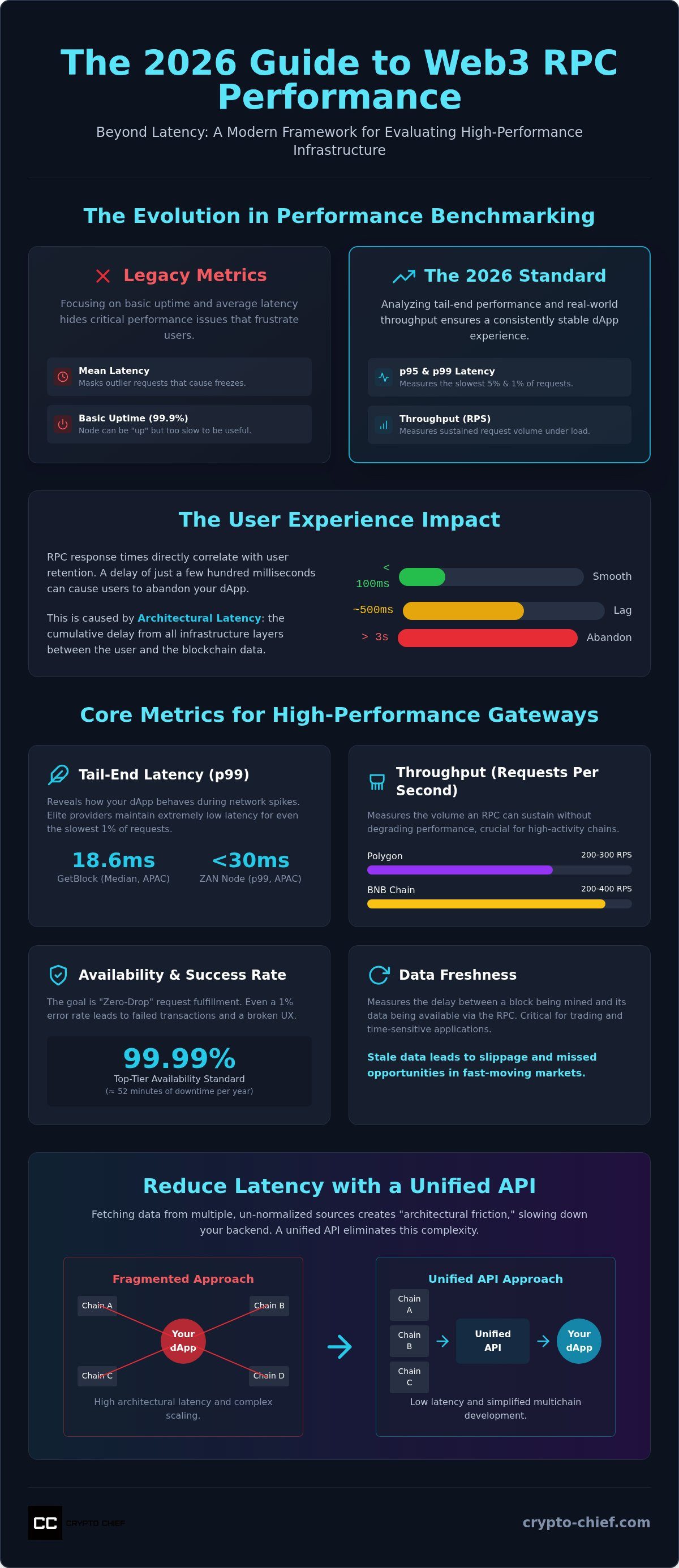
Frontend bounce rates correlate directly with RPC response times. If a wallet balance takes three seconds to load, the user will likely close the tab. Architectural Latency is the cumulative delay generated by the sum of all infrastructure layers between a client request and the final data response. While JSON-RPC remains the standard for one-off queries, developers building real-time dashboards now prioritize WebSockets. This allows for persistent, low-latency connections that are essential for real-time event streaming and high-frequency trading. When milliseconds are the difference between a successful trade and a failed transaction, your choice of protocol becomes a business-critical decision.
The 2026 Standard for Blockchain Infrastructure Stability
The baseline expectation for enterprise infrastructure has moved from 99.9% uptime to "Zero-Drop" request fulfillment. It's not enough for a service to be available; every single request must return a valid response without timeout errors, especially during periods of network congestion. For a global audience, strategic node distribution is non-negotiable. Infrastructure providers must manage data consistency across geographically dispersed nodes so that a user in one region sees the same blockchain state as a user in another. Achieving this level of stability requires a unified approach to data normalization, which you can explore further in our technical documentation. This ensures that performance remains elite even as you scale across dozens of blockchains simultaneously.
Key Metrics for Evaluating High-Performance RPC Gateways
Average response times tell a partial story. Real-world web3 rpc performance benchmarks rely on p95 and p99 latency, which track the slowest 5% and 1% of requests respectively. These metrics reveal how your dApp behaves during network spikes or high-load events. If your p99 latency jumps to several seconds while your average stays low, your users will experience intermittent, frustrating freezes. In the Asia-Pacific region, for instance, ZAN Node achieves response times under 30ms, while GetBlock reports a median latency of 18.6ms in the same area. These figures represent the elite tier of performance that developers should target.
Throughput measures the volume your provider can sustain without degrading. A provider might boast 20ms latency but fail when you hit 200 Requests Per Second (RPS). High-throughput networks like BNB Chain often require 200 to 400 RPS, while Polygon benchmarks typically sit between 200 and 300 RPS. If your infrastructure cannot handle these volumes, your application will face significant bottlenecks during periods of high on-chain activity.
Success rates are the silent killers of user experience. An error ratio of even 1% can lead to failed transactions and broken frontends. Data freshness is equally vital; it measures the delta between a block being produced and its data being available via the RPC. In fast-moving markets, stale data leads to slippage and missed opportunities. Top-tier providers in 2026 now commit to 99.99% availability, ensuring that downtime is limited to roughly 52 minutes per year.
Latency vs. Throughput: Finding the Right Balance
A fast node that rate-limits early becomes a bottleneck as your user base grows. Scaling requires testing the limits of your provider using load-testing tools to simulate peak traffic conditions. While EVM chains have established performance profiles, non-EVM chains like Solana demand significantly higher throughput and lower latency to function effectively. Balancing these two metrics ensures your infrastructure remains stable even during viral growth phases.
Data Integrity and Normalization Speed
Fetching raw data from multiple un-normalized sources adds significant processing overhead to your backend. This "architectural friction" slows down everything from wallet balance updates to complex DeFi analytics. Utilizing a unified blockchain API reduces this processing time by delivering pre-normalized data. Benchmarking the speed of smart contract event decoding is essential for applications that rely on real-time on-chain triggers. For developers seeking to streamline these complex workflows, integrating a high-performance Crypto Processing API provides the necessary speed and compliance foundations for global growth.
Benchmarking Methodology: Synthetic vs. Real-World Traffic
Relying on simple "ping" tests to evaluate your infrastructure is a common mistake that leads to skewed data. While a ping measures the basic network round-trip time, it fails to account for the actual computational work a node performs when processing a request. True web3 rpc performance benchmarks require a methodology that mirrors your application's actual behavior. A provider might show a 15ms ping but take 300ms to process a complex eth_call involving multiple state lookups. If your benchmarking doesn't simulate the specific methods your dApp uses, you aren't measuring performance; you're measuring distance.
Simulating weighted traffic patterns is the most effective way to gain actionable insights. Most dApps don't call every method with equal frequency. A typical DeFi application might execute a high volume of eth_getBalance requests but only a few, highly critical eth_call or eth_getLogs requests. Your benchmarks should reflect this ratio. Testing state-heavy requests is particularly vital for DeFi, as these calls require the node to access and process large amounts of historical data, which can vary significantly in speed between providers depending on their indexing strategy and hardware specs.
Network congestion and gas price fluctuations also play a role in how you interpret your data. While RPC speed isn't directly tied to gas prices, periods of high network activity often coincide with increased load on the RPC provider's infrastructure. Benchmarking during these peak times reveals how a provider handles "noisy neighbors" and whether their rate-limiting or load-balancing logic holds up under pressure. Without this context, your data only reflects the best-case scenario, leaving you vulnerable when the network gets busy.
Tools of the Trade: Open Source vs. Provider Benchmarks
Independent verification is essential for making an informed choice. Tools like Chainbench and CompareNodes allow you to run standardized tests against multiple endpoints simultaneously. For more granular control, many developers build custom benchmarking suites using Python or Go to simulate specific user journeys. Warm-up requests must be excluded from valid benchmarks because they artificially inflate performance results by hitting local caches that won't be available during unpredictable real-world traffic spikes. Using these tools ensures your data is grounded in reality rather than marketing claims.
Cross-Chain Performance Consistency
Consistency across multiple networks is often the biggest differentiator between providers. It's common for a service to excel at Ethereum but struggle with the high-throughput demands of Layer 2 solutions or fast chains like Solana. Evaluating a web3 rpc gateway involves measuring response consistency across 10 or more chains to ensure your multichain strategy doesn't have a weak link. You should also measure the latency of cross-chain message passing, as this dictates how quickly your application can respond to events happening on different networks.
Web3 API Cost Optimization: The Pay-Per-Call Performance Ratio
Raw speed is a vanity metric if it drains your operational budget. In 2026, the most sophisticated teams use the Performance-to-Price (P2P) metric to evaluate their infrastructure. This ratio balances latency and throughput against the actual cost per request, ensuring that your web3 rpc performance benchmarks align with your business goals. A provider that offers ultra-low latency but forces you into a massive monthly commitment may have a worse P2P ratio than a slightly slower, pay-per-call service.
Tiered pricing models often hide poor performance in their lower brackets. Developers frequently find themselves paying for "dead capital"; these are unused request quotas that expire at the end of the month. Dead capital hurts growth. This inefficiency makes it difficult to scale responsibly, as you're often forced to jump to a much higher price point just to access a marginal increase in rate limits. Transitioning to pay as you go rpc nodes eliminates this waste by ensuring you only pay for the performance your application actually consumes.
Calculating the real cost of RPC request batching is a critical step for high-volume dApps. By grouping multiple queries into a single call, you can significantly reduce the total number of requests sent to the provider. This strategy not only lowers your direct costs but also improves the perceived speed of your application. Efficiency is the goal.
Eliminating Wasted Overhead in Infrastructure Budgeting
Benchmarks are a powerful tool for justifying infrastructure spend to stakeholders. By comparing the effective cost per request across different providers, you can demonstrate the tangible value of high-performance nodes. Implementing optimized call patterns and removing redundant requests can reduce total infrastructure costs by 30-50% without compromising on the user experience. It's about building a leaner, more efficient stack that prioritizes utility over sheer volume.
Scaling Performance Without Scaling Costs
Smart caching layers can dramatically improve your benchmark results while lowering your monthly fees. By serving frequently accessed data from a local cache, you reduce the load on your RPC provider and minimize the latency for your users. Leveraging Energy and resource-efficient nodes also contributes to a more sustainable and cost-effective architecture. Integrating real-time cost-tracking directly into your developer dashboard allows you to monitor spending trends and identify optimization opportunities before they impact your bottom line. To start building a more efficient multichain infrastructure, explore how our Crypto Processing API can streamline your operations and reduce architectural overhead.
Scaling with Crypto Chief: The High-Performance Multichain Standard
Scaling a decentralized application across multiple networks shouldn't force a compromise between speed and security. Crypto Chief provides unified access to 50+ blockchains through a single, high-performance endpoint, eliminating the need to manage dozens of disparate provider relationships. This structural integrity allows developers to maintain rigorous web3 rpc performance benchmarks across diverse environments, from high-throughput Layer 2s to established mainnets. Our pay-per-call transparency ensures that your infrastructure budget is spent only on the performance you actually use, removing the "dead capital" common in subscription models.
Compliance often introduces unwanted friction into the request lifecycle. Many builders struggle to integrate risk detection without incurring significant latency penalties that degrade the user experience. Crypto Chief solves this by embedding AML Intelligence directly into the infrastructure layer. This integration allows for real-time risk detection and block-level monitoring without the typical round-trip delays associated with external compliance APIs. Coupled with our real-time event streaming, your dApp can respond to on-chain movements instantly, providing the seamlessness that modern users expect.
Architectural Excellence for Enterprise Builders
Reliability is built on intelligent routing and global distribution. Crypto Chief maintains elite p95 standards by automatically directing traffic to the most responsive nodes in our global network. This reduces the cumulative delay of infrastructure layers and ensures that your application remains performant regardless of where your users are located. We've prioritized technical accessibility by providing comprehensive documentation that reduces integration complexity from weeks to hours. For performance-first apps, our non-custodial crypto processing API offers a secure, high-speed foundation for global transaction management.
Future-Proofing Your Web3 Infrastructure
The next generation of Web3 innovators needs a silent, powerful partner that understands the practical challenges of the field. Crypto Chief isn't just a service provider; it's an engine designed for builders who value logic, uptime, and scalability. You don't have to guess how your dApp will perform under pressure. You can start benchmarking your application on our platform today to see the difference that architectural efficiency makes. It's time to move beyond unoptimized infrastructure and embrace a unified standard. Optimize your Web3 performance with Crypto Chief and build the future of decentralized finance with confidence.
Mastering the Architecture of Speed
In 2026, building a resilient dApp requires more than just high-level uptime; it demands a deep understanding of web3 rpc performance benchmarks that reflect real-world traffic patterns. We've explored how prioritizing p95 and p99 latency metrics reveals the true stability of your infrastructure. By moving beyond synthetic ping tests and adopting a Performance-to-Price ratio, you can eliminate the wasted overhead of tiered subscriptions. Efficiency is the goal.
Infrastructure shouldn't be a bottleneck for innovation. With a Unified Multichain API and transparent pay-per-call pricing, you can scale across 50+ blockchains without the complexity of managing multiple providers. Integrating enterprise-grade AML Intelligence ensures compliance without sacrificing the millisecond-level speed your users expect. The right foundation acts as a silent partner. It allows you to focus on your product while the engine handles the load.
Start Building with Crypto Chief’s High-Performance RPC Gateway and transform your infrastructure into a competitive advantage. We're here to help you build faster, more reliable decentralized applications today.
Frequently Asked Questions
What is a good p95 latency for a Web3 RPC provider in 2026?
A good p95 latency for high-performance providers in 2026 typically falls below 50ms for major EVM networks. Stability is key. While median latencies in optimized global regions might hover around 18.6ms, the p95 figure accounts for the slowest 5% of requests. For high-speed networks like Solana, developers should aim for even lower thresholds to ensure dApp responsiveness isn't compromised during peak on-chain activity.
How does pay-per-call pricing compare to tiered RPC plans for high-volume dApps?
Pay-per-call pricing eliminates the "dead capital" inherent in tiered plans, where unused request quotas expire at the end of each billing cycle. It's more efficient. For high-volume dApps, this model ensures you only pay for actual throughput rather than a pre-defined bucket that might not match your traffic patterns. This transparent approach allows for more predictable scaling without the sudden price jumps often found in tiered infrastructure models.
Can I benchmark my own RPC nodes against public endpoints?
Yes, you can use open-source tools like Chainbench or custom scripts written in Python or Go to compare your self-hosted nodes against public endpoints. Data doesn't lie. These web3 rpc performance benchmarks provide a baseline for your specific geographic location and workload. It's essential to exclude "warm-up" requests from your data to ensure the results reflect real-world cold-start performance rather than artificial cache hits.
How does node location affect Web3 RPC performance benchmarks?
Node location is a primary factor in latency due to the physical distance data must travel between the client and the server. Distance matters. Unoptimized infrastructure can see latencies up to 400ms, whereas strategically placed nodes can reduce this to under 30ms. Global distribution ensures that your evaluation remains consistent for users regardless of their physical proximity to the blockchain's primary validator clusters.
What is the difference between synthetic and real-world RPC benchmarking?
Synthetic benchmarking uses basic "ping" tests to measure raw network speed, whereas real-world benchmarking simulates actual dApp traffic patterns. Context is everything. Real-world tests prioritize high-compute methods like eth_call or eth_getLogs, which require significant node resources. Relying on synthetic data alone often masks architectural bottlenecks that only appear when the node is processing complex, state-heavy blockchain queries under load.
How do I reduce my Web3 API expenses without sacrificing response speed?
You can reduce expenses by implementing intelligent caching layers and adopting a pay-per-call pricing model that eliminates wasted subscription overhead. Stop overpaying. Optimizing your request patterns through batching also reduces the total number of calls made to the provider. These strategies allow you to maintain elite response speeds while ensuring that every cent of your infrastructure budget is spent on active, value-generating request fulfillment.
Why is data consistency as important as latency in RPC benchmarks?
Latency matters for speed, but data consistency ensures that your dApp provides accurate information to all users simultaneously. Accuracy is non-negotiable. If your RPC nodes are out of sync, different users might see conflicting blockchain states, leading to failed transactions or broken interfaces. Reliable web3 rpc performance benchmarks must account for the time it takes for a new block to be visible across the entire node network.
Does using a unified API increase the latency of my blockchain requests?
A well-architected unified API actually reduces architectural latency by normalizing data across multiple chains before it reaches your application. It simplifies everything. Instead of your backend performing multiple un-normalized fetches and decoding complex events, the unified layer delivers pre-processed data. This streamlined flow minimizes the processing time required on your end, resulting in faster end-to-end responsiveness for multichain decentralized applications without the need for custom indexing.