
Why are you still paying for idle infrastructure when your users only care about millisecond execution? In a network environment where Arbitrum One now processes up to 2.1 million transactions daily, relying on a congested public arbitrum rpc node is no longer a viable strategy for production-grade dApps. You've likely felt the frustration of hitting unexpected rate limits during peak activity, or the financial drain of monthly subscriptions that charge for capacity you rarely fully utilize. It's a common struggle to find that perfect equilibrium between technical reliability and fiscal logic.
This guide empowers you to master the Arbitrum Nitro v3.11.0 architecture and the ArbOS 61 "Elara" upgrade to build high-performance, cost-effective decentralized applications. You'll learn how to eliminate the friction of tiered subscription models by transitioning to a transparent, pay-per-call infrastructure that scales seamlessly alongside your user base. We'll break down the mechanics of low-latency connections, explore the benefits of multidimensional gas pricing, and provide a clear roadmap for reducing your operational overhead while maintaining absolute structural integrity.
Key Takeaways
- Grasp the technical nuances of the Nitro upgrade and how it optimizes RPC compatibility for more efficient data querying and execution.
- Identify why a dedicated arbitrum rpc node is the only way to ensure stable performance and avoid the downtime caused by public rate limits.
- Evaluate your infrastructure based on geographic latency and the availability of advanced methods like archive data or debug tracing.
- Streamline your development workflow by utilizing a unified API that integrates RPC connectivity with critical AML and processing features.
- Optimize your operational budget by shifting to a pay-per-call model that eliminates the wasted overhead of traditional monthly subscription plans.
What is an Arbitrum RPC Node and Why is it Critical for L2?
An arbitrum rpc node isn't just a technical requirement; it's the vital communication link between your application's logic and the distributed ledger. Without this gateway, your dApp remains isolated, unable to read balances or broadcast the transactions that drive user value. By utilizing a Remote Procedure Call (RPC) interface, developers interact with the network via standard JSON-RPC methods, effectively outsourcing the heavy lifting of maintaining a synchronized blockchain state to specialized infrastructure. This setup allows you to execute methods like eth_call or eth_sendRawTransaction without the massive resource overhead of running your own hardware.
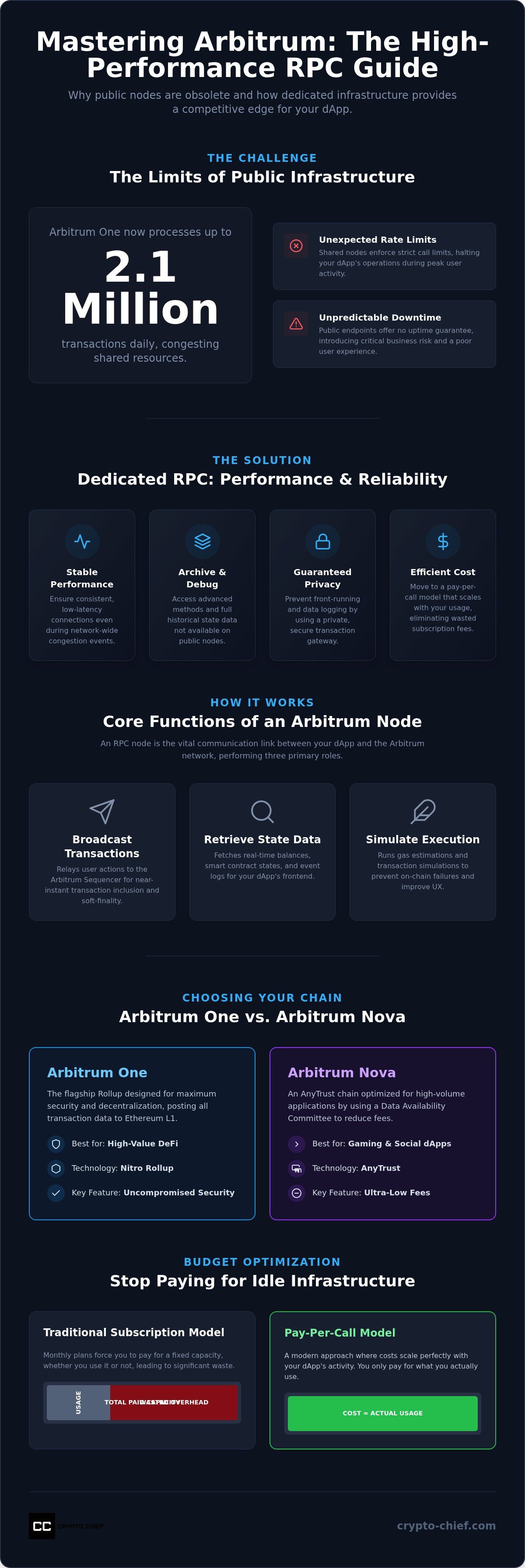
In the context of Layer 2 scaling solutions, these nodes play a specialized role. Unlike Ethereum Layer 1, where block times and throughput are more constrained, Arbitrum is designed for high-velocity environments that process up to 2.1 million transactions daily. The infrastructure must handle a massive volume of data queries without latency spikes. While public endpoints serve as a useful entry point for early experimentation, the demands of 2026 production environments have made them obsolete for professional builders. Rate limits and unpredictable downtime on shared nodes now represent a critical business risk. Reliable, private access through a dedicated RPC Gateway has become the standard for maintaining uptime during periods of network congestion.
The Core Functions of an Arbitrum Node
Modern nodes do more than just relay data; they serve as the engine for user experience. Their primary responsibilities include:
- Broadcasting Transactions: Relaying user actions to the Arbitrum Sequencer for immediate inclusion and near-instant soft-finality.
- State Data Retrieval: Fetching real-time balances, contract states, and event logs for DeFi dashboards and NFT marketplaces.
- Execution Simulation: Running gas estimations and smart contract simulations to ensure transactions don't fail before they're sent to the chain.
Arbitrum One vs. Arbitrum Nova: Choosing the Right Endpoint
Your choice of an arbitrum rpc node depends heavily on your specific use case. Arbitrum One is the flagship Rollup, utilizing the Nitro architecture to provide maximum security for high-value DeFi applications. It's the logical choice for protocols where decentralization and data availability on Ethereum are non-negotiable. In contrast, Arbitrum Nova uses AnyTrust technology to achieve ultra-low fees, making it the preferred choice for social dApps and gaming. Professional developers often require endpoints that support both chains to maintain cross-chain utility and give their users the best possible fee environment. As the network evolves with ArbOS 61 "Elara", your infrastructure provider must stay ahead of these technical shifts to ensure seamless compatibility.
The Technical Architecture: Nitro, Sequencers, and RPC Methods
The architecture of Arbitrum has evolved significantly with the Nitro stack, moving toward a more Ethereum-aligned execution environment. By integrating Geth directly into its core, Nitro ensures that an arbitrum rpc node behaves almost identically to a standard Ethereum node. This shift minimizes the friction for developers who rely on established tools like Hardhat, Foundry, or Ethers.js. The system's efficiency is rooted in its ability to compile the core Geth code into WebAssembly (WASM), allowing for high-speed execution while maintaining the rigorous security required for fraud proofs. This technical alignment means that most JSON-RPC methods you use on Ethereum Mainnet work seamlessly on Arbitrum without modification.
Beyond technical compatibility, the economic impact of L2 scaling has demonstrated that architectural efficiencies directly translate to lower overhead for dApp operators. Running a self-hosted node requires substantial hardware investment, often involving high-performance NVMe storage and significant RAM to maintain the blockchain state. Managed gateways provide a logical alternative, handling the complexities of the Nitro stack while offering optimized access to the network's state. For teams focused on growth, offloading this maintenance allows for a more concentrated effort on product development rather than infrastructure upkeep.
How Nitro Impacts Your API Calls
Nitro impacts your API calls by introducing more predictable gas pricing and improved simulation accuracy. The ArbOS 61 "Elara" upgrade further refines this by supporting dynamic gas pricing, which you can query directly via the RPC. The Nitro execution environment operates as a specialized WASM-based fraud-proof system that ensures transaction validity while maintaining high-performance execution. This architecture allows for more sophisticated debugging via debug_traceTransaction, providing developers with granular insights that were previously difficult to obtain on earlier Layer 2 iterations. It's a significant leap forward for those who require deep state inspection for complex DeFi protocols.
Understanding Sequencer Feed and Latency
The Sequencer acts as the primary orchestrator of the network, ordering transactions and providing near-instant soft-finality. When you send a transaction through an arbitrum rpc node, it's relayed to the Sequencer for immediate inclusion in a block. Latency in this path is critical. High-latency connections can lead to failed arbitrage opportunities or poor user experiences during high-traffic events. Professional builders often prioritize providers that maintain low-latency paths to the Sequencer to ensure their transactions are propagated as quickly as possible. For those seeking this level of performance without the technical burden of self-hosting, exploring a dedicated Arbitrum RPC Gateway is a strategic step toward production-grade reliability.
Public vs. Private Arbitrum RPCs: Performance and Cost Comparison
Choosing a public arbitrum rpc node often seems like a logical cost-saving measure during the initial development phase. However, this "free" entry point quickly becomes a liability when transitioning to a production environment. Public endpoints are shared resources subject to aggressive rate limits, which can cause intermittent dApp downtime or failed transaction broadcasts during periods of high network activity. For a user, a single failed eth_call is enough to erode trust in your platform's stability. Relying on best-effort infrastructure introduces a bottleneck that prevents true scalability.
Beyond reliability, security remains a paramount concern for professional builders. Private endpoints protect your dApp from "man-in-the-middle" data scraping, ensuring that your transaction patterns and user queries aren't exposed to third-party observers who monitor public traffic. This layer of privacy is essential for maintaining a competitive edge and protecting user intent in high-stakes DeFi environments. By isolating your traffic, you eliminate the noise and interference inherent in shared public gateways, resulting in a cleaner and more predictable execution environment.
Comparing Reliability and Uptime
Reliability isn't a luxury; it's a structural requirement. Public nodes operate on a best-effort basis, making them suitable only for "Hello World" projects or early-stage testing. Managed gateways, by contrast, offer 99.9% uptime guarantees and utilize global load balancing to route requests to the nearest healthy instance. While self-hosting provides the highest level of control, it introduces significant overhead, requiring 24/7 DevOps monitoring and expensive hardware maintenance that often outweighs the benefits for most scaling dApps.
The Economics of Pay-Per-Call Infrastructure
The traditional model of tiered subscriptions often forces developers to pay for unused capacity. If your dApp requires 1.2 million requests per month, you're frequently pushed into a tier that provides 5 million, leaving you with significant wasted overhead. The modern approach in 2026 favors a pay-per-call model. By utilizing a prepaid token balance, you only pay for the specific requests your application makes. This ensures that your infrastructure costs scale perfectly with your actual user base, eliminating the need for manual plan upgrades during sudden traffic spikes. For a deeper look at optimizing your stack, see our Web3 RPC Gateway: The Architect’s Guide to Multichain Infrastructure. This model provides the efficiency and seamlessness needed to maintain a high-performance arbitrum rpc node without the financial friction of legacy billing structures.
How to Select and Integrate an Arbitrum RPC Provider
Selecting the right arbitrum rpc node is a decision that dictates the long-term scalability of your dApp. A poor choice leads to vendor lock-in or unpredictable overhead that drains your development budget. You need an infrastructure partner that prioritizes standard JSON-RPC compatibility over proprietary, closed-loop systems. This ensures your application remains portable and resilient as the Layer 2 ecosystem matures. Integration should be a straightforward process that empowers your team to focus on building features rather than debugging connection strings.
To ensure your infrastructure meets production standards, follow these five essential steps during your evaluation:
- Step 1: Evaluate geographic node distribution. Minimize latency by ensuring your provider has a global edge presence near your primary user clusters.
- Step 2: Check support for advanced methods. Ensure access to debug_traceTransaction and archive data if your dApp requires deep historical analysis or complex troubleshooting.
- Step 3: Analyze pricing transparency. Avoid providers that hide costs behind complex "compute unit" multipliers. Look for straightforward models where one call equals one unit of cost.
- Step 4: Test WebSocket (WSS) support. Real-time applications like decentralized exchanges require stable WSS connections for instant event listening and state updates.
- Step 5: Verify library integration. Confirm the endpoint works seamlessly with standard Web3 libraries like Viem or Web3.js to avoid custom wrapper bloat.
Latency and Global Edge Performance
Physical node location is a critical factor for Arbitrum because of its exceptionally fast block times. If your node is geographically distant from your users, the round-trip time for a request can exceed the block time itself, leading to stale data or failed transactions. You can easily test your endpoint speed using a simple cURL command to measure the time to first byte. For applications planning a multichain expansion, choosing a provider that offers high-performance endpoints across multiple networks simplifies your stack and reduces integration friction.
Optimizing Your Request Efficiency
Smart developers don't just choose a fast node; they optimize how they use it. You can significantly reduce your total call volume and operational costs by implementing request batching. This technique allows you to combine multiple queries into a single JSON-RPC call, which is detailed in our guide on RPC Request Batching for Cost Reduction. Additionally, you should consider using webhooks for event monitoring. This approach is far more efficient than constant RPC polling, as it only pushes data to your server when a specific on-chain event occurs. It's a cleaner, more logical way to handle high-velocity data streams.
Ready to deploy on a foundation built for scale? Create your high-performance Arbitrum RPC endpoint today and experience the difference of a builder-centric gateway.
Crypto Chief: High-Performance Arbitrum RPC Gateway
Scaling a decentralized application on Arbitrum requires more than just a raw connection. It demands an infrastructure partner that understands the multifaceted nature of Web3 development. Crypto Chief provides a robust arbitrum rpc node solution designed for builders who prioritize uptime, cost-efficiency, and structural integrity. By offering a high-performance gateway that integrates seamlessly with your existing stack, we remove the friction of maintaining complex backend systems. Our platform is built on a foundation of professional confidence, ensuring that your dApp remains responsive even during the most intense periods of network activity.
What sets this infrastructure apart is the commitment to transparency and logic. Unlike legacy providers that trap users in tiered subscriptions, Crypto Chief utilizes a true pay-per-call model. You maintain full control over your budget through a prepaid API token balance system. This approach eliminates the wasted overhead of paying for unused capacity, allowing your costs to scale in direct proportion to your actual request volume. It's a logical solution for both individual creators and enterprise-level architects who require a steady, knowledgeable guide through the complexities of Layer 2 infrastructure.
Beyond the RPC: A Unified Developer Suite
Modern dApp development often involves juggling multiple third-party services for compliance and payments. Crypto Chief simplifies this by providing a unified environment that extends beyond simple data querying. You can integrate AML Intelligence directly into your transaction flow to detect and mitigate risk before it impacts your protocol. Our Crypto Processing API also enables non-custodial payment workflows, allowing you to build sophisticated financial products without the burden of managing fragmented infrastructure. This unified approach ensures that your transition from a single RPC call to a full-scale multichain ecosystem is smooth and consistent.
Getting Started in Minutes
Deploying your production-grade arbitrum rpc node is a methodical process designed to respect your time. Once you access the dashboard, you can generate a dedicated endpoint and configure your prepaid balance with just a few clicks. Our developer-first documentation provides clear integration paths for any project, whether you're building on Arbitrum One or Arbitrum Nova. This elite service is accessible to everyone, from lone builders to global enterprises, offering the same high-performance engine to all.
Start building on Arbitrum with Crypto Chief and secure the reliable foundation your dApp deserves.
Architecting for the Next Million Transactions
Scaling on Arbitrum in 2026 demands a shift from fragile, shared infrastructure to resilient, dedicated systems. You've seen how the Nitro v3.11.0 stack and the Elara upgrade have redefined performance expectations; staying competitive now requires an arbitrum rpc node that offers both technical precision and economic logic. By moving away from the "free" trap of public endpoints and the wasted overhead of tiered subscriptions, you reclaim control over your application's stability and your operational budget.
True scalability is found in a unified approach. Crypto Chief provides a seamless foundation where 99.9% uptime for global dApps meets a transparent pay-per-call model. This architecture allows you to integrate AML intelligence and non-custodial processing through a single, unified API, removing the friction of fragmented vendor management while maintaining absolute structural integrity. It's the logical choice for builders who prioritize logic and performance over marketing fluff.
The tools for high-velocity innovation are ready. Register for a Pay-Per-Call Arbitrum RPC Endpoint and build your dApp on a foundation designed for performance. Your users deserve a seamless experience, and we're here to ensure you deliver it.
Frequently Asked Questions
Is there a free Arbitrum RPC node I can use for production?
Publicly available free nodes are generally unsuitable for production environments because they lack the necessary reliability and throughput. While they work for initial development or testing, they impose strict rate limits that can cause dApp downtime during high-traffic events. Professional builders typically transition to a private arbitrum rpc node to ensure dedicated capacity and consistent uptime for their users.
What is the difference between an Arbitrum full node and an archive node?
An Arbitrum full node maintains the current chain state and allows you to query recent data, which is sufficient for most standard dApp interactions. In contrast, an archive node preserves the entire history of every state change since the genesis block. You'll need archive access if your application requires historical balance checks or deep analytical queries of past contract states for auditing purposes.
How do I change the RPC URL in my MetaMask to Arbitrum One?
To update your connection, open MetaMask and navigate to Settings, then Networks, and select Add Network. Enter "Arbitrum One" as the name and paste the unique URL provided by your arbitrum rpc node gateway. Ensure the Chain ID is set to 42161 and the currency symbol is ETH to complete the integration and start interacting with the network.
Why is my Arbitrum RPC request being rate limited?
Rate limiting occurs when your request volume exceeds the capacity allowed by your current endpoint provider. This is a common issue with public URLs or shared tiers during periods of network congestion. Switching to a private gateway with a pay-per-call model often resolves this by providing a dedicated path for your queries without artificial caps on your growth or performance.
Does Arbitrum support WebSocket (WSS) connections for real-time data?
Yes, Arbitrum supports WebSocket connections, which are essential for dApps that require real-time event monitoring. Unlike standard HTTP polling, WSS allows your application to maintain an open connection for instant updates on block changes or contract events. This reduces latency and provides a more responsive experience for users interacting with high-velocity DeFi protocols or gaming applications.
How much does it cost to run a managed Arbitrum RPC node in 2026?
The cost of managed infrastructure has shifted away from expensive monthly subscriptions toward more transparent, usage-based models. Instead of paying for unused capacity, you can now utilize a pay-per-call system where you only spend what is necessary for your actual traffic. This approach eliminates the financial friction of legacy plans and allows your infrastructure to scale logically with your user base without hidden multipliers.
What is the Chain ID for Arbitrum One and Arbitrum Nova?
Arbitrum One operates on Chain ID 42161, while Arbitrum Nova uses Chain ID 42170. It's critical to use the correct ID in your configuration to ensure your transactions are routed to the intended network and processed correctly. Most modern development frameworks and wallets will automatically detect these values when you input a valid RPC endpoint from a professional provider.
Can I use the same RPC provider for Arbitrum and Ethereum?
Yes, many professional providers offer unified access to both networks through a single platform. This multichain approach simplifies your development stack by allowing you to manage multiple endpoints via a unified API. It's a highly efficient way to build cross-chain applications without the complexity of coordinating with several different infrastructure vendors or managing multiple billing accounts.
Tags: arbitrum rpc node