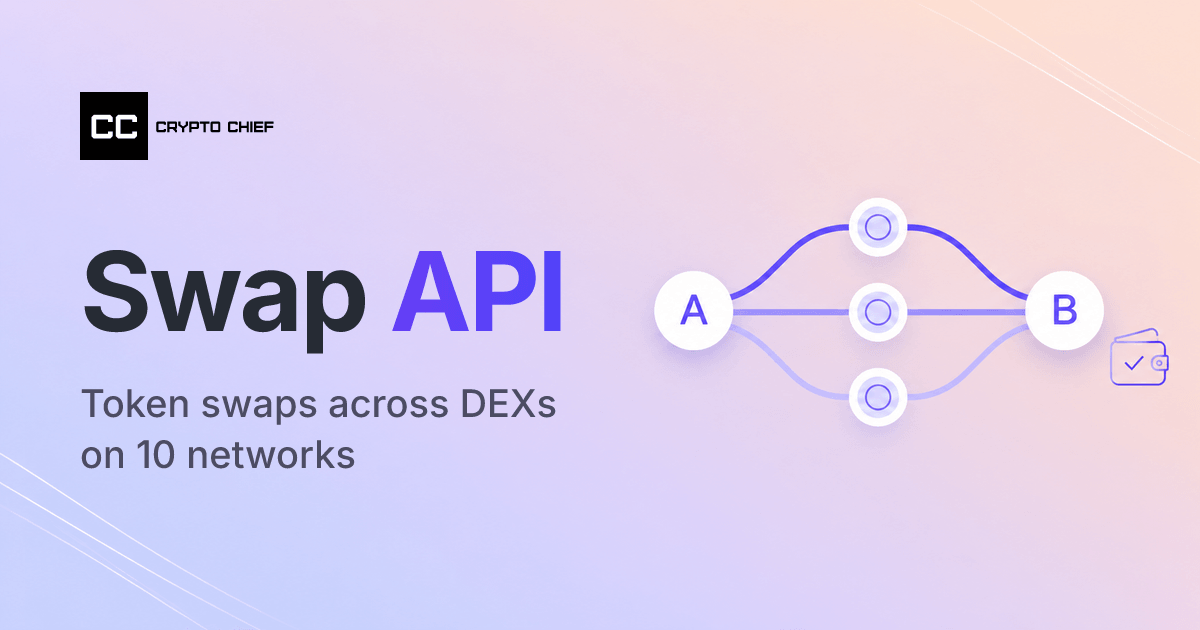
Crypto Chief has launched Swap API, a non-custodial DEX aggregator API for adding token swaps to wallets, exchanges and payment products. Available from 26 October 2026, it brings ten mainnets into one request format, with a project key and credit balance shared with the RPC Gateway.
Your application requests a quote, builds the transaction when the user is ready, and passes the returned steps to a wallet or backend signer. Crypto Chief supplies the route and transaction data; signing and submission stay with your application.
Bring token swaps into your own product
A wallet can keep the swap journey inside its interface. An exchange can add an on-chain convert feature. A payment provider can prepare a conversion from its treasury wallet into the asset it uses for settlement. Each needs the same core capabilities: a route, a readable cost breakdown and a transaction its signer understands.
The Swap API handles pool discovery, routing and transaction construction across the supported networks. Your team owns the customer experience: showing the quote, collecting approval, authorizing the transaction and tracking its outcome.
One swap API across EVM, TRON, Solana, TON and XRP Ledger
The launch covers Ethereum, BNB Smart Chain, Polygon, Arbitrum One, OP Mainnet, Avalanche C-Chain, TRON, Solana, TON and XRP Ledger. Seven testnets support integration rehearsals. Query the network and liquidity-source endpoints for current readiness before enabling a market in your application.
Inputs follow a common structure, while the build response uses the transaction format of the selected network. An EVM wallet receives an Ethereum transaction object; other networks use formats suited to wallets such as TronLink, Phantom, Tonkeeper and Xaman.
Both tokens belong to the selected network. Multichain support lets you offer swaps on several chains through one integration; moving an asset between chains requires a separate bridging flow.
A quote your users can evaluate
A headline exchange rate is only part of the decision. The routing engine considers expected output, estimated network costs and execution risk. The quote exposes pool fees, price impact, the minimum output allowed by your slippage setting and whether setup steps are required.
That gives your interface useful information before asking for a signature. Show what the user pays, what they expect to receive, the minimum they accept and the network cost. Put that breakdown next to the confirmation action so users can review the trade before signing.
At build time, the API re-reads pool state and reports simulation status. A failed simulation returns an error without a swap transaction. Your integration should also handle an unavailable or incomplete simulation explicitly. A quote can expire, and network conditions can change before execution.
Pay per API call, with no provider fee taken from the swap
At launch, a quote costs $0.0001 and a build costs $0.001, paid from project credits. Crypto Chief adds no percentage fee to the swapped amount. Network fees, liquidity-pool fees and any partner fee you configure remain separate costs.
For a concrete usage example, one million quotes cost $100 and 100,000 builds cost another $100: $200 in quote-and-build API charges. Approval and reference-data calls are additional, as are on-chain costs. These figures count API operations, rather than completed trades. A validation or business error, including no route found or a failed simulation, is chargeable; qualifying availability failures are refunded under the published billing rules.
This model lets you estimate infrastructure spend from how often your interface requests prices and prepares transactions. See the Swap API pricing and billing rules before setting refresh intervals or retry policies.
A partner fee for the feature you build
Wallets and other integrators can configure a recipient and an on-chain partner fee. The launch supports up to 100 basis points on EVM networks, TRON and TON, and up to 300 basis points on Solana and XRP Ledger. Collection mechanics and wallet requirements vary by network; the network notes explain them.
Make that fee visible in your product and calculate the user’s minimum received amount with it included. Keeping the integrator fee separate from API usage helps your team assess the feature’s economics without treating network costs as revenue.
Start with one complete swap journey
- Create a project and fund its API credits. Existing RPC Gateway users can use their project key and balance.
- Request a quote for a supported pair. Display costs, price impact and minimum output, then handle any required approval or trust-line setup.
- Build when the user is ready. Check the returned steps and simulation status before requesting a signature.
- Sign, submit and track the original transaction. Handle expired quotes, insufficient balances and uncertain submission results without creating an unintended second trade.
For a Crypto Processing wallet, the processing-wallet integration guide covers signing and sending supported steps on EVM networks, TRON, TON and Solana.
Build your first integration: create a Crypto Chief project, open the Swap API documentation and test a complete quote-to-settlement flow. The product overview brings together network coverage, examples and commercial terms.