
What if the primary bottleneck for your high-throughput dApp isn't the blockchain itself, but the infrastructure you've chosen to reach it? While the Movement Network offers theoretical speeds exceeding 160,000 transactions per second, many developers find their performance capped by public endpoints that prioritize volume over precision. If you've struggled with rate limits stalling your progress or high latency from generic providers, you're already aware that a standard movement rpc node isn't always enough for production-grade applications. You need a solution that bridges the gap between Move-native performance and the familiar EVM tools your team relies on daily.
This guide provides a comprehensive roadmap to mastering the technical landscape of Movement Network RPCs, focusing on how to scale your infrastructure with stability and cost-efficiency. We'll examine the shift toward pay-per-call pricing models that eliminate the waste of tiered subscriptions, ensuring your costs remain as predictable as your uptime. By the end of this article, you'll understand how to integrate seamless EVM compatibility and leverage global, low-latency gateways to deliver a superior experience for your users on both Mainnet and Testnet.
Key Takeaways
- Understand the technical role of a movement rpc node as the essential bridge between the Move execution environment and EVM-compatible developer tools.
- Identify critical performance metrics, including geographic distribution and full namespace support, to ensure low-latency interactions for a global user base.
- Learn why transitioning from shared public endpoints to private infrastructure is necessary to avoid the "noisy neighbor" effect and service interruptions during peak traffic.
- Discover how a pay-per-call pricing model eliminates the financial waste of tiered subscriptions by aligning your infrastructure costs with actual network demand.
- Explore how to streamline multichain development by integrating Movement with familiar environments like MetaMask and Hardhat through a unified RPC gateway.
What is a Movement RPC Node and How Does It Work?
A movement rpc node acts as the primary interface for any decentralized application (dApp) attempting to communicate with the Movement Network. At its core, this infrastructure utilizes a Remote Procedure Call (RPC) protocol to allow developers to execute code on a remote server as if it were local. This connection is vital for reading on-chain data and broadcasting new transactions via JSON-RPC methods. Without a reliable node, your dApp is essentially isolated from the blockchain, unable to fetch state or update the ledger. Common methods you'll use include:
- eth_blockNumber: Retrieves the most recent block height from the network.
- eth_getBalance: Checks the MOVE token balance of a specific address.
- eth_sendRawTransaction: Submits a signed transaction to the network for execution.
The Move-EVM Hybrid Architecture
Movement is unique because it combines the security of the Move language with the accessibility of the Ethereum Virtual Machine (EVM). This is achieved through a specialized EVM-RPC proxy. When a developer sends an eth_call, the proxy translates these requests into Move-native operations. This hybrid approach allows you to use familiar tools like Hardhat while benefiting from the high-performance Move environment. It's a bridge that minimizes friction for Ethereum developers entering the ecosystem.
Movement Mainnet vs. Testnet Endpoints
The Movement Mainnet operates under Chain ID 126, while the Testnet uses Chain ID 250. During early development, public endpoints are often sufficient for basic testing. However, relying on public infrastructure during a Mainnet launch is a risk. These endpoints are frequently throttled. A common pitfall is failing to account for network congestion, which can lead to failed transactions if your movement rpc node isn't optimized for production throughput.
In 2026, the demand for scalable infrastructure is critical. As the Movement Network targets theoretical capabilities exceeding 160,000 transactions per second, your backend must be able to keep pace. Dedicated infrastructure is no longer a luxury; it's a requirement for any dApp that expects to handle real-world traffic. High-performance nodes provide the low-latency response times and high request-per-second (RPS) limits necessary to prevent your application from lagging. By utilizing a professional RPC gateway, you ensure that your infrastructure remains a silent, powerful partner in your growth.
Evaluating Movement RPC Providers: Performance Metrics That Matter
Selecting a movement rpc node involves more than checking a status page for a green light. In 2026, production-grade dApps require granular performance data to ensure seamless user interactions. While many providers claim high availability, the true test lies in sustained throughput and data integrity during peak network activity. You don't just need a connection; you need a guarantee that your infrastructure won't buckle when transaction volume spikes.
Throughput and rate limits are often misunderstood. Many providers implement "hard caps" that immediately drop connections once a limit is reached, potentially breaking your dApp's frontend. A superior approach involves "soft caps" or flexible scaling that allows for brief bursts in traffic. This flexibility is essential for handling sudden events like NFT mints or market volatility without degrading the user experience. Additionally, data consistency must be absolute. High-integrity node synchronization prevents "forked" data, where different nodes in a cluster return conflicting block information, a common issue with poorly managed shared infrastructure.
Latency and Global Node Distribution
Latency is often a direct result of physical distance. If your node infrastructure is centralized in a single region, users on the other side of the globe will experience frustrating delays in transaction propagation. Crypto Chief addresses this by utilizing a global network of nodes to minimize round-trip times for every request. For a production-ready dApp, you should measure p95 latency, ensuring that 95% of requests are served within a tight window, typically targeting under 20ms for read operations to maintain a snappy interface.
Reliability and Uptime in 2026
99.9% uptime is no longer an achievement; it's the baseline for professional operations. Relying on single-provider public endpoints during periods of network congestion introduces a single point of failure that can paralyze your application. This stability is particularly important given the broader ecosystem context, such as the Movement Labs bankruptcy news, which highlights the necessity of choosing independent, resilient infrastructure providers who remain operational regardless of the primary developer entity's status. High-availability RPC clusters for the Movement network function as a load-balanced network of redundant nodes that maintain synchronized state to prevent downtime and ensure consistent data delivery during peak traffic.
Method support is the final, often overlooked, piece of the puzzle. A robust provider must implement the full eth_ and net_ namespaces without performance degradation on complex calls like eth_getLogs. Many generic providers offer shallow implementations that fail when asked to parse large datasets or historical blocks. If you're building for a global audience, choosing a high-performance RPC gateway is the first step toward a truly scalable architecture.
Public vs. Private Movement Nodes: When to Upgrade
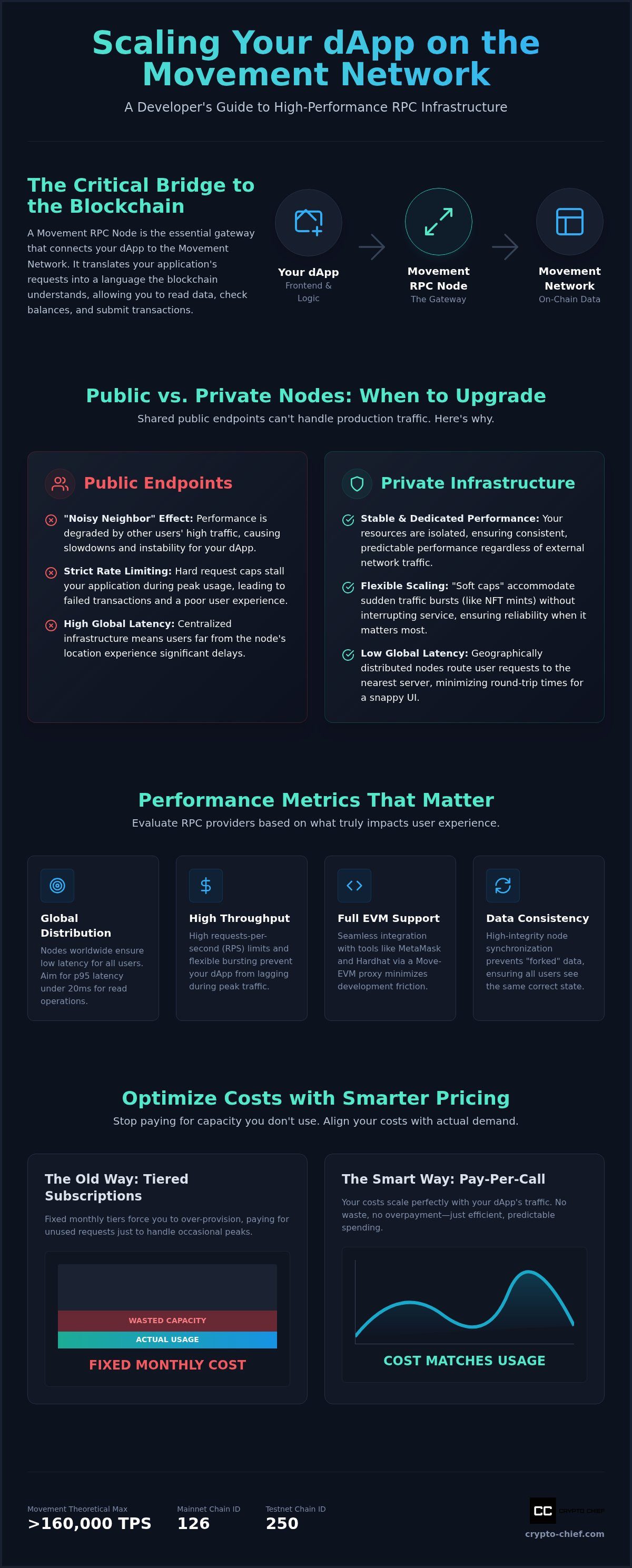
Every developer begins their journey with public endpoints. They're accessible, free, and require zero configuration to start testing basic functions. However, as a project transitions from a prototype to a production-grade dApp, these shared resources reveal their structural flaws. A shared movement rpc node often falls victim to the "noisy neighbor" problem. This occurs when other users on the same infrastructure experience a traffic spike, consuming the available bandwidth and CPU cycles. Your application pays the price in the form of unpredictable latency and sluggish response times that frustrate your end users.
Security and reliability are the next major hurdles to consider. Public endpoints are typically unauthenticated, meaning you lack a dedicated secure tunnel for your data. This absence of authentication makes it harder to track usage or protect against certain types of network-level interference. If your error logs are increasingly filled with 429 "Too Many Requests" errors, it's a clear signal that your dApp has outgrown its current environment. These interruptions don't just stall development; they erode user trust during critical moments like high-volume swaps, liquidations, or NFT mints where every millisecond counts.
The Limitations of Free Infrastructure
Typical rate limits for Movement public endpoints in 2026 are designed for casual experimentation, not sustained commercial use. You won't find technical support or Service Level Agreements (SLAs) attached to these free services, leaving you without a fallback if a node goes offline during a major network event. This lack of accountability creates a fragile foundation that can't support the uptime requirements of a professional application. Furthermore, the security risks associated with unauthenticated public RPC calls can leave your dApp vulnerable to data spoofing or man-in-the-middle attacks.
Advantages of Dedicated RPC Gateways
Transitioning to a dedicated gateway provides the structural integrity your project needs to scale. You gain access to custom rate limits and prioritized transaction mempools, ensuring your calls aren't stuck behind a queue of low-priority traffic. These gateways also offer enhanced data indexing, which significantly accelerates eth_getLogs and filter queries by pre-processing blockchain data. You can Explore Crypto Chief RPC Gateway features to see how a professional infrastructure partner removes the friction of shared nodes while offering the stability and speed your users expect.
Deciding when to upgrade is a matter of balancing growth with stability. If your user base is expanding globally or you're preparing for a Mainnet launch, the move to a private movement rpc node becomes a strategic necessity. It shifts your focus from troubleshooting infrastructure bottlenecks back to building the core features of your application. By investing in dedicated access, you ensure that your dApp remains responsive and secure, regardless of how much traffic the rest of the network is handling.
Optimizing Infrastructure Costs with Pay-Per-Call Pricing
Traditional infrastructure models often force a compromise between cost and capability. For a developer managing a movement rpc node, the typical monthly subscription creates a persistent financial leak. You're forced to pay for a high-tier plan just to handle occasional traffic spikes, yet your actual usage remains far below that ceiling most of the time. This over-provisioning is an inefficient relic of legacy SaaS that doesn't align with the fluid nature of on-chain activity.
A pay-per-call model solves this by ensuring you only pay for the requests your dApp actually makes. This alignment is critical for startups and established protocols alike. It transforms infrastructure from a fixed overhead into a variable cost that scales perfectly with your user base. If your traffic drops during a quiet market, your costs drop instantly. If a viral event causes a surge, your gateway handles the load without requiring a manual plan upgrade or risking a service cutoff.
Comparing Token-Based vs. Tiered Pricing
Token-based systems offer a level of transparency that tiered plans cannot match. You can track every API request at the granular level, allowing for precise auditing of your infrastructure spend. This visibility helps you identify inefficient code patterns that might be inflating your costs. To maximize these savings, you can Learn about RPC Request Batching to further reduce costs by combining multiple data fetches into a single call.
Budgeting for Movement Mainnet Launch
Preparing for a Mainnet launch requires a predictable financial roadmap. Estimating your RPC costs based on projected user transactions allows you to allocate resources effectively before the first block is even produced. Crypto Chief’s dashboard provides a real-time view of your consumption, giving you the data needed to adjust your strategy on the fly. Prepaid balances prevent service interruptions by ensuring your movement rpc node remains active as long as your account maintains a positive credit, effectively removing the risk of billing failures during high-traffic windows.
Effective cost management is the foundation of a sustainable dApp. By moving away from rigid subscriptions, you gain the freedom to experiment and grow without the fear of hidden fees or wasted capacity. If you're ready to align your infrastructure costs with your actual growth, register your account to start using a high-performance RPC gateway today.
Scaling with Crypto Chief’s Movement RPC Gateway
Scaling a production-grade dApp in 2026 requires an infrastructure partner that understands the nuances of the Move-EVM hybrid landscape. Crypto Chief provides this foundation through a high-performance movement rpc node gateway, designed to remove the friction of manual configuration and unstable connections. By centralizing your access points, you can manage your Movement, Ethereum, and Polygon nodes from a single platform, ensuring that your backend remains lean and your deployment cycles stay fast. It's about more than just connectivity; it's about providing a silent, powerful engine that supports your creative responsibilities without getting in the way.
Seamless integration with the tools your team already relies on is a priority. Whether you're deploying smart contracts through Remix, managing complex scripts in Hardhat, or providing a wallet interface via MetaMask, our gateway provides the standard JSON-RPC interface required for immediate compatibility. You don't need to build custom proxies or complex middleware. You simply swap your endpoint URL and begin building. This "builder-centric" approach ensures that your transition from Ethereum-native development to the Movement Network is as smooth as possible.
Multichain Scalability via Unified API
Enterprise-level multichain strategies often fail because of fragmented data. Our Unified API addresses this by normalizing data across disparate chains, allowing your application to query Movement Mainnet alongside legacy networks without rewriting your core logic. This approach is detailed in The Architect’s Guide to a Unified Web3 Developer Platform, which explores how to position Movement within a broader cross-chain ecosystem. This unified visibility is essential for maintaining structural integrity as your dApp expands into new markets.
Getting Started: Your First Request
Setting up your first request takes seconds. After generating your API key in the dashboard, you select the Movement Network and immediately gain access to a dedicated movement rpc node. A basic JSON-RPC request for the latest block height on Movement Mainnet looks like this: curl -X POST --data '{"jsonrpc":"2.0","method":"eth_blockNumber","params":[],"id":1}' [Your_Endpoint_URL]. This direct access allows you to move from ideation to execution without the typical infrastructure bottlenecks that stall early-stage projects.
For builders ready to deploy, the Crypto Chief Documentation offers comprehensive guides for rapid setup. You can register for a Movement RPC endpoint today to secure your infrastructure. If your project requires specialized configurations or global throughput guarantees, contact our team for custom enterprise solutions tailored to your unique scaling needs.
Future-Proofing Your Movement Network Infrastructure
Building on the Movement Network requires a transition from experimental testing to production-ready stability. You've seen how a dedicated movement rpc node eliminates the performance bottlenecks of shared public endpoints, providing the low-latency response times your users expect. By prioritizing high-integrity node synchronization and full EVM method support, you ensure your dApp remains resilient during periods of extreme network congestion. The shift toward pay-per-call pricing further streamlines this process, allowing you to scale without the financial waste of rigid monthly tiers.
Are you ready to deploy on a foundation built for the next generation of high-throughput applications? Our platform provides the global high-performance network, pay-per-call cost savings, and 24/7 developer support you need to succeed. Don't let infrastructure limitations stall your growth; instead, choose a partner that understands the practical challenges of the Move ecosystem. Get Started with a Movement RPC Node today and take control of your dApp's scalability. We're here to help you build the future of decentralized finance with confidence and precision.
Frequently Asked Questions
What is the Movement Network and how does its RPC differ from Ethereum?
Movement is a Layer 1 blockchain that utilizes the Move programming language while providing an EVM-compatible interface through a specialized proxy. Unlike standard Ethereum nodes, a movement rpc node must translate Ethereum-style JSON-RPC calls into Move-native operations. This allows you to use familiar Ethereum tools while benefiting from the superior security and performance of the Move execution environment.
How do I add the Movement Network to MetaMask using an RPC node?
Adding Movement to MetaMask requires navigating to the "Add Network" settings and entering the specific configuration for your chosen provider. Use the Network Name "Movement Mainnet", your unique RPC URL, Chain ID 126, and the currency symbol MOVE. For developers working in the staging environment, the Movement Testnet uses Chain ID 250 and follows the same setup process.
What are the rate limits for public Movement RPC endpoints?
Public endpoints for the Movement Network are typically subject to strict rate limits that prioritize accessibility over performance. These limits often cap requests at a low threshold per second to prevent infrastructure abuse. If your dApp requires high-volume interactions or consistent uptime during network spikes, upgrading to a private gateway is necessary to avoid these hard caps.
Is there a free Movement RPC node available for testing?
Free public nodes are available for initial development and small-scale testing cycles. These endpoints provide a low-barrier entry point but lack the technical support and high request-per-second (RPS) limits required for production applications. Most builders use these for basic experimentation before transitioning to a dedicated service that offers guaranteed performance and global reach.
How does pay-per-call pricing work for Web3 RPC nodes?
Pay-per-call pricing operates by deducting costs from a prepaid token balance based on the actual volume of requests your application makes. This model ensures that you aren't paying for idle capacity or unused monthly tiers. It aligns your infrastructure expenses directly with your dApp's growth, making it a highly efficient choice for both startups and enterprise-level operations.
Can I use Movement RPC nodes for real-time event monitoring?
High-performance movement rpc node infrastructure supports real-time event monitoring through WebSockets and optimized polling methods. This capability is vital for dApps that need to react instantly to on-chain events like transaction confirmations or smart contract state changes. Professional gateways ensure these data streams remain synchronized and provide the low latency required for time-sensitive applications.
What is the best RPC provider for the Movement Network in 2026?
The ideal provider for your project is one that balances global node distribution with a transparent, usage-based pricing model. Crypto Chief offers a robust RPC Gateway that supports Movement Mainnet and Testnet alongside other major chains like Ethereum and Polygon. This builder-centric platform provides the structural integrity and 24/7 support needed to scale your application in the competitive 2026 landscape.
How do I estimate the RPC costs for my Movement dApp?
Estimating costs involves projecting the average number of RPC calls generated by each user session and multiplying that by your expected traffic. You should account for different request types, as complex queries like eth_getLogs may consume more resources. Monitoring your real-time spend via a provider's dashboard allows you to refine these estimates as your user base expands.
Tags: movement rpc node