
Relying on persistent WebSocket connections for production-grade dApps in 2026 is an architectural risk that most scaling projects can no longer afford. While these streams were once the standard, the reality of managing a web3 event listener api at scale often involves fighting dropped connections and high RAM usage that eats into your margins. You've likely experienced the frustration of missing critical events during node downtime or struggling to normalize data across fragmented chains. It's a common bottleneck that turns a promising build into an infrastructure nightmare.
We understand that your focus should be on building the next generation of decentralized tools, not babysitting unstable node connections. This guide will show you how to master a more resilient, event-driven architecture using managed streams that scale without the overhead. You'll discover how to achieve stable data delivery and predictable pay-per-call pricing while maintaining multi-chain compatibility. We'll explore the transition from legacy polling to a unified, high-performance engine that ensures your application remains responsive, secure, and perfectly synced.
Key Takeaways
- Learn how a web3 event listener api serves as the essential bridge between on-chain state changes and off-chain logic through standardized JSON-RPC protocols.
- Compare the architectural impact of persistent WebSockets versus HTTP-based webhooks to select the most stable and resource-efficient delivery mechanism for your application.
- Implement robust data integrity measures, such as idempotency and reorg handling, to ensure that real-time data remains reliable even during network instability.
- Reduce operational friction and infrastructure costs by utilizing managed multichain streams that eliminate the need for self-hosted listener maintenance.
- Streamline your development cycle with unified multichain support, allowing you to track events across diverse networks through a single, high-performance interface.
What is a Web3 Event Listener API?
A Web3 event listener API acts as a sophisticated bridge between the immutable execution of a blockchain and the dynamic requirements of off-chain applications. Without this interface, your software is effectively blind to the network's activity unless it manually asks for updates. Instead of forcing your server to constantly ask "is it done yet?", a web3 event listener api pushes specific data directly to your stack the moment a state change occurs. This creates a reactive environment where your database, user interface, and notification systems stay perfectly synchronized with the ledger. It's the difference between a static archive and a living, breathing application.
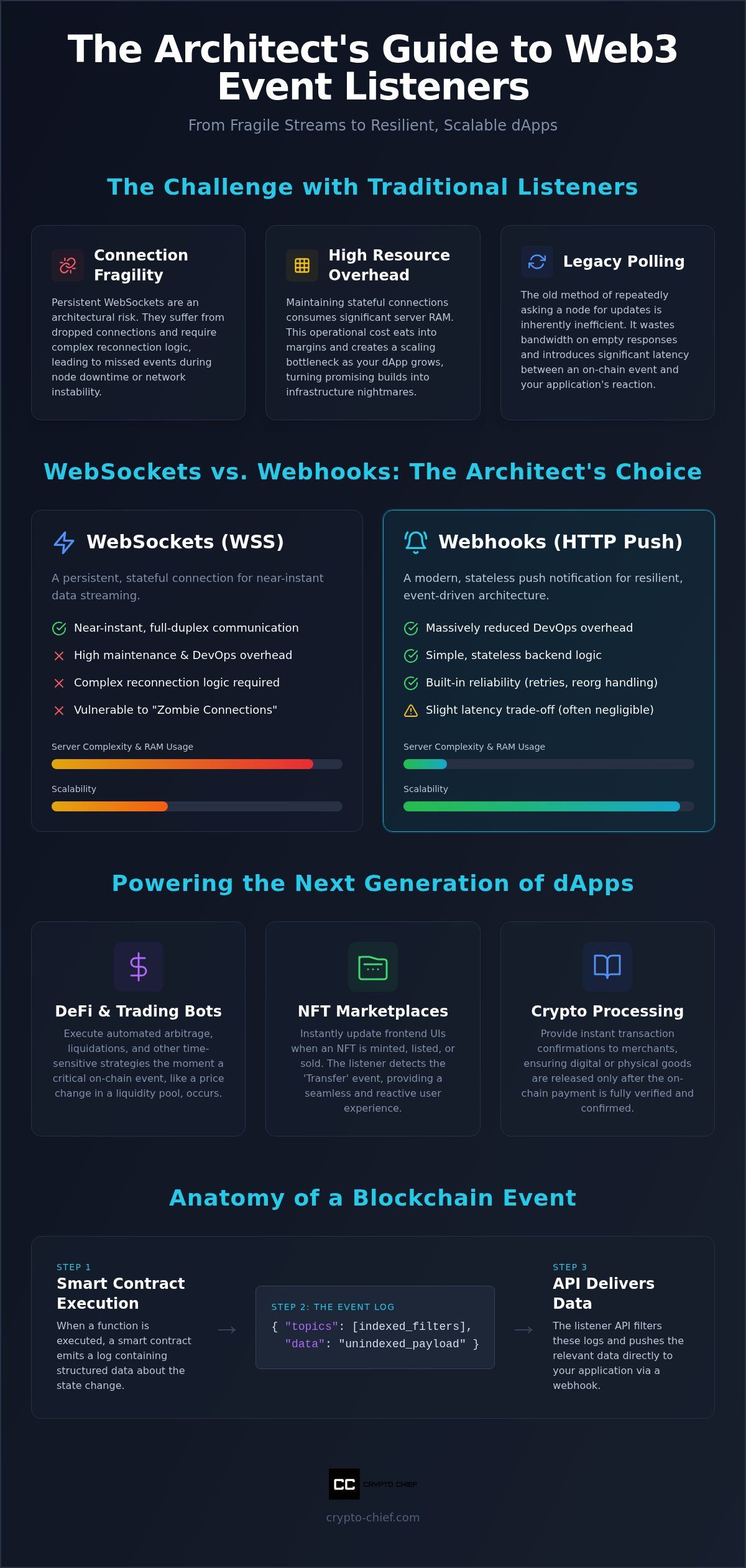
Modern data retrieval relies on standard JSON-RPC methods, primarily eth_getLogs for historical queries and eth_subscribe for real-time streams. While legacy architectures relied on polling, a process where a client requests data at fixed intervals, modern streaming provides a direct feed that minimizes latency. This transition is vital for developers who need to maintain high performance. Polling is inherently inefficient; it wastes bandwidth on empty responses and introduces delays between the block confirmation and the application's reaction. Streaming solves this by maintaining an open channel that only transmits when relevant activity is detected, ensuring your infrastructure isn't bogged down by redundant requests.
The Anatomy of a Blockchain Event
When a smart contract executes logic on the Ethereum Virtual Machine (EVM), it can emit logs that contain specific details about the transaction. These logs consist of "topics," which are indexed 32-byte words used for quick searching, and a "data" payload that holds unindexed information like large strings or complex arrays. Nodes index these logs as they process blocks, making them searchable via an API. An Event Log is the cryptographic proof of a state change. By filtering for specific topic signatures, a web3 event listener api can isolate the exact movements your application cares about while ignoring the noise of the rest of the network. This granular control allows for precise data indexing without the need to scan every byte of every block.
Common Use Cases for Event Listening
Real-time connectivity is no longer a luxury; it's a requirement for any competitive decentralized service. For instance, high-volume crypto processing platforms use event listeners to provide instant transaction confirmations to merchants, ensuring that goods or services are released only after the on-chain payment is verified. Automated trading bots rely on these triggers to execute arbitrage or liquidations the moment a price threshold is crossed in a liquidity pool. Even in the creative space, NFT marketplaces use listeners to update frontend UIs instantly. When a user mints a token, the listener detects the 'Transfer' event and refreshes the gallery without requiring a manual page reload, providing a seamless experience that users now expect from professional dApps.
WebSockets vs. Webhooks: Choosing Your Listening Mechanism
Choosing the right delivery protocol is a foundational decision that dictates the long-term stability of your web3 event listener api. Traditionally, developers have defaulted to WebSockets (WSS) because they provide a persistent, full-duplex communication channel. This allows for near-instantaneous data pushes the moment a node detects a relevant log. However, the maintenance burden of a stateful connection is often underestimated. While the raw speed of WSS is impressive, the architectural complexity it introduces can create significant technical debt as your application scales beyond a few simple listeners.
Webhooks, or HTTP Push notifications, offer a stateless alternative that shifts the burden of connection management away from your server. Instead of your application maintaining a constant "heartbeat" with a node, the provider pushes a POST request to your endpoint when an event occurs. This simplifies your backend significantly. You don't need to manage socket pools or complex reconnection logic. For most production environments, the slight latency trade-off is a small price to pay for the massive reduction in DevOps overhead. It allows your team to focus on business logic rather than infrastructure stability.
One of the most pervasive issues with self-hosted listeners is the "Zombie Connection" problem. This occurs when a WebSocket appears to be open but has silently dropped due to network instability, load balancer timeouts, or node restarts. Your script continues to run, but it's no longer receiving data. Detecting these silent failures requires sophisticated "keep-alive" logic and automated retry loops that can be notoriously difficult to get right. By the time your monitoring alerts you to the gap, you may have already missed critical on-chain events. Webhooks effectively eliminate this risk by treating every notification as an independent, verifiable request.
When to Use WebSockets (WSS)
WebSockets remain the superior choice for specific high-performance scenarios. If you're building a client-side browser application that needs to update a UI in real-time without a backend intermediary, WSS is the standard. It's also indispensable for high-frequency trading bots where a 200ms delay could result in a failed arbitrage opportunity. In these cases, connecting directly to high-availability Ethereum RPC nodes ensures you're getting the rawest, fastest data feed possible. Just be prepared to implement robust client-side error handling to manage inevitable connection drops.
The Case for Managed Webhooks
Managed webhooks represent the modern standard for server-side blockchain integration. They eliminate the need for persistent socket maintenance, allowing your server to remain completely stateless and horizontally scalable. You can handle thousands of concurrent contract listeners across multiple chains without worrying about CPU or RAM exhaustion from open socket connections. This architecture is inherently more secure; it reduces your attack surface by limiting the number of open ports and persistent connections your infrastructure must defend. If you're looking for a more resilient way to handle data, utilizing a high-performance RPC Gateway can provide the stable foundation your project requires.
Solving the Scalability Challenge in Web3 Data Streaming
Scaling a web3 event listener api requires more than just a stable connection; it demands an infrastructure capable of processing high-volume data without creating performance bottlenecks. When you run a local listener, you aren't just paying for a virtual machine. You're incurring hidden costs in CPU cycles, outbound bandwidth, and significant DevOps hours spent troubleshooting node synchronization issues. This operational drag becomes exponential when you attempt to normalize data across diverse networks like Ethereum, BNB Smart Chain, and Polygon simultaneously. Each chain has its own block times and log formats, making manual data aggregation a constant source of friction.
Managed services alleviate this pressure by absorbing the complexity of multi-chain maintenance. Instead of managing individual node clusters for every network, a unified provider delivers standardized payloads that look the same regardless of the source. This shift to a pay-per-call model optimizes your budget by ensuring you only pay for the specific events your application consumes. It's a strategic move from fixed, high-overhead infrastructure to a variable cost structure that aligns perfectly with your actual usage. You don't need to over-provision hardware for peak loads that may only happen once a week.
Infrastructure Overhead vs. Managed APIs
Analyzing the total cost of ownership (TCO) for self-hosted event indexing often reveals a harsh reality: the time spent maintaining uptime usually outweighs the initial hardware savings. Managed services provide higher uptime guarantees (SLA) than individual nodes because they utilize distributed clusters and automated failovers. If one node lags, the system routes your request to a healthy peer instantly. For a deeper dive into how these systems function at scale, read our guide on Web3 RPC Gateway architecture to understand the mechanics of backend scaling.
Ensuring Data Integrity During Chain Reorganizations
Real-time data is only valuable if it's accurate. In the world of blockchain, a "chain reorganization" can occur when a block is dropped or replaced, potentially invalidating the events your listener just processed. If your application acts on a "Transfer" event that is later rolled back, you face a critical data integrity failure. To mitigate this risk, a robust web3 event listener api must implement "confirmation depth" logic, delaying notifications until a block reaches a specific level of certainty. Finality represents the point at which a transaction is considered irreversible by the network's consensus rules, serving as the ultimate safeguard for event-driven logic.
Implementation Guide: Best Practices for Web3 Event Tracking
Developing a resilient integration requires more than a simple connection; it demands a disciplined approach to data ingestion. Your first priority is defining filters with surgical precision. By specifying the target contract address and the exact Keccak-256 hash of the event signature, known as topics, you ensure your web3 event listener api only processes relevant data. This reduces the signal-to-noise ratio and keeps your compute costs predictable. Many architects make the mistake of listening to broad block ranges without filters, which leads to unnecessary data parsing and increased latency.
Idempotency is your second line of defense against data corruption. In distributed systems, message delivery is often guaranteed "at least once," meaning your application might receive the same event notification multiple times. To prevent duplicate processing, implement a logic that checks a unique composite key in your database before executing any business logic. Using the transaction hash paired with the log index serves as a foolproof identifier. This ensures that a single deposit or NFT mint never triggers multiple state changes in your off-chain system, maintaining the absolute integrity of your user data.
Robust error handling and security are the final pillars of a professional setup. Network timeouts and node failures are inevitable, so your system must utilize exponential backoff for all retries. For historical data lookups, use request batching to group multiple queries into a single JSON-RPC call, which significantly lowers the total number of round trips. Finally, never expose your web3 event listener api keys in client-side code. Always move these interactions to a secure backend environment and utilize IP whitelisting to prevent unauthorized access to your infrastructure. If you're ready to deploy these practices, you can create a developer account to access high-availability streams immediately.
Optimising Event Filters
Precision at the smart contract level is the most effective way to scale. Solidity developers should utilize the indexed keyword for critical parameters like user addresses or token IDs, as this allows the node to search for these values directly within the topics. This architectural choice enables you to listen for multiple contracts within a single API request if they share the same ABI, which drastically lowers your operational overhead. For specific implementation details and the exact syntax required for complex filtering, refer to the Crypto Chief Documentation.
Handling Missing Data and Downtime
No infrastructure has 100% uptime, so you must design for the "Gap-Fill" scenario. When your connection resumes after a disconnect, your system should automatically use eth_getLogs to query the range between your last processed block and the current network head. This ensures no events are lost during the transition. Streaming remains superior to polling for mission-critical applications because it provides a proactive push that minimizes the delay between on-chain execution and off-chain reaction. For more on building these resilient workflows, check our Real-Time Blockchain Webhooks guide for implementation templates.
Scaling with Crypto Chief EventStream and Unified API
Scaling a decentralized application across multiple networks often introduces a fragmented codebase and inconsistent data formats. Crypto Chief's web3 event listener api resolves these complexities by providing a single, high-performance interface for Ethereum, Polygon, and Tron. Instead of maintaining separate logic for every new chain, you can ingest standardized data through a unified pipeline. This structural integrity ensures your backend remains lean and responsive, regardless of how many networks your dApp supports. It's a strategic foundation that allows you to expand your global reach without increasing your technical debt.
EventStream webhooks represent a significant shift away from the instability of legacy WebSocket connections. By delivering real-time push notifications directly to your endpoints, EventStream eliminates the need for constant heartbeat monitoring and complex reconnection loops. You'll no longer waste resources on "Zombie Connections" or idle socket pools. This architecture is built for builders who value uptime and logic over infrastructure maintenance. Every notification is a decisive, independent request, providing the reliability required for enterprise-ready applications.
Transparency and security are baked into the core of the platform. The pay-per-call model offers absolute budget predictability; you only pay for the specific data your application consumes, removing the friction of restrictive monthly tiers. Security isn't an afterthought, either. With integrated AML Intelligence, your web3 event listener api can instantly flag high-risk events or illicit addresses, allowing you to maintain compliance in an increasingly regulated environment. This combination of efficiency and safety makes it the silent, powerful partner your project needs to thrive in 2026.
The Power of the Unified API
Normalization is the primary benefit of a unified approach. Crypto Chief handles the heavy lifting of translating varied chain-specific log formats into a consistent, easy-to-parse JSON structure. This means your developers don't have to write custom parsers for every new smart contract or network update. It simplifies the developer experience, allowing your team to focus on the creative aspects of your dApp. To further secure your event-driven workflows, you can integrate our AML Intelligence services to monitor on-chain activity in real-time.
Getting Started in Minutes
Deploying a professional-grade listener shouldn't take weeks. You can generate your API keys and begin streaming blockchain events almost immediately through an intuitive dashboard. Whether you're building a simple notification bot or a complex cross-chain aggregator, world-class support and comprehensive developer documentation are always available to guide your implementation. Don't let infrastructure bottlenecks slow your innovation. Register for your Crypto Chief API key today and experience the future of real-time blockchain data.
Architecting for Resilience in a Multichain World
Transitioning from legacy polling to a modern web3 event listener api is the most impactful choice a developer can make for long-term scalability. You've seen how shifting to a webhook-driven architecture eliminates the instability of persistent sockets while ensuring data integrity during chain reorganizations. By centralizing your data ingestion through a unified interface, you remove the friction of fragmented network protocols and high infrastructure maintenance costs. It's about working smarter; let the background engine handle the complexity so you can focus on building innovative user experiences.
With a global RPC network maintaining 99.9% uptime and a transparent pay-per-call pricing model, you gain the reliability of an enterprise-grade stack without hidden monthly fees. You can seamlessly track activity across Ethereum, BSC, and Polygon through a single, powerful gateway. Start Streaming Blockchain Events with Crypto Chief today and build with the confidence of a stable, high-performance foundation. Your next great dApp deserves an infrastructure that never blinks.
Frequently Asked Questions
What is the difference between eth_subscribe and eth_getLogs?
The primary difference lies in the delivery model; eth_subscribe creates a real-time stream for new events, while eth_getLogs retrieves historical data from past blocks. Use eth_subscribe to keep your application synchronized with the current network head as transactions occur. Conversely, eth_getLogs is essential for recovering data missed during downtime or indexing historical activity for a specific contract range.
Can I listen for Web3 events using a standard HTTP provider?
Standard HTTP providers don't support real-time event subscriptions because they are stateless and lack the persistent connection required for a push model. To listen for events over HTTP, you must either implement a polling strategy with eth_getLogs or use a managed web3 event listener api that delivers data via webhooks. Webhooks are the superior choice for HTTP-based stacks because they provide push notifications without the overhead of constant polling.
How do I handle dropped WebSocket connections in my event listener?
Handling dropped connections requires implementing "heartbeat" pings to detect silent failures and automated reconnection loops with exponential backoff logic. Once the connection is re-established, you must query for missing blocks using a historical log method to ensure no data was lost during the outage. This complex maintenance is why many architects now prefer managed EventStream webhooks, which eliminate the need for persistent socket management entirely.
What are "topics" in a Web3 event listener API?
Topics are indexed 32-byte parameters within a blockchain log that allow a web3 event listener api to filter for specific actions with high precision. The first topic is always the Keccak-256 hash of the event signature, such as a Transfer or Mint event. Subsequent topics contain indexed arguments from the smart contract, like sender or receiver addresses, enabling fast searching without scanning the entire unindexed data payload.
Is it better to use Webhooks or WebSockets for blockchain event tracking?
Webhooks are generally the better choice for server-side applications because they are stateless, horizontally scalable, and remove the burden of persistent connection maintenance. They allow your infrastructure to handle thousands of concurrent contract listeners without exhausting CPU or RAM. WebSockets remain preferable for client-side browser interfaces where low-latency UI updates are critical, though they require significantly more DevOps effort to remain stable in production.
How does pay-per-call pricing work for Web3 event APIs?
Pay-per-call pricing operates on a transparent, utility-based model where you are billed only for the individual API requests or webhook notifications your application actually consumes. This eliminates the need for expensive monthly tiers that often charge for unused capacity or idle connections. It provides predictable cost scaling, ensuring that your infrastructure expenses align directly with your application's actual network activity and user growth.
Can I listen to multiple smart contracts with a single API key?
You can monitor multiple smart contracts across different chains using a single API key through a Unified API or EventStream service. This centralized approach simplifies your credential management and allows you to aggregate data from Ethereum, Polygon, and BNB Smart Chain into a single backend pipeline. It's a much more efficient alternative to managing separate node connections and individual API keys for every network you support.
How do I filter events for a specific wallet address?
To filter for a specific wallet address, you must include that address as a parameter in your event filter's indexed topics. If the smart contract's event indexes the address, the node can isolate those logs instantly without parsing unrelated transactions. For example, in an ERC-20 Transfer event, you can set the second topic to the sender's address to track all outgoing movements associated with that specific wallet.
Tags: web3 event listener api