
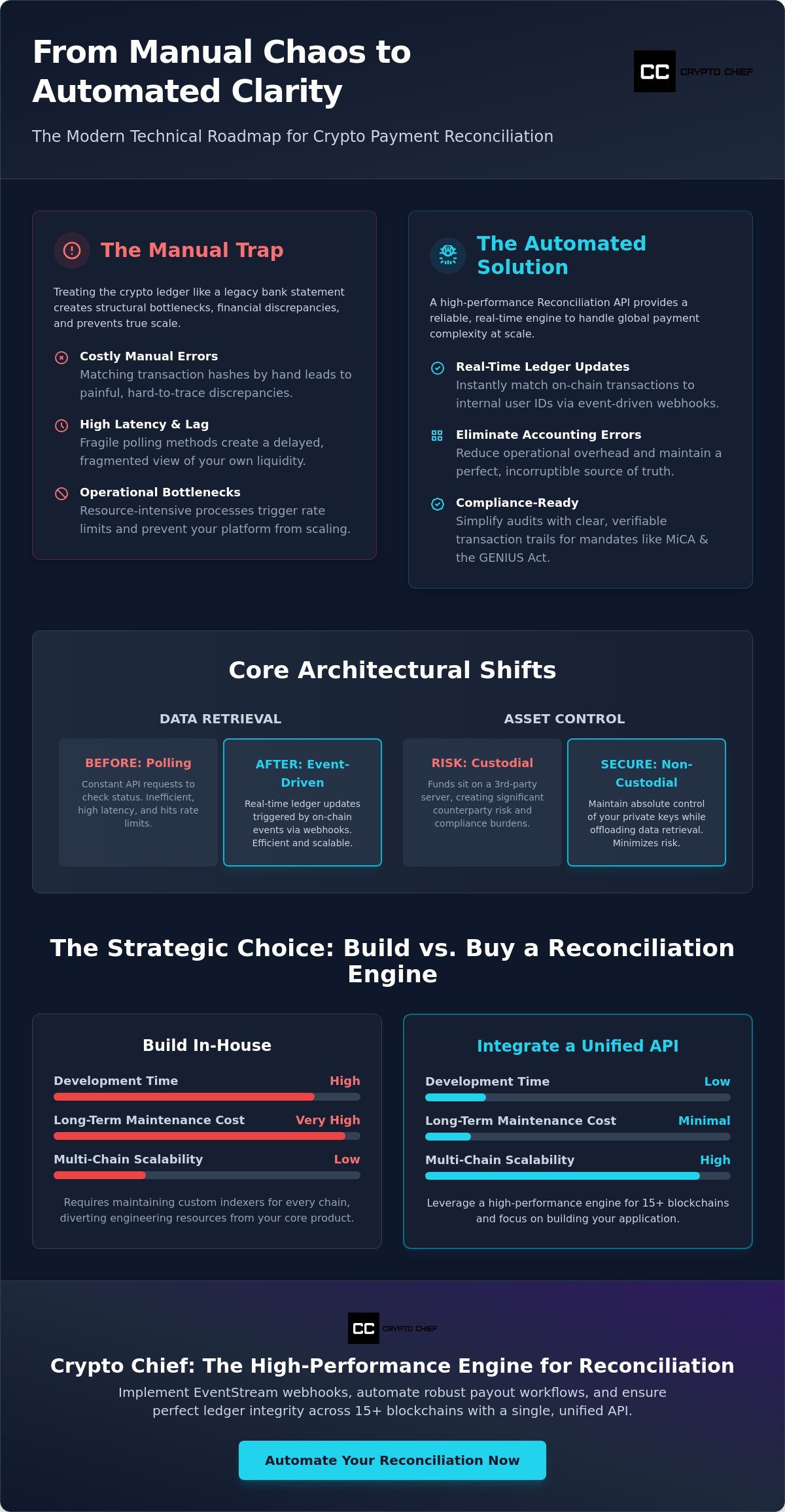
Why is your team still treating the crypto ledger like a legacy bank statement that only balances at the end of the month? If you're manually matching transaction hashes to internal user IDs, you aren't just losing time; you're operating with a fragmented, laggy view of your own liquidity. You know that manual reconciliation errors lead to painful financial discrepancies, particularly when high latency and cross-chain events turn payment confirmation into a moving target. It's a structural bottleneck that prevents true scale.
This guide provides a technical roadmap to eliminating these discrepancies by integrating a high-performance crypto payment reconciliation api. We'll show you how to move beyond manual checks to a reliable, non-custodial system that triggers real-time ledger updates via webhooks. We'll explore how to architect an event-driven flow that maintains perfect integrity while staying compliant with 2026 mandates like the MiCA framework and the GENIUS Act. You'll gain the blueprint for a silent, powerful engine that handles the complexity of global payments so you can focus on building your core product.
Key Takeaways
- Master the transition from fragile polling methods to an event-driven architecture that accurately matches on-chain transaction hashes to internal database IDs.
- Reduce operational overhead by integrating a crypto payment reconciliation api that provides real-time ledger updates and eliminates manual accounting errors.
- Architect robust payout workflows that automatically navigate network congestion and gas fluctuations for seamless, non-custodial distributions.
- Understand the engineering trade-offs between building custom multichain indexers and leveraging a unified API to minimize long-term maintenance costs.
- Implement EventStream webhooks to capture specific smart contract events and wallet transfers across 15+ blockchains, ensuring your infrastructure scales with your transaction volume.
Understanding the Crypto Payment Reconciliation API Architecture
Reconciliation is the structural bridge between public blockchain data and your private business logic. It's the methodical process of matching every on-chain transaction hash to a specific internal database ID, ensuring that your user's balance reflects the reality of the distributed ledger. Without a robust crypto payment reconciliation api, your financial records remain decoupled from the actual movement of assets, creating a visibility gap that grows with every new transaction. Modern architecture demands more than just a snapshot; it requires a persistent, verifiable link between the chain and your ledger.
Many developers start by using traditional polling methods, but these systems inevitably fail at enterprise scale. Constant API requests to check transaction statuses consume unnecessary resources and often trigger aggressive rate limits from node providers. This creates latency, where a payment might be confirmed on-chain minutes before your system acknowledges it. A unified API layer solves this by normalizing data formats across multiple chains, allowing your application to ingest transaction data from Ethereum, Solana, or Tron through a single, consistent schema. It removes the burden of maintaining custom indexers for every new network you support.
The Manual Reconciliation Trap
Relying on manual "block explorer checking" is a terminal bottleneck for any growing platform. Human error in transcribing hashes or verifying amounts leads to discrepancies that are difficult to untangle after the fact. These errors undermine the integrity of a double-entry bookkeeping system, where every crypto deposit must have a corresponding and accurate entry in your fiat or stablecoin ledger. In high-volume environments, the risk of missed deposits or misattributed funds becomes a direct threat to your bottom line. Automation isn't just about speed; it's about maintaining a single source of truth that humans can't accidentally corrupt.
Non-Custodial vs. Custodial Reconciliation
The architectural choice between custodial and non-custodial systems defines your security posture. By utilizing non-custodial crypto payment APIs, you maintain absolute control over your private keys while offloading the heavy lifting of data retrieval to a high-performance infrastructure. This setup ensures that your funds aren't sitting on a third-party server, reducing your counterparty risk significantly. It also simplifies compliance with evolving regulations like the EU's MiCA framework and the U.S. GENIUS Act. Both mandates emphasize the need for clear, auditable transaction trails. A non-custodial crypto payment reconciliation api provides this transparency by delivering real-time, verifiable data directly into your environment, making financial audits a matter of technical reporting rather than manual investigation.
How to Automate Crypto Payouts API Integration
Automating outbound value transfers requires a shift from simple transaction broadcasting to a comprehensive, lifecycle-aware system. While receiving funds is a matter of observation, sending them is a high-stakes "write" operation that demands absolute precision. A robust crypto payment reconciliation api acts as the essential feedback loop here, ensuring that every automated payout is not only executed but also accurately mirrored in your internal accounting records. Without this automated handshake, your outbound ledger will quickly drift from the on-chain reality.
The first technical hurdle in automation is handling network volatility. Gas fees on Ethereum or transaction costs on Solana can spike within seconds, potentially stalling your payout queue. Your integration should utilize dynamic fee estimation to ensure transactions are confirmed within your desired timeframe without overpaying. Furthermore, implementing idempotent requests is non-negotiable. By attaching a unique idempotency key to every payout request, you prevent the system from executing duplicate transactions if a network timeout occurs during the initial broadcast. This safeguard is the primary defense against the costly error of double-paying a recipient due to a transient API error.
Step-by-Step Payout Automation
A reliable payout workflow begins with rigorous destination address validation. Before a transaction ever hits the mempool, your system must verify the address checksum and ensure the recipient's chain matches the asset being sent. Using Unified APIs allows you to maintain a single payout schema regardless of whether you are sending USDT on Tron or USDC on Polygon. This abstraction layer is particularly valuable for event normalization. While different blockchains use varying structures for transaction receipts, a unified layer provides a consistent JSON response. This allows your backend to parse confirmation data without needing chain-specific logic for every new network you integrate.
Risk Mitigation in Automated Payouts
Speed must never come at the expense of security. As the regulatory oversight of crypto assets tightens in 2026, automated systems must incorporate real-time compliance checks. Integrating AML Intelligence into your payout trigger allows you to automatically flag or block outbound transfers to high-risk addresses before the funds leave your wallet. Additionally, establishing threshold limits and requiring multi-sig approvals for high-value distributions adds a critical layer of human or programmatic oversight. If you're ready to secure your outbound flows, exploring a non-custodial processing API is a logical next step for your architecture. This ensures you maintain full control over your private keys while benefiting from an enterprise-grade automation framework.
Real-Time Reconciliation via EventStream Webhooks
Moving from a polling-based architecture to an event-driven model represents a fundamental paradigm shift in how developers handle on-chain data. Traditional systems that rely on constant API requests to check for new blocks are inherently inefficient; they consume excessive bandwidth and often introduce artificial delays into your settlement process. By contrast, using a crypto payment reconciliation api equipped with webhook capabilities allows your infrastructure to remain idle until a specific event occurs. This push model ensures that your system reacts the moment a transaction is broadcast or confirmed, reducing the latency between a user action and your ledger update.
Handling the complexities of decentralized networks requires more than just listening for events. You must also account for chain reorgs and forks. A robust integration doesn't just trigger an event on the first confirmation; it tracks the block depth and provides updates if a transaction is dropped or superseded by a different branch. This level of technical precision is critical for maintaining a reliable financial record. Understanding how blockchain impacts auditing is essential here, as real-time verification replaces the periodic, backward-looking reconciliation of the past. Your system becomes a living ledger that stays in sync with the chain.
Configuring Webhook Listeners
Precision is the hallmark of a high-performance EventStream setup. You can define granular filter parameters to listen only for specific smart contract interactions, token transfers, or transactions above a certain value threshold. This filtering happens at the provider level, ensuring your server isn't flooded with irrelevant data. To maintain 99.9% delivery uptime, your listener should implement a robust retry logic and signature verification to secure the incoming payload. For those looking to implement advanced filtering logic, referencing the Real-Time Blockchain Webhooks guide provides the necessary technical depth for complex multichain environments.
Data Normalization and Ledger Injection
Once an event is captured, the challenge lies in transforming raw hex data into human-readable database entries. A unified crypto payment reconciliation api simplifies this by providing a normalized JSON response regardless of the underlying blockchain. Whether you're receiving a Transfer event from an ERC-20 contract on Ethereum or a SPL token transfer on Solana, the data arrives in a consistent format. This allows you to automate the Matched status in your ERP or custom back-office tool without writing unique parsing logic for every chain. By mapping these multichain events to a single internal accounting format, you eliminate the manual mapping errors that typically plague crypto-native financial operations.
Comparing Reconciliation Tools: Build vs. Buy
Deciding whether to build an internal reconciliation engine or purchase a specialized solution often centers on the illusion of control. While constructing a custom multichain indexer might seem like a straightforward engineering task, it quickly evolves into a perpetual maintenance cycle. The initial development phase is merely the tip of the iceberg. True operational costs lie in the ongoing management of node infrastructure, where hard forks, client updates, and breaking API changes require constant developer intervention. Integrating a crypto payment reconciliation api shifts this heavy lifting to a dedicated partner, allowing your team to focus on core product features rather than blockchain plumbing.
Maintenance overhead is the silent killer of internal crypto projects. When a network like Ethereum or Solana undergoes a major upgrade, your custom indexer must be updated and tested in lockstep to prevent data gaps. If your internal team isn't monitoring these changes 24/7, a single missed block can lead to ledger discrepancies that take days to untangle. A third-party provider assumes this responsibility, ensuring that the data flowing into your reconciliation loop remains accurate and synchronized with the latest chain state.
The Infrastructure Cost Factor
Calculating the total cost of ownership for a self-hosted RPC node cluster reveals significant hidden expenses. Beyond the raw hardware or cloud credits, you're paying for the specialized DevOps talent required to maintain high-availability nodes across multiple networks. A pay-per-call pricing model offers a more efficient alternative, as it eliminates the "idle cost" of running nodes during periods of low transaction volume. It's a scalable approach that aligns your infrastructure spend directly with your business growth. Many "unlimited" plans from standard providers eventually hide performance throttling behind fair-use policies, whereas a transparent token model ensures consistent throughput when you need it most.
Reliability and Global Uptime
For global payment applications, geographical latency can introduce significant delays in reconciliation. A geo-distributed Web3 RPC Gateway ensures that your application can fetch transaction data from the nearest node, minimizing the time it takes to confirm a payout. Enterprise-grade services provide strict SLAs that internal teams often struggle to match without massive redundancy. If you're ready to move away from the high-maintenance "build" model, you can register for a developer account to begin testing a unified crypto payment reconciliation api. This transition provides a stable foundation for scaling your financial operations without the burden of managing a complex, multichain node stack.
Crypto Chief: The High-Performance Engine for Reconciliation
Crypto Chief functions as the silent, high-performance partner that converts the theoretical complexities of blockchain data into a streamlined operational reality. By providing unified access to over 15 blockchains, including Ethereum and Solana, the platform eliminates the need for fragmented, chain-specific integrations. This crypto payment reconciliation api acts as a single point of truth, merging transaction processing with real-time event monitoring to ensure your internal ledgers remain accurate without the constant need for manual oversight. It is the logical conclusion for any developer seeking to build a robust, enterprise-ready financial stack.
The economic model of Web3 infrastructure is often obscured by rigid, expensive monthly subscriptions that don't account for fluctuating transaction volumes. Crypto Chief addresses this with a prepaid API token model, ensuring you pay only for the reconciliation data you actually consume. This approach removes the financial waste associated with idle nodes while providing the structural integrity required for global applications. It's a logic-driven solution for architects who value scalability and efficiency over the unpredictable costs of traditional node providers. You maintain full control over your budget and your keys, ensuring that your growth is never hindered by arbitrary pricing tiers.
Unifying Your Tech Stack
Consolidating your infrastructure under a single provider reduces vendor sprawl and simplifies your security architecture. With one API key, your team can manage everything from outbound distributions via our Crypto Processing API to real-time risk detection through AML Intelligence. This unified approach ensures that every transaction is vetted and recorded through the same high-performance engine, creating a cohesive narrative for your financial operations. You can access detailed API documentation to see how these services interlock to provide a comprehensive, non-custodial foundation for your business. It's about building a reliable foundation that removes friction for the end user.
Getting Started with Automated Reconciliation
Implementing a modern crypto payment reconciliation api shouldn't be a months-long engineering project. Once you create your account at the Crypto Chief registration portal, you can configure your first EventStream webhook in under 5 minutes. This rapid deployment capability allows you to begin automating your ledger updates immediately, testing the integration in a live environment without significant upfront investment. If your platform requires custom enterprise workflows or complex multichain settlement logic, you can consult with our technical team to architect a bespoke solution that meets your specific performance and compliance requirements. We've solved the complex problems so you don't have to.
Future-Proofing Your Financial Infrastructure
The transition from manual ledger management to an automated, event-driven architecture is no longer a luxury for enterprise-grade applications. It's a requirement for stability. By adopting a high-performance crypto payment reconciliation api, you eliminate the visibility gaps that lead to financial discrepancies and operational friction. You've seen how a unified approach across 15+ chains simplifies your stack, while non-custodial workflows ensure you never sacrifice control for the sake of automation. It's about creating a system that remains resilient regardless of network congestion or chain-specific complexities.
The choice between building a custom indexer and leveraging a specialized partner comes down to where you want your engineering talent focused. Why manage node clusters when you can utilize a pay-per-call model that scales directly with your transaction volume? Crypto Chief provides the structural integrity and real-time EventStream webhooks needed to maintain a perfect ledger in a multichain world. It's time to replace legacy polling with a silent, powerful engine that works in the background so you can focus on your core product. Your path to a friction-free financial infrastructure starts with a single integration, and we're here to help you build it.
Start Automating Your Reconciliation with Crypto Chief
Frequently Asked Questions
What is a crypto payment reconciliation API?
A crypto payment reconciliation API is a technical interface that automates the matching of on-chain transaction hashes to your internal database IDs. It acts as a bridge between public blockchain data and your private accounting software. By using this API, developers can eliminate manual spreadsheet entries and ensure their internal ledgers reflect the real-time state of the distributed ledger without human intervention. It's the foundation of a reliable financial stack.
How does an automate crypto payouts API handle gas fees?
Automated payout APIs handle gas fees by utilizing real-time dynamic fee estimation. This system analyzes current network congestion on chains like Ethereum or Solana to suggest the optimal gas price for immediate confirmation. By automating this process, your application avoids the risk of stalled transactions during fee spikes while also preventing overpayment during periods of low activity. It ensures your outbound transfers remain both fast and cost-effective.
Is it better to use webhooks or polling for transaction reconciliation?
Webhooks are the preferred choice for modern reconciliation because they utilize an event-driven architecture. While polling requires your server to make constant, repetitive requests to check for updates, webhooks push data to your endpoint the moment a transaction occurs. This reduces server overhead and ensures your ledger updates happen with minimal latency. It's a more scalable approach for high-volume payment environments where real-time accuracy is non-negotiable.
Can I reconcile transactions across multiple blockchains with one API?
You can absolutely reconcile multichain transactions using a single crypto payment reconciliation api. A unified API layer normalizes data from disparate networks like Bitcoin, BSC, and Polygon into a consistent JSON format. This abstraction allows your backend to process every transaction through the same logic, regardless of which blockchain the asset is moving on. It removes the burden of building and maintaining separate indexers for every new chain you support.
How do I ensure AML compliance during automated crypto reconciliation?
Ensuring AML compliance requires integrating automated risk screening into your reconciliation loop. By utilizing AML Intelligence, your system can check destination addresses against global sanction lists in real-time. This ensures that every automated payout or received deposit is vetted for compliance with 2026 regulations like the MiCA framework before the transaction is finalized. It's a proactive way to maintain regulatory integrity without slowing down your automated workflows.
What is the cost of using an automated reconciliation service?
The cost of automated reconciliation typically follows a pay-per-call or prepaid token model. This approach is more efficient than legacy monthly subscriptions because you only pay for the specific blockchain events or API requests you use. It allows smaller creators and large enterprises alike to scale their infrastructure costs in direct proportion to their actual transaction volume. You don't have to worry about paying for idle node capacity during quiet periods.
How do non-custodial APIs improve reconciliation security?
Non-custodial APIs improve security by ensuring that the service provider never has access to your private keys. You maintain full ownership of your assets while the API handles the heavy lifting of indexing and data delivery. This architecture eliminates the risk of losing funds to a provider-side breach and simplifies the auditing process for regulated financial applications. It's a secure way to automate data flow without compromising the safety of your treasury.
Does Crypto Chief support reconciliation for stablecoins like USDT and USDC?
Crypto Chief provides comprehensive support for reconciling stablecoins such as USDT and USDC across all supported networks. Our EventStream service can be configured to listen for specific smart contract events, allowing you to automate the tracking of stablecoin payouts and deposits. This ensures your internal balance remains perfectly synced with your on-chain stablecoin holdings at all times. It's an essential tool for businesses using stablecoins as their primary payment rail.