
What if the difference between a successful cross-chain execution and a failed liquidation isn't your smart contract code, but the fifteen seconds it takes for your infrastructure to hear the network? You likely already feel the friction of high latency causing missed events; it's a persistent challenge as the 2026 regulatory landscape demands more precise transaction monitoring. Managing real-time crypto transaction alerts across fragmented Layer 2s often feels like an impossible choice between paying unpredictable subscription costs to node providers or accepting unacceptable lag. It's a common hurdle for developers who need to scale high-volume applications without drowning in infrastructure overhead.
This guide will help you master the architecture of Web3 event streaming to build dApps that are responsive, secure, and cost-effective. We'll show you how to move beyond complex multichain data normalization to achieve true low-latency notifications. You'll learn how to implement a unified data layer that reduces backend complexity while ensuring your application remains compliant with the latest global standards. We're diving into the technical shifts from polling to streaming that define the next generation of blockchain connectivity.
Key Takeaways
- Transition from inefficient "pull" models to high-performance "push" architectures that don't delay notifications when transactions occur on the blockchain.
- Compare the technical nuances of Webhooks and WebSockets to determine which method best supports your application's specific security and latency requirements.
- Optimize your infrastructure budget by moving toward a cost-effective pay-per-call model for real-time crypto transaction alerts.
- Streamline your development cycle with a practical three-step guide to registering endpoints and managing secure API access.
- Leverage a unified engine to normalize data across multiple chains; it's a strategy that reduces the engineering hours spent on complex multichain integration.
The Role of Real-Time Crypto Transaction Alerts in Web3 Infrastructure
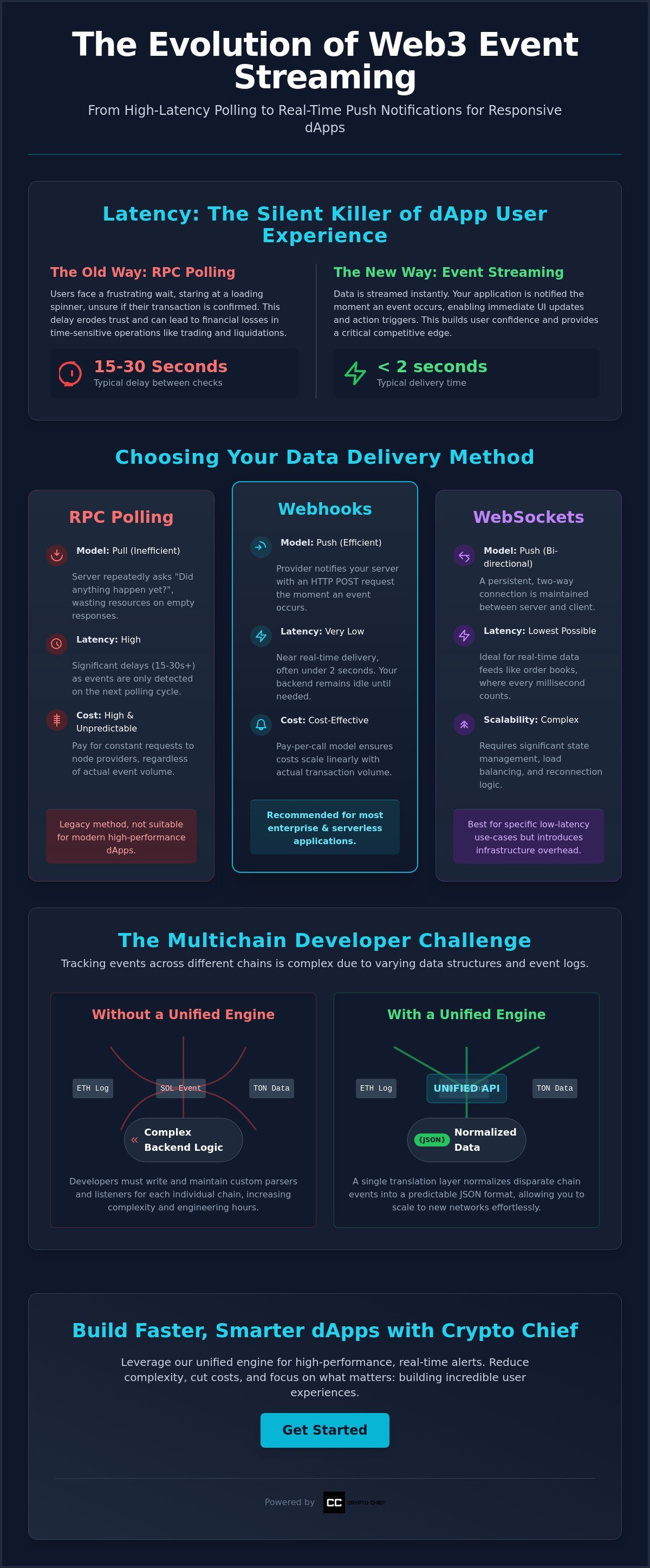
Modern Web3 applications don't wait for data; they react to it. In the legacy era of blockchain development, builders relied on inefficient pull mechanisms, repeatedly asking a node if a specific event had occurred. This process, known as RPC polling, is inherently flawed for the high-performance demands of 2026. It consumes unnecessary bandwidth and introduces significant lag that degrades the user experience. Today, real-time crypto transaction alerts serve as the essential push mechanism of blockchain data. Instead of your server constantly querying the network, the infrastructure notifies your server the moment a transaction is indexed. This shift to event streaming forms the backbone of responsive dApps, enabling a seamless flow of information from the block to the user interface without the technical debt of manual polling.
Why Latency is the Silent Killer of dApp UX
User trust is fragile in decentralized finance. When a user sends a transaction, they expect an immediate confirmation within the application interface. If your app relies on near-real-time polling that checks every 15 to 30 seconds, that user is left staring at a loading spinner, wondering if their funds are safe. For arbitrageurs and those managing liquidations, these seconds are the difference between a successful execution and a total loss. True real-time streaming architectures deliver data in under 25 seconds under normal conditions, often reaching the client before the block is even fully finalized. By utilizing Webhooks, developers can ensure their systems trigger actions the millisecond a relevant event is detected. This speed isn't just a feature; it's a competitive necessity in a market where sub-second latency determines who wins the trade.
Multichain Data Normalization: The Developer Challenge
Building a cross-chain application introduces a massive data management hurdle. Tracking events across Ethereum, Solana, and TON simultaneously is difficult because each network uses different architectures, event logs, and data structures. A developer would traditionally need to write custom parsers and maintain separate listeners for every chain they support. Implementing a unified blockchain api simplifies this experience by acting as a translation layer between your backend and the fragmented blockchain ecosystem. Data normalization is the translation of disparate chain events into a single, predictable JSON format. This approach allows you to scale to new networks without rewriting your entire notification logic. By centralizing real-time crypto transaction alerts into a normalized stream, you reduce infrastructure overhead and focus on building features rather than managing low-level network nuances.
How Real-Time Alerts Work: Webhooks vs. WebSockets vs. RPC Polling
Architecting a system for real-time crypto transaction alerts requires a strategic choice between three primary delivery methods. Each approach carries distinct infrastructure trade-offs that impact your application's reliability and operational costs. While RPC polling was once the standard, its "pull" model is fundamentally inefficient; your server must repeatedly request updates, which wastes CPU cycles and bandwidth on empty responses. In contrast, the "push" models used by Webhooks and WebSockets shift the burden of monitoring to the provider. This allows your backend to remain dormant until a specific event occurs, drastically reducing idle resource consumption.
WebSockets offer a persistent, bi-directional connection that is ideal for low-latency data feeds, yet they introduce significant state management challenges. Maintaining thousands of concurrent connections requires complex load balancing and robust reconnection logic to handle the inevitable network drops. For most enterprise applications, Webhooks have emerged as the superior standard. They are stateless, making them easier to scale within modern cloud environments. By using a Webhook-based architecture, you can trigger specific backend functions only when necessary, ensuring your infrastructure scales linearly with your actual transaction volume.
The Scalability of Webhook Architectures
Webhooks excel in serverless environments. When an event is detected, the provider sends an HTTP POST request to your endpoint, which can directly trigger an AWS Lambda function or a Google Cloud Function. This event-driven approach eliminates the need for a standing server to manage connections. High-performance tools like EventStream are designed to handle millions of simultaneous triggers, providing a reliable foundation for global dApps. To ensure mission-critical reliability, these systems must include built-in retry logic and delivery guarantees. If your endpoint is temporarily down, the system should automatically attempt redelivery, preventing the loss of vital transaction data during peak traffic or maintenance windows.
Integrating AML Risk Intelligence into the Alert Stream
In the 2026 regulatory environment, receiving a raw transaction alert is often only the first step. For exchanges and payment processors, speed must be balanced with compliance. Integrating a crypto aml risk detection api directly into your alert pipeline allows you to pre-filter events before they reach your user-facing logic. This creates a sophisticated workflow where a transaction is detected, its risk is instantly scored, and the alert is only delivered if it meets your security thresholds. If a high-risk wallet is involved, you can block the notification or flag it for manual review. This automated layer of AML Intelligence protects your platform from illicit activity without adding manual overhead to your compliance team.
Selecting a Provider: Accuracy, Latency, and Cost Optimization
Choosing a partner for real-time crypto transaction alerts requires a shift from comparing simple feature lists to auditing structural logic. In 2026, the industry is moving away from the hidden costs inherent in tiered subscription models. These traditional plans often force builders into high-priced brackets for capacity they don't utilize, or they impose punitive overage fees when a sudden market volatility spike triggers a surge in events. A more sustainable approach involves global node distribution. By routing requests through a geographically dispersed network, providers can minimize the physical distance between the blockchain event and your server, effectively cutting milliseconds off the delivery time. For enterprise-grade applications, this technical performance must be backed by SOC2 and ISO certifications, which ensure that the provider adheres to rigorous security and data privacy standards.
The Pay-Per-Call Advantage for Web3 Startups
Prepaid API token balances offer a practical safeguard against "bill shock" during periods of intense network activity. When you compare the cost of delivering 1 million alerts, a tiered plan often carries a fixed overhead that makes each notification more expensive for smaller projects. A pay-per-request model ensures that your infrastructure spend is perfectly aligned with your actual usage. Pay-per-call models allow developers to scale from MVP to enterprise without changing providers. This flexibility is vital for startups that need to manage lean budgets while maintaining the ability to handle viral growth instantly.
Evaluating Multichain RPC Reliability
The accuracy of your notifications depends entirely on the health of the underlying web3 rpc gateway. If a node provider delivers stale data, your application might trigger real-time crypto transaction alerts for blocks that haven't reached finality or have been reorganized. This risk is particularly high on fast-moving networks where block times are measured in seconds. Reliability must be consistent across all supported chains. Whether you are monitoring high-liquidity assets on Ethereum, high-frequency trades on BNB Smart Chain, or scaling solutions like Polygon, the data must be fresh. A reliable gateway prevents synchronization errors by maintaining high-uptime connections to the latest block headers across every integrated network.
Implementation Guide: Setting Up Real-Time Alerts in 3 Steps
Integrating real-time crypto transaction alerts into your dApp doesn't have to be a multi-month engineering project. In the 2026 development environment, the focus has shifted from building custom listeners to configuring high-performance streams that plug directly into your existing stack. This transition allows your team to focus on the user experience while the underlying infrastructure handles the heavy lifting of block indexing and event delivery. By following a structured deployment workflow, you can move from a local proof-of-concept to a production-ready environment with full confidence in your data integrity and speed.
Step 1: Configure Your Event Filters
Precision is the foundation of high-performance event streaming. You start by defining your scope, whether you're monitoring a specific whale wallet, a decentralized exchange liquidity pool, or custom smart contract events like "Swap" or "Liquidate." Setting value thresholds is a critical optimization step; it ensures your system isn't overwhelmed by "dust" transactions or automated spam that can inflate your processing costs. You can find chain-specific event signatures and ABI structures in the docs.crypto-chief.com to ensure your filters are technically accurate and optimized for the specific nuances of each network.
Step 2: Endpoint Integration and Security
Once your filters are active, you must provide a stable, secure destination for the data. Your receiving URL must be capable of handling HTTP POST requests with low latency and high availability. Security is not optional in this phase. You should always implement signature verification to confirm that incoming payloads are authentic and haven't been intercepted or spoofed. For applications expecting high-concurrency spikes, it's best practice to decouple the receiving endpoint from your core business logic using a message broker. This architectural choice prevents your primary server from crashing during periods of intense network volatility or high-volume market events.
Step 3: Validation and AML Filtering
Testing on the mainnet is an expensive and unnecessary risk. Before going live, use a crypto faucet to obtain test tokens and trigger on-chain events in a controlled sandbox environment. This allows you to verify that your logic handles every transaction state correctly without spending real capital. This is also the stage where you enable the AML Intelligence module. By automating risk assessment at the point of entry, you ensure that every notification is pre-vetted for regulatory compliance and security. Monitor your delivery logs closely during this phase to identify any latency bottlenecks before they impact your end users.
Ready to build? Get started with your first event stream and experience the speed of enterprise-grade Web3 data delivery today.
Crypto Chief: The Unified Engine for High-Performance Alerts
Building a resilient Web3 application requires more than just a connection to the blockchain; it requires a partner that understands the nuances of data integrity and delivery speed. Crypto Chief serves as this foundation, providing the high-performance engine necessary to power real-time crypto transaction alerts at scale. By utilizing the EventStream and Unified API, developers can bypass the tedious process of manual node configuration and data parsing. This infrastructure is designed to act as a silent, powerful partner, ensuring that your backend receives a clean, normalized stream of events regardless of the underlying network's complexity. It's about removing the technical friction that often stalls innovation in the decentralized space.
Security and autonomy remain core pillars of our service architecture. The non-custodial crypto processing api ensures that you retain full control over your private keys and transaction logic while benefiting from our enterprise-grade delivery network. We don't just provide data; we provide a stable environment where your application can thrive without the risk of infrastructure-induced downtime. As the market matures toward the strict regulatory standards of 2026, having a reliable system that integrates both speed and compliance becomes your most significant competitive advantage.
Unified Infrastructure for Global Scalability
Complexity shouldn't be a barrier to expansion. With a single API key, your team gains immediate access to over 10 major blockchains, allowing you to deploy multichain features in a fraction of the traditional development time. Our Solana and TRON RPC nodes are specifically optimized to handle the high throughput and low block times of these networks, ensuring that your real-time crypto transaction alerts arrive with sub-second precision. This global uptime is maintained through a distributed network of nodes that eliminates single points of failure. You can register for a free account today to begin testing your event streams in a production-grade environment.
Enterprise Support and Custom Solutions
For large-scale exchanges and financial institutions, off-the-shelf solutions are often insufficient for complex operational requirements. We offer sophisticated White Label options that allow you to integrate our high-performance infrastructure directly into your branded ecosystem. This level of partnership includes 24/7 technical support, ensuring that your mission-critical systems remain operational during periods of extreme market volatility. Whether you are building a boutique dApp or a global liquidity platform, our architects are available to assist with custom infrastructure design. We invite you to visit our contact page for a detailed consultation on how to align our event streaming capabilities with your specific business goals.
Architecting for the Next Generation of Blockchain Connectivity
The shift from legacy polling to high-performance event streaming is the defining move for dApps in 2026. You've learned that efficiency relies on choosing the right delivery method, whether it's the stateless scalability of Webhooks or the bi-directional speed of WebSockets. Success in this landscape requires more than just raw data; it demands a unified approach that balances speed with risk management. By implementing real-time crypto transaction alerts through a robust, multichain provider, you eliminate the technical debt of maintaining individual node connections. It's time to transition from managing infrastructure to perfecting your product.
With a focus on global multi-chain support and pay-per-call cost efficiency, our platform removes the financial and technical barriers to entry. You can secure your users and your reputation by leveraging integrated AML risk intelligence directly within your data stream. Start Building with Real-Time EventStream to experience a foundation built for stability and performance. We're here to help you scale your vision with precision, logic, and the reliable infrastructure your project deserves.
Frequently Asked Questions
What is the difference between a blockchain webhook and a WebSocket?
A webhook is a stateless "push" notification where the provider sends an HTTP POST request to your server's endpoint the moment an event occurs. This architecture is highly scalable and ideal for serverless environments. In contrast, a WebSocket maintains a persistent, two-way communication channel between your client and the server. While WebSockets offer slightly lower latency for high-frequency data, they require more complex state management to handle thousands of concurrent connections.
How much latency should I expect from real-time crypto transaction alerts?
Modern, enterprise-grade systems can deliver real-time crypto transaction alerts in under 15 to 25 seconds under normal market conditions. This speed ensures that your application reacts to on-chain events almost as soon as they are indexed by the network. While the specific latency can vary based on network congestion and block times, using a managed event stream is significantly faster than traditional RPC polling, which often introduces a lag of 30 seconds or more.
Can I get alerts for specific smart contract events like "Swap" or "Mint"?
Yes, you can configure granular filters to monitor specific smart contract events by providing the contract address and the event signature. This allows your application to track complex decentralized finance actions, such as liquidity additions or NFT minting, without processing every transaction on the chain. By defining these specific parameters in your EventStream setup, you ensure that your backend only triggers for the data points that are relevant to your business logic.
Are real-time alerts compatible with non-EVM chains like Bitcoin or TON?
Real-time alerts are fully compatible with non-EVM architectures, including UTXO-based networks like Bitcoin and asynchronous chains like TON. A unified API layer normalizes the disparate data structures of these networks into a predictable JSON format. This allows developers to integrate real-time crypto transaction alerts across multiple ecosystems using a single, consistent workflow, eliminating the need to build custom listeners for every unique blockchain architecture.
How does the pay-per-call pricing model work for transaction alerts?
The pay-per-call model aligns your infrastructure costs directly with your actual network usage by charging only for the alerts you receive. Instead of paying for a high-tier monthly subscription that you might not fully utilize, you maintain a prepaid balance of API tokens. This flexible structure is particularly beneficial for startups and scaling dApps, as it prevents "bill shock" during market volatility and ensures you aren't paying for idle capacity during quieter periods.
Is it possible to filter alerts based on the AML risk score of the sender?
You can integrate AML risk intelligence directly into your alert stream to pre-filter transactions based on their security profile. This allows your system to automatically flag or block notifications from high-risk wallets before they reach your user-facing interface. By combining transaction monitoring with automated risk scoring, you can maintain regulatory compliance and protect your platform from illicit activity without adding manual overhead to your operations team.
What happens if my server is down when a webhook alert is sent?
Reliable providers implement automated retry logic with exponential backoff to handle temporary server outages. If your endpoint fails to return a successful status code, the system will attempt to redeliver the payload multiple times over several minutes or hours. This delivery guarantee ensures that critical transaction data isn't lost during maintenance windows or unexpected downtime, providing the structural integrity required for mission-critical Web3 applications.
Do I need to run my own node to receive real-time transaction alerts?
You don't need to run or maintain your own node infrastructure to receive alerts. A managed RPC gateway handles the resource-intensive tasks of block indexing, network synchronization, and event filtering on your behalf. This approach reduces your operational overhead and allows you to focus on building features rather than managing the complex hardware and software requirements of a global blockchain node network.