
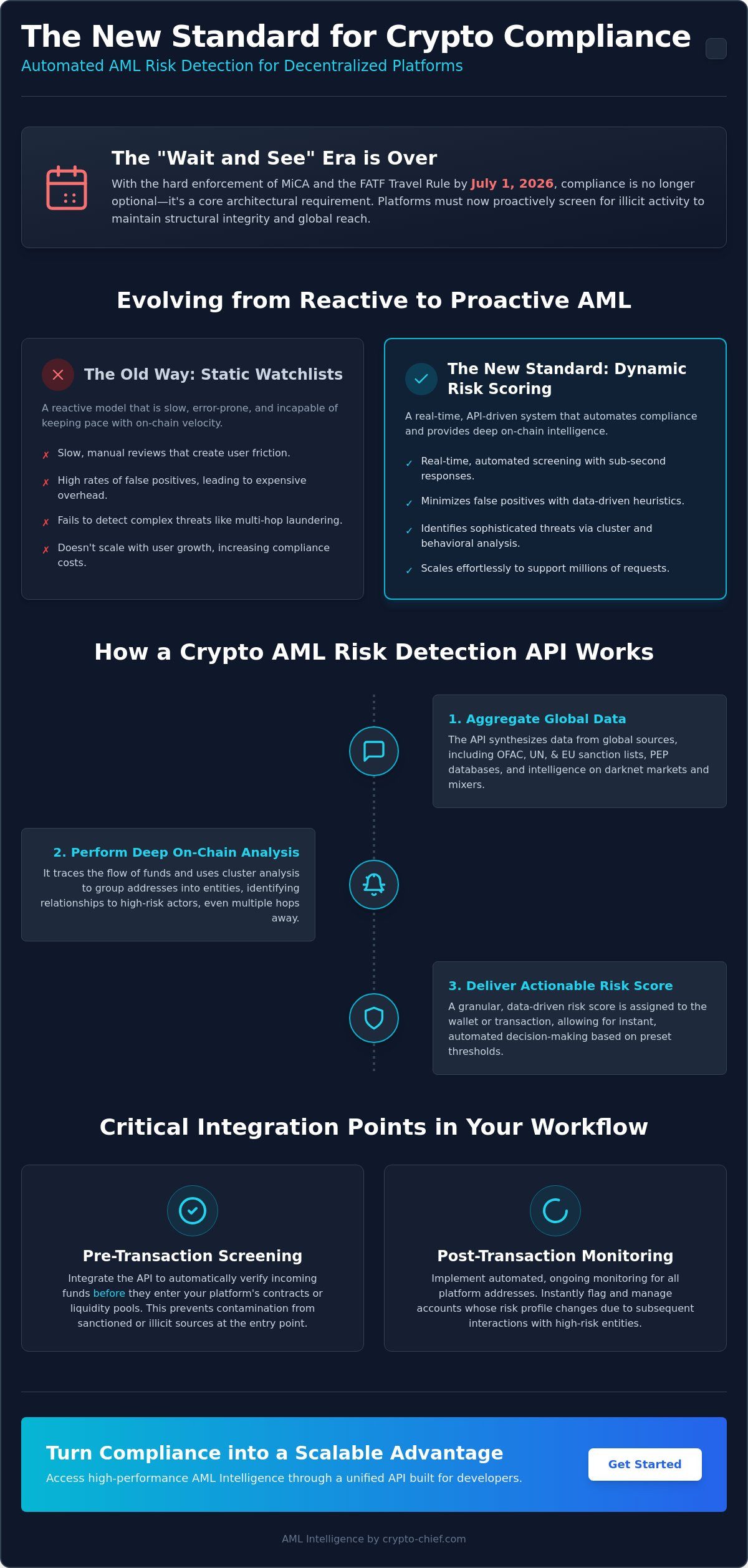
The hard enforcement of MiCA as of July 1, 2026, has officially ended the era of "wait and see" for decentralized applications and service providers. Compliance is no longer a secondary roadmap item; it's a core architectural requirement for any platform that values structural integrity and global reach. Integrating a robust crypto aml risk detection api is the only way to move beyond static watchlists and embrace the real-time, automated monitoring that modern regulators demand. You shouldn't have to choose between satisfying the FATF Travel Rule and maintaining a frictionless user experience.
We understand that managing fragmented risk data across multiple chains often leads to high false-positive rates and expensive, manual overhead. This guide details how to implement high-performance AML intelligence to automate risk scoring for every transaction, effectively reducing your regulatory exposure while keeping your non-custodial workflows intact. We'll examine the technical pathways to normalizing on-chain data and securing your ecosystem against illicit activity without slowing down your deployment cycles. By the end of this article, you'll know exactly how to turn compliance from a bottleneck into a scalable, high-performance layer of your infrastructure.
Key Takeaways
- Understand why real-time, automated screening is now the baseline for non-custodial platforms following 2026 regulatory mandates.
- Learn how a crypto aml risk detection api leverages global sanction lists and behavioral heuristics to identify illicit activity with technical precision.
- Evaluate the differences between static watchlists and dynamic risk scoring to implement a framework that minimizes false positives for your users.
- Identify the critical architectural points for deploying risk detection, including pre-transaction screening and automated post-transaction monitoring.
- Discover how to access high-performance AML Intelligence through a unified API that prioritizes scalability and cost-efficiency for builders.
What is a Crypto AML Risk Detection API and Why is it Essential in 2026?
A crypto aml risk detection api is a programmatic interface that queries global blockchain ledgers to assign granular risk scores to specific wallet addresses and transactions. In 2026, this technology has transitioned from a specialized security feature into a foundational requirement for any platform handling digital assets. It replaces the slow, reactive models of the past with a proactive system that screens activity in real-time. By integrating these APIs, developers can automatically verify that incoming funds aren't originating from high-risk sources like sanctioned entities, known exploiters, or mixers before they ever touch the platform's liquidity pools.
The core utility of this technology lies in its ability to aggregate and normalize data from disparate global sources. These include international sanction lists, Politically Exposed Persons (PEP) databases, and sophisticated tracking for illicit entities such as darknet markets. Instead of relying on manual reviews that can't keep pace with on-chain velocity, an API-first approach allows Web3 teams to set automated thresholds for acceptable risk levels. This creates a silent, powerful layer of defense that operates in the background of your application.
The Regulatory Imperative for dApps and Exchanges
The global landscape for Anti-Money Laundering (AML) has tightened significantly with the 2026 enforcement of the FATF Travel Rule. Crypto-asset service providers are now required to collect and transmit originator and beneficiary information for transfers, often with a zero-euro threshold. Interacting with sanctioned mixers or darknet markets carries severe legal risks and can result in frozen assets. Utilizing AML Intelligence shields developers from unintentional non-compliance by providing the data needed to block high-risk interactions instantly. It ensures that your platform remains a safe environment for legitimate users while keeping regulators satisfied.
Technical Advantages of API-Based Risk Scoring
Manual wallet screening is prone to human error and simply doesn't scale with modern user demands. Automated systems offer sub-second response times, which is critical for high-frequency trading environments where every millisecond counts. A robust crypto aml risk detection api handles the complex task of data normalization across dozens of blockchains, keeping your local infrastructure lean and focused on your core product.
- Accuracy: Eliminates the subjectivity of manual reviews by using data-driven heuristics and verified datasets.
- Efficiency: Enables instant decision-making for deposits and withdrawals without human intervention.
- Scalability: Supports millions of requests monthly without requiring a proportional increase in compliance staff.
This architectural choice ensures that as your user base grows, your compliance overhead remains manageable and predictable. It provides a reliable foundation that removes friction for both the developer and the end-user while maintaining high structural integrity.
How Risk Detection Engines Evaluate On-Chain Activity
Modern risk detection engines operate as sophisticated intelligence layers, synthesizing vast amounts of raw data into actionable scores. A high-performance crypto aml risk detection api doesn't simply check a static list; it performs a deep-dive analysis of a wallet's entire history and its relationship to broader entity clusters. By aggregating data from the OFAC, UN, and EU sanction lists alongside regulated feeds, the engine builds a comprehensive profile of on-chain actors. This allows developers to distinguish between a legitimate user and an address that is only three hops away from a major exchange exploit.
Tracing the flow of funds requires more than just looking at the immediate sender. Cluster analysis groups seemingly unrelated addresses into a single entity based on their spending behavior. If an address interacts with a known illicit cluster, its risk score increases proportionally. This level of scrutiny is consistent with the FinCEN advisory on illicit crypto activity, which highlights specific red flags that automated systems are designed to catch. The engine then assigns a risk category, such as "High," "Medium," or "Low," providing a clear signal for your internal compliance workflows to act upon.
Heuristic Patterns and Behavioral Analysis
Behavioral heuristics are the detection of non-standard fund movement patterns. These engines look for rapid-fire transactions that often signal automated mixing or attempts to obfuscate the audit trail. They also identify "dusting" attacks, where tiny amounts of crypto are sent to thousands of addresses to track their owners. By flagging these layering attempts early, platforms can prevent illicit funds from entering their ecosystem. This behavioral layer is what separates a modern crypto aml risk detection api from basic, outdated screening tools.
Data Normalization Across Multiple Blockchains
Tracking risk across Ethereum, BNB Chain, and Solana presents a significant technical hurdle due to differing network protocols. A Unified Blockchain API simplifies this process by normalizing data into a consistent format. This ensures that a "High Risk" score on one chain carries the same weight and structural meaning on another. Builders can rely on a single integration to maintain security across their entire multichain deployment, ensuring consistent risk scoring regardless of where the transaction originates.
Managing these complex evaluations manually is impossible at scale. Leveraging a dedicated AML Intelligence tool allows your team to focus on building features while the engine handles the heavy lifting of on-chain forensics. It's a practical, everyday tool that provides the elite performance required for global scalability.
Static Watchlists vs. Dynamic Risk Scoring: Choosing the Right Framework
Choosing a compliance framework requires a calculated balance between execution speed and analytical depth. Static watchlists serve as the initial line of defense, providing rapid cross-references against known sanctioned entities from global databases. These lists are effective for catching "known bad actors" instantly, yet they remain inherently reactive. If an address is newly generated or hasn't been officially flagged by a governing body, a static check will return a false negative. This inherent limitation is why 2026 compliance standards have shifted toward a more nuanced, reputation-based model.
Dynamic risk scoring evaluates the "reputation" of an address by analyzing its entire transactional history and its proximity to illicit clusters. A high-performance crypto aml risk detection api doesn't just look for a name; it calculates a probability score based on real-time behavior. This hybrid approach is essential in an era where sophisticated money launderers frequently rotate wallets to evade simple list-based detection. By combining the immediate certainty of a watchlist with the predictive power of dynamic scoring, developers build a more resilient security posture that adapts as new threats emerge on-chain.
Reducing False Positives in High-Volume Environments
High false-positive rates are the primary disruptor of legitimate user UX. To maintain a seamless experience, technical teams must tune their sensitivity settings through custom risk thresholds. For instance, a platform might allow automated processing for transactions under a specific value from "Medium-Low" addresses while flagging larger transfers for review. Implementing whitelists for trusted institutional partners further refines this process. For a deeper dive into how these scoring mechanisms compare to legacy providers, explore our Elliptic vs. AML Intelligence comparison to see how scoring accuracy impacts your operational overhead.
The Importance of Funds Tracing Forensics
Regulatory scrutiny often extends well beyond the immediate counterparty. Understanding the ultimate source of wealth is critical for satisfying enhanced due diligence requirements in a professional environment. Forensics tools allow you to visualize fund flows, tracing assets through multiple hops to identify their true origin. Integrating a Blockchain Funds Tracing API empowers your compliance team to conduct deep investigations without leaving your internal dashboard. This level of visibility is no longer a luxury; it's a structural necessity for generating the detailed reports that internal auditors and global regulators expect.
Architectural Integration: Where to Deploy Risk Detection in Your Workflow
Integrating a crypto aml risk detection api requires a strategic approach that spans the entire transaction lifecycle. It isn't enough to simply check a wallet once during registration. Successful implementation involves multiple touchpoints to ensure the ecosystem remains secure without degrading performance. By treating compliance as an architectural layer rather than an afterthought, developers can build systems that are both resilient and regulator-ready.
Effective architecture places risk detection at four critical stages within your application logic. Pre-transaction screening involves querying the destination address before a user executes a withdrawal or transfer, which prevents interaction with sanctioned mixers or exploiters. Post-transaction monitoring utilizes real-time alerts via webhooks to identify suspicious incoming funds, allowing for immediate internal reviews or automated flagging. During user onboarding, screening the primary wallet establishes a baseline reputation and identifies high-risk users before they can access core services. Finally, automated blocking should be implemented to freeze accounts or reject transactions when a risk score exceeds a pre-defined threshold, removing the need for constant manual oversight.
The "Silent Partner" Integration Model
Compliance shouldn't disrupt the user journey. By running checks in the background, you maintain a frictionless UX. Developers often cache risk scores for frequently used addresses to reduce API calls and minimize latency. This "silent partner" approach ensures that security is always active but never intrusive. You can review the official documentation to understand the endpoint structures and how to integrate these checks into your existing codebase without reinventing the wheel.
Case Study: Risk Detection in Non-Custodial Processing
Merchants are particularly vulnerable to receiving "dirty" crypto, which can lead to their accounts being frozen on centralized exchanges when they attempt to off-ramp. Securing a Non-Custodial Crypto Payment API with integrated AML solves this problem by providing a defensive buffer. By automating the rejection of high-risk incoming transactions, platforms protect the merchant's financial integrity and ensure only clean assets enter the payment flow. This case study demonstrates that risk detection is a functional utility that preserves liquidity and business continuity.
Start building a more resilient infrastructure. Deploy AML Intelligence to automate your risk detection today.
AML Intelligence by Crypto Chief: Scalable Risk Detection for Builders
Crypto Chief delivers a high-performance engine designed to remove the friction of regulatory compliance for modern builders. While many providers lock users into rigid enterprise tiers, our crypto aml risk detection api operates on a utility-first model that respects your operational logic. We've built this infrastructure for engineers who value uptime and structural integrity above all else. By acting as a silent, powerful partner, we allow your team to focus on core feature development while we handle the complexities of global on-chain forensics.
A primary advantage of our ecosystem is the Unified API. You don't need separate billing or fragmented dashboards for different services; one API balance covers your RPC Gateway, processing needs, and AML Intelligence. This streamlined approach reduces administrative bloat and ensures that your global infrastructure remains lean. Our network is distributed to provide low-latency response times, ensuring that your risk checks never become a performance bottleneck for high-velocity applications.
Cost Optimization with Prepaid API Tokens
We've eliminated the burden of "zombie" subscriptions that drain resources regardless of actual usage. With our pay-per-call model, you only pay for the specific requests your application makes. This allows you to scale from ten requests during an MVP phase to ten million requests in a production environment with a predictable cost structure. You can easily manage your balance and monitor usage through the Crypto Chief dashboard, providing full transparency into your compliance overhead.
Getting Started with AML Intelligence
Integrating our crypto aml risk detection api is a straightforward process designed for immediate deployment. After generating your API key, you can make your first test request to access multichain risk data via a single, unified endpoint. Our documentation provides the logic needed to interpret scores and implement automated triggers. For teams requiring specialized support or custom enterprise configurations, our technical support team is available to assist with complex architectural requirements. We are committed to providing a reliable foundation that empowers you to build secure, compliant, and globally scalable dApps.
Future-Proof Your Infrastructure with Automated Risk Intelligence
Navigating the complexities of the 2026 regulatory environment requires a shift from manual oversight to automated, data-driven intelligence. We've examined how a robust crypto aml risk detection api integrates into your existing workflows to provide sub-second responses and actionable risk scores across multiple blockchains. By adopting a hybrid model of static screening and dynamic behavioral analysis, you protect your platform from the risks of "dirty" crypto while maintaining the frictionless experience your users expect.
Crypto Chief empowers developers with a pay-per-call pricing model, ensuring you only pay for the specific intelligence you use. Our global multichain coverage and enterprise-grade uptime provide a reliable foundation for any dApp or payment processor. Whether you're an individual creator or an enterprise architect, our tools are built to scale with your logic and speed. Take the final step in securing your ecosystem and protecting your business continuity.
Start Screening Transactions with AML Intelligence
Building a compliant future starts with the right technical partner. It's time to deploy with confidence.
Frequently Asked Questions
What is the difference between KYC and KYT in crypto?
KYC (Know Your Customer) focuses on verifying the identity of an individual through documentation, while KYT (Know Your Transaction) monitors real-time on-chain behavior. KYT is essential because verified users can still receive illicit funds after onboarding. By using a crypto aml risk detection api, platforms can continuously assess the risk of every transfer, ensuring that the source of wealth remains legitimate throughout the user's lifecycle.
How does a crypto AML API detect sanctioned addresses?
Detection engines cross-reference wallet addresses against global sanction lists, such as those maintained by OFAC, the UN, and the EU. Advanced APIs go further by using cluster analysis to identify addresses that belong to a sanctioned entity even if they aren't explicitly listed. This proactive forensic approach ensures that your platform doesn't interact with addresses that are only a few hops away from a darknet market or a known exploiter.
Can an AML API prevent my exchange account from being frozen?
An AML API prevents account freezes by allowing you to reject "dirty" crypto before it enters your wallet. When you attempt to off-ramp funds to a centralized exchange, any history of interaction with illicit clusters can trigger an immediate freeze. By screening incoming transactions at the point of entry, you ensure that your liquidity remains clean and that your platform's reputation with institutional partners stays intact.
How much does a crypto AML risk detection API typically cost?
Industry pricing typically follows two models: monthly subscriptions or pay-per-call utility billing. Subscriptions often require a significant upfront commitment, which can be inefficient for scaling projects. In contrast, utility-based models allow developers to pay only for the requests they actually make. This flexibility is critical for managing operational overhead while maintaining high-performance compliance standards across various transaction volumes.
Is real-time transaction monitoring required for DeFi protocols?
Real-time monitoring is becoming a standard requirement for DeFi protocols operating in regulated jurisdictions. With the 2026 enforcement of MiCA and the FATF Travel Rule, decentralized platforms are under pressure to identify and block illicit activity. Implementing an automated risk detection layer helps dApps satisfy these requirements without compromising the permissionless nature of their underlying smart contracts, providing a necessary buffer against regulatory scrutiny.
What blockchains are covered by Crypto Chief’s AML Intelligence?
AML Intelligence provides comprehensive multichain coverage for major networks including Bitcoin, Ethereum, BNB Smart Chain, Polygon, and Tron. It also supports specialized chains like TON, Litecoin, and Dogecoin. This wide-reaching support ensures that you can normalize risk data across your entire infrastructure through a single integration, removing the need to manage fragmented compliance tools for different assets in your ecosystem.
How do I reduce false positives in my AML risk scoring?
You can reduce false positives by tuning your risk thresholds based on transaction size and historical user behavior. Setting custom parameters allows you to automate approvals for low-value transfers from low-risk addresses while flagging larger movements for manual review. Additionally, implementing whitelists for trusted institutional partners ensures that legitimate high-volume activity doesn't trigger unnecessary alerts, maintaining a seamless user experience for your most active participants.
Can I integrate AML risk detection into a non-custodial wallet?
Integration into non-custodial wallets is a standard practice for developers who want to protect their users from interacting with malicious addresses. By querying a crypto aml risk detection api before a user sends funds, the wallet can provide a warning if the destination is associated with a known exploit or sanction list. This adds a powerful layer of security that empowers users to make informed decisions while protecting the wallet's overall ecosystem.